
Chef Juliette
John Dory (St. Pierre)
John Dory has the delicacy of sole and the firmness of turbot. A light flouring, a quick butter sauté, and nut-brown beurre noisette show exactly why looks never mattered.
A cooking platform built around craft, culture, and the stories behind what we eat.
Created by Chef Juliette
Based on No. 1962, Roast Gosling, from Le Guide Culinaire (1907) by Auguste Escoffier
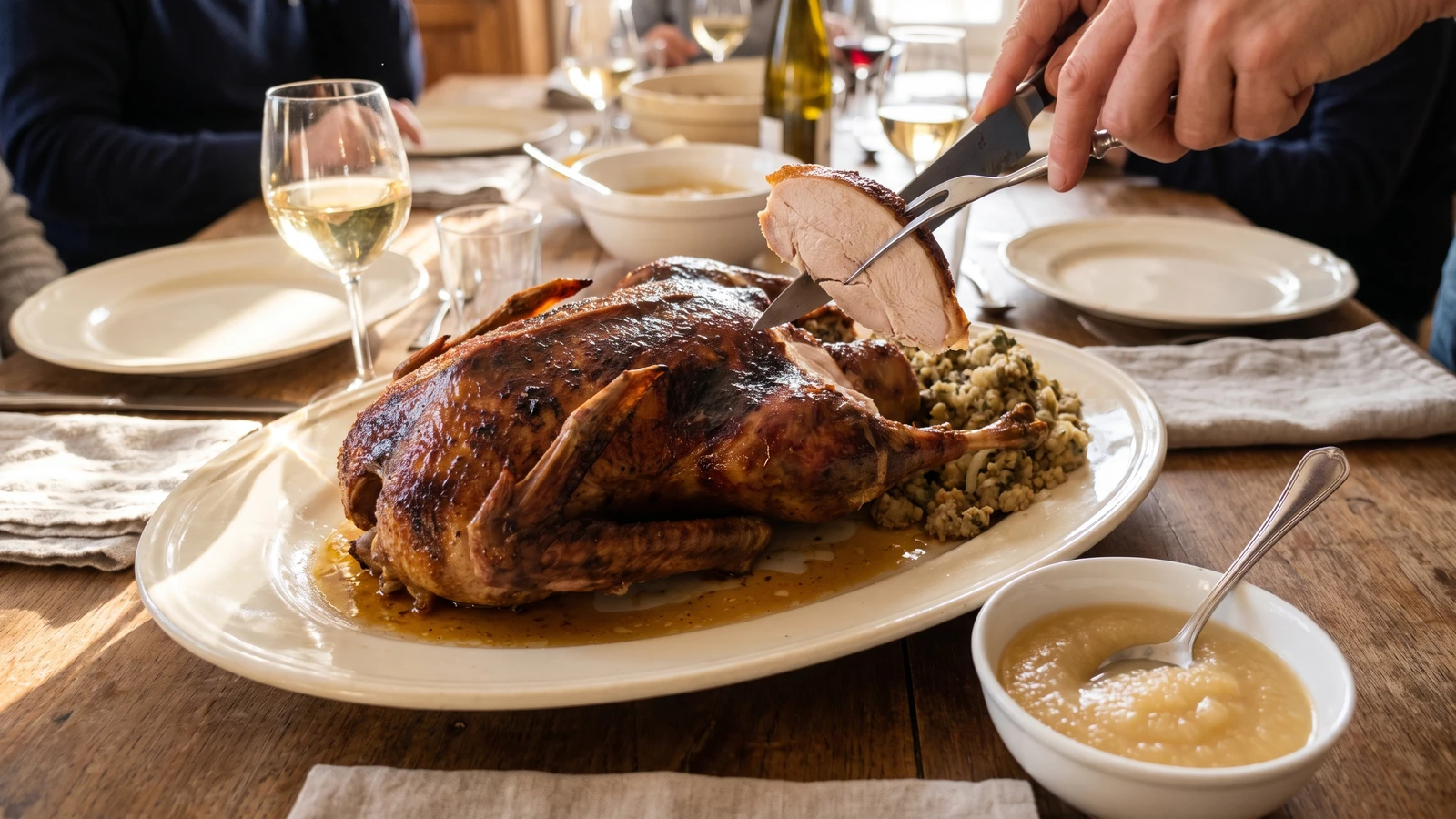
A burnished Oison Rôti, rich with sage and onions, teaches the discipline of rendered fat and exact timing: carve it straight from the oven and pass lukewarm apple sauce.
Oison Rôti (roast gosling) teaches one hard, useful truth: a rich bird succeeds by losing fat as deliberately as it gains colour. Never let the rendered fat collect beneath the roast. Drain it steadily and the skin turns taut and bronze; neglect it and the pan smokes while the underside grows heavy.
The original entry assumed a brigade in which a roasting hand watched the bird, a saucier stood ready, stock was never off the fire, and separate numbered preparations simply appeared when called. This roast needs no stockpot or salamander. For one cook, one stove, one evening, a sturdy rack replaces the constantly tended roasting setup, an opening burst of high oven heat supplies the colour, and a thermometer gives the certainty. I have scaled the dish to one full-grown young gosling for four, while keeping what is the dish itself: Sage and Onions Stuffing (for Turkeys, Ducks and Geese) (No. 1944), Apple Sauce (No. 112), and immediate carving.
The numbered preparations are brigade scaffolding, so they may be made ahead in your own kitchen. The rendering and timing cannot be shortened. Before you touch the pan, remember the step that decides everything: remove the fat regularly, then carve the Oison Rôti the minute it is safely cooked.
Oison rôti belongs to the festive roasting table across France rather than to one regional larder, but this precise garniture carries an English origin: the French classical canon identifies sage-and-onion stuffing and apple sauce as the English way with gosling. French compendia preserved neighboring table customs when the pairing answered the meat, and tart apple remains a particularly sensible foil for the bird's abundant fat. The dish corrects a common misconception about the canon, which has welcomed useful preparations from beyond France for generations while naming their provenance plainly.
Quantity
1 bird, 7 to 8 pounds (3.2 to 3.6 kg)
giblets removed
Quantity
3 cups (720 ml / 650 g) Sage and Onions Stuffing (for Turkeys, Ducks and Geese) (No. 1944)
freshly prepared and cooled until just warm
Quantity
1 tablespoon (15 ml / 18 g)
Quantity
1 teaspoon (5 ml / 2 g)
Quantity
Up to 1 cup (240 ml / 240 g)
only if needed to prevent scorching
| Ingredient | Quantity |
|---|---|
| full-grown young goslinggiblets removed | 1 bird, 7 to 8 pounds (3.2 to 3.6 kg) |
| Sage and Onions Stuffing (for Turkeys, Ducks and Geese)freshly prepared and cooled until just warm | 3 cups (720 ml / 650 g) Sage and Onions Stuffing (for Turkeys, Ducks and Geese) (No. 1944) |
| fine sea salt | 1 tablespoon (15 ml / 18 g) |
| freshly ground black pepper | 1 teaspoon (5 ml / 2 g) |
| hot water (optional)only if needed to prevent scorching | Up to 1 cup (240 ml / 240 g) |
| Apple Sauceserved lukewarm | 2 cups (480 ml / 500 g) Apple Sauce (No. 112) |
Prepare the Sage and Onions Stuffing (for Turkeys, Ducks and Geese) (No. 1944) and Apple Sauce (No. 112) according to their own entries. Let the stuffing cool until just warm, but keep the apple sauce covered for reheating later. Heat the oven to 425°F (220°C) with a rack in the lower third, and set a sturdy roasting rack inside a deep roasting pan.
Pull any loose pads of fat from the cavity and save them for rendering another day. Dry the gosling meticulously inside and out, then prick the skin over the legs, flanks, and lower breast at 1-inch (2.5 cm) intervals with a fine skewer. Pierce only the skin and its fat, not the flesh beneath; those small openings let the fat escape without releasing the bird's juices. Season the cavity and exterior evenly with the salt and pepper.
Spoon the Sage and Onions Stuffing (for Turkeys, Ducks and Geese) (No. 1944) loosely into the neck and body cavities. Leave room for heat to circulate, because stuffing pressed into a solid mass cooks too slowly. Fold the neck skin over, tie the legs without pulling them tightly against the body, and tuck the wing tips underneath. If all the stuffing will not fit loosely, put the remainder in a shallow covered baking dish and cook it beside the bird during the final 35 to 45 minutes, until its centre reaches 165°F (74°C).
Set the gosling breast-side up on the rack and roast for 20 minutes at 425°F (220°C). This opening heat begins the browning a grand kitchen might once have encouraged with more elaborate roasting equipment. Do not baste. The bird supplies abundant fat of its own, and pouring that fat back over the skin only softens what you are trying to crisp.
Reduce the oven to 350°F (175°C) and continue roasting for about 2 hours to 2 hours 20 minutes. After the first 30 minutes, carefully ladle the rendered fat from the pan into a heatproof bowl; repeat every 30 minutes and rotate the pan for even colour. If the brown film on the pan begins turning black or the oven starts smoking, drain the fat immediately and add 1/4 cup (60 ml / 60 g) of the hot water to the bare pan, never over the bird. Lower the heat by 25°F (15°C) for ten minutes if needed. Ça se rattrape. If the breast darkens too quickly, cover only that area loosely with foil.
Begin checking after 1 hour 45 minutes at the lower temperature. The gosling is ready when the thickest part of the thigh, clear of the bone, and the centre of the stuffing both register at least 165°F (74°C). The skin should be deep bronze and dry to the touch. If the meat is ready but the stuffing has not reached temperature, remove the stuffing to a shallow dish and return it to the oven while you carve the bird; do not make the finished roast wait for its centre.
Warm the Apple Sauce (No. 112) gently until lukewarm, never hot. Move the gosling to a warmed carving board, remove the string, and spoon the stuffing into a hot serving dish. Carve the Oison Rôti at once, taking off the legs first and then cutting the breast into broad slices. Arrange it immediately on a warmed platter and send it to the table with the stuffing and apple sauce. This roast will not wait, and neither should your guests. À table!
1 serving (about 640g)
Culinary guides, cultural storytelling, and the editorial depth that makes cooking meaningful.
Discover Culinary ExplorerChef Juliette
John Dory has the delicacy of sole and the firmness of turbot. A light flouring, a quick butter sauté, and nut-brown beurre noisette show exactly why looks never mattered.

Chef Juliette
Fresh haddock proves its delicacy in the meunière pan: a fine flour crust, moist pearly flakes, and beurre noisette sharpened with lemon and parsley, ready from one skillet in half an hour.

Chef Juliette
Éperlans à l’Anglaise turns small fish into a lesson in disciplined coating: boned smelts under a close, crisp crumb, pan-fried in clarified butter and finished with bright, half-melted maître d’hôtel butter.

Chef Juliette
Tiny smelts, shallot, mushrooms, white wine, gratin sauce, and fine bread raspings meet a fierce oven, where the fish must turn tender in the same breath the buttered crust bronzes.