Chef Juliette
Accompaniment of Roasts
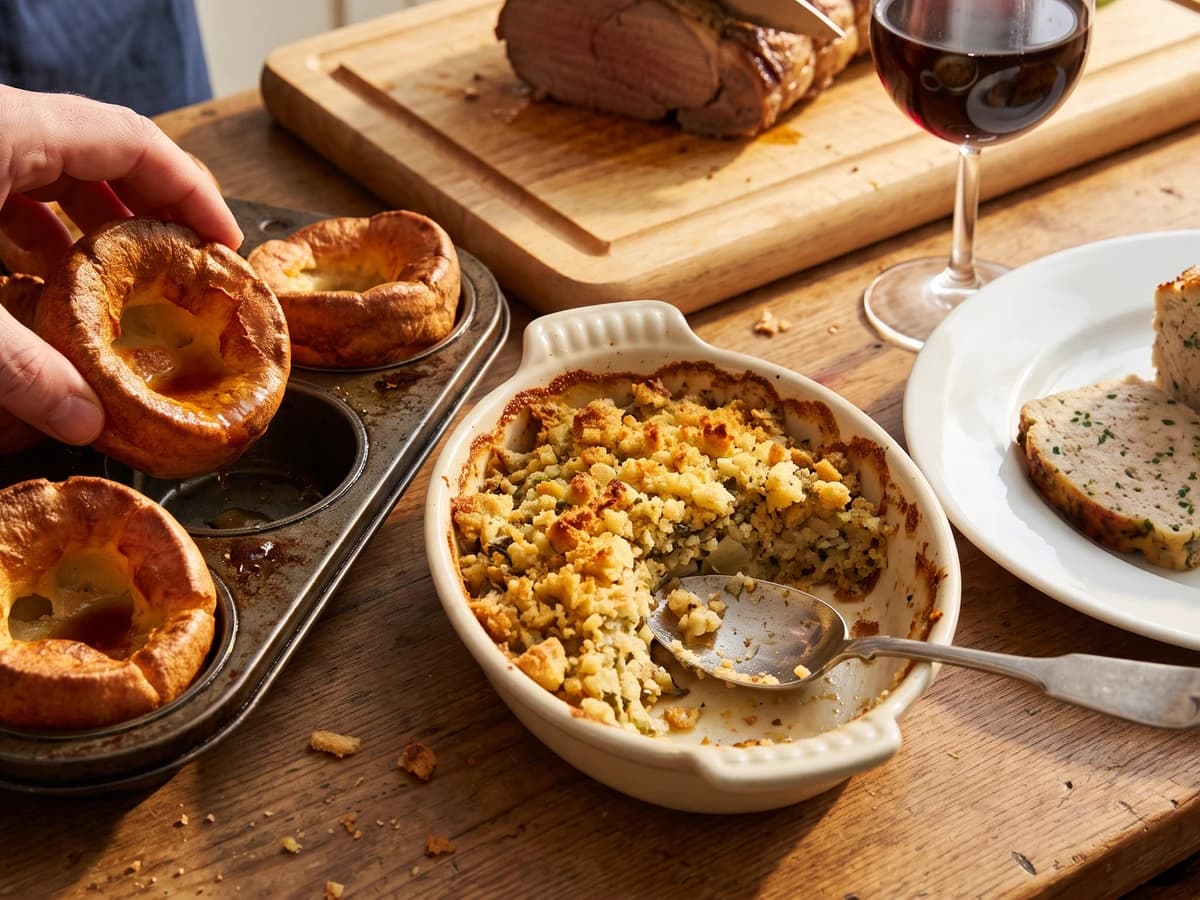
The roast keeps its sauce and gains its proper escort: lofty Yorkshire pudding for beef, sage and onion dressing for birds, or veal stuffing for pork and veal, each scaled for four.
A cooking platform built around craft, culture, and the stories behind what we eat.

Created by Chef Juliette
Based on No. 1960, Roast Young Turkeys, from Le Guide Culinaire (1907) by Auguste Escoffier
Bacon shields the breast, sage and onions perfume the cavity, and careful knife work gives tender drumsticks: a burnished holiday bird with proper gravy and bread sauce beside it.
Dindonneau rôti (roast young turkey) teaches that a whole bird is won before it meets the oven. The one true thing is this: draw the hard tendons from the legs before trussing, or even beautifully roasted drumsticks eat like string. Then protect the lean breast with bardage, covering it with bacon, while the darker leg meat catches up.
The original recipe assumed a roast cook with a braiding needle, a saucier at hand, stock never off the fire, a special steam mould for the alternative stuffing, and a salamander ready to crisp the bacon. Your honest equivalents are a sturdy trussing needle or clean kitchen pliers, one roasting pan, good unsalted poultry stock, a heatproof bowl over simmering water, and the household broiler. The separate stations are brigade scaffolding and can go. Tendon removal, bardage, gentle roasting, and a gravy built from the fond are the dish and must stay. One cook, one stove, one evening.
When it is ready, the skin is burnished beneath the lifted bacon, the gravy runs glossy, and the sage and onions scent the first cut into the cavity. Before you touch the roasting pan, take your time with those pale cords in the legs. Everything afterward is easier.
Dindonneau rôti belongs to the French festive table rather than to one province: classical Paris kitchens handled the young bird as an oversized pullet, drawing its leg tendons and protecting the breast with bacon. Sage-and-onion stuffing, bread sauce, and cranberry reveal its passage through the Anglo-French hotel table, where French roasting practice met British and American holiday accompaniments. The bird and technique sit firmly in the French canon, while this particular service was deliberately international.
Quantity
1 bird, 8 to 10 lb (3.6 to 4.5 kg)
neck and giblets removed and reserved
Quantity
3 cups (710 ml / about 675 g) Sage and Onions Stuffing (for Turkeys, Ducks and Geese) (No. 1944)
chilled
Quantity
3 cups (710 ml / about 650 g) Veal Stuffing (For Veal and Pork) (No. 1945)
use instead of the sage-and-onion stuffing
Quantity
12 slices (about 12 oz / 340 g)
Quantity
4 tablespoons (60 ml / 57 g)
softened and divided
Quantity
1 tablespoon (15 ml / 18 g)
Quantity
2 teaspoons (10 ml / 4 g)
Quantity
3 cups (710 ml / 710 g)
Quantity
1 cup (240 ml / 240 g)
use as needed to protect the roasting fond
Quantity
1/4 cup (60 ml / 30 g)
Quantity
2 cups (475 ml / about 475 g)
warmed for serving
| Ingredient | Quantity |
|---|---|
| young turkeyneck and giblets removed and reserved | 1 bird, 8 to 10 lb (3.6 to 4.5 kg) |
| Sage and Onions Stuffing (for Turkeys, Ducks and Geese)chilled | 3 cups (710 ml / about 675 g) Sage and Onions Stuffing (for Turkeys, Ducks and Geese) (No. 1944) |
| Veal Stuffing (For Veal and Pork) (optional)use instead of the sage-and-onion stuffing | 3 cups (710 ml / about 650 g) Veal Stuffing (For Veal and Pork) (No. 1945) |
| thinly sliced unsmoked streaky bacon | 12 slices (about 12 oz / 340 g) |
| unsalted buttersoftened and divided | 4 tablespoons (60 ml / 57 g) |
| fine sea salt | 1 tablespoon (15 ml / 18 g) |
| freshly ground black pepper | 2 teaspoons (10 ml / 4 g) |
| unsalted poultry stock | 3 cups (710 ml / 710 g) |
| hot wateruse as needed to protect the roasting fond | 1 cup (240 ml / 240 g) |
| all-purpose flour | 1/4 cup (60 ml / 30 g) |
| prepared Bread saucewarmed for serving | 2 cups (475 ml / about 475 g) |
Set a rack in the lower third of the oven and heat it to 425°F (220°C). Pat the turkey dry inside and out. Put the neck, heart, and gizzard in a saucepan with the poultry stock, reserving the liver for another use, and hold them at a bare simmer for 45 minutes. Strain the strengthened stock and keep it warm for the gravy.
Lay one leg with its inner face upward. At the narrow hock end, make two shallow incisions through the skin and tendon sheath, one just above and one just below the last joint, stopping when the ivory cords appear. Slip a sturdy trussing needle beneath one tendon, wind the cord around the needle by turning it, and pull steadily toward the hock; remove the tendons one at a time and repeat on the other leg. If a cord snaps, expose only enough of its end to grip it with sanitized needle-nose kitchen pliers, then pull in line with the leg. Do not dig through the meat looking for it.
Season the cavity with one-third of the salt and pepper. Spoon in the chilled Sage and Onions Stuffing (for Turkeys, Ducks and Geese) (No. 1944) immediately before roasting, filling the cavity loosely because tightly packed stuffing heats too slowly. Put any excess in a buttered covered baking dish to cook beside the turkey during its final 40 minutes. If you are serving the veal alternative, leave the cavity empty. Fold the neck skin underneath, tuck the wing tips back, and tie the legs together without wrenching them tightly against the breast.
Rub 2 tablespoons of the butter over the turkey and season the outside with the remaining salt and pepper. Lay the bacon over the breast and upper thighs in overlapping slices, leaving no lean breast meat exposed, then secure the bardage with two loose loops of butcher's twine. Set the turkey breast-side up on the rack in the roasting pan and pour 1/2 cup of the hot water beneath it.
Roast at 425°F (220°C) for 20 minutes, then reduce the oven to 350°F (175°C) without opening the door. After another 45 minutes, baste the legs and exposed joints with the pan fat and rotate the pan. Continue roasting, basting every 30 minutes rather than fussing over it constantly. If the fond on the pan floor turns from deep brown toward black, add a small splash of hot water around the rack. The water protects the fond; it does not wash the bird.
If using the alternative accompaniment, butter a 3-cup heatproof bowl and pack it firmly with the Veal Stuffing (For Veal and Pork) (No. 1945). Cover tightly with buttered parchment and foil, then place the bowl on a rack inside a deep lidded pot with gently simmering water below, but not touching, the bowl. Cook in the enclosed moist heat for 60 to 75 minutes, replenishing the water if needed, until the centre reaches 160°F (71°C). Rest it for 10 minutes before unmoulding and cutting it into thick slices.
After about 1 hour 45 minutes of total roasting, lift off the bacon and place it on a small baking sheet. Baste the exposed breast with pan fat and return the turkey to the oven until the skin is deep gold. Begin checking the temperature after 2 hours 15 minutes total: the breast must reach 165°F (74°C), the inner thigh 170°F (77°C), and the centre of the cavity stuffing 165°F (74°C). If the breast is ready before the thighs, cover it again with bacon or foil while the legs finish. If the meat is ready but the stuffing is below temperature, spoon the stuffing into its buttered dish, cover it, and bake it to 165°F (74°C) while the bird rests. No sacrifice required.
Tilt the turkey carefully so the cavity juices run into the roasting pan, then transfer the bird to a warm platter. Rest it for 30 to 40 minutes under a very loose tent of foil; wrap it tightly and the skin softens. During the final minutes of resting, broil the reserved bacon just until its edges crisp, watching continuously because it can pass from bronze to burnt very quickly.
Spoon excess fat from the roasting pan, leaving 2 tablespoons with the browned fond. If the pan is not safe for the stovetop, scrape everything into a saucepan. Stir in the flour over medium heat and cook this roux for 2 minutes, then whisk in the warm strengthened stock a little at a time, scraping up every brown trace. Simmer for 8 to 12 minutes, until the gravy coats the back of a spoon, then taste before adding salt because the bacon has already spoken. If it is lumpy, strain it; if it looks greasy, skim the surface and whisk in a spoonful of hot stock. Ça se rattrape. Finish off the heat with 1 tablespoon of butter for gloss.
Remove the trussing twine and spoon the sage-and-onion stuffing into a warm serving bowl. Take off the legs at the joints, separate the thighs and drumsticks, and carve the breast into generous slices. Arrange the meat on the platter with the crisp bacon and, if chosen, slices of the moulded veal stuffing. Bring the gravy and warm Bread sauce separately so each guest can have both. Never apologize at your own table. À table!
1 serving (about 1000g)
Culinary guides, cultural storytelling, and the editorial depth that makes cooking meaningful.
Discover Culinary ExplorerChef Juliette
The roast keeps its sauce and gains its proper escort: lofty Yorkshire pudding for beef, sage and onion dressing for birds, or veal stuffing for pork and veal, each scaled for four.
Chef Juliette
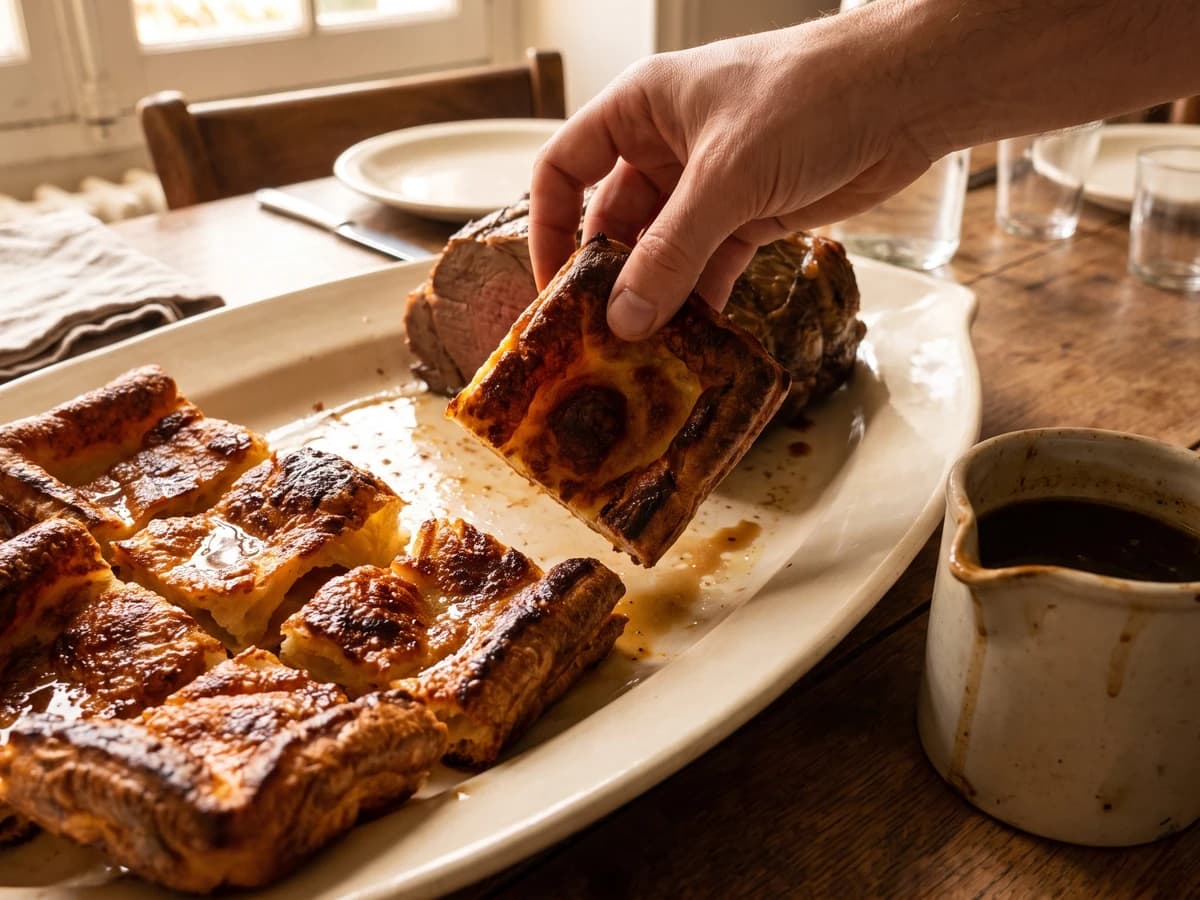
Pouding du Yorkshire teaches the law of hot fat: an egg-rich, nutmeg-scented batter poured into smoking beef dripping, rising bronze and crisp before it catches the roast's savory juices.

Chef Juliette
Whole-baked onions are the lesson: sweet before they meet the pan, never acrid, then joined with butter, dried sage, milk-softened breadcrumbs, and veal fat in the classical 2:2:1 proportion.

Chef Juliette
Equal weights of chopped suet, fine breadcrumbs, and parsley, bound with egg and plenty of nutmeg, make a compact poached farce that slices neatly beside roast veal or pork.