
Chef Juliette
Accompaniment of Roasts
The roast keeps its sauce and gains its proper escort: lofty Yorkshire pudding for beef, sage and onion dressing for birds, or veal stuffing for pork and veal, each scaled for four.
A cooking platform built around craft, culture, and the stories behind what we eat.
Created by Chef Juliette
Based on No. 1945, Veal Stuffing (For Veal and Pork), from Le Guide Culinaire (1907) by Auguste Escoffier
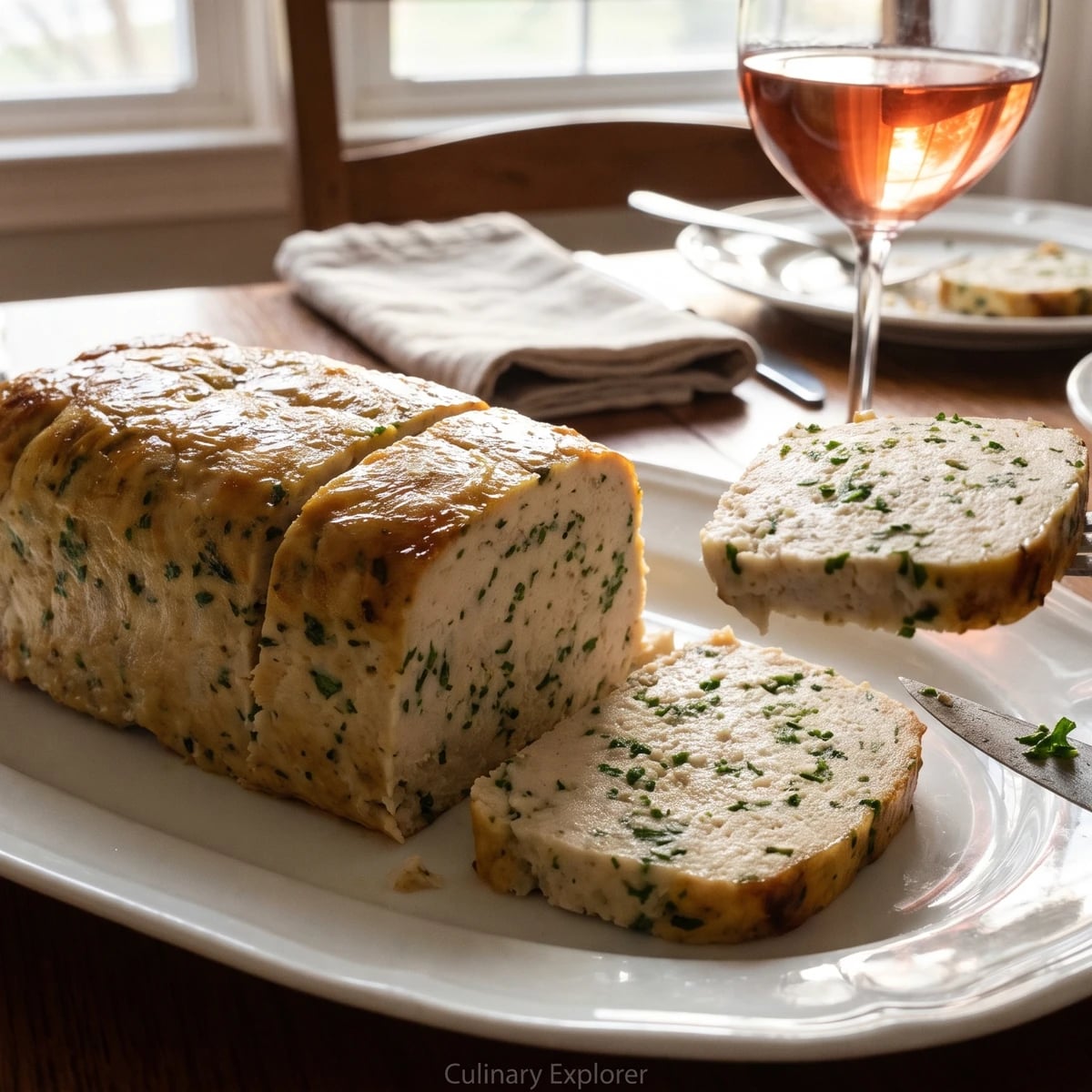
Equal weights of chopped suet, fine breadcrumbs, and parsley, bound with egg and plenty of nutmeg, make a compact poached farce that slices neatly beside roast veal or pork.
Farce pour veau et porc (stuffing for veal and pork) teaches the discipline of ratios. Before you touch a pan, know the one true thing: equal means equal by weight. Suet, sifted breadcrumbs, and chopped parsley occupy wildly different volumes, and a measuring cup would turn the book's clean thirds into guesswork. The nutmeg must be generous and the egg must bind, not flood.
The original entry assumed two pounds of prepared farce and three small eggs, enough for professional service. Here, 125 grams of each principal ingredient and one modern large egg preserve that proportion almost exactly, while a one-litre pudding basin set in a roasting tin replaces a dedicated poaching mould. The large batch is brigade scaffolding and can go. The equal thirds, liberal nutmeg, and egg cohesion are the dish, so they stay.
Poached gently, the farce emerges compact but tender, bright with parsley, warmly perfumed with nutmeg, and rich enough to stand beside roast veal or pork without hiding inside it. Mix only until a squeezed handful holds, then poach at a bare tremble; a hard boil renders the suet too quickly and coarsens the crumb. Weigh the three equal parts before anything else. That is the step that decides the dish.
This farce is not the property of one French region; its real home is the cuisine bourgeoise roast course, where veal or pork arrived with a seasoned bread-and-fat accompaniment that made the joint more generous. Classical household and professional kitchens kept these preparations under the family name farces, using them inside joints, in ballotines, or poached in moulds as separate garnishes. The useful correction is that stuffing need not cook inside the meat: poaching it in a mould gives the cook control over doneness and produces orderly slices for the serving platter.
Quantity
About 3/4 cup (125 g)
kept cold and very finely chopped
Quantity
1 1/4 cups (125 g)
sifted
Quantity
2 firmly packed cups (125 g)
thoroughly dried and finely chopped
Quantity
1 large egg (about 3 tablespoons / 50 g without shell)
beaten
Quantity
1 1/4 teaspoons (6 ml / 7 g)
Quantity
1/2 teaspoon (2.5 ml / 1 g)
Quantity
1 teaspoon (5 ml / 2 g)
Quantity
1 tablespoon (15 ml / 14 g)
softened, for the mould
| Ingredient | Quantity |
|---|---|
| fresh beef suetkept cold and very finely chopped | About 3/4 cup (125 g) |
| fine dry breadcrumbssifted | 1 1/4 cups (125 g) |
| flat-leaf parsley leaves and tender stemsthoroughly dried and finely chopped | 2 firmly packed cups (125 g) |
| large eggbeaten | 1 large egg (about 3 tablespoons / 50 g without shell) |
| fine sea salt | 1 1/4 teaspoons (6 ml / 7 g) |
| freshly ground black pepper | 1/2 teaspoon (2.5 ml / 1 g) |
| freshly grated nutmeg | 1 teaspoon (5 ml / 2 g) |
| unsalted buttersoftened, for the mould | 1 tablespoon (15 ml / 14 g) |
Heat the oven to 160°C (325°F) and bring a kettle of water to the boil. Butter a one-litre heatproof pudding basin generously, including the rim, then butter a round of parchment for the top. Set the basin inside a roasting tin deep enough to hold water halfway up its sides.
Weigh the suet, sifted breadcrumbs, and chopped parsley separately. You need exactly 125 grams of each. Keep the suet cold as you chop it; warm suet smears instead of remaining in fine pieces, and those pieces should render gradually through the farce. Make certain the parsley is dry before weighing, because clinging water loosens the mixture.
Combine the suet, breadcrumbs, parsley, salt, pepper, and nutmeg in a wide bowl, lifting and turning until the green is evenly distributed. Pour in the beaten egg and mix with your fingers or a sturdy fork only until a squeezed portion holds together. Rest it for ten minutes so the crumbs can absorb the egg. If it seems slack, chill it before changing anything; warmed suet often causes the trouble. If it still crumbles after resting, work in cold water one teaspoon at a time. Ça se rattrape. Stop the moment it coheres.
Press the farce firmly into the prepared basin a handful at a time, pushing each layer against the sides so no large air pockets remain. Level the top without compressing it into a brick. Lay the buttered parchment directly against the mixture, buttered side down, then seal the basin tightly with foil.
Pour the hot water into the roasting tin until it reaches halfway up the basin, then transfer the bain-marie to the oven. Poach for 45 to 55 minutes, keeping the water at no more than a bare quiver, until the centre reaches 71°C (160°F) and feels set but springy. If the bath begins boiling hard or fat floods the surface, lower the oven to 140°C (285°F) and add a little cool water to the bath. Gentle heat keeps the crumb tender and the suet inside the farce.
Lift the basin from the water, remove the foil and parchment, and let the farce rest for fifteen minutes. Pour off any fat pooled at the edge, run a thin knife around the sides, and invert it onto a warm platter. If it clings, wrap the outside of the basin briefly with a hot damp cloth, then try again. Cut into slices about 1.5 cm thick and serve warm beside roast veal or pork. It need never go inside the joint. À table!
1 serving (about 105g)
Culinary guides, cultural storytelling, and the editorial depth that makes cooking meaningful.
Discover Culinary Explorer
Chef Juliette
The roast keeps its sauce and gains its proper escort: lofty Yorkshire pudding for beef, sage and onion dressing for birds, or veal stuffing for pork and veal, each scaled for four.

Chef Juliette
Pouding du Yorkshire teaches the law of hot fat: an egg-rich, nutmeg-scented batter poured into smoking beef dripping, rising bronze and crisp before it catches the roast's savory juices.

Chef Juliette
Whole-baked onions are the lesson: sweet before they meet the pan, never acrid, then joined with butter, dried sage, milk-softened breadcrumbs, and veal fat in the classical 2:2:1 proportion.

Chef Juliette
Rôtis de Boucherie puts beef in its proper place: deeply browned, rosy within, and served as the substantial relevé, with a glossy pan jus and no ceremony one cook cannot manage.