
Chef Juliette
John Dory (St. Pierre)
John Dory has the delicacy of sole and the firmness of turbot. A light flouring, a quick butter sauté, and nut-brown beurre noisette show exactly why looks never mattered.
A cooking platform built around craft, culture, and the stories behind what we eat.
Created by Chef Juliette
Based on No. 1955, Pullets, from Le Guide Culinaire (1907) by Auguste Escoffier
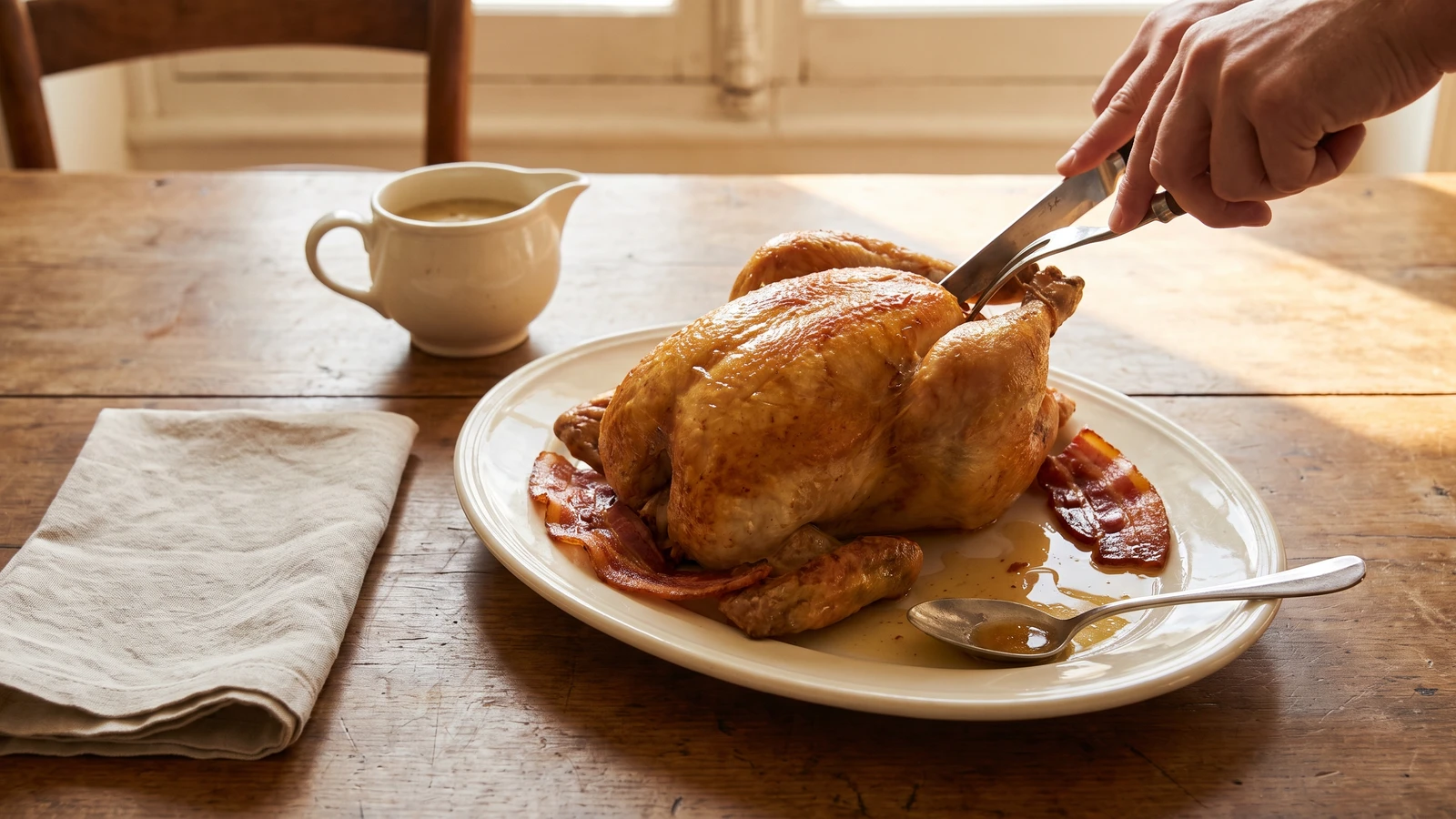
Poularde rôtie teaches the whole discipline of roasting: salt within, shield the breast with bacon, let fierce heat colour the bird, then trust white juices and the thermometer together.
Poularde rôtie (roast pullet) teaches the discipline that settles every roast bird: protect the breast until the legs have nearly caught up, then expose it just long enough to take colour. Salt belongs inside, bacon belongs outside, and the final ten minutes uncovered are not decoration. They are the moment the bird becomes roast poultry rather than merely cooked poultry.
The original hung large birds before a concentrated fire, with a cook tending their distance and a very hot dish waiting. The plural entry becomes one large pullet for four, and a wire rack in a fierce oven supplies the same dry, surrounding heat. The spit, hook, and constant attendant are brigade scaffolding and can go; the trussing, interior salt, bacon shield, and late uncovering are the dish and must stay. A brief rest replaces the hands that once unhooked, plattered, and carried the bird while it settled. Bread Sauce (No. 113) remains a finished preparation, served hot and separately as the book intended. One cook, one stove, one evening.
Judge doneness by two witnesses. Tilt the bird over a white plate and look for juice that runs white or clear rather than rosy, then confirm with a thermometer at the breast and thigh. If the breast colours before the legs finish, cover only the bronzed area and keep roasting. Ça se rattrape. The step that matters most is removing the bacon when the bird is nearly cooked, not before; too soon dries the breast, too late leaves it pale.
Poularde rôtie belongs to French cuisine bourgeoise, the comfortable household and Sunday table where a well-fed young hen was prized for its broad, tender breast. Classical kitchens carried that domestic roast onto grand tables without changing its governing method: truss the bird, protect it with bardes de lard, roast before strong heat, then uncover it for colour. The Bread Sauce (No. 113), crisp bacon, and grilled sausages recorded alongside it belong to English service rather than a French regional garnish, a revealing example of one roasting method crossing between two table traditions.
Quantity
1 (about 4 to 4½ lb / 1.8 to 2 kg)
giblets removed and bird patted dry
Quantity
1½ teaspoons (7.5 ml / 9 g)
Quantity
6 thin slices (about 6 oz / 170 g)
Quantity
1 cup (240 ml / 240 g), plus more only if needed
| Ingredient | Quantity |
|---|---|
| large pulletgiblets removed and bird patted dry | 1 (about 4 to 4½ lb / 1.8 to 2 kg) |
| fine sea salt | 1½ teaspoons (7.5 ml / 9 g) |
| unsmoked streaky bacon | 6 thin slices (about 6 oz / 170 g) |
| hot water | 1 cup (240 ml / 240 g), plus more only if needed |
| Bread Saucehot, for serving | 1 cup (240 ml / 250 g) Bread Sauce (No. 113) |
Heat the oven to 425°F (220°C), or 400°F (200°C) with a fan, with a rack in the lower middle. Set a wire rack inside a shallow roasting pan. Salt the pullet thoroughly inside the cavity, fold the wing tips underneath, and tie the legs close to the body with kitchen twine. Trussing makes one compact shape, so the narrow legs do not race ahead while the breast remains exposed.
Lay the bacon slices across the breast in overlapping strips, carrying them down the sides wherever the meat is least protected. Tie one loose loop of twine around the bird if the slices threaten to slide. The bacon is a barde, a protective layer of fat: it bastes the breast while the legs receive the fierce heat they need. Set the pullet breast-side up on the rack.
Roast without basting for 55 to 65 minutes. The bacon is already doing that work, and repeatedly opening the oven only weakens the heat. Watch the pan rather than the clock alone: the drippings should brown into a savoury fond, not blacken. If the fond begins catching, pour 2 tablespoons of the hot water into the pan without wetting the bird. Ça se rattrape, and the saved fond will become the gravy.
When the thickest part of the breast reaches about 155 to 158°F (68 to 70°C), lift off the bacon and place it on a small tray beside the bird. Return both to the oven for 10 to 15 minutes, until the breast is deeply golden, the bacon is crisp, and the thermometer reaches at least 165°F (74°C) in the breast and 170°F (77°C) in the inner thigh without touching bone. Tilt the pullet over a white plate; the juice from the cavity must run white or clear. If it remains rosy or the temperature is low, cover the already bronzed breast loosely with bacon or foil and roast in 5-minute intervals.
Transfer the pullet to a serving platter warmed with hot water and dried well. Rest it for 10 minutes with the breast left uncovered so its colour remains proud. This short pause lets the juices settle while you finish the gravy; resting much longer defeats the source's demand for a bird served truly hot.
Pour the roasting fat into a heatproof jug, leaving the brown fond in the pan. Set the pan over medium heat, add ¾ cup (180 ml / 180 g) of the hot water, and scrape until every browned morsel dissolves. Add the juices collected on the platter and boil for 3 to 5 minutes, until the gravy tastes concentrated but remains light enough to pour. Skim excess fat. If the bacon has made it too salty, loosen it with the remaining water; if it tastes thin, reduce it a minute longer.
Arrange the crisp bacon around the whole pullet and bring it to the table on the hot platter. Serve the clear pan gravy and the hot Bread Sauce (No. 113) in separate sauceboats, allowing each person to choose one or both. Carve at the table while the breast is still succulent and the skin holds its colour. À table!
1 serving (about 390g)
Culinary guides, cultural storytelling, and the editorial depth that makes cooking meaningful.
Discover Culinary ExplorerChef Juliette
John Dory has the delicacy of sole and the firmness of turbot. A light flouring, a quick butter sauté, and nut-brown beurre noisette show exactly why looks never mattered.

Chef Juliette
Fresh haddock proves its delicacy in the meunière pan: a fine flour crust, moist pearly flakes, and beurre noisette sharpened with lemon and parsley, ready from one skillet in half an hour.

Chef Juliette
Éperlans à l’Anglaise turns small fish into a lesson in disciplined coating: boned smelts under a close, crisp crumb, pan-fried in clarified butter and finished with bright, half-melted maître d’hôtel butter.

Chef Juliette
Tiny smelts, shallot, mushrooms, white wine, gratin sauce, and fine bread raspings meet a fierce oven, where the fish must turn tender in the same breath the buttered crust bronzes.