
Chef Juliette
John Dory (St. Pierre)
John Dory has the delicacy of sole and the firmness of turbot. A light flouring, a quick butter sauté, and nut-brown beurre noisette show exactly why looks never mattered.
A cooking platform built around craft, culture, and the stories behind what we eat.
Created by Chef Juliette
Based on No. 1954, Venison Roasts, from Le Guide Culinaire (1907) by Auguste Escoffier
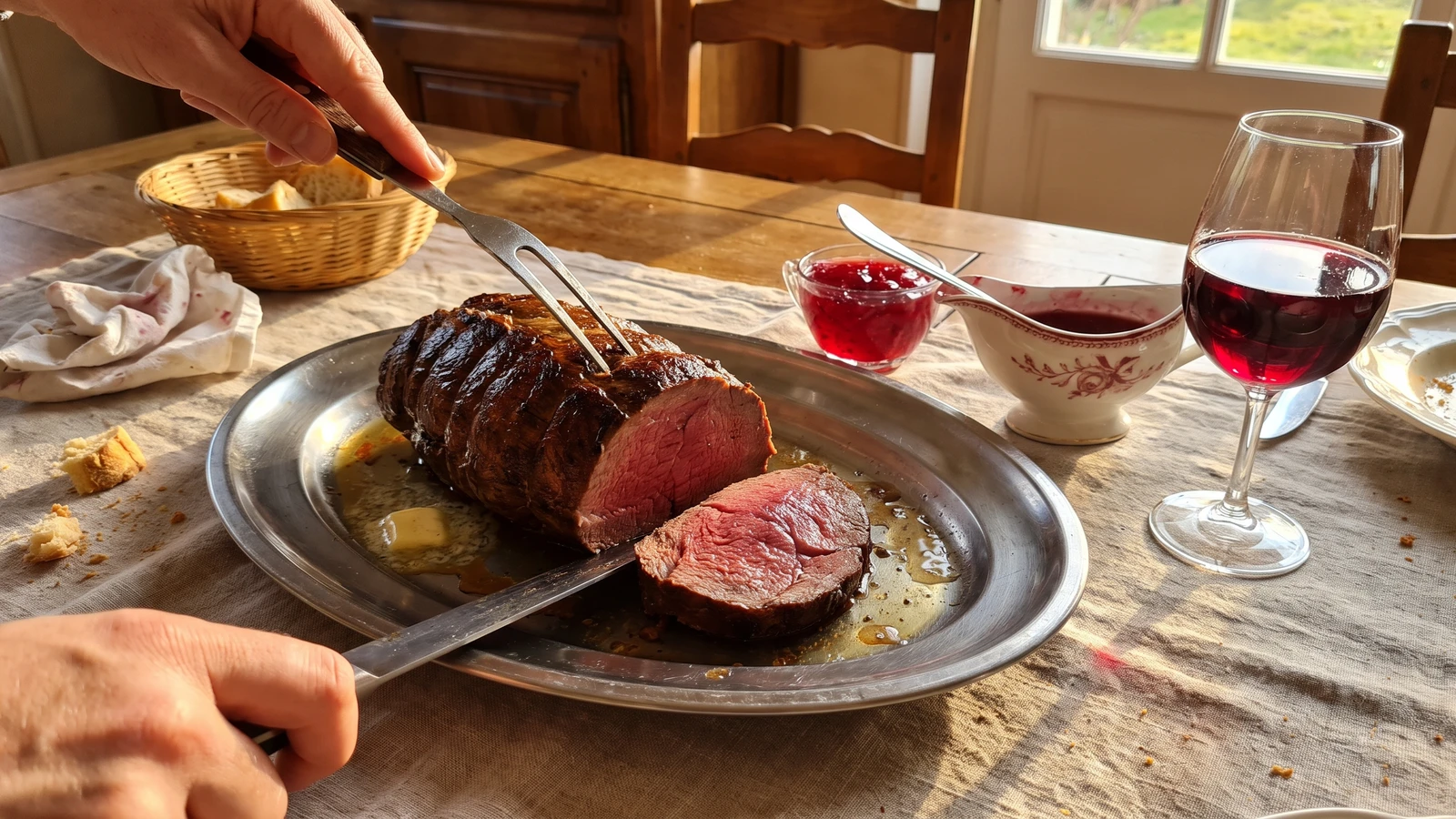
Two classical protections for lean venison, bacon around tender roebuck or a suet-paste jacket around haunch, meet fierce heat and fast final browning so the carved center stays rosy and succulent.
Rôtis de venaison (venison roasts) teach one hard rule: protect the lean exterior, then stop cooking while the center is still rosy. Roebuck takes no marinade. It is trimmed, barded with bacon, and roasted before fierce heat; a substantial fallow-deer or stag haunch wears a firm suet-paste jacket until the final minutes, when the covering comes off and butter, flour, and fierce heat make the crust.
The original method assumed game properly conditioned in a dry, airy larder, a larding needle, a fierce hearth, and a cook who could hand the joint to a saucier. Your honest equivalents are butcher-aged venison, an uncovered rest in the refrigerator, overlapping bacon instead of internal larding, a probe thermometer, and the oven at full heat with its broiler standing in for the salamander. The peppered flour coating used to protect hanging meat from damp and flies was larder scaffolding, so it goes. The protective covering and quick final browning are the dish, so they stay. A sauceboat of redcurrant jelly means you don't need a stockpot or saucier waiting in the wings.
Choose the route that matches your cut, then trust the thermometer more than the clock. The decisive moment comes when the center reaches 44 to 46°C, or 111 to 115°F: strip away the protection, season, butter the surface, and brown it quickly without cooking the rosy center away. One cook, one stove, one evening.
Rôtis de venaison belong to the tables de chasse of Sologne, where the condition of the animal and the skill of roasting mattered more than a bath of wine. French game cookery distinguishes chevreuil, roe deer, from daim and cerf, fallow deer and stag: lean roebuck was barded with bacon, while a substantial haunch could be sealed in suet paste and stripped for a last fierce browning. The persistent misconception is that all venison wants marinade, but prime roasting joints were kept away from it and often served with a sharp game sauce or a sauceboat of redcurrant jelly.
Quantity
1 roast, 2½ pounds (1.1 kg)
completely trimmed of silverskin and tendons
Quantity
10 to 12 thin slices, about 8 ounces (225 g)
for the roebuck route
Quantity
2½ cups (590 ml / 300 g)
for the haunch jacket
Quantity
1¼ cups loosely packed (300 ml / 150 g)
kept very cold, for the haunch jacket
Quantity
½ cup plus 2 tablespoons (150 ml / 150 g), or just enough to bind
for the haunch jacket
Quantity
1 tablespoon (15 ml / 14 g)
for oiling the parchment
Quantity
1 tablespoon (15 ml / 8 g)
for final browning
Quantity
4 tablespoons (60 ml / 57 g)
melted
Quantity
2 teaspoons (10 ml / 12 g)
Quantity
½ cup (120 ml / 160 g)
stirred smooth
Quantity
none; Cooked Marinade for Venison (No. 168) is expressly excluded from this roast
| Ingredient | Quantity |
|---|---|
| boneless venison roast, either roebuck leg or saddle, or fallow-deer or stag haunchcompletely trimmed of silverskin and tendons | 1 roast, 2½ pounds (1.1 kg) |
| larding bacon or unsmoked streaky bacon (optional)for the roebuck route | 10 to 12 thin slices, about 8 ounces (225 g) |
| all-purpose flour (optional)for the haunch jacket | 2½ cups (590 ml / 300 g) |
| finely shredded beef suet (optional)kept very cold, for the haunch jacket | 1¼ cups loosely packed (300 ml / 150 g) |
| ice-cold water (optional)for the haunch jacket | ½ cup plus 2 tablespoons (150 ml / 150 g), or just enough to bind |
| neutral oil (optional)for oiling the parchment | 1 tablespoon (15 ml / 14 g) |
| all-purpose flourfor final browning | 1 tablespoon (15 ml / 8 g) |
| unsalted buttermelted | 4 tablespoons (60 ml / 57 g) |
| fine salt | 2 teaspoons (10 ml / 12 g) |
| redcurrant jellystirred smooth | ½ cup (120 ml / 160 g) |
| marinade, deliberately omitted | none; Cooked Marinade for Venison (No. 168) is expressly excluded from this roast |
Ask for a properly aged, intact whole-muscle roast. Remove every strip of silverskin and hard tendon, because fierce roasting will tighten them into cords, but leave any clean, firm white fat on a fallow-deer or stag haunch. Pat the meat thoroughly dry and, if time allows, leave it uncovered on a rack in the refrigerator for 12 to 24 hours. Do not use the Cooked Marinade for Venison (No. 168). Marinade would soften the clean game flavor and wet the surface when this method needs dry meat, protective fat, and direct heat.
For roebuck, barder means to wrap lean meat in fat. Lay the bacon slices over the roast with their edges overlapping, covering the surface completely, then tie them snugly with kitchen string at 1-inch, or 2.5 cm, intervals. This is the home equivalent of pushing strips of larding bacon through the meat with a larding needle. The bacon protects the roast without puncturing a small, tender joint. If you are cooking the larger haunch route, skip this step.
For a fallow-deer or stag haunch, make the pâte de suif, a firm suet paste. Toss the cold suet through the 2½ cups of flour, then work in most of the ice water until the mixture forms a stiff, cohesive dough; add the remaining water only if dry patches remain. Roll it about ¼ inch, or 6 mm, thick, enclose the haunch completely, and pinch every seam closed. Brush a large sheet of parchment with the oil, wrap it around the dough, and secure it with string. This jacket is insulation, not pastry for eating. If a seam cracks while wrapping, patch it with a scrap of cold dough and press firmly.
Heat the oven to 475°F, or 245°C, with a rack in the upper-middle position. Set the protected roast on a wire rack inside a shallow roasting pan and insert a probe into the thickest part without touching the rack. Roast the bacon-barded roebuck for 15 minutes before checking its progress; a suet-jacketed haunch will usually need 25 minutes before its first check. Rotate the pan once, then continue until the center reaches 111 to 115°F, or 44 to 46°C, about 25 to 40 minutes for roebuck and 35 to 50 minutes for the jacketed haunch. The clock can only advise you. The thermometer decides.
Raise the oven to its highest setting, preferably 500°F, or 260°C, and turn on the broiler if it needs time to heat. For roebuck, cut away the string and lift off the bacon. For haunch, remove the parchment, crack open the suet jacket, and discard it completely. Season the bare roast evenly with the salt. Dust a haunch very lightly with the remaining tablespoon of flour; for roebuck, omit the flour because the bacon has already left a fine film of fat. Brush either roast generously with melted butter and return it to the fierce heat for 4 to 7 minutes, turning once, until the surface is burnished brown and the center reaches 122 to 126°F, or 50 to 52°C. If the flour forms pale patches, brush them with another trace of butter and give them 30 seconds under the broiler. We don't apologize for butter.
Transfer the roast to a warm platter and rest it uncovered for 15 to 20 minutes. Carryover heat should bring the center to roughly 129 to 135°F, or 54 to 57°C, while the juices settle through the meat. Do not cover it tightly, or the new crust will soften. Pour any clear resting juices over the roast just before carving.
Carve the venison across the grain into slices about ⅜ inch, or 1 cm, thick, keeping the rosy slices slightly overlapping on the platter. Stir the redcurrant jelly until spoonable and send it separately in a small sauceboat, so each guest can take as much sharp sweetness as wanted. Serve at once. À table!
1 serving (about 260g)
Culinary guides, cultural storytelling, and the editorial depth that makes cooking meaningful.
Discover Culinary ExplorerChef Juliette
John Dory has the delicacy of sole and the firmness of turbot. A light flouring, a quick butter sauté, and nut-brown beurre noisette show exactly why looks never mattered.

Chef Juliette
Fresh haddock proves its delicacy in the meunière pan: a fine flour crust, moist pearly flakes, and beurre noisette sharpened with lemon and parsley, ready from one skillet in half an hour.

Chef Juliette
Éperlans à l’Anglaise turns small fish into a lesson in disciplined coating: boned smelts under a close, crisp crumb, pan-fried in clarified butter and finished with bright, half-melted maître d’hôtel butter.

Chef Juliette
Tiny smelts, shallot, mushrooms, white wine, gratin sauce, and fine bread raspings meet a fierce oven, where the fish must turn tender in the same breath the buttered crust bronzes.