Culinary Explorer

A cooking platform built around craft, culture, and the stories behind what we eat.
Discover Culinary Explorer
Alouettes du Père Philippe

Alouettes du Père Philippe

Created by Chef Juliette

Based on No. 1931, Alouettes du Père Philippe, from Le Guide Culinaire (1907) by Auguste Escoffier

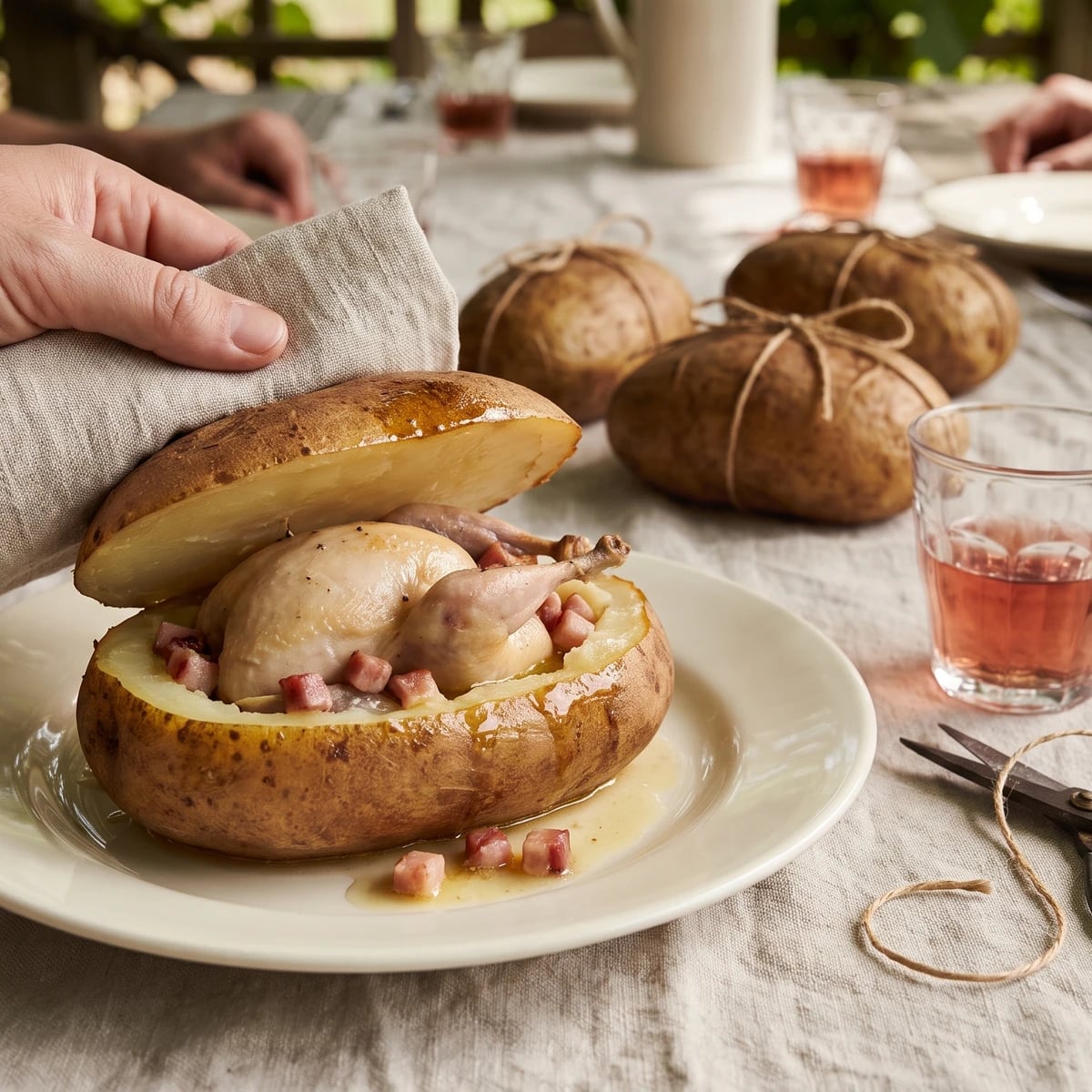
A tiny game bird, bacon, butter, and a hollow potato become one sealed parcel, baked until the potato drinks the juices and serves as both cooking pot and supper.

Main Dishes
French
Outdoor Dining
Comfort Food
Dinner Party
45 min
Active Time
1 hr 10 min cook1 hr 55 min total
Yield4 servings

Alouettes du Père Philippe (Père Philippe’s larks baked inside potatoes) teaches cuisson à l’étouffée, cooking in a sealed enclosure. The potato is not a garnish here. It is the pot, and the one true thing to know before touching a pan is that its walls must be even and its lid must close tightly. Leave a thin place and the juices escape; seal it properly and bird, bacon, butter, and potato cook as one.

The old formula needed neither a saucier nor stock kept warm. Its brigade luxury was different: fine larks ready for the pan, a root-spoon, and a live hearth whose cinders could be renewed by another pair of hands. Wild larks are protected or unavailable in many markets, so four small farmed quail take their place honestly. Quail are larger, which requires extra-large potatoes and a longer cooking time. A hot home oven, oiled parchment, and a snug outer wrapping of foil replace the enclosing cinders. One cook, one stove, one evening.

The outer foil is scaffolding, a clean way to reproduce the pressure and surrounding heat of an ash bed. Hollowing the potato, raidir, or stiffening, the bird in butter, keeping the book’s one-third ounce of bacon per bird, and sealing each matching lid are the dish itself. Don't rush the hollowing. An even potato shell is the step that decides everything that follows.

Alouettes du Père Philippe belongs to the named game-bird preparations of the French classical grand-kitchen table, and its formula makes no claim to Lyon, Provence, or another regional larder. Its method traveled from hearth cookery into the codified repertoire: hot cinders surrounded an oiled-paper parcel while an ordinary potato became both casserole and edible casing. Père Philippe remains the dedicatee named in the title, but the enduring idea is structural, a tiny bird, salted pork, and butter sealed so none of their juices can escape.

The technique, the tradition, and the story behind every dish.

Discover Culinary Explorer

Ingredients

extra-large russet or other floury baking potatoes

Quantity

4, each 12 to 14 oz (340 to 400 g)

scrubbed

small farmed quail

Quantity

4, each 4 to 5 oz (115 to 140 g)

oven-ready with heads and feet removed

unsmoked salted pork belly

Quantity

¼ cup (60 ml / 38 g) prepared by Blanchings (No. 273)

cut into ¼-inch dice

unsalted butter

Quantity

3 tablespoons (45 ml / 42 g)

neutral oil

Quantity

1 tablespoon (15 ml / 14 g)

for the parchment

fine salt

Quantity

½ teaspoon (2.5 ml / 3 g)

divided

Equipment Needed

  • Heavy rimmed baking sheet or cast-iron griddle, at least 13 by 18 inches (33 by 46 cm)
  • 12-inch (30 cm) skillet
  • Melon baller or 1-inch (2.5 cm) root-spoon
  • Fine cotton kitchen twine, four lengths about 30 inches (75 cm) each
  • Baking parchment and heavy-duty foil
  • Instant-read thermometer

Instructions

  1. 1

    Prepare the oven

    Set a heavy rimmed baking sheet or cast-iron griddle in the lower third of the oven and heat to 425°F (220°C). Cut four 14-inch (35 cm) squares each of baking parchment and heavy foil. Brush one face of every parchment square lightly with the oil. The preheated metal gives strong heat beneath the parcels, while the oven surrounds them as the renewed cinders once did.

  2. 2

    Hollow the potatoes

    Keep each potato whole and unpeeled. From one long side, cut a matching lid about ⅙ inch (4 mm) thick, then use a melon baller or root-spoon to hollow the potato, leaving an even shell about ⅜ inch (1 cm) thick. Preserve each lid with its own potato. Season the cavities with half the salt. If the spoon breaks through a wall, ça se rattrape: press a thin shaving of the reserved potato firmly over the opening from inside, smear it with a little butter, and place that side against the parchment when wrapping.

    Test the cavity without forcing the raw quail inside. If it pinches the bird or lifts the lid, remove another thin layer of potato; pressing harder only cracks the vessel.
  3. 3

    Raidir the quail

    Pat the quail dry and season them lightly with the remaining salt, remembering that the pork is already salted. Have the diced pork belly prepared by Blanchings (No. 273) and pat it dry. Melt the butter in a 12-inch (30 cm) skillet over medium heat until it foams. Raidir the quail in two batches, turning each for 60 to 90 seconds, only until the skin loses its raw shine and the flesh firms slightly. Do not brown or cook them through. Return all four birds to the skillet, add the bacon dice, and turn everything together for 30 seconds. Take the pan from the heat and retain every spoonful of its butter and pork fat. If the butter colors too quickly, lower the heat and add a small piece of fresh butter. Ça se rattrape, provided the fat has not turned bitter.

  4. 4

    Fill and seal

    Divide a few bacon dice among the potato cavities. Fold each quail’s legs and wings close to its body, settle one bird into each potato, and distribute the remaining bacon and cooking fat around and over them. Return every lid in its original direction. If a lid rocks, shave potato from its underside rather than compressing the bird. Tie each potato crosswise with kitchen twine so the lid cannot lift. Set it oiled-parchment side down, wrap closely, then enclose it in foil with the seam uppermost. The tight lid is the dish; treat it with more attention than the parcel’s appearance.

  5. 5

    Bake the parcels

    Place the wrapped potatoes seam-side up on the preheated sheet. Bake for 55 to 65 minutes, turning each parcel carefully after 30 minutes so the potato cooks evenly. Test one after 50 minutes: a thin knife should pass through the potato shell without resistance, and a thermometer inserted through the lid seam into the thickest part of the quail should register 165°F (74°C). If either is short of its mark, rewrap the parcel and return all four for 8 to 10 minutes. The original larks needed about 40 minutes in cinders; larger farmed quail and their larger potato vessels need this added time.

  6. 6

    Open and serve

    Rest the parcels for 8 minutes, then remove the foil and parchment and set one potato on each plate. Cut the twine, lift the lid away from your hands, and spoon the pooled butter and bacon juices back over the quail. The tender potato flesh is eaten with the bird, scraped directly from its shell. Bring them to the table while the cut edges still gleam. À table!

Chef Tips

  • Do not buy wild larks unless their sale and possession are lawful where you live. Small farmed quail preserve the whole-bird construction without disguising the substitution; because they are larger, the potatoes and cooking time increase with them.
  • Choose long, floury potatoes without narrow waists, green patches, or deep eyes. Each must hold a whole quail while retaining a ⅜-inch (1 cm) wall. Round potatoes look charming until the root-spoon meets them, then the comedy begins.
  • Use unsmoked salted pork belly, not sweet or heavily smoked breakfast bacon. The book gives one-third ounce per bird, which is 38 g for four, and that modest quantity seasons the enclosed juices without taking command of them.
  • For a live-fire version, build a deep bed of mature hardwood embers with no open flame. Wrap each oiled-parchment parcel in two tight layers of foil, nest it among the embers, mound more around the sides, and replenish them as they fade. Turn after 25 minutes and begin checking at 50 minutes, using the same tenderness and 165°F (74°C) tests.
  • Use the scooped potato flesh for a soup, mash, or breakfast hash. Keep it covered with cold water in the refrigerator and use it within a day; it is good food, simply not part of this preparation.

Advance Preparation

  • The salted pork belly can be diced and prepared by Blanchings (No. 273) up to 24 hours ahead. Pat it dry, cover, and refrigerate.
  • The quail can be dried and held uncovered in the refrigerator for up to 8 hours. A dry surface lets the butter stiffen the skin cleanly instead of making it wet and grey.
  • Scrub the potatoes and cut the wrapping materials earlier in the day, but hollow the potatoes no more than 30 minutes before filling. Cover the cut surfaces with a barely damp towel and do not soak the vessels, since absorbed water dilutes the enclosed juices.
  • Once filled, bake the parcels within 30 minutes. This dish is best brought from oven to table; reheating continues to cook the tiny birds and costs the tenderness the potato enclosure was built to protect.

Frequently Asked Questions

Nutrition Information

1 serving (about 390g)

Calories
610 calories
Total Fat
27 g
Saturated Fat
10 g
Trans Fat
0 g
Unsaturated Fat
15 g
Cholesterol
90 mg
Sodium
480 mg
Total Carbohydrates
66 g
Dietary Fiber
5 g
Sugars
2 g
Protein
26 g

Note: Chef personas and recipes are created with AI assistance. Cook with care: follow safe food-handling practices, check doneness with a thermometer when needed, and adapt for allergies and your kitchen.

Where cooking meets culture.

Culinary guides, cultural storytelling, and the editorial depth that makes cooking meaningful.

Discover Culinary Explorer

More from Poultry (Volaille) - Partridge (Perdrix et Perdreaux)

Browse the full collection