
Chef Juliette
John Dory (St. Pierre)
John Dory has the delicacy of sole and the firmness of turbot. A light flouring, a quick butter sauté, and nut-brown beurre noisette show exactly why looks never mattered.
A cooking platform built around craft, culture, and the stories behind what we eat.
Created by Chef Juliette
Based on No. 1906, Cailles glacées Maryland, from Le Guide Culinaire (1907) by Auguste Escoffier
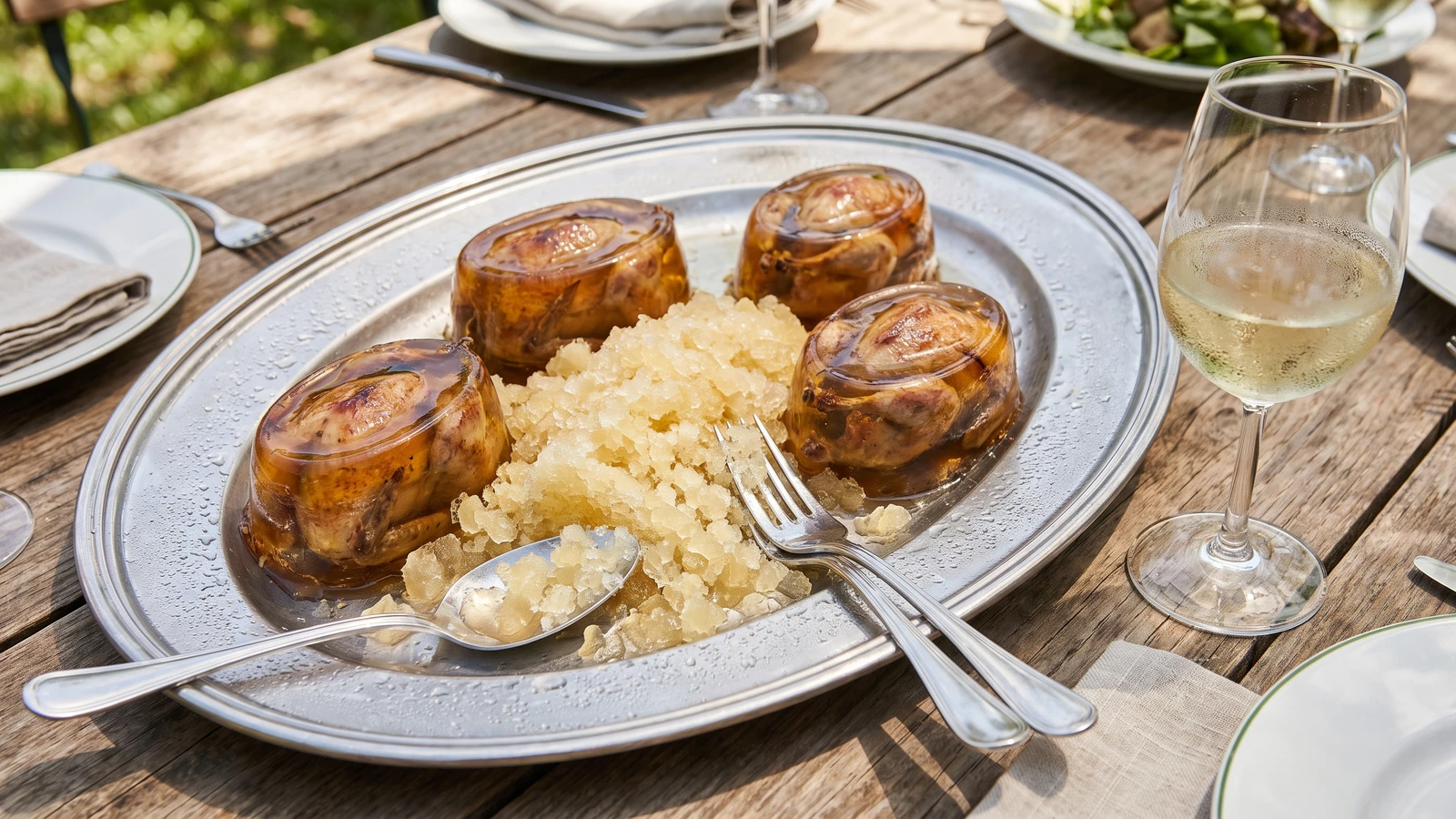
Cold glazed quails gleaming in clear aspic, arranged around a crag of bright pineapple granité: a make-ahead centerpiece where exact syrup density and patient chilling create the drama.
Cailles glacées Maryland (cold glazed quails with pineapple granité) teaches that temperature is structure. The quail, aspic, and granité must meet fully cold, yet the one true thing is simpler: keep the granité syrup thin. A heavy syrup remains slush while a light one freezes into loose crystals that can be piled like a rough golden rock.
The book's brief instruction assumed a garde-manger with clarified aspic always ready, bird-shaped moulds on the shelf, and a freezing pail at hand. At home, rich clear stock set with measured gelatin replaces the standing aspic, four small oval bowls replace the specialty moulds, and a shallow metal pan with an ordinary fork replaces the freezing pail. The elaborate silhouette was brigade scaffolding and may go. The gleaming cold glaze and rough-grained pineapple ice are the dish, so they stay. One cook, one stove, one evening.
On the platter, the quail shows bronze beneath transparent aspic while the pineapple granité sits in the center, pale gold and sharply cold. It is generous, strange in the best classical manner, and particularly suited to a long outdoor lunch because nearly all the work is finished beforehand. Before touching a pan, make the granité syrup and keep it below fourteen degrees Baumé; heavy syrup is the one mistake the freezer cannot hide.
Cailles glacées Maryland belongs to the French grand-service cold table, the domain of the garde-manger, rather than to Maryland's regional kitchen. In this formula, Maryland is a garnish-name defined by pineapple granité, one of the transatlantic place-names French menu writers attached to New World accompaniments; it should not be confused with the fried poultry preparation that also carries the name. Across banquet and bourgeois tables, moulded aspic kept small birds neat for advance service while the fruit ice supplied a sharp, melting contrast.
Quantity
8, about 5 to 6 oz (140 to 170 g) each
Quantity
2 teaspoons (10 ml / 10 g)
divided
Quantity
1 teaspoon (5 ml / 2 g)
Quantity
3 tablespoons (45 ml / 43 g)
divided
Quantity
3½ cups (840 ml / 840 g)
Quantity
2 tablespoons (30 ml / 18 g)
Quantity
½ cup (120 ml / 120 g)
for blooming
Quantity
1 teaspoon (5 ml / 3 g)
only if the aspic needs strengthening
Quantity
1 tablespoon (15 ml / 15 g)
only for the additional gelatin
Quantity
1 medium, yielding 4 cups (950 ml / 650 g) trimmed flesh
peeled, cored, and diced
Quantity
¼ cup (60 ml / 50 g)
Quantity
¾ cup (180 ml / 180 g)
Quantity
Up to ¼ cup (60 ml / 60 g)
only if the granité mixture needs thinning
| Ingredient | Quantity |
|---|---|
| oven-ready quails | 8, about 5 to 6 oz (140 to 170 g) each |
| fine sea saltdivided | 2 teaspoons (10 ml / 10 g) |
| finely ground white pepper | 1 teaspoon (5 ml / 2 g) |
| unsalted butterdivided | 3 tablespoons (45 ml / 43 g) |
| rich, clear, unsalted chicken stock | 3½ cups (840 ml / 840 g) |
| unflavored powdered gelatin | 2 tablespoons (30 ml / 18 g) |
| cold waterfor blooming | ½ cup (120 ml / 120 g) |
| unflavored powdered gelatin (optional)only if the aspic needs strengthening | 1 teaspoon (5 ml / 3 g) |
| cold water (optional)only for the additional gelatin | 1 tablespoon (15 ml / 15 g) |
| ripe pineapplepeeled, cored, and diced | 1 medium, yielding 4 cups (950 ml / 650 g) trimmed flesh |
| granulated sugar | ¼ cup (60 ml / 50 g) |
| filtered water | ¾ cup (180 ml / 180 g) |
| ice water (optional)only if the granité mixture needs thinning | Up to ¼ cup (60 ml / 60 g) |
Combine the filtered water and sugar in a small saucepan and warm gently, stirring only until the sugar disappears. Do not reduce it. The classical limit is fourteen degrés Baumé, a syrup-density reading; these weights keep the syrup safely below it without asking you to own a saccharometer. Cool completely, blend with the pineapple until smooth, then press through a fine sieve into a shallow metal pan. Freeze for 45 minutes, rake the frozen edges toward the center with a fork, and repeat every 30 to 40 minutes until the mixture consists of loose, pale-gold crystals, about 3 hours. Cover and keep frozen.
Sprinkle the 2 tablespoons of gelatin evenly over the ½ cup of cold water and leave it to bloom for 10 minutes. Meanwhile, bring the chicken stock to a bare simmer and reduce it gently to exactly 3 cups (720 ml / 720 g), skimming away every trace of fat. Remove it from the heat, whisk in the bloomed gelatin until dissolved, and strain through a damp fine cloth or coffee filter. Do not boil after adding gelatin, which weakens the set and dulls the stock's clarity. Spread a spoonful on a cold saucer and freeze it for 5 minutes; it should tremble but hold its shape. If it still runs, bloom the reserved teaspoon of gelatin in the reserved tablespoon of water, rewarm the aspic gently, and whisk it in.
Heat the oven to 425°F (220°C). Dry the quails thoroughly, then season them inside and out with the salt and white pepper. Melt half the butter in a wide ovenproof pan over medium-high heat. Brown four quails at a time, adding the remaining butter for the second batch, until their breasts and legs are deeply golden. Transfer all eight birds to a shallow roasting pan, breast-side up, and roast for 7 to 10 minutes, until the thickest part of a thigh reaches 165°F (74°C). Cold poultry must be fully cooked, but take it out as soon as it reaches that mark so the small breasts remain tender.
Rest the quails for 10 minutes, just until they can be handled. Pull away the breast lobes intact, then slide the thigh and drumstick meat from the fine bones, preserving the bronzed skin wherever possible. Check carefully for stray bones. Spread the meat in one layer on a clean tray and refrigerate uncovered until completely cold, about 45 minutes. Warm meat clouds aspic and can melt its first coat, so do not hurry this chill.
Rinse four 1½-cup (350 ml) oval moulds or small bowls with cold water and leave them damp. Pour about 2 tablespoons (30 ml / 30 g) of cool, fluid aspic into each one, rolling the mould so the base and sides receive a thin coat. Refrigerate for 8 to 10 minutes, until set, then repeat for a smooth glaze. Keep the remaining aspic fluid by setting its bowl over barely warm water if necessary.
Divide the chilled quail among the moulds, placing the finest breast pieces skin-side against the aspic so their bronze shows when unmoulded. Arrange the leg meat through the center. Pour in enough aspic to reach halfway, then chill for 15 minutes until tacky; this anchors the meat instead of letting it float. Fill to the rim with the remaining aspic. If an air pocket appears, slide in a thin skewer and press gently until the bubble rises, then cover the mark with another spoonful of aspic. Chill for at least 4 hours, preferably overnight.
Ten minutes before serving, rake the granité from edge to center with a sturdy fork, breaking every clump into coarse, separate crystals. If it has frozen into a hard slab, leave it at room temperature for 5 minutes and try again; if it has become wet, spread it flat and return it to the freezer for 15 minutes. Do not press the crystals together. Their loose grain is the whole point.
Dip each mould in warm water for 3 seconds, dry the outside, and invert it onto a chilled oval platter. If it clings, repeat the dip for 2 seconds rather than forcing it. Arrange the four moulded portions around the platter, then spoon the granité into a high, irregular rock at the center without compacting it. Add the granité only at the last moment because raw pineapple can soften gelatin during prolonged contact. For outdoor dining, set the platter over a shallow tray of ice and bring it out only when everyone is seated. Serve immediately. À table!
1 serving (about 640g)
Culinary guides, cultural storytelling, and the editorial depth that makes cooking meaningful.
Discover Culinary ExplorerChef Juliette
John Dory has the delicacy of sole and the firmness of turbot. A light flouring, a quick butter sauté, and nut-brown beurre noisette show exactly why looks never mattered.

Chef Juliette
Fresh haddock proves its delicacy in the meunière pan: a fine flour crust, moist pearly flakes, and beurre noisette sharpened with lemon and parsley, ready from one skillet in half an hour.

Chef Juliette
Éperlans à l’Anglaise turns small fish into a lesson in disciplined coating: boned smelts under a close, crisp crumb, pan-fried in clarified butter and finished with bright, half-melted maître d’hôtel butter.

Chef Juliette
Tiny smelts, shallot, mushrooms, white wine, gratin sauce, and fine bread raspings meet a fierce oven, where the fish must turn tender in the same breath the buttered crust bronzes.