
Chef Juliette
John Dory (St. Pierre)
John Dory has the delicacy of sole and the firmness of turbot. A light flouring, a quick butter sauté, and nut-brown beurre noisette show exactly why looks never mattered.
A cooking platform built around craft, culture, and the stories behind what we eat.
Created by Chef Juliette
Based on No. 1904, Cailles glacées Cerisette, from Le Guide Culinaire (1907) by Auguste Escoffier
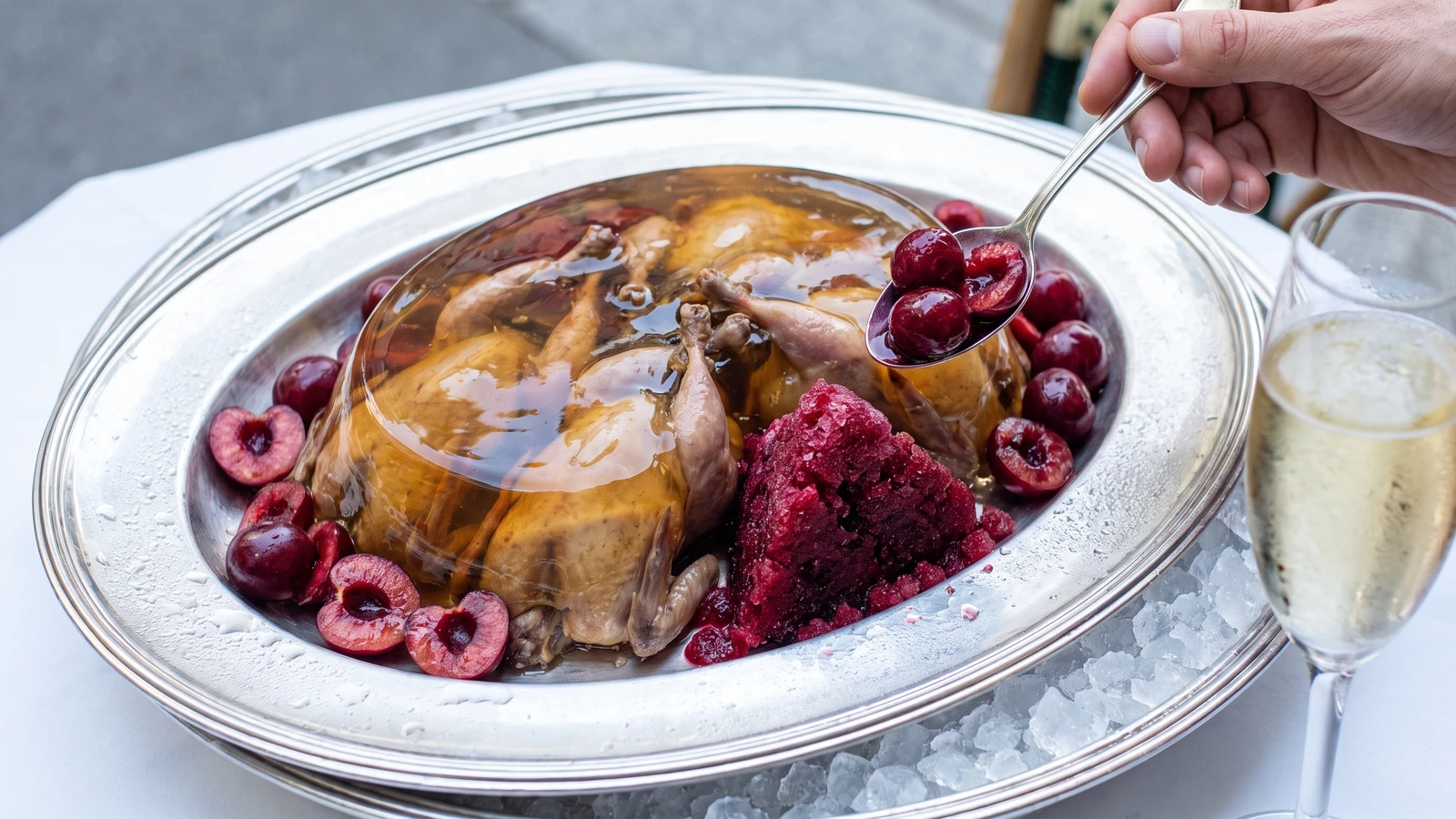
Four Champagne-poached quails, held in shining veal aspic around a crystalline cherry granité, with cold syrup-poached cherries tucked between them: a formal-looking supper built by patience, not fuss.
Cailles glacées Cerisette (chilled quails in veal aspic with cherry granité) teaches that clarity is flavor made visible. The quails are poached gently in strong veal stock and Champagne, then enclosed in their own gelée, a savory jelly that should be clear enough to show every curve of the bird. One truth decides it before you touch the pan: remove every trace of grease from the cooking liquor. A thin film clouds the gelée, weakens its grip, and steals its shine.
The original kitchen had collagen-rich veal stock never far from the fire, a saucier to strain the liquor, separate hands tending the frozen garnish, and an ice-incrusted serving dish waiting in the cold room. At home, use four molds, a refrigerator, a shallow bed of crushed ice, and a measured little reinforcement of gelatin only if your stock needs it. The sculpted ice display was brigade scaffolding and can go. The fat-free gelée, the granular cherry preparation, and the quails poached for twelve quiet minutes are the dish and must stay. One cook, one stove, one evening of work, then the cold takes the watch.
The finished platter should look almost jewel-like without becoming fussy: amber-clear quails around ruby cherry ice, with plump cold cherries between them. Degrease the liquor with unreasonable attention. Everything after that is arrangement, and ça se rattrape if the set needs strengthening.
Cailles glacées Cerisette belongs to the grand cold-table repertoire of Parisian suppers and formal buffets, where small birds were poached, molded beneath clear gelée, and served against a sharply flavored frozen preparation. Here, glacées means thoroughly chilled and made glossy by the set cooking liquor, not coated with a sweet glaze. Cerisette names the cherry character of the presentation rather than a French region: cherry granité at the center, syrup-poached cherries between the birds.
Quantity
4, about 4½ to 5 ounces (125 to 140 g) each
giblets removed
Quantity
5 cups (1.2 L / about 1.2 kg)
Quantity
1 cup (240 ml / about 240 g)
Quantity
1 teaspoon (5 ml / 6 g), divided, plus more as needed
Quantity
¼ teaspoon (1.25 ml / 0.5 g)
Quantity
Up to 6¾ teaspoons (33 ml / 21 g)
use only if needed to strengthen the set
Quantity
6 tablespoons (90 ml / 90 g), divided
Quantity
2 cups (480 ml / about 300 g)
stemmed and pitted
Quantity
¾ cup (180 ml / 150 g)
Quantity
¾ cup (180 ml / 180 g)
Quantity
3 cups (720 ml / about 600 g), prepared according to Granités (No. 2930)
fully frozen
Quantity
8 cups (1.9 L / about 1.2 kg)
for chilling and serving
| Ingredient | Quantity |
|---|---|
| oven-ready whole quailsgiblets removed | 4, about 4½ to 5 ounces (125 to 140 g) each |
| strong unsalted veal stock | 5 cups (1.2 L / about 1.2 kg) |
| brut Champagne | 1 cup (240 ml / about 240 g) |
| fine sea salt | 1 teaspoon (5 ml / 6 g), divided, plus more as needed |
| finely ground white pepper | ¼ teaspoon (1.25 ml / 0.5 g) |
| unflavored powdered gelatin (optional)use only if needed to strengthen the set | Up to 6¾ teaspoons (33 ml / 21 g) |
| cold water for blooming gelatin (optional) | 6 tablespoons (90 ml / 90 g), divided |
| ripe red cherriesstemmed and pitted | 2 cups (480 ml / about 300 g) |
| granulated sugar | ¾ cup (180 ml / 150 g) |
| water for cherry syrup | ¾ cup (180 ml / 180 g) |
| cherry-juice Granitéfully frozen | 3 cups (720 ml / about 600 g), prepared according to Granités (No. 2930) |
| crushed icefor chilling and serving | 8 cups (1.9 L / about 1.2 kg) |
Make certain the cherry-juice Granité from Granités (No. 2930) is fully frozen before beginning. Chill four small oval molds and the serving platter. Pat the quails dry, tuck the wing tips underneath, and tie the legs neatly together so each bird holds a compact oval shape inside its mold. Season them with half the salt and the white pepper, then keep them cold while the poaching liquor heats.
Combine the veal stock and Champagne in a snug, heavy saucepan and bring them to a bare simmer. Lower in the quails breast-side down and cover them with a parchment cartouche. Hold the liquor at a faint tremble, about 180 to 185°F (82 to 85°C), for 12 minutes, turning the birds halfway if the liquor does not cover them completely. A hard boil toughens the breasts and clouds the liquor. Check the thickest part of a thigh without touching bone; it must reach 165°F (74°C). If it has not, continue in one-minute intervals. Lift each quail directly into its chilled mold, breast-side down, and refrigerate promptly.
Strain the cooking liquor through a fine sieve lined with damp muslin into a fat separator, then pour the lean liquor into a clean saucepan, leaving the first layer of grease behind. Simmer until reduced to 4 cups (960 ml), tasting only after the reduction before adding the remaining salt. Transfer it to a shallow metal bowl, cool it rapidly over crushed ice, then refrigerate until any remaining fat turns opaque on the surface. Lift off every trace. If small beads remain, touch a clean sheet of paper towel flat against the surface and lift it away; repeat with fresh paper. This is the step that decides the shine, and there is no virtue in rushing it.
Warm the degreased liquor gently until it becomes fluid, without boiling. Spoon a tablespoon onto a chilled saucer and refrigerate it for 5 minutes. It should form a clear, tender gel that holds when the saucer is tilted. If it slides, ça se rattrape: bloom 4½ teaspoons (22 ml / 14 g) gelatin in 4 tablespoons (60 ml / 60 g) cold water for 5 minutes, then dissolve it completely in the warm liquor and test again. If the second test remains too soft for unmolding, bloom the final 2¼ teaspoons (11 ml / 7 g) gelatin in the remaining 2 tablespoons (30 ml / 30 g) water and add it. Do not boil after adding gelatin, since trapped bubbles and renewed grease make clear gelée difficult.
Pass the finished gelée through the clean fine sieve once more. Set its bowl over crushed ice and stir slowly until the liquid is cool and just beginning to feel syrupy. If it sets in the bowl, warm it gently until fluid again; nothing is lost. Pour the gelée slowly around each chilled quail until the mold is full, nudging the bird only enough to release hidden air pockets. Refrigerate uncovered for 30 minutes, then cover without touching the surface and chill for at least 5 hours, preferably overnight.
Bring the sugar and water to a boil in a small saucepan, stirring only until the sugar dissolves. Simmer for 2 minutes, add the pitted cherries, and poach them gently for 2 to 3 minutes, just until glossy and tender while still holding their shape. Remove the pan from the heat and cool the cherries completely in their syrup. Chill them, then drain them thoroughly before plating so loose syrup cannot run beneath the molded quails.
Nest the chilled serving platter in a shallow tray of crushed ice. Dip one mold in warm water for 5 seconds, wipe its outside dry, invert it onto the platter, and lift straight upward. Repeat with the remaining molds, arranging the four quails around an open center. If one clings, return the mold to warm water for 2 seconds rather than pulling at the gelée. If an edge softens, chill the platter for 10 minutes and it will firm again.
At the last moment, rake the fully frozen cherry-juice Granité from Granités (No. 2930) into light crystals and mound it in a compact pyramid at the center of the platter. Fill the gaps between the molded quails with small heaps of the cold, well-drained cherries. Carry the platter to the table over its bed of ice while the gelée remains bright and the Granité granular. À table!
1 serving (about 550g)
Culinary guides, cultural storytelling, and the editorial depth that makes cooking meaningful.
Discover Culinary ExplorerChef Juliette
John Dory has the delicacy of sole and the firmness of turbot. A light flouring, a quick butter sauté, and nut-brown beurre noisette show exactly why looks never mattered.

Chef Juliette
Fresh haddock proves its delicacy in the meunière pan: a fine flour crust, moist pearly flakes, and beurre noisette sharpened with lemon and parsley, ready from one skillet in half an hour.

Chef Juliette
Éperlans à l’Anglaise turns small fish into a lesson in disciplined coating: boned smelts under a close, crisp crumb, pan-fried in clarified butter and finished with bright, half-melted maître d’hôtel butter.

Chef Juliette
Tiny smelts, shallot, mushrooms, white wine, gratin sauce, and fine bread raspings meet a fierce oven, where the fish must turn tender in the same breath the buttered crust bronzes.