Culinary Explorer

A cooking platform built around craft, culture, and the stories behind what we eat.
Discover Culinary Explorer
Bécasse à la Favart

Bécasse à la Favart

Created by Chef Juliette

Based on No. 1876, Bécasse à la Favart, from Le Guide Culinaire (1907) by Auguste Escoffier

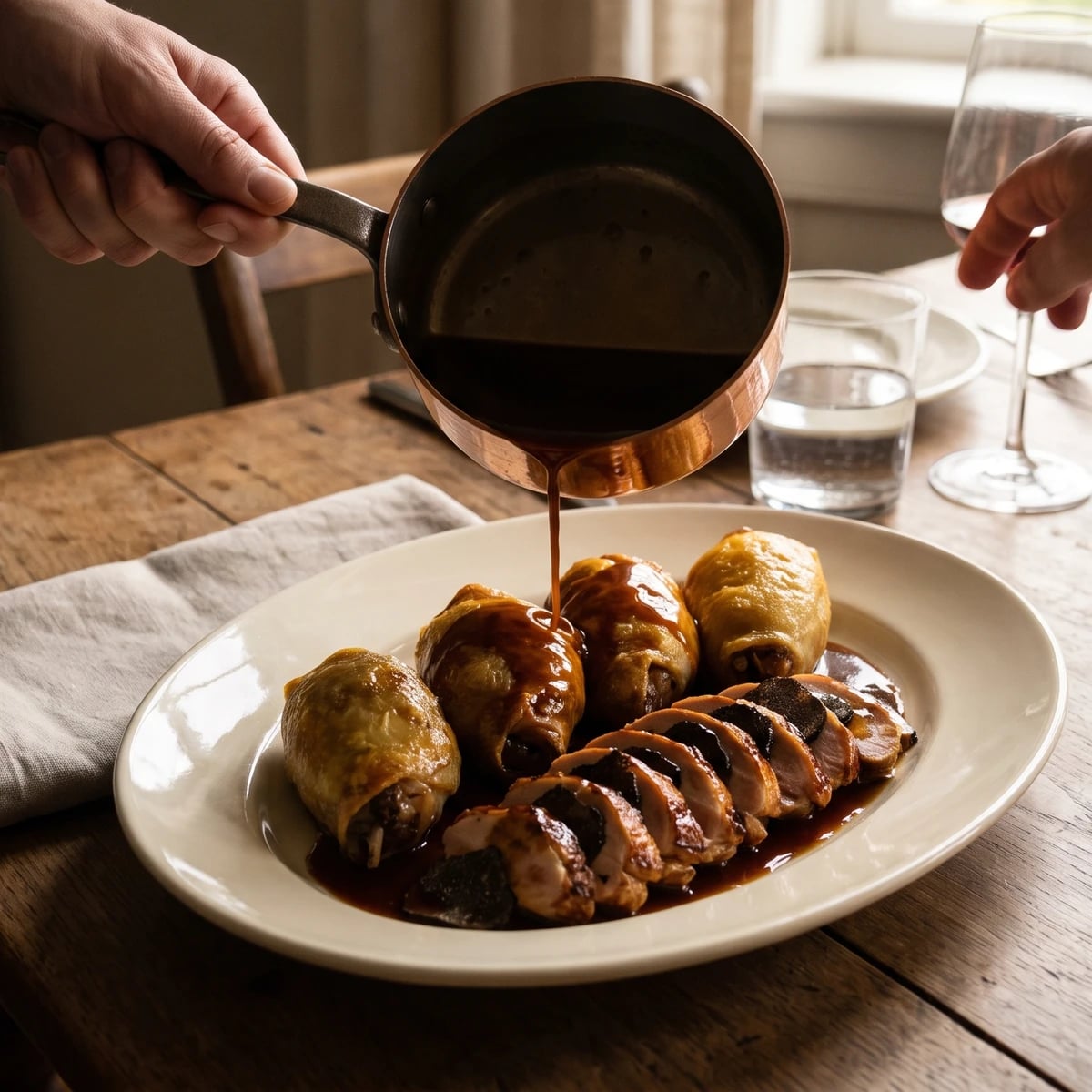
A woodcock case rebuilt with silken offal mousseline, sliced suprêmes, and black truffle, then poached at the barest tremble and served with glossy demi-glace deepened by its own fumet.

Main Dishes
French
Special Occasion
Celebration
Dinner Party
1 hr 30 min
Active Time
1 hr 10 min cook2 hr 40 min total
Yield4 servings

Bécasse à la Favart (woodcock in a boned case with truffled mousseline) teaches control at the gentlest edge of heat. The carcass becomes a serving case, the livers and intestines are worked into the mousseline (silken forcemeat), the suprêmes (breast fillets) return in slices beneath a central row of truffle, and the bird's fumet (concentrated game essence) deepens the half-glaze. The one true thing is simple: the poaching liquid must tremble but never boil.

The book sends you to Soufflé de Caneton Rouennais (No. 1764) and assumes a poultry cook to bone the cases, a saucier on staff, a stockpot never off the fire, and spare raw bird for the forcemeat. Your honest equivalents are a narrow boning knife, a food processor kept cold, proper veal demi-glace, and a quick fumet made from the woodcock bones. The spare half-duckling becomes cold chicken breast because sacrificing more woodcock merely to supply neutral muscle changes the shopping, not the dish. Strong buttered paper becomes doubled parchment tied with twine. The tartlets from the duck preparation are service scaffolding and are not carried into Favart; the intact cases, intestines, foie gras, truffle, and twenty-minute poach must stay. A salamander has no work here because the finish is poached, not browned.

Four birds make four generous portions, one cook, one stove, one evening. Keep every part of the mousseline cold, then watch the poach more closely than the clock. If the liquid surges, pull the pan from the heat and cool it with a spoonful of stock. Ça se rattrape, but gentleness is what keeps the cases whole.

Bécasse à la Favart belongs to Parisian classical cooking, where named preparations often honored the stage; Favart points toward the Opéra-Comique circle rather than any woodcock-hunting region. Whether the dedication belongs to the playwright, his performer wife, or the theatrical house carrying the family name is less certain than menu lore suggests. The method remains unmistakably game cookery: refinement concentrates the woodcock through its intestines, truffle, fumet, and half-glaze rather than disguising it.

The technique, the tradition, and the story behind every dish.

Discover Culinary Explorer

Ingredients

Soufflé de Caneton Rouennais

Quantity

1 referenced preparation framework (No. 1764)

used for the carcass cases, mousseline, and covered poach

whole woodcock

Quantity

4

plucked, heads and feet removed, cavity organs intact, legally obtained and promptly chilled

unsalted butter

Quantity

4 tablespoons (60 ml / 56 g)

divided

shallots

Quantity

2 medium, about 1/2 cup (120 ml / 80 g)

thinly sliced

carrot

Quantity

1 small, about 1/3 cup (80 ml / 45 g)

thinly sliced

thyme

Quantity

4 sprigs

bay leaf

Quantity

1

unsalted chicken or light game stock

Quantity

3 cups (720 ml / 720 g)

skinless chicken breast

Quantity

1 packed cup (240 ml / 225 g)

diced and thoroughly chilled

raw foie gras

Quantity

1/3 cup (80 ml / 85 g)

diced and thoroughly chilled

egg white

Quantity

1 large

thoroughly chilled

fine sea salt

Quantity

2 teaspoons (10 ml / 12 g)

divided

finely ground white pepper

Quantity

1/2 teaspoon (2.5 ml / 1 g)

black truffle

Quantity

1 small, about 1/4 cup (60 ml / 30 g)

thinly sliced

real veal demi-glace

Quantity

3/4 cup (180 ml / 190 g)

cold unsalted butter

Quantity

2 tablespoons (30 ml / 28 g)

diced for finishing

Equipment Needed

  • Narrow flexible boning knife
  • Small poultry shears
  • Food processor with a chilled bowl and blade
  • Fine-mesh sieve or tamis
  • 11-inch (28 cm) covered ovenproof sauté pan
  • Small heavy saucepan
  • Instant-read thermometer
  • Baking parchment and kitchen twine

Instructions

  1. 1

    Prepare the offal

    Work with one cold bird at a time. Open the vent as little as possible and withdraw the organs without tearing the surrounding skin. Separate and retain each liver and the intact intestines; remove the gall bladder without piercing it, and discard the crop, gizzard, visible grit, bile-stained tissue, or anything damaged or improperly chilled. Blot the retained offal rather than rinsing it under the tap, then refrigerate it over ice while you prepare the birds. Clean the knife, board, and your hands before handling anything else.

    The intestines are part of Favart, but freshness is not negotiable. If they are punctured, tainted, or came from a bird that was not promptly chilled, discard them and choose another woodcock preparation.
  2. 2

    Poêler the birds

    Heat the oven to 425°F (220°C). Pat the birds dry and season them lightly with some of the salt. Melt 2 tablespoons (30 ml / 28 g) of the butter in a covered ovenproof sauté pan, turn the birds in the foaming butter until their skin takes a light butter-gold color, then add half the shallot and carrot. Cover and poêler, meaning butter-roast under cover, for 5 to 7 minutes. The breasts should remain distinctly underdone because they cook again over the mousseline. Transfer the birds to a tray and let them cool only until they can be handled.

  3. 3

    Form the cases

    Lift both suprêmes cleanly from each bird and refrigerate them, covered. Working through the breast opening, loosen the rib cage, keel, and back bones with the tip of a boning knife, snip the joints as needed, and draw the bones out while preserving the skin, legs, and outer shape as a hollow case. Scrape away any bloodshot tissue and check carefully for shot. Slice each suprême crosswise into neat collops. If a case develops a small tear, patch it from the inside with buttered parchment; the collar added later will hold it securely.

  4. 4

    Build the fumet

    Break the reserved bones into a few pieces. Melt the remaining 1 tablespoon (15 ml / 14 g) butter in a small saucepan and brown the bones until their edges are deep gold. Add the remaining shallot and carrot along with the vegetables from the roasting pan, then pour in the stock and add the thyme and bay. Bring only to a quiet simmer, skim the surface, and cook uncovered for 25 minutes. Strain without pressing and reduce to 1 1/2 cups (360 ml / 360 g). If it reduces too far, restore the measure with stock. Reserve 1 cup for poaching and 1/2 cup for the sauce.

  5. 5

    Work the mousseline

    Chill the food processor bowl and blade. Process the cold chicken, woodcock livers, intestines, 1 teaspoon (5 ml / 6 g) of the salt, and the white pepper until the paste becomes smooth and tacky. Add the egg white and process just until absorbed, then add the foie gras and pulse until uniform. Work the mousseline through a fine sieve into a bowl set over ice; this removes fibrous membrane while carrying the intestines fully into the forcemeat. Poach a teaspoonful in barely simmering water until it reaches 165°F (74°C), then taste and correct the seasoning. If the test releases fat or feels grainy, chill the mousseline for 15 minutes and pulse it briefly until cohesive. Ça se rattrape. Never taste the mixture raw.

  6. 6

    Rebuild the birds

    Lower the oven to 275°F (135°C). Following the structure of Soufflé de Caneton Rouennais (No. 1764), butter the inside of each case and divide the mousseline among them, filling only to the natural breast line. Shape it gently so each bird regains its compact form. Lay the sliced suprêmes over the mousseline in overlapping rows and place a straight row of truffle slices down the middle. Wrap each case with a doubled strip of buttered parchment and tie it with kitchen twine. The collar replaces the strong buttered paper of the brigade kitchen and prevents the soft filling from spreading.

  7. 7

    Poach without boiling

    Set the collared cases snugly in a shallow covered pan and pour the warm reserved cup of fumet around them, not over their decorated tops. Cover tightly and poach in the oven for about 20 minutes. Check halfway through: the liquid should show only an occasional tremble. A boil can split the cases and make the mousseline coarse. If it surges, remove the pan from the oven, uncover it, and add 2 tablespoons of cool stock around the birds before continuing at gentler heat. If a seam opens, press buttered parchment against it and retie the collar. Cook until the center of the mousseline reaches 165°F (74°C); if necessary, continue in 3-minute intervals.

  8. 8

    Finish the half-glaze

    Lift the cooked cases to a warm tray and rest them for 5 minutes. Strain 1/2 cup (120 ml / 120 g) of their poaching liquor into a clean saucepan, add the reserved 1/2 cup fumet and the veal demi-glace, then reduce over medium heat until the sauce is glossy and naps the back of a spoon. Remove it from the heat and whisk in the cold finishing butter a few pieces at a time. If the butter separates, whisk a teaspoon of cold fumet in a clean warm pan, then add the sauce back by spoonfuls. Taste for salt only after reducing.

  9. 9

    Serve at once

    Remove the twine and parchment without disturbing the suprêmes or truffle. Arrange the four cases on a warmed oval platter, keeping their reconstructed shape visible. Pour the woodcock fumet half-glaze into a warmed sauceboat and serve it at the same time, spooning it over each portion at the table. À table!

Chef Tips

  • Woodcock is wild migratory game, and hunting, sale, and possession rules differ sharply by place. Buy or receive only legally obtained birds from a source that can confirm prompt chilling and careful handling. Inspect every bird for shot and bloodshot tissue.
  • Ask a game butcher to pluck the birds and remove the heads and feet while leaving the body skin and cavity organs intact. Do not ask for ordinary oven-ready birds; without the intestines and an undamaged case, this particular preparation cannot be made as written.
  • Fresh black truffle is splendid when its season and your purse agree. A good preserved whole black truffle is the honest classical-pantry answer at other times; drain it well and slice it yourself rather than buying flavorless pre-cut pieces.
  • Use a true veal demi-glace that sets softly when cold and contains no floury gravy thickener. The sauce must gain its body from gelatin and reduction, then its final sheen from real butter.
  • Pour a mature red Burgundy or a restrained red Bordeaux. The wine needs enough depth for woodcock and truffle, but not so much force that the small bird disappears beneath it.

Advance Preparation

  • The veal demi-glace may be prepared or purchased several days ahead and kept chilled. Warm only the measured amount needed for the final sauce.
  • The birds may be poêlé, boned into cases, and used to make the fumet up to 6 hours before serving. Keep the cases, suprêmes, offal, and finished fumet separately covered and cold.
  • The filled and collared cases may wait in the refrigerator for up to 2 hours. Poach them directly from the cold and expect the center to need 3 to 5 minutes beyond the usual twenty.
  • Reduce the fumet and demi-glace together shortly before serving, but whisk in the finishing butter only after the cases have finished poaching.

Frequently Asked Questions

Nutrition Information

1 serving (about 295g)

Calories
620 calories
Total Fat
38 g
Saturated Fat
17 g
Trans Fat
1 g
Unsaturated Fat
20 g
Cholesterol
270 mg
Sodium
1700 mg
Total Carbohydrates
10 g
Dietary Fiber
2 g
Sugars
3 g
Protein
53 g

Note: Chef personas and recipes are created with AI assistance. Cook with care: follow safe food-handling practices, check doneness with a thermometer when needed, and adapt for allergies and your kitchen.

Where cooking meets culture.

Culinary guides, cultural storytelling, and the editorial depth that makes cooking meaningful.

Discover Culinary Explorer

More from Poultry (Volaille) - Partridge (Perdrix et Perdreaux)

Browse the full collection