
Chef Juliette
Caneton Nantais à la Choucroûte
A whole Nantes duckling, browned and gently braised with Rhine wine, carved over choucroute glazed nearly dry with salt pork, then finished beneath a restrained veil of glossy veal sauce.
A cooking platform built around craft, culture, and the stories behind what we eat.
Created by Chef Juliette
Based on No. 1764, Soufflé de Caneton Rouennais, from Le Guide Culinaire (1907) by Auguste Escoffier
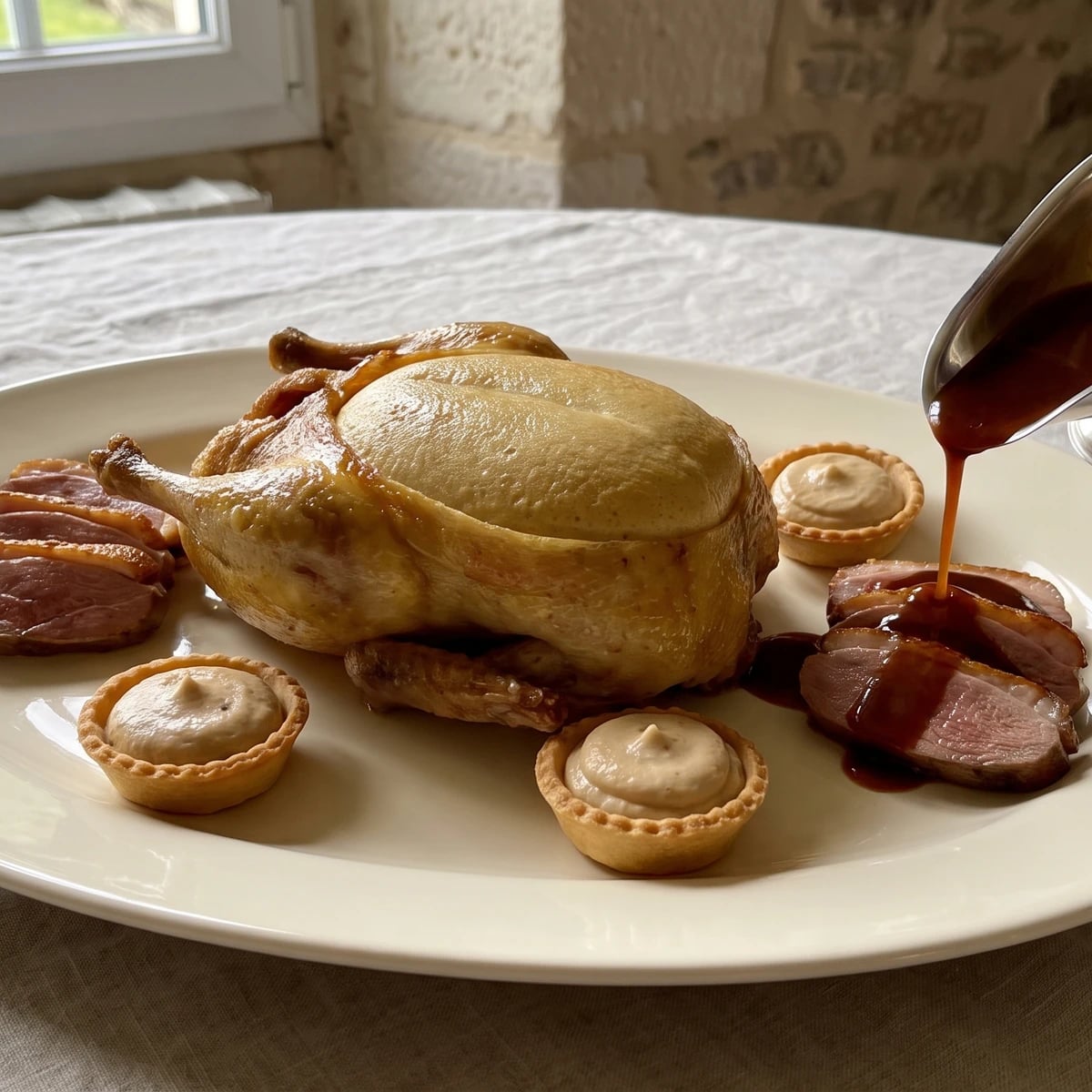
A whole duckling becomes its own serving case, filled with duck liver and foie gras mousseline, poached gently, then surrounded with tartlets and warm suprême beside glossy Rouennaise sauce.
Soufflé de Caneton Rouennais (Rouen duckling rebuilt with a foie gras mousseline) teaches one severe and useful lesson: a mousseline, a smooth and light forcemeat, stays delicate only while it stays cold. Let the duck meat or foie gras warm under the blade and the fat separates, leaving a grainy filling where there should be silk.
The brigade version assumes Poëlings complete at one station, a saucier holding the Rouennaise sauce over a stockpot that never goes cold, a second half-duckling waiting for the forcemeat, and several hands to bone the cooked bird while it is warm. It needs no salamander; the finish is a gentle covered poach. For four, the second half-duckling becomes 12 ounces of boneless duck meat, a processor and sieve replace the mortar work, and a covered oval casserole in a bain-marie replaces the great poaching pan. One cook, one stove, one evening.
Ready-baked tartlet shells replace the pastry station because making four tiny crusts is brigade scaffolding. The cold mousseline, the hollowed duck case, the paper band, the breast slices, and the Rouennaise sauce are the dish itself, so they stay. Before you touch the processor, chill its bowl, the duck meat, the liver, and both portions of foie gras. That cold is what decides the result.
Soufflé de Caneton Rouennais belongs to Rouen in Normandy, where young duckling and liver-enriched Rouennaise sauce form a distinct local tradition, separate from Normandy's cream-led dishes. Grand kitchens carried that regional pairing into a ceremonial pièce by removing the bones, refilling the bird, and reconstructing its shape for the table. Despite the name, soufflé here is not an egg-white puff from a ramekin; it means the light hot forcemeat forming the rebuilt breast of the duckling.
Quantity
1, 4 to 4½ lb (1.8 to 2 kg), for Poëlings (No. 250)
giblets removed, liver reserved
Quantity
about ⅓ cup diced (2 oz / 55 g)
very cold
Quantity
about 2 cups diced (12 oz / 340 g)
very cold
Quantity
1
Quantity
about ½ cup diced (3 oz / 85 g)
very cold
Quantity
1½ teaspoons (7.5 ml / 9 g)
Quantity
¼ teaspoon (1.25 ml / 0.5 g)
Quantity
1 tablespoon (15 ml / 14 g)
softened
Quantity
⅓ cup plus 1 tablespoon diced (3 oz / 85 g)
very cold, to be puréed
Quantity
4, about 2½ inches (6 cm) wide
Quantity
1¼ cups (300 ml / about 300 g)
| Ingredient | Quantity |
|---|---|
| whole young ducklinggiblets removed, liver reserved | 1, 4 to 4½ lb (1.8 to 2 kg), for Poëlings (No. 250) |
| raw duck liver from the ducklingvery cold | about ⅓ cup diced (2 oz / 55 g) |
| raw skinless, boneless duck meat from another half-ducklingvery cold | about 2 cups diced (12 oz / 340 g) |
| large egg white | 1 |
| raw foie gras for the mousselinevery cold | about ½ cup diced (3 oz / 85 g) |
| fine salt | 1½ teaspoons (7.5 ml / 9 g) |
| finely ground white pepper | ¼ teaspoon (1.25 ml / 0.5 g) |
| unsalted buttersoftened | 1 tablespoon (15 ml / 14 g) |
| raw foie gras for the tartletsvery cold, to be puréed | ⅓ cup plus 1 tablespoon diced (3 oz / 85 g) |
| fully baked savory tartlet shells | 4, about 2½ inches (6 cm) wide |
| prepared Rouennaise sauce | 1¼ cups (300 ml / about 300 g) |
Remove and chill the raw liver before cooking. Cook the duckling by Poëlings (No. 250), following that preparation as written and stopping when the bird is only just done. The breast should reach 160°F (71°C), then rise to 165°F (74°C) during a five-minute covered rest; the deepest part of the thigh must also reach at least 165°F (74°C). If either remains below that mark after resting, return the bird to the oven briefly. Overcooking now dries the suprêmes before they ever reach the tartlets.
Set the warm duckling breast-side up. Cut close along the keel bone and raise the two suprêmes, the breast fillets, in whole lobes. Wrap them together in buttered parchment and cover so they retain their moisture. Through the breast opening, use poultry shears and a short boning knife to cut the ribs from the spine and remove the breastbone, rib cage, and main frame in manageable pieces. Leave the legs, wings, outer skin, and as much attached meat intact as possible, creating a hollow case that still suggests the bird. If the skin tears, overlap the edges and reinforce the inside with a small buttered parchment patch. Ça se rattrape.
Set the chilled processor bowl over ice if your kitchen is warm. Pulse the raw duck meat and duck liver until very fine, scraping the bowl often. Add the 3 ounces (85 g) of foie gras, the egg white, salt, and white pepper, then process only until the mixture is smooth and tacky. Press it through a fine sieve into a cold bowl. If the mixture begins to look greasy or its temperature rises above 50°F (10°C), stop and chill it for fifteen minutes before continuing; cold restores the emulsion before the fat separates completely. Poach a teaspoonful in barely simmering water until it reaches 165°F (74°C), taste, and correct the seasoning. Weigh out and reserve 3 ounces (85 g) of the finished mousseline for the tartlets.
Butter a snug oval casserole and a doubled strip of strong parchment about 4 inches (10 cm) wide. Spoon the remaining mousseline into the duck case, filling the hollow and rounding the top to reconstruct the natural breast of the bird. Bring the skin edges toward the filling without stretching them. Wrap the buttered parchment band around the body and secure it with kitchen twine, firmly enough to support the shape but not so tightly that the mousseline cannot expand slightly. Set the bird breast-side up in the prepared casserole.
Press the second 3-ounce (85 g) portion of raw foie gras through the clean sieve to make a purée. Fold it gently into the reserved mousseline in equal weights, keeping the mixture cold. Divide it among the four baked tartlet shells and smooth the tops without compacting them. Set the tartlets in a small buttered heatproof dish that can sit beside the duck casserole in the same roasting pan.
Heat the oven to 325°F (165°C). Place the duck casserole and tartlet dish inside a deep roasting pan, cover both tightly, and pour very hot water into the outer pan until it reaches halfway up their sides without touching the food. Poach for twenty minutes, then check with a thin probe. Remove the tartlets once their centres are set and register 165°F (74°C). Continue cooking the duckling until the centre of its mousseline also reaches 165°F (74°C), usually another five to fifteen minutes in home cookware. The original twenty minutes remains the first check, not a wager with raw poultry. If the water begins bubbling hard, add a little cool water to the outer pan; violent heat makes the mousseline grainy.
During the final five minutes, place the wrapped suprêmes in a covered dish in the oven so they warm without drying. Heat the Rouennaise sauce separately over the gentlest flame, stirring until it is glossy and flows from a spoon. Do not boil it. If it tightens too much, remove it from the heat and whisk in 1 tablespoon (15 ml) of hot water.
Rest the reconstructed duckling for five minutes, then cut away the twine and peel off the parchment band. Transfer it carefully to a warm oval platter. Slice each suprême diagonally into two thick collops and place one on every foie gras tartlet. Surround the duckling with the four tartlets and bring the Rouennaise sauce to the table separately, as the dish requires. À table!
1 serving (about 440g)
Culinary guides, cultural storytelling, and the editorial depth that makes cooking meaningful.
Discover Culinary Explorer
Chef Juliette
A whole Nantes duckling, browned and gently braised with Rhine wine, carved over choucroute glazed nearly dry with salt pork, then finished beneath a restrained veil of glossy veal sauce.

Chef Juliette
A butter-poêled Aylesbury duckling, bronzed only after its covered roast, with mint inside and clear veal gravy brightened by lemon. The lesson is simple: poêlé means butter, a lid, and no added liquid.

Chef Juliette
Caneton Molière rebuilds a boned duckling around foie gras, pork, and two truffle rows, then poaches it in carcass stock before a glossy Madeira finish. The lesson is cold filling, even shaping, and gentle heat.

Chef Juliette
Caneton Braisé aux Navets turns one cocotte into a lesson in glazing: burnished duck, pearl onions, and turnips carried to light brown before they finish in a glossy classical sauce.