
Chef Juliette
John Dory (St. Pierre)
John Dory has the delicacy of sole and the firmness of turbot. A light flouring, a quick butter sauté, and nut-brown beurre noisette show exactly why looks never mattered.
A cooking platform built around craft, culture, and the stories behind what we eat.
Created by Chef Juliette
Based on No. 1874, Woodcock and Snipe (Bécasse et Bécassines), from Le Guide Culinaire (1907) by Auguste Escoffier
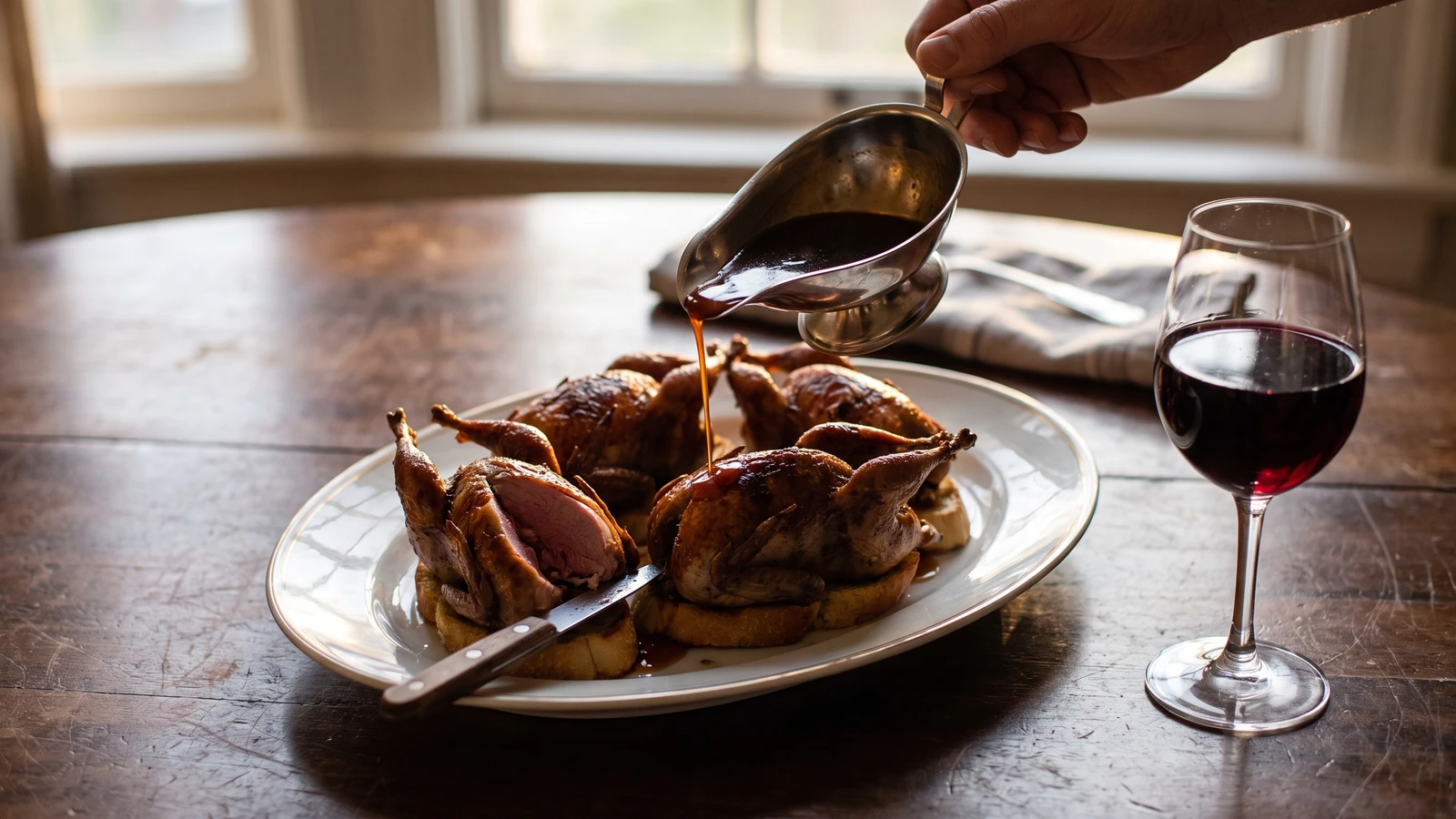
Woodcock holds its fumet where grouse fades. Buy the birds properly matured, roast them pink, then catch every browned drop in a butter-mounted pan jus.
Bécasse et bécassines (woodcock and snipe) teach the strictest lesson in roasting: maturity and speed are one technique. Woodcock's fumet, the concentrated essence extracted from game, persists where grouse's fades, yet the bird gives its full character only when professionally matured to what the game larder calls moderately high. Before you touch a pan, know the one true thing: roast a properly matured bird underdone, because an immature bird tastes timid and an overcooked one leaves its perfume in the oven.
The source entry offers a judgment rather than a formula. It gives no seasonings, sequence, or quantities to shrink, so the four-person scale follows classical portioning: one woodcock or two snipe each. A grand kitchen assumed a larder hand to judge the hanging, a saucier beside a stockpot that never went cold, and a salamander, the fierce overhead grill, waiting to bronze the skin. At home, a legal game source handles the aging, the roasting pan extracts its own fumet, and the broiler supplies the final breath of top heat. One cook, one stove, one evening.
The separate game essence and extra hands are brigade scaffolding; they can go. Proper maturity, barding, fierce heat, a rosy center, and a short rest are the dish, and they stay. Watch the breast, not the clock. Pulling each small bird at the right temperature is the step that matters most.
Woodcock and snipe belong to the French table of la chasse rather than to one provincial larder: bécasse comes from damp woodland coverts along migratory routes, while bécassine comes from Atlantic marshes and wet meadows. From hunters' kitchens the birds passed into bourgeois dining rooms and grand kitchens, where cooks prized their persistent fumet and often served them on canapés enriched with the chopped trail, the cleaned edible innards. In game language, moderately high means deliberately matured under controlled cold conditions until the aroma deepens, not spoiled; it is no license to hang wild birds casually in a home pantry.
Quantity
4 woodcock (about 2½ to 3 lb / 1.1 to 1.4 kg total) or 8 snipe (about 1½ to 2 lb / 700 to 900 g total)
professionally matured under refrigeration
Quantity
1¾ teaspoons (9 ml / 10 g)
Quantity
1 teaspoon (5 ml / 2 g)
Quantity
8 tablespoons (120 ml / 113 g)
divided
Quantity
8 thin slices (about 4 oz / 115 g)
Quantity
4 slices (about 5 oz / 140 g)
crusts removed
Quantity
4 woodcock sets or 8 snipe sets
kept refrigerated
Quantity
1 cup (240 ml / 240 g)
divided
| Ingredient | Quantity |
|---|---|
| oven-ready woodcock or snipeprofessionally matured under refrigeration | 4 woodcock (about 2½ to 3 lb / 1.1 to 1.4 kg total) or 8 snipe (about 1½ to 2 lb / 700 to 900 g total) |
| fine sea salt | 1¾ teaspoons (9 ml / 10 g) |
| freshly ground black pepper | 1 teaspoon (5 ml / 2 g) |
| unsalted butterdivided | 8 tablespoons (120 ml / 113 g) |
| bardes de lard (thin unsmoked fatback slices) | 8 thin slices (about 4 oz / 115 g) |
| close-crumbed white breadcrusts removed | 4 slices (about 5 oz / 140 g) |
| cleaned livers and hearts from the birds (optional)kept refrigerated | 4 woodcock sets or 8 snipe sets |
| cold waterdivided | 1 cup (240 ml / 240 g) |
Examine every bird under good light. Remove pinfeathers and any visible shot with kitchen tweezers, trim away badly bloodshot tissue, and confirm that the cavities are clean. Do not rinse them; water spreads contamination and prevents browning. Pat the skin completely dry. Properly matured game smells deep, nutty, and unmistakably wild, but never sour, ammoniacal, or rotten.
Cut the bread into one canapé per woodcock or two smaller canapés per serving of snipe. Melt 2 tablespoons of the butter in a frying pan over medium heat and brown the bread patiently on both sides until crisp and deep gold. If using the cleaned organs, mince them finely. Melt 1 further tablespoon of butter, cook the hearts for 2 minutes, add the livers, and continue until no raw center remains and they reach 165°F (74°C); mash them with a pinch of the measured salt and pepper, then spread them thinly over the toast. If no organs were supplied, use that butter on the canapés instead.
Set a rack in the upper third of the oven and heat it to 475°F (245°C), placing a heavy ovenproof skillet inside for 10 minutes. Season the birds inside and out, rub them with 3 tablespoons of softened butter, and tie the legs neatly against the body. Barder means wrapping lean meat with fat: lay 2 bardes de lard across each woodcock breast or 1 across each snipe, securing them with twine. The fat protects these small, lean breasts during the first fierce minutes without burying their fumet under smoke or spice.
Set the birds breast-up in the hot skillet with space between them. Roast woodcock for 8 minutes or snipe for 4 minutes. Remove the bardes de lard, baste thoroughly with the butter and rendered fat, then roast woodcock for another 4 to 6 minutes or snipe for another 2 to 4 minutes. The classical endpoint is rosé, pink at the breast. Where local guidance and carefully controlled provenance permit pink service, remove the birds when the breast reaches 140°F (60°C), allowing the rest to carry it toward 145°F (63°C). Food-safety guidance commonly calls for 165°F (74°C) for game birds; use that endpoint for pregnant, elderly, very young, or immunocompromised guests, and whenever provenance or cold-chain handling is uncertain.
Place each woodcock on a whole canapé, or arrange 2 snipe over the smaller canapés, and rest them uncovered for 7 to 8 minutes. The bread catches the butter and game juices while the breast relaxes. Do not wrap the birds tightly in foil; trapped moisture softens the skin you worked to brown. Pour any juices that collect on the platter back into the roasting skillet.
Pour off loose fat from the roasting skillet, leaving the dark browned film and about 1 tablespoon of fat behind. Set the skillet over medium-high heat, add ¾ cup (180 ml / 180 g) of the cold water, and scrape until every browned speck dissolves. Boil briskly until reduced to about ⅓ cup (80 ml), then add the resting juices. Remove the pan from the heat and whisk in the final 2 tablespoons (30 ml / 28 g) of cold butter until the fumet becomes glossy and lightly thickened. If it tastes too fierce, loosen it with reserved water. If the butter separates, whisk in 1 tablespoon of cold water off the heat. Ça se rattrape.
Taste the fumet before adding any remaining salt. Spoon it over the breasts and around the canapés, leaving the toast edges crisp, and bring the birds to the table whole. Small game yields best to a sharp knife and clean fingers; ceremony is less useful than appetite here. À table!
1 serving (about 225g)
Culinary guides, cultural storytelling, and the editorial depth that makes cooking meaningful.
Discover Culinary ExplorerChef Juliette
John Dory has the delicacy of sole and the firmness of turbot. A light flouring, a quick butter sauté, and nut-brown beurre noisette show exactly why looks never mattered.

Chef Juliette
Fresh haddock proves its delicacy in the meunière pan: a fine flour crust, moist pearly flakes, and beurre noisette sharpened with lemon and parsley, ready from one skillet in half an hour.

Chef Juliette
Éperlans à l’Anglaise turns small fish into a lesson in disciplined coating: boned smelts under a close, crisp crumb, pan-fried in clarified butter and finished with bright, half-melted maître d’hôtel butter.

Chef Juliette
Tiny smelts, shallot, mushrooms, white wine, gratin sauce, and fine bread raspings meet a fierce oven, where the fish must turn tender in the same breath the buttered crust bronzes.