Culinary Explorer

A cooking platform built around craft, culture, and the stories behind what we eat.
Discover Culinary Explorer
Timbale de Perdreau Diane

Timbale de Perdreau Diane

Created by Chef Juliette

Based on No. 1872, Timbale de Perdreau Diane, from Le Guide Culinaire (1907) by Auguste Escoffier

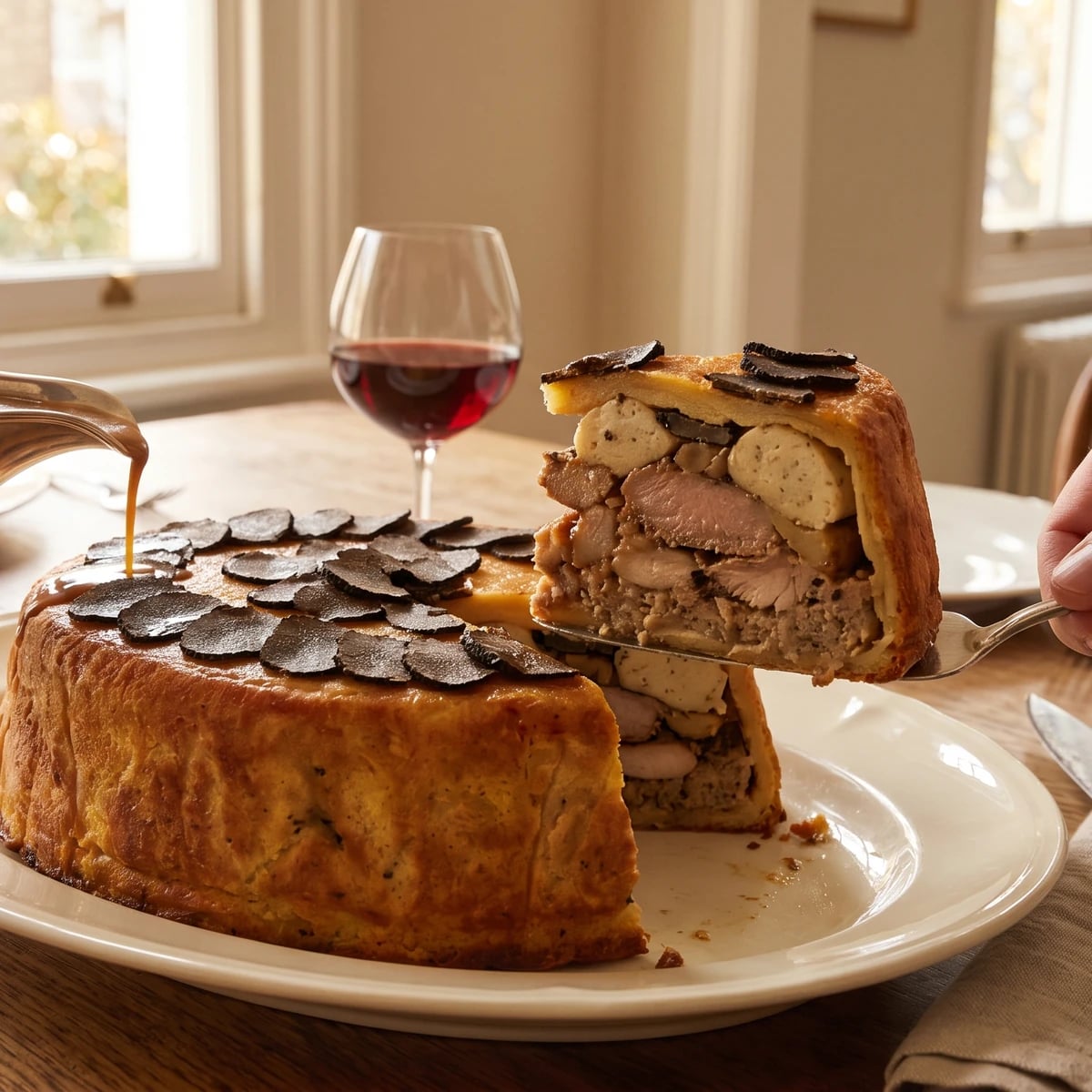
Truffle crescents reveal a silken partridge timbale filled with tiny quenelles, mushrooms, and Madeira-bound game, then crowned with freshly roasted suprêmes and ringed with glossy Diane sauce.

Main Dishes
French
Special Occasion
Celebration
Dinner Party
1 hr 30 min
Active Time
2 hr cook3 hr 30 min total
Yield4 servings

Timbale de Perdreau Diane (moulded partridge timbale with truffles and Diane sauce) teaches the discipline of gentle heat. Before you touch a pan, know this: the bain-marie, the hot-water bath, must barely shiver. A boil squeezes fat and juices from the forcemeat, then the shell weeps, shrinks, and may fall when unmoulded.

The original entry assumed a saucier on staff, game stock never off the fire, a roasting spit, and a kitchen where the salamander stood ready, even though this dish asks for the oven's gentlest heat rather than its fiercest. Your home equivalent is one reduced game-and-Madeira foundation divided in two: one part binds the quenelles, while the other becomes Diane sauce with cream, truffle juice, and butter. A conventional oven supplies both the gentle poach and the fresh roast for the suprêmes, the breast fillets. One cook, one stove, one evening.

The brigade's separate sauce stations and service choreography are scaffolding, so they go. The truffle-lined mould, raw partridge forcemeat, layer of game gratin forcemeat from Gratins (No. 268), small truffled quenelles, and crown of freshly roasted suprêmes are the dish, so they stay. Keep the paste cold, then keep the water calm. That is the work that matters most.

Timbale de Perdreau Diane belongs to the Parisian classical game table, where the name Diane, the huntress, signals a preparation of game, truffles, and a rich accompanying sauce. Here timbale names the moulded form rather than a pastry case: partridge appears first as a truffle-scaled poached forcemeat, then again as roast breast suprêmes arranged in a crown. The dish passed into bourgeoise celebration cooking by keeping that contrast of smooth forcemeat and freshly roasted game, even when a household had one oven instead of a brigade.

The technique, the tradition, and the story behind every dish.

Discover Culinary Explorer

Ingredients

skin-on partridge breast suprêmes

Quantity

8 (about 1¼ pounds / 560 g)

chilled

boneless, skinless partridge meat for the lining forcemeat

Quantity

1 pound 2 ounces (500 g)

kept very cold

boneless, skinless partridge meat for the truffled quenelles

Quantity

7 ounces (200 g)

kept very cold

partridge carcasses

Quantity

2 (about 1 pound / 450 g)

chopped

unsalted butter

Quantity

9 tablespoons (135 ml / 128 g)

divided

shallots

Quantity

2 medium (about ½ cup / 120 ml / 80 g)

thinly sliced

dry Madeira

Quantity

1½ cups (360 ml / 350 g)

unsalted game stock or dark chicken stock

Quantity

4 cups (960 ml / 960 g)

very cold heavy cream for the forcemeats

Quantity

1½ cups (360 ml / 360 g)

divided

heavy cream for the Diane sauce

Quantity

½ cup (120 ml / 120 g)

large egg whites

Quantity

4 (about ½ cup / 120 ml / 120 g)

divided

preserved black truffles

Quantity

4 whole (about 4 ounces / 115 g)

drained; 55 g cut into crescents, 15 g minced, 30 g sliced, and 15 g julienned; juice reserved

reserved truffle juice

Quantity

2 tablespoons (30 ml / 30 g)

fine sea salt

Quantity

4½ teaspoons (22 ml / 27 g)

divided

ground white pepper

Quantity

1 teaspoon (5 ml / 2 g)

divided

prepared game gratin forcemeat from Gratins (No. 268)

Quantity

½ cup (120 ml / 115 g)

small button mushrooms

Quantity

1½ cups (360 ml / 170 g)

quartered

Equipment Needed

  • Food processor with metal blade
  • 6½-inch (16 cm) shallow metal timbale or charlotte mould, about 6 cups (1.5 litres)
  • Deep roasting pan for the bain-marie
  • Heavy saucepan and fine-mesh sieve
  • Large ovenproof frying pan
  • Instant-read thermometer
  • Small offset spatula and two teaspoons

Instructions

  1. 1

    Build Madeira reduction

    Melt 1 tablespoon of the butter in a heavy saucepan over medium heat. Add the chopped partridge carcasses and brown them deeply on every side, leaving a dark glaze across the pan floor without letting it burn. Add the shallots and cook until softened. Pour in the Madeira, scrape up the fond, and reduce until only one-quarter remains. Add the stock and simmer uncovered until reduced to exactly 2 cups (480 ml). Strain through a fine sieve and skim away the fat. If it has reduced too far, add enough hot stock to restore the measure. Ça se rattrape.

  2. 2

    Make cold forcemeats

    Chill the food processor bowl and blade for 15 minutes. For the lining forcemeat, process the 500 g portion of partridge with 3 egg whites, 2 teaspoons of the salt, and ½ teaspoon of the white pepper until smooth and tacky. With the motor running, add 1 cup (240 ml) of the cold cream gradually. Scrape into a chilled bowl. Make the quenelle forcemeat with the remaining 200 g partridge, 1 egg white, ¾ teaspoon salt, ¼ teaspoon white pepper, and 6 tablespoons (90 ml) cream, then fold in the minced truffle. Reserve the final 2 tablespoons (30 ml) cream. Poach a teaspoon of each mixture in barely trembling water and taste it. Adjust the seasoning now. If either paste turns glossy with loose fat, stop and chill it over ice, then beat in a spoonful of the reserved cold cream. Ça se rattrape. Cover both forcemeats and keep them cold.

    Cold is structure. Warm meat smears its fat instead of holding it, and no amount of vigorous processing will repair a paste that has been allowed to heat.
  3. 3

    Line and pre-poach

    Heat the oven to 300°F (150°C). Coat a 6½-inch (16 cm) shallow metal timbale mould liberally with 2 tablespoons butter. Arrange the truffle crescents over the bottom and sides in overlapping rows, pressing them into the butter so they hold. Chill for 10 minutes. Reserve about ¾ cup of the lining forcemeat for the lid, then press the rest over the bottom and sides in an even layer ⅔ inch (1.7 cm) thick, removing every air pocket. Set the mould in a deep roasting pan and add hot water to reach halfway up its sides. Poach for 12 to 15 minutes, until the exposed forcemeat is just set and remains pale.

  4. 4

    Add gratin layer

    Lift the mould from the bain-marie and keep the water hot. Spread the prepared game gratin forcemeat from Gratins (No. 268) in a thin, complete layer over the pre-poached lining, using a damp offset spatula to keep it even. This layer brings the browned depth of game beneath the gentler raw forcemeat, so carry it across both the bottom and sides.

  5. 5

    Prepare filling garnish

    Bring a wide saucepan of salted water to the barest tremble. Shape the truffled forcemeat between two teaspoons into small quenelles about 1 inch (2.5 cm) long. Poach them in batches for 4 to 5 minutes, until firm and cooked through, then drain carefully. Melt 1 tablespoon butter in a frying pan and sauté the mushrooms until their moisture has gone and their edges are bronze. Combine the quenelles, mushrooms, sliced truffles, and ½ cup (120 ml) of the reduced Madeira sauce. The sauce should coat the garnish without pooling. If it is loose, reduce it separately for another minute; if it tightens too far, loosen it with a spoonful of stock.

  6. 6

    Fill and seal

    Spoon the bound garnish into the lined mould, settling it gently without crushing the quenelles. Leave about ⅜ inch (1 cm) at the top. Spread the reserved raw forcemeat over the filling in a thin coat, joining it firmly to the lining around the edge so the timbale is completely sealed. Smooth the surface with a damp spatula.

  7. 7

    Poach in bain-marie

    Return the mould to the bain-marie, with the water still reaching halfway up its sides. Poach at 300°F (150°C) for 30 to 35 minutes, exactly until the centre reaches 165°F (74°C). The water must barely shiver. If bubbles begin breaking hard against the mould, remove the roasting pan, replace a cup of the hot water with cool water, and lower the oven to 285°F (140°C). A few beads of fat are a warning, not a verdict; calm the bath and continue gently. Let the cooked timbale rest in its mould for 10 minutes.

  8. 8

    Finish Diane sauce

    While the timbale rests, place the remaining 1½ cups (360 ml) Madeira reduction in a clean saucepan. Add the ½ cup cream, reserved truffle juice, and julienned truffle. Simmer gently until the Diane sauce again measures about 1½ cups and naps the back of a spoon. Remove it from the heat and whisk in 3 tablespoons cold butter, one piece at a time. If the sauce looks oily, whisk in a tablespoon of cold stock off the heat, then resume adding the butter slowly. Keep it warm without letting it boil.

  9. 9

    Roast the suprêmes

    Raise the oven to 425°F (220°C). Dry the suprêmes carefully and season them with the remaining salt and white pepper. Melt the final 2 tablespoons butter in a large ovenproof frying pan. Brown the breasts skin-side down for 2 to 3 minutes, until the skin is deep gold, then turn them for 30 seconds. Transfer the pan to the oven for 4 to 6 minutes, until the thickest breast reaches 160°F (71°C). Rest for 5 minutes and verify that carryover heat has brought them to 165°F (74°C); if not, return them to the oven briefly.

  10. 10

    Unmould and crown

    Place a warmed serving platter over the mould and invert both decisively. Lift the mould straight upward. If the timbale clings, lay a hot damp towel over the mould for 30 seconds, then try again; do not scrape around the patterned sides. Arrange the freshly roasted suprêmes in a crown over the timbale. Spoon a narrow thread of Diane sauce around its base and send the rest in a warmed sauceboat. Cut generous wedges at the table. À table!

Chef Tips

  • Ask a game butcher for eight skin-on suprêmes, 700 g of boneless partridge trim, and two carcasses. If buying whole birds, six medium partridges usually provide what you need, but have the butcher weigh the trim after removing the breasts.
  • Good preserved whole black truffles are the classical pantry's honest answer outside the fresh season. Buy them whole so the crescents remain visible after unmoulding, and keep their juice for the Diane sauce.
  • Always test-poach both forcemeats before lining the mould. It checks seasoning, but it also exposes a loose or grainy texture while there is still time to chill and correct the mixture.
  • Metal conducts the bain-marie's heat evenly and releases more cleanly than ceramic. Measure the mould before beginning; a shallow 6-cup (1.5-litre) mould gives the proper balance of shell, filling, and roast crown.
  • A mature red Burgundy suits the earthiness of partridge, mushroom, Madeira, and truffle without overwhelming the forcemeat.
  • Refrigerate leftovers within two hours and keep them for no more than two days. Reheat covered in a gentle bain-marie until the centre reaches 165°F (74°C), warming the sauce separately.

Advance Preparation

  • The Madeira reduction can be prepared up to two days ahead. Cool it quickly, cover, and refrigerate; reheat before dividing it between the filling and Diane sauce.
  • Prepare the game gratin forcemeat from Gratins (No. 268) a day ahead and keep it covered in the cold.
  • Both raw forcemeats may be made and test-poached up to six hours before assembly. Keep them tightly covered and properly chilled.
  • The timbale may be filled and sealed up to four hours before poaching. Refrigerate it in the mould, then begin the bain-marie shortly before the meal so the roast suprêmes can crown it fresh from the oven.

Frequently Asked Questions

Nutrition Information

1 serving (about 590g)

Calories
1190 calories
Total Fat
83 g
Saturated Fat
47 g
Trans Fat
2 g
Unsaturated Fat
34 g
Cholesterol
520 mg
Sodium
3200 mg
Total Carbohydrates
13 g
Dietary Fiber
3 g
Sugars
8 g
Protein
98 g

Note: Chef personas and recipes are created with AI assistance. Cook with care: follow safe food-handling practices, check doneness with a thermometer when needed, and adapt for allergies and your kitchen.

Where cooking meets culture.

Culinary guides, cultural storytelling, and the editorial depth that makes cooking meaningful.

Discover Culinary Explorer

More from Poultry (Volaille) - Partridge (Perdrix et Perdreaux)

Browse the full collection