
Chef Juliette
John Dory (St. Pierre)
John Dory has the delicacy of sole and the firmness of turbot. A light flouring, a quick butter sauté, and nut-brown beurre noisette show exactly why looks never mattered.
A cooking platform built around craft, culture, and the stories behind what we eat.
Created by Chef Juliette
Based on No. 1864, Perdreau à la Bourguignonne, from Le Guide Culinaire (1907) by Auguste Escoffier
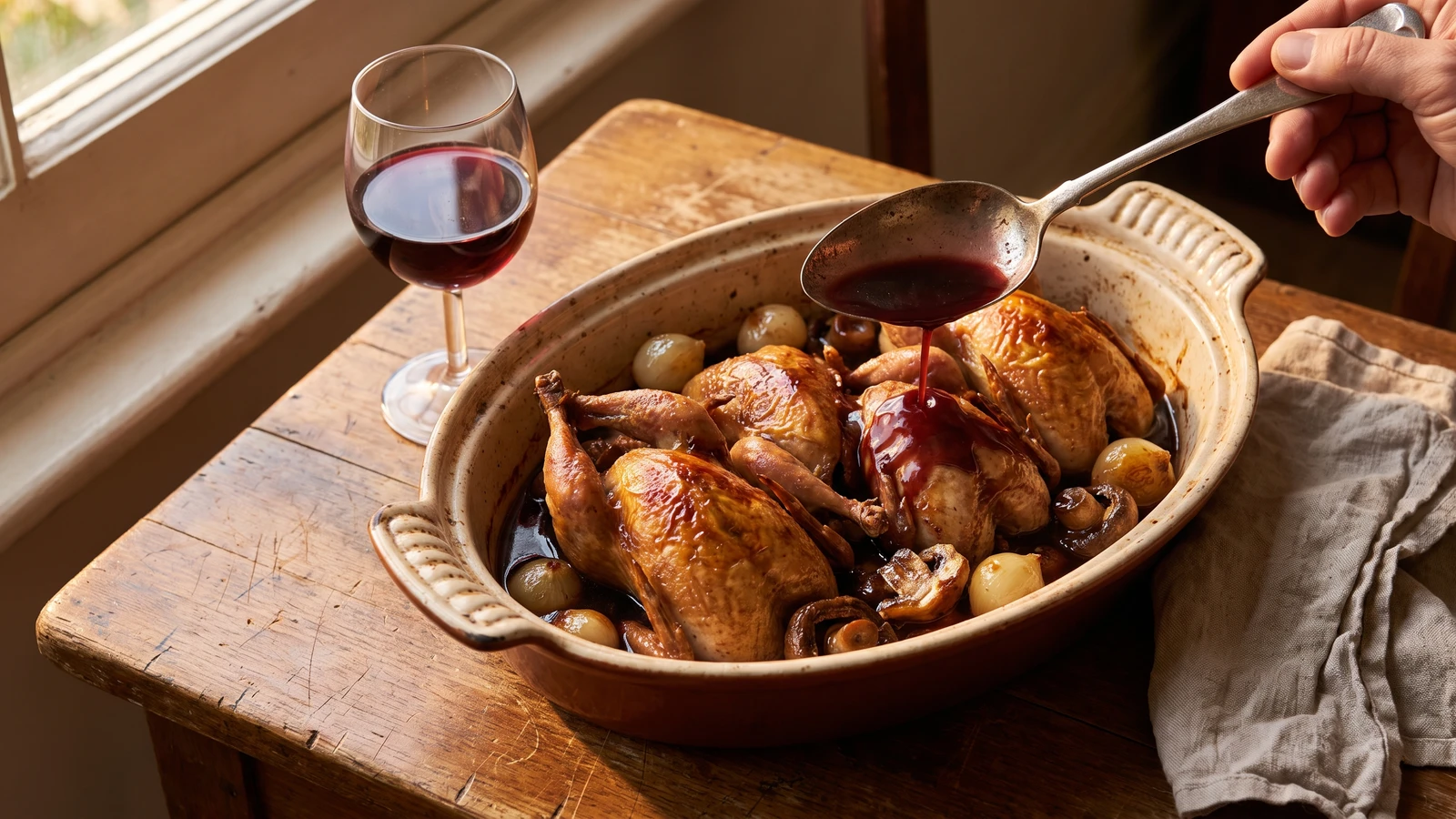
Young partridge cooked poêlé in butter, then finished with glazed onions, mushroom caps, and red Burgundy reduced into game half-glaze: a compact lesson in preserving delicacy while building a wine-dark sauce.
Perdreau à la Bourguignonne (young partridge in the Burgundy manner) teaches the clean border between poêlé, a covered butter-roast, and a braise. The bird cooks in butter beneath a lid before wine ever touches it. Moisten too early and you haven't simplified the work, you've changed the dish. That is the one true thing to know before touching the pan.
The book assumed a saucier on staff, game stock never off the fire for the half-glaze, cooked mushroom heads and glazed onions waiting to be counted out, and a proper terrine beside the poêling pan. At home, prepared game half-glaze, a fine-mesh sieve, and a shallow covered casserole take those jobs. The singular entry becomes four birds, while its ratio stays exact: six onions, six mushroom caps, one glass of red wine, and one spoonful of half-glaze for each. Ready-made garnishes were brigade scaffolding; cooking the onions and mushrooms in sequence is the honest home equivalent. Poëlings (No. 250), the two-thirds wine reduction, and the seven-to-eight-minute finish are the dish itself and remain untouched. One cook, one stove, one evening.
The reward is a burnished bird surrounded by pearl onions and mushroom caps, its sauce garnet, glossy, and just thick enough to cling. Watch the wine reduction above all. Stop when only one-third remains, because that is where Burgundy turns from raw wine into sauce.
À la Bourguignonne in the classical repertoire names a Burgundy manner more than a single village recipe: red wine, small onions, mushrooms, and a concentrated meat or game sauce. Here partridge is first cooked poêlé and only then meets the wine sauce, so the dish is not a red-wine braise despite its garnish. Grand kitchens held the onions, mushrooms, and game half-glaze ready beside the pan; the home cook preserves the same sequence by preparing the garnish first and reducing the bird's deglazing wine hard.
Quantity
4, 12 to 14 ounces (340 to 400 g) each, for Poëlings (No. 250)
Quantity
24 (about 10 ounces / 285 g)
peeled
Quantity
24 (about 8 ounces / 225 g)
wiped clean, stems removed
Quantity
2 tablespoons (30 ml / 28 g)
divided
Quantity
1/2 cup (120 ml / 120 g)
Quantity
1 teaspoon (5 ml / 4 g)
Quantity
1 1/2 teaspoons (7.5 ml / 9 g)
divided
Quantity
3/4 teaspoon (3.75 ml / 1.5 g)
Quantity
2 cups (480 ml / 480 g)
Quantity
1/4 cup (60 ml / 65 g)
preferably unsalted
| Ingredient | Quantity |
|---|---|
| oven-ready young partridges | 4, 12 to 14 ounces (340 to 400 g) each, for Poëlings (No. 250) |
| small pearl onionspeeled | 24 (about 10 ounces / 285 g) |
| small button mushroom capswiped clean, stems removed | 24 (about 8 ounces / 225 g) |
| unsalted butterdivided | 2 tablespoons (30 ml / 28 g) |
| water | 1/2 cup (120 ml / 120 g) |
| granulated sugar | 1 teaspoon (5 ml / 4 g) |
| fine sea saltdivided | 1 1/2 teaspoons (7.5 ml / 9 g) |
| freshly ground black pepper | 3/4 teaspoon (3.75 ml / 1.5 g) |
| dry red Burgundy wine | 2 cups (480 ml / 480 g) |
| prepared game half-glazepreferably unsalted | 1/4 cup (60 ml / 65 g) |
Put the pearl onions in a wide skillet with 1 tablespoon (15 ml / 14 g) of the butter, the water, the sugar, and a pinch of the measured salt. Cover and simmer gently for 8 to 10 minutes, until a small knife enters with only slight resistance. Uncover and roll the onions through the pan as the water evaporates, letting the butter and sugar leave them pale gold and glossy. If the sugar catches before the onions are tender, add 2 tablespoons (30 ml / 30 g) water, cover again, and finish them gently. Reserve the onions.
Melt the remaining 1 tablespoon (15 ml / 14 g) butter over medium-high heat. Add the mushroom caps in one layer, rounded sides down, and let them take colour before turning them. Season with another pinch of salt and cook until tender but still plump, about 5 minutes. If they shed water, raise the heat and let that liquid evaporate in the pan; draining it throws away their flavour. Reserve with the onions.
Pat the partridges dry, tuck the wing tips beneath the backs, and tie the legs close to the bodies with kitchen twine. Season inside and out with the remaining salt and the pepper. Cook the birds to three-quarters doneness according to Poëlings (No. 250), stopping while the breasts still yield beneath a finger and register about 140 to 145°F (60 to 63°C) at their thickest point. Move directly to the finish, because partly cooked game must never be cooled or held for later.
Transfer the three-quarters-cooked partridges to a shallow 4-quart covered casserole or terrine, breast sides up. Arrange exactly six glazed onions and six cooked mushroom caps around each bird. Cover loosely while you make the sauce, keeping the waiting time short.
Pour the red Burgundy into the partridge's poêling pan and bring it to a lively boil, scraping every browned trace from the bottom. Reduce by two-thirds, until about 2/3 cup (160 ml / 160 g) remains and the raw smell of wine has softened into something dark and rounded. Stir in the game half-glaze and simmer for 2 minutes. If the reduction races past its mark and turns syrupy, take it off the heat and whisk in hot water 1 tablespoon (15 ml / 15 g) at a time. Ça se rattrape.
Strain the sauce through a fine-mesh sieve into a small saucepan or heatproof jug. Let it stand for a minute, then skim away the butter and grease that rise to the surface. The sauce should pour freely while coating a spoon with a thin garnet glaze. Taste before adding any salt, because prepared half-glaze can carry plenty of its own.
Pour the sauce over and around the partridges, cover the casserole, and return it to a 375°F (190°C) oven for 7 to 8 minutes. The sauce should barely tremble at the edge, never boil hard. Check the thickest part of each bird without touching bone; it must reach 165°F (74°C). If necessary, continue in 2-minute intervals so the lean breast doesn't spend one moment longer in the oven than it needs.
Rest the covered birds for 5 minutes. If the sauce looks thin, lift the partridges and garnish out, reduce the sauce briefly on the stove, then return everything to the terrine; if it has tightened, loosen it with a spoonful of hot water. Serve one whole partridge per person with six onions, six mushroom caps, and a generous spoonful of the glossy sauce. À table!
1 serving (about 340g)
Culinary guides, cultural storytelling, and the editorial depth that makes cooking meaningful.
Discover Culinary ExplorerChef Juliette
John Dory has the delicacy of sole and the firmness of turbot. A light flouring, a quick butter sauté, and nut-brown beurre noisette show exactly why looks never mattered.

Chef Juliette
Fresh haddock proves its delicacy in the meunière pan: a fine flour crust, moist pearly flakes, and beurre noisette sharpened with lemon and parsley, ready from one skillet in half an hour.

Chef Juliette
Éperlans à l’Anglaise turns small fish into a lesson in disciplined coating: boned smelts under a close, crisp crumb, pan-fried in clarified butter and finished with bright, half-melted maître d’hôtel butter.

Chef Juliette
Tiny smelts, shallot, mushrooms, white wine, gratin sauce, and fine bread raspings meet a fierce oven, where the fish must turn tender in the same breath the buttered crust bronzes.