
Chef Juliette
Selle de Chevreuil et Cuissot
Selle de Chevreuil et Cuissot teaches the discipline of game: strip every tendon, skip marinade for a young, well-hung joint, roast in butter, and stop before leanness turns to dryness.
A cooking platform built around craft, culture, and the stories behind what we eat.
Created by Chef Juliette
Based on No. 1854, Chaud-froid de Faisan à la Buloz, from Le Guide Culinaire (1907) by Auguste Escoffier
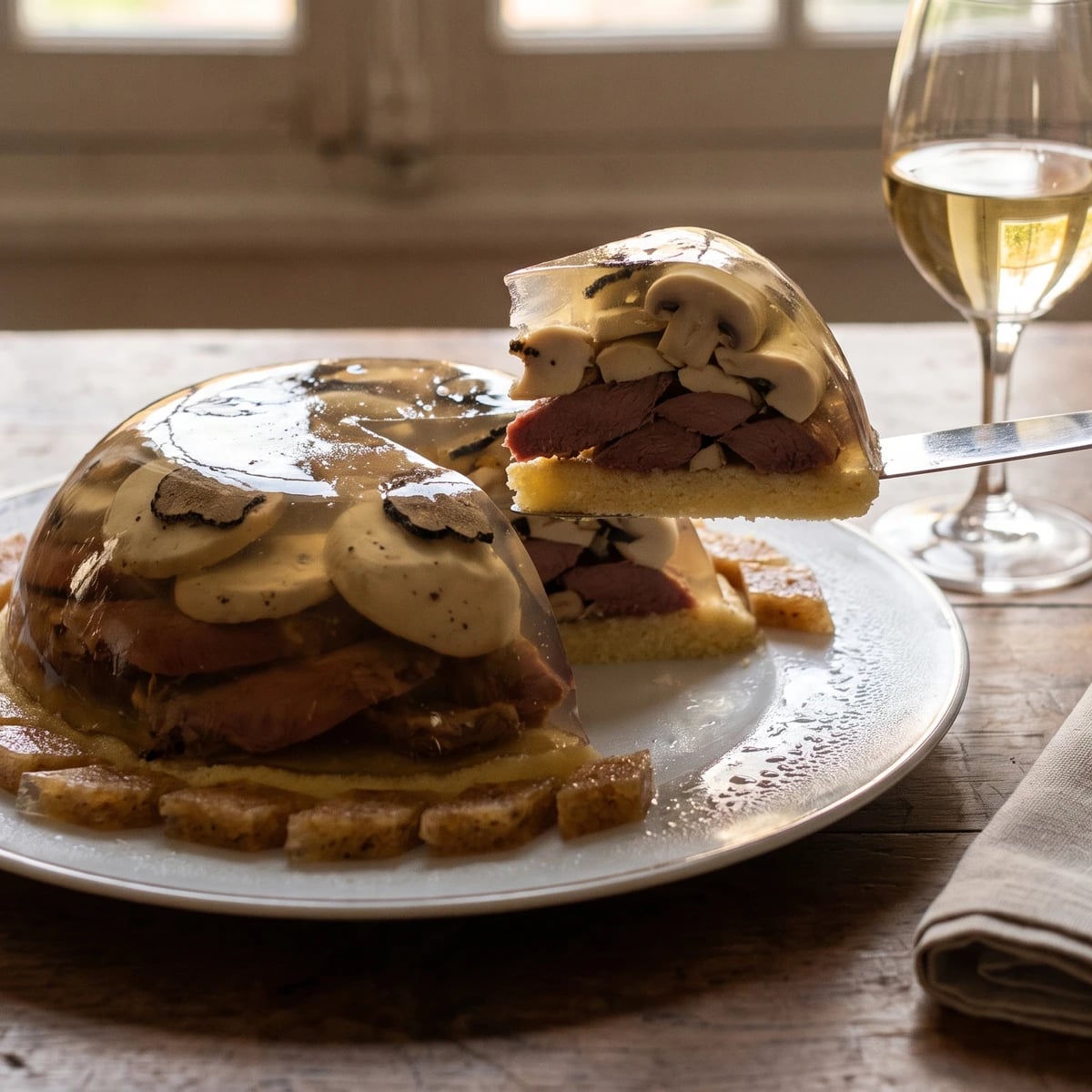
Brown-glazed pheasant suprêmes and ivory mushrooms alternate beneath a clear, truffle-set dome of aspic, a cold centerpiece whose elegance depends on temperature, not ornament alone.
Chaud-froid de Faisan à la Buloz (cold glazed pheasant in aspic) teaches one true thing before all others: temperature is an ingredient. The pheasant must be cool, the two sauces fluid enough to coat but cold enough to cling, and the aspic barely liquid when it enters the mould. Miss that narrow window and the pattern slides; meet it and brown-glazed suprêmes, ivory mushrooms, and black truffle appear suspended beneath a clear dome.
The original kitchen assumed a saucier on staff, a stock never off the fire, broken ice always within reach, and a garde-manger cook free to tend the mould. A salamander waited elsewhere on the line, but this cold dish asks nothing of it. At home, one concentrated pheasant fumet replaces the standing stockpot, a chilled tray replaces the ice bench, and the refrigerator does the waiting. One cook, one stove, one evening of work, then the cold finishes the job.
The brigade's endless bowls of ice and spare hands were scaffolding, so they can go. The poêlé pheasant, brown and white chaud-froid sauces, alternating arrangement, truffle, and clear aspic are the dish, so they stay. Before you touch the pan, clear a level shelf in the refrigerator and chill the mould; controlling the sauces at coating temperature is the step that decides everything.
Chaud-froid belongs to the formal cold service of Parisian grand kitchens, where cooked poultry and game were glazed with sauces strengthened by jelly, then arranged for the buffet without losing their character to the chill. Its name records the central contrast: the food is cooked hot, dressed cold, and protected beneath aspic. À la Buloz is one of the canon's personal honorifics rather than a regional style; the surviving formula is precise about pheasant, two colours of chaud-froid, truffle, and a dome, but leaves the dedicatee unexplained.
Quantity
2½ cups (600 ml / 600 g)
for the pheasant fumet
Quantity
4 cups (960 ml / 960 g), for moulding according to Another Method of Preparing Aspics de Filets de Soles (No. 916)
melted and divided
Quantity
10 mushrooms, about 8 ounces (225 g)
stems trimmed and caps grooved
Quantity
1 small truffle, about 1 ounce (28 g)
very thinly sliced
Quantity
5 tablespoons (75 ml / 70 g)
divided
Quantity
3 tablespoons (45 ml / 24 g)
divided
Quantity
½ cup (120 ml / 120 g)
Quantity
¾ cup (180 ml / 130 g)
Quantity
3 cups (720 ml / 720 g)
Quantity
Up to 2 teaspoons (10 ml / 12 g)
divided
Quantity
½ teaspoon (2.5 ml / 1 g)
Quantity
¼ teaspoon (1.25 ml / 0.5 g)
| Ingredient | Quantity |
|---|---|
| whole farmed pheasant | 1 whole pheasant, about 2½ pounds (1.1 kg), for Poëlings (No. 250), with the poëling liquor from Poëlings (No. 250) reserved |
| unsalted brown veal stock or strong chicken stockfor the pheasant fumet | 2½ cups (600 ml / 600 g) |
| well-seasoned clear chicken or game aspic jellymelted and divided | 4 cups (960 ml / 960 g), for moulding according to Another Method of Preparing Aspics de Filets de Soles (No. 916) |
| small button mushroomsstems trimmed and caps grooved | 10 mushrooms, about 8 ounces (225 g) |
| black trufflevery thinly sliced | 1 small truffle, about 1 ounce (28 g) |
| unsalted butterdivided | 5 tablespoons (75 ml / 70 g) |
| plain flourdivided | 3 tablespoons (45 ml / 24 g) |
| heavy cream | ½ cup (120 ml / 120 g) |
| fine semolina | ¾ cup (180 ml / 130 g) |
| water | 3 cups (720 ml / 720 g) |
| fine saltdivided | Up to 2 teaspoons (10 ml / 12 g) |
| freshly ground black pepper | ½ teaspoon (2.5 ml / 1 g) |
| ground white pepper | ¼ teaspoon (1.25 ml / 0.5 g) |
Chill a 1-quart (950 ml) dome mould, a rimmed metal tray, and two parchment-lined plates. Keep the melted aspic fluid but cool, about 75°F (24°C), and place a small saucer in the refrigerator for testing the sauces. The mould must be cold and completely dry, because water trapped against the metal weakens the first layer of jelly.
Prepare the pheasant according to Poëlings (No. 250), and reserve every spoonful of the aromatic poëling liquor produced by Poëlings (No. 250). The source asks for the bird underdone; at home, keep its moisture without compromising safety by cooking until the thickest breast reaches 160°F (71°C), then rest it covered until the thermometer registers 165°F (74°C). Let it stand for 10 minutes before carving.
Lift off the suprêmes, the breast fillets, and remove their skin. Slice each across the grain into thin collops about ¼ inch (6 mm) thick, keeping the pieces broad and intact, then chill them on one prepared plate. Chop the carcass and legs, place them in the poëling pan with the reserved liquor and the stock, and simmer gently for 25 to 30 minutes. Strain and degrease this fumet, a concentrated game essence, then reduce it if necessary to about 2¼ cups (540 ml). Keep it hot.
Melt 1½ tablespoons of the butter in a small saucepan, stir in 1½ tablespoons of the flour, and cook until the roux turns hazelnut brown and smells toasted. Gradually whisk in 1¼ cups (300 ml) of the fumet, then simmer until the sauce coats the back of a spoon. Remove it from the heat, whisk in ½ cup (120 ml) of the melted aspic, and season with black pepper and enough salt to taste clear and savoury when dabbed on the chilled saucer. Cool the sauce, stirring often, until it reaches about 86°F (30°C) and falls from the spoon in a thick ribbon. Coat every collop evenly and lay it on the chilled plate. If the glaze runs off, it is too warm; chill it for a few minutes. If it sets in ridges before you can spread it, warm the bowl briefly over warm water and whisk. Ça se rattrape.
Melt 1 tablespoon of the butter in a small pan. Add the grooved mushrooms and 2 tablespoons (30 ml) of fumet, cover, and cook gently for 5 to 7 minutes, just until tender and still pale. Drain and chill them. For the white chaud-froid, melt another 1½ tablespoons of butter, stir in the remaining 1½ tablespoons of flour, and cook for 1 minute without colouring. Whisk in ¾ cup (180 ml) fumet and the cream, then simmer gently until smooth and thick enough to coat a spoon. Remove from the heat, whisk in ½ cup (120 ml) aspic, and season with white pepper and salt. Cool to about 86°F (30°C), coat all ten mushrooms, and set them on the second chilled plate. Test and correct the consistency exactly as for the brown sauce.
Bring the water to a boil with 1 teaspoon of the salt. Rain in the semolina while whisking, then cook over low heat for 8 to 10 minutes, stirring until very thick and pulling cleanly from the pan. Beat in the remaining 1 tablespoon butter. Spread it immediately into a smooth disc about 8 inches (20 cm) wide and ¾ inch (2 cm) high in the centre of a round serving platter. Cover and chill until firm. Pour ¾ cup (180 ml) of the remaining aspic into a shallow dish to a depth of about ¼ inch (6 mm). Chill until fully set, then cut it into small diamonds. These are the aspic croûtons, cut pieces of jelly used to border the finished dish.
Clothe the chilled dome mould with clear aspic following Another Method of Preparing Aspics de Filets de Soles (No. 916): pour in enough cool liquid aspic to coat the interior, rotate the mould slowly over the chilled tray, and drain away the excess when an even layer about ⅛ inch (3 mm) thick has set. Fix the truffle slices to the base and sides with drops of aspic, arranging them simply enough that the pheasant remains visible. If the coating slides, the mould or jelly is too warm. Chill both for 5 minutes and repeat; the first layer must hold before anything heavier touches it.
Arrange the brown-coated pheasant collops and white-coated mushrooms alternately against the sides of the mould, keeping the presentation faces outward. After each row, spoon in a thin film of cool aspic and chill for 5 minutes to fix it before adding the next. Fill the centre with the remaining collops and mushrooms, preserving the alternation wherever it will show, then pour in enough aspic to fill every gap and cover the contents. If a piece begins to float, stop pouring, chill until fixed, and continue with the remaining jelly.
Cover the mould and refrigerate it on a level shelf for at least 4 hours, preferably overnight, until the aspic is firm through the centre. Do not freeze it. Freezing clouds the jelly, weakens its structure, and spoils the clean surface the dish depends upon.
Run the tip of a thin knife only around the top edge. Dip the mould in warm water for 3 to 5 seconds, dry it, and invert it directly onto the cold semolina cushion. If it does not release, return the mould upright and repeat for 2 seconds; too much warmth melts the outer glaze before the centre lets go. Border the cushion with the clear aspic croûtons and serve the chaud-froid well chilled, cutting through the dome with a thin, sharp knife. À table!
1 serving (about 725g)
Culinary guides, cultural storytelling, and the editorial depth that makes cooking meaningful.
Discover Culinary Explorer
Chef Juliette
Selle de Chevreuil et Cuissot teaches the discipline of game: strip every tendon, skip marinade for a young, well-hung joint, roast in butter, and stop before leanness turns to dryness.

Chef Juliette
A three-day marinade perfumes this lean saddle, but the roast lives or dies by its rosy center; the tray fond, cream, meat glaze, and one juniper berry make the sauce.

Chef Juliette
A butter-poêled venison saddle, carved rosy and flanked by unsweetened pears scented with cinnamon and lemon, with clear game jus and redcurrant jelly at the table.

Chef Juliette
Verjuice perfumes rather than pickles this saddle, while a thermometer protects its rosy centre. Poivrade and red-currant jelly meet in strict equality, with semi-candied cherries folded through for the generous game table.