Culinary Explorer

A cooking platform built around craft, culture, and the stories behind what we eat.
Discover Culinary Explorer
Faisan à la Régence

Faisan à la Régence

Created by Chef Juliette

Based on No. 1843, Faisan à la Régence, from Le Guide Culinaire (1907) by Auguste Escoffier

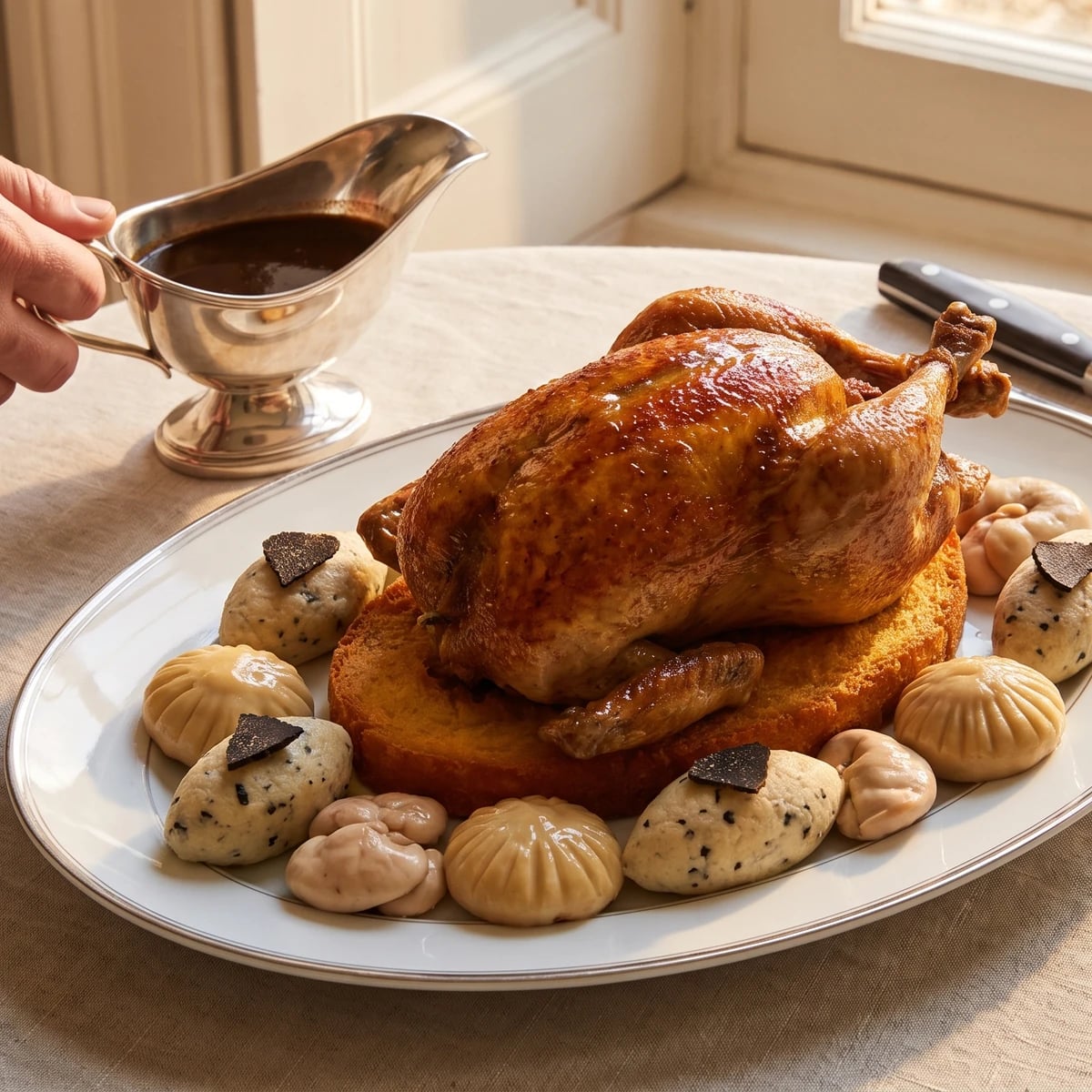
Faisan à la Régence brings the grand garnish home: a butter-poêled bird, delicate game quenelles, grooved mushrooms and cocks’ kidneys, with Salmis sauce gleaming beside it.

Main Dishes
French
Special Occasion
Celebration
Dinner Party
1 hr 15 min
Active Time
1 hr 30 min cook2 hr 45 min total
Yield4 servings

Faisan à la Régence (pheasant in the Régence style) teaches one true thing before you touch a pan: poêling, a covered butter-roast, is not braising. No stock touches the pheasant while it cooks. The bird concentrates in butter first, then the stock extracts those browned juices afterward for the Salmis, a reduced game sauce scented here with truffle essence.

The original assumed a saucier tending the reduction, brown stock never off the fire, and spare hands shaping game quenelles and grooving mushrooms. The larded wrapping and constant brigade basting were scaffolding; the covered-casserole method in Poëlings (No. 250), concentrated unsalted stock, and a food processor give one home cook the honest equivalents. A salamander adds nothing here because uncovering the casserole colors the bird. We keep the low croûton, the three alternating garnishes, and the separate sauceboat because those are the dish. One cook, one stove, one evening.

When it reaches the table, the pheasant should be burnished and upright on its butter-fried bread, surrounded by pale truffle-marked quenelles, glossy fluted mushrooms, and delicate cocks’ kidneys. The decisive step is this: do not moisten the pheasant as it cooks; stock enters only afterward, when it captures the butter-borne savor for the Salmis sauce.

Faisan à la Régence belongs to the formal Parisian game repertoire, and Régence is a service designation rather than a regional cooking style. Its alternating ring of quenelles, grooved mushrooms, and cocks’ kidneys displays the organized work of the grand kitchen, while the separate Salmis sauce carries the pheasant’s cooking juices back to the table. The garnish is not idle decoration: it supplies soft game, earthy mushroom, delicate offal, truffle, and butter-fried bread around a lean roasted bird.

The technique, the tradition, and the story behind every dish.

Discover Culinary Explorer

Ingredients

whole oven-ready pheasant

Quantity

1 bird, 2½ to 3 pounds (1.1 to 1.35 kg), prepared by Poëlings (No. 250), plus 1 cup (240 ml / 240 g) reserved poëling liquor

neck and wing tips reserved

boneless pheasant or partridge meat

Quantity

8 ounces (225 g)

kept cold, with all sinew removed

large egg white

Quantity

1

cold heavy cream

Quantity

½ cup (120 ml / 120 g)

fine sea salt

Quantity

2½ teaspoons (12 ml / 15 g), divided, plus more as needed

finely ground white pepper

Quantity

½ teaspoon (2.5 ml / 1 g), divided

preserved or fresh black truffle

Quantity

1 small truffle, about ½ ounce (15 g)

drained if preserved

natural black truffle juice or truffle essence

Quantity

1 tablespoon (15 ml / 15 g)

large white mushrooms

Quantity

8, about 12 ounces (340 g)

stems trimmed

cocks’ kidneys or prepared veal sweetbread

Quantity

8 cocks’ kidneys, about 3 ounces (85 g), or 3 ounces (85 g) veal sweetbread

kidneys cleaned, or sweetbread blanched, pressed, and cut into 8 ovals

unsliced pain de mie

Quantity

1 round, 7 inches wide and ¾ inch thick, about 4 ounces (115 g)

unsalted butter

Quantity

7 tablespoons (105 ml / 100 g), divided

small shallot

Quantity

1, about 1½ ounces (40 g)

finely sliced

plain flour

Quantity

1 tablespoon (15 ml / 8 g)

dry Madeira

Quantity

¾ cup (180 ml / 180 g)

rich unsalted brown game or chicken stock

Quantity

2½ cups (600 ml / 600 g), divided

fresh lemon juice

Quantity

1 tablespoon (15 ml / 15 g)

water for poaching

Quantity

2 quarts (1.9 L / 1.9 kg)

Equipment Needed

  • Heavy covered casserole, about 5 quarts
  • Food processor with metal blade
  • Instant-read thermometer
  • Small sharp paring knife or channel knife
  • Fine-mesh sieve
  • Wide shallow saucepan
  • Large warmed oval platter
  • Warmed sauceboat

Instructions

  1. 1

    Prepare the garnish

    Chill the food processor bowl and blade for 15 minutes, and keep the game meat, egg white, and cream cold. Cut 8 small diamonds or rounds from the truffle for decorating the quenelles, then mince the remaining truffle. Groove each mushroom cap by holding a small knife at a shallow angle and rotating the mushroom against it to cut evenly spaced curved channels; reserve every trimming for the sauce. Cut the pain de mie into a low, neat round large enough to support the pheasant.

  2. 2

    Make the quenelles

    Pulse the cold game meat with 1 teaspoon of the salt and half the white pepper until it becomes fine and tacky. Add the egg white and pulse until fully absorbed, then drizzle in the cream gradually, reserving 1 tablespoon, and stop as soon as the mixture is smooth. Fry or poach a teaspoonful, taste, and correct the seasoning. If the forcemeat looks grainy or oily, it has become warm. Stop immediately. Ça se rattrape: chill it for 15 minutes, then pulse briefly with the reserved cold cream until smooth again.

    Cold is the structure of a mousseline forcemeat. Warm meat releases its fat, and no amount of continued processing will bully it back into place.
  3. 3

    Poach the quenelles

    Bring the water to a bare tremble and season it lightly. Divide the forcemeat into 8 equal portions and shape them into small rounds with damp spoons, pressing one truffle decoration onto each. Lower them into the water and poach without boiling for 8 to 12 minutes, turning once, until gently firm and 165°F (74°C) at the center. Lift them out with a slotted spoon and hold covered. A hard boil makes them swell roughly and turn tough; if the water begins rolling, add a small glass of cold water and lower the heat.

  4. 4

    Build the Salmis base

    Melt 1 tablespoon of the butter in a small heavy saucepan and brown the pheasant neck and wing tips thoroughly. Add the shallot and mushroom trimmings, cooking until the shallot colors at its edges. Stir in the flour and cook it to a hazelnut brown, then add the Madeira in three additions, scraping the pan clean each time. Reduce by half, pour in 2 cups (480 ml / 480 g) of the stock, and simmer gently for 25 minutes. Strain through a fine sieve, pressing lightly, then reduce the liquid to about 1 cup (240 ml / 240 g). This is the small-batch Salmis foundation that replaces a saucier’s waiting game sauce.

  5. 5

    Poêle the pheasant

    Prepare the pheasant by Poëlings (No. 250), using a heavy covered casserole just large enough to hold it. Do not add stock or other liquid while the bird cooks; that distinction is the grammar of poêling, and adding liquid now turns the result into a braise. Uncover as the preparation directs so the skin takes an even burnished color, then cook until the thickest parts of the breast and thigh reach 165°F (74°C). Rest the bird, loosely covered, for 15 minutes, and reserve 1 cup (240 ml / 240 g) of the strained poëling liquor.

  6. 6

    Cook the mushrooms

    Melt 1 tablespoon of the butter in a wide pan. Add the grooved mushrooms, lemon juice, ¼ cup (60 ml / 60 g) of the stock, a pinch of salt, and a little white pepper. Cover and cook gently for 7 to 10 minutes, turning once, until tender but still shapely. Uncover and roll them through their reduced buttery glaze. Keep them covered and warm.

  7. 7

    Cook the kidneys

    Keep the poaching water below a boil and lower in the cocks’ kidneys. Poach gently until opaque, tender, and 165°F (74°C) at the center, about 5 to 7 minutes, then drain and roll them through 1 tablespoon of melted butter. If using sweetbread ovals, brown them gently in the same butter until golden on both sides. Cocks’ kidneys are the proper garnish; sweetbread is the honest home substitute when a poultry butcher cannot supply them, preserving the delicate offal note without pretending the change is invisible.

  8. 8

    Fry the croûton

    Melt 2 tablespoons of the butter in a skillet over medium heat and fry the pain de mie round until deep gold on both faces, adding the butter gradually so the bread absorbs it without scorching. This low croûton is a butter-fried pedestal, not a dry piece of toast; it supports the pheasant and catches every carving juice. Set it in the center of a warmed oval platter.

  9. 9

    Finish the Salmis

    Let the reserved poëling liquor settle, then skim away every visible bead of grease and strain it finely. Reduce it to ½ cup (120 ml / 120 g), combine it with the Salmis base, and simmer until the sauce coats the back of a spoon in a glossy film. Remove it from the heat, stir in the truffle juice or essence and minced truffle, then whisk in the remaining 2 tablespoons of cold butter a little at a time. If the butter separates into an oily rim, stop. Ça se rattrape: whisk 1 tablespoon of cold stock in a clean warm saucepan, then add the sauce gradually until it comes together. Taste for salt and white pepper, and transfer the Salmis sauce to a warmed sauceboat.

  10. 10

    Arrange the Régence

    Warm the quenelles, mushrooms, and kidneys together over very low heat with the remaining ¼ cup (60 ml / 60 g) stock, keeping the pan covered and never allowing it to boil. Set the rested pheasant upright on the croûton. Arrange the game quenelles, grooved mushrooms, and cocks’ kidneys alternately around it in a generous, even ring, with the truffle decorations facing upward. Bring the pheasant to the table whole and serve the truffle-scented Salmis sauce separately. À table!

Chef Tips

  • Choose a plump farmed hen pheasant if you have the option. It carries more fat than a hard-flown wild bird and tolerates roasting better; technique still comes first, so protect either one from overcooking.
  • Order cocks’ kidneys from a specialist poultry butcher and confirm that the term means rooster testicles, not renal kidneys. If they cannot be found, pressed veal sweetbread gives the closest delicate texture and pale appearance. Chicken liver is too dark and assertive for this garnish.
  • Use natural truffle juice from a jar of preserved black truffles when fresh truffle is beyond reach. Synthetic truffle oil overwhelms the pheasant and leaves the Salmis smelling louder than it tastes.
  • The grooving and alternating ring are deliberate, but they need not look machined. Even spacing matters more than identical shapes; cooking well is not cooking fancy.
  • Serve with a red Burgundy whose fruit has some restraint. The pheasant and truffle want perfume rather than weight, and the Madeira already supplies the sauce with sweetness and depth.
  • Refrigerate leftover pheasant and sauce separately within 2 hours. Keep them for up to 2 days, reheating the meat covered with a spoonful of stock and warming the sauce without boiling.

Advance Preparation

  • The game quenelles can be shaped and poached 1 day ahead. Chill them promptly in a covered container with a spoonful of their poaching liquid, then reheat gently during final assembly.
  • The Salmis foundation can be made 1 day ahead through straining and reduction. Add the poëling liquor, truffle essence, and finishing butter only shortly before serving.
  • The mushrooms may be grooved several hours ahead and kept covered with a damp towel. Clean the cocks’ kidneys the same day, or blanch and press the sweetbread 1 day ahead.
  • Do not fry the croûton in advance. Its crisp, butter-rich surface is lost under refrigeration, and this small last-minute job earns its place.

Frequently Asked Questions

Nutrition Information

1 serving (about 425g)

Calories
850 calories
Total Fat
53 g
Saturated Fat
26 g
Trans Fat
1 g
Unsaturated Fat
26 g
Cholesterol
365 mg
Sodium
1850 mg
Total Carbohydrates
24 g
Dietary Fiber
2 g
Sugars
7 g
Protein
68 g

Note: Chef personas and recipes are created with AI assistance. Cook with care: follow safe food-handling practices, check doneness with a thermometer when needed, and adapt for allergies and your kitchen.

Where cooking meets culture.

Culinary guides, cultural storytelling, and the editorial depth that makes cooking meaningful.

Discover Culinary Explorer

More from Poultry (Volaille) - Venison and Ground Game

Browse the full collection