
Chef Juliette
John Dory (St. Pierre)
John Dory has the delicacy of sole and the firmness of turbot. A light flouring, a quick butter sauté, and nut-brown beurre noisette show exactly why looks never mattered.
A cooking platform built around craft, culture, and the stories behind what we eat.
Created by Chef Juliette
Based on No. 1835, Faisan à la Choucroûte, from Le Guide Culinaire (1907) by Auguste Escoffier
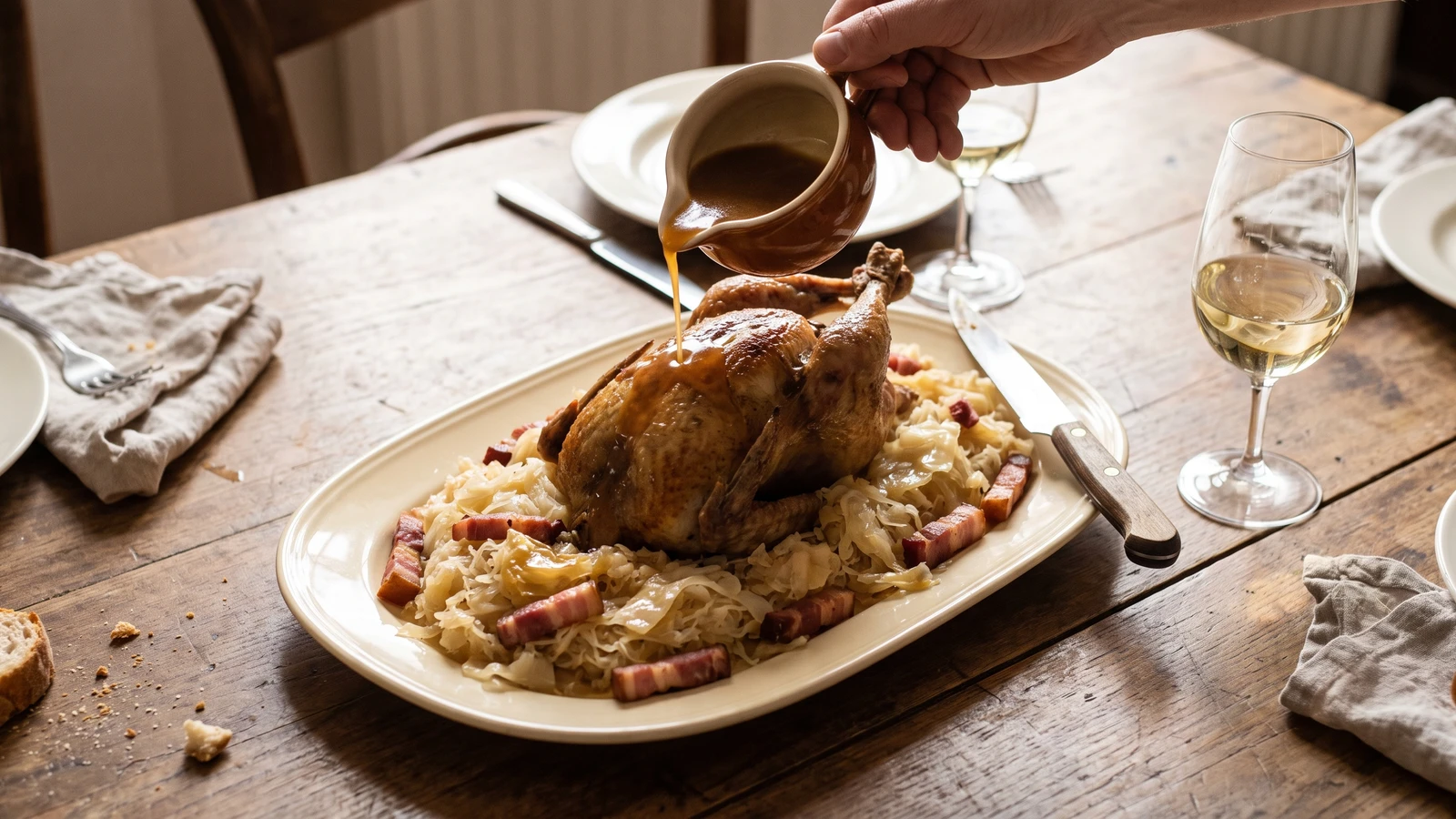
Faisan à la Choucroûte sets butter-poëled pheasant over foie-gras-enriched cabbage, then sends the strained cooking liquor apart, glossy and deliberately greasy, because restraint means stopping before the bird dries.
Faisan à la Choucroûte (pheasant over braised sauerkraut) teaches restraint before anything else: the bird must be only just cooked. The choucroûte can wait, the bacon can wait, and the liquor can be loosened, but pheasant breast gives you no second chance once it dries.
The formula assumes Sauerkraut (Choucroûte) (No. 2097) already braised, Poëlings (No. 250) organized at the proper scale, a game fumet stockpot never off the fire, and a saucier free to finish the liquor. Here, those referenced preparations are made ahead, the brigade quantity becomes one young pheasant for four, a snug cocotte replaces the deep poëling pan, and a fine-mesh sieve replaces the serviette. The equipment and volume have changed because one cook needs sensible work; the foie-gras fat, bacon border, butter-rich poëling, and frankly greasy liquor remain because they are the dish.
The banquet quantity and extra garnishes are scaffolding and can go. What stays is exact: drain the choucroûte well, keep the bird tender, and let the game-scented fat remain visible in the sauceboat. Begin checking the breast early. That moment, before the cook meets anything else, decides the whole platter.
Choucroûte belongs firmly to Alsace, where fermented cabbage became a sustaining household braise and, at generous tables, the foundation for pork, sausages, and cured meats. Faisan à la Choucroûte is the grand-kitchen branch of that practice: tender pheasant replaces the usual central garnish, while foie-gras fat carries the cabbage toward the game larder without confusing its Alsatian foundation. The poëling liquor is intentionally left somewhat greasy; its sheen is part of the formula, not careless saucemaking.
Quantity
1 bird, 2 1/2 to 3 pounds (1.1 to 1.4 kg)
giblets removed and skin thoroughly dried
Quantity
1 1/2 teaspoons (7.5 ml / 9 g)
Quantity
3/4 teaspoon (3.75 ml / 2 g)
Quantity
5 cups (1.2 L / 1.1 kg) Sauerkraut (Choucroûte) (No. 2097)
braised with 3 tablespoons (45 ml / 42 g) foie-gras fat; 8 cooked bacon rectangles (6 oz / 170 g) reserved
Quantity
1/2 cup (120 ml / 120 g)
| Ingredient | Quantity |
|---|---|
| young, tender oven-ready pheasantgiblets removed and skin thoroughly dried | 1 bird, 2 1/2 to 3 pounds (1.1 to 1.4 kg) |
| fine sea salt | 1 1/2 teaspoons (7.5 ml / 9 g) |
| freshly ground black pepper | 3/4 teaspoon (3.75 ml / 2 g) |
| prepared Sauerkraut (Choucroûte)braised with 3 tablespoons (45 ml / 42 g) foie-gras fat; 8 cooked bacon rectangles (6 oz / 170 g) reserved | 5 cups (1.2 L / 1.1 kg) Sauerkraut (Choucroûte) (No. 2097) |
| Poëlingsscaled for one pheasant | 1 home-scale preparation Poëlings (No. 250) |
| concentrated game fumet | 1/2 cup (120 ml / 120 g) |
Heat the oven to 350°F (180°C). Let the pheasant lose its refrigerator chill for 20 minutes, then dry it again. Bring the finished Sauerkraut (Choucroûte) (No. 2097) and the one-bird preparation of Poëlings (No. 250) to the stove. Keep the eight bacon rectangles from the choucroûte apart for the border; they are already cooked and need only warming.
Warm the Sauerkraut (Choucroûte) (No. 2097) gently in a covered saucepan for 15 to 20 minutes, stirring from the bottom, until the strands glisten with foie-gras fat and are hot throughout. Drain it thoroughly in a colander, then return it to the warm pan off the heat. If it still sheds liquid when pressed with a spoon, set it uncovered over low heat for two minutes and turn it gently. Ça se rattrape. The platter needs a succulent bed, not a puddle.
Season the pheasant inside and out with the salt and pepper, then apply Poëlings (No. 250) at one-bird scale in the snug cocotte. Begin checking after 25 minutes; a young bird commonly needs 30 to 40 minutes, but the thermometer governs. Remove it when the thigh reaches at least 165°F (74°C) and the thickest breast reaches 160 to 162°F (71 to 72°C), then rest it loosely covered for 10 minutes and verify that the breast reaches 165°F (74°C). If the breast is ready while the thighs lag, remove the breast halves and return the legs to the oven. Better a neatly reassembled bird than dry meat kept whole for ceremony.
At the liquor-finishing stage of Poëlings (No. 250), combine the poëling liquor with the game fumet. Let them simmer gently together for 10 minutes so the fumet draws the pheasant and vegetable savor from the cooking fat, then strain through a fine-mesh sieve into a warm sauceboat. Skim only any large, standing pool of fat. The liquor should remain glossy and somewhat greasy, exactly as the dish requires. If it reduces too fiercely or tastes too salty, loosen it one tablespoon of hot water at a time; the sauce is concentrated, not punitive.
Spread the well-drained Sauerkraut (Choucroûte) (No. 2097) along a warmed long platter. Set the rested pheasant on top and surround the cabbage with the warmed bacon rectangles, making a generous border rather than a fussy pattern. If the breasts were removed to protect them, slice them thickly and arrange them over the cabbage with the legs alongside. Send the poëling liquor apart so each person can spoon on its full, game-scented richness. À table!
1 serving (about 485g)
Culinary guides, cultural storytelling, and the editorial depth that makes cooking meaningful.
Discover Culinary ExplorerChef Juliette
John Dory has the delicacy of sole and the firmness of turbot. A light flouring, a quick butter sauté, and nut-brown beurre noisette show exactly why looks never mattered.

Chef Juliette
Fresh haddock proves its delicacy in the meunière pan: a fine flour crust, moist pearly flakes, and beurre noisette sharpened with lemon and parsley, ready from one skillet in half an hour.

Chef Juliette
Éperlans à l’Anglaise turns small fish into a lesson in disciplined coating: boned smelts under a close, crisp crumb, pan-fried in clarified butter and finished with bright, half-melted maître d’hôtel butter.

Chef Juliette
Tiny smelts, shallot, mushrooms, white wine, gratin sauce, and fine bread raspings meet a fierce oven, where the fish must turn tender in the same breath the buttered crust bronzes.