
Chef Juliette
John Dory (St. Pierre)
John Dory has the delicacy of sole and the firmness of turbot. A light flouring, a quick butter sauté, and nut-brown beurre noisette show exactly why looks never mattered.
A cooking platform built around craft, culture, and the stories behind what we eat.
Created by Chef Juliette
Based on No. 1827, Feathered Game, from Le Guide Culinaire (1907) by Auguste Escoffier
Ten classes, one governing rule: mature pheasant and woodcock under expert control, keep the other birds fresh, and never pierce a young bird with fat or pretend it will save an old one.
Gibier à plume, faisan rôti (feathered game, roast pheasant), teaches that maturity must suit the bird before heat ever touches it. Faisandage, the controlled maturation of game, suits the first and fourth classes, including pheasant, partridge, woodcock, and snipe. The other classes are cooked fresh, with aquatic birds guarded most firmly from becoming high. Misapply that rule and no sauce can give the bird back its own character.
The original entry is a classification, not a brigade formula. It assumes a game dealer able to judge the bird's age and hanging point, a cool larder with a moderate draught, and cooks who already know how to roast and turn the fond into jus. For tonight, two young pheasants stand in for brigade quantities, good unsalted stock replaces the stockpot never off the fire, and one roasting pan does the work a saucier might have finished separately. The larding needle and salamander go entirely: the first is expressly rejected because it veils young meat and cannot repair old, while the second is unnecessary when the birds are turned through a hot oven. One cook, one stove, one evening.
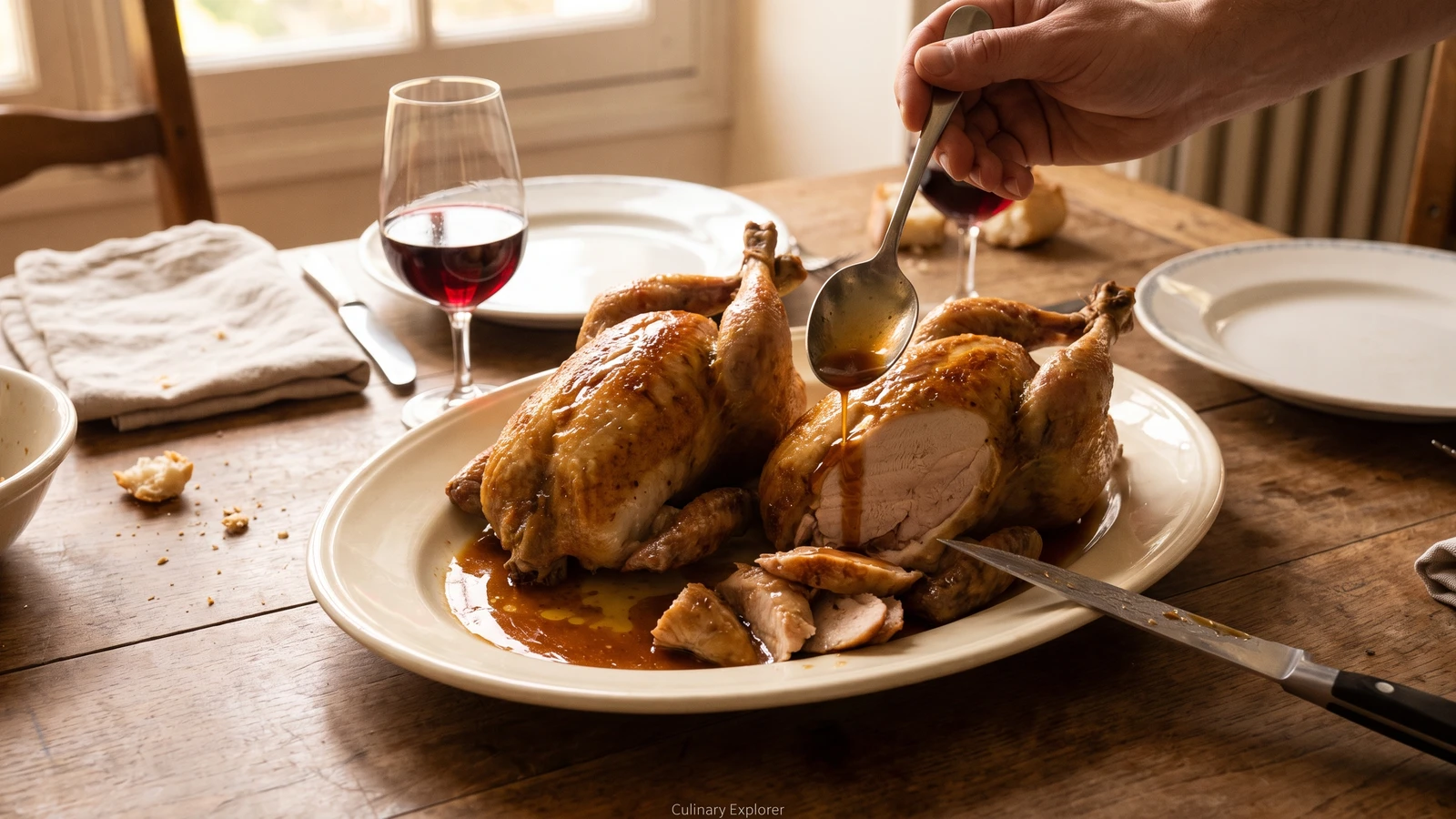
The roasting stays plain so the pheasant tastes of pheasant. Butter carries the browning, the pan fond builds the jus, and a final monter au beurre gives it gloss without weight. The step that matters most comes before the pan: choose a young bird whose maturation has been handled by a reputable game supplier, never improvised in a home larder.
Gibier à plume belongs to the French hunting table and the national classical kitchen rather than to one region, passing from field to game dealer and then into bourgeois dining rooms and formal service. Its ten culinary classes distinguish birds by how their flesh responds after the hunt: the first and fourth classes were allowed controlled maturation, while the remaining eight were prepared fresh, especially ducks, teal, and other aquatic birds. The canon also corrects a persistent misconception about larding, which masks a young bird's flavor and cannot restore tenderness or quality to an old one.
Quantity
2, about 1¼ to 1½ lb (570 to 680 g) each
sourced legally, professionally matured if wild, and patted dry
Quantity
2 teaspoons (10 ml / 12 g)
Quantity
1 teaspoon (5 ml / 2 g)
Quantity
5 tablespoons (75 ml / 71 g)
divided; melt 3 tablespoons and keep 2 tablespoons cold
Quantity
1, about 5 oz (140 g)
quartered
Quantity
1, about 4 oz (115 g)
cut into ¾-inch pieces
Quantity
4 sprigs
Quantity
1
Quantity
¾ cup (180 ml / 180 g)
Quantity
1½ cups (360 ml / 360 g)
Quantity
up to ¼ cup (60 ml / 60 g)
| Ingredient | Quantity |
|---|---|
| young, oven-ready pheasantssourced legally, professionally matured if wild, and patted dry | 2, about 1¼ to 1½ lb (570 to 680 g) each |
| fine sea salt | 2 teaspoons (10 ml / 12 g) |
| freshly ground black pepper | 1 teaspoon (5 ml / 2 g) |
| unsalted butterdivided; melt 3 tablespoons and keep 2 tablespoons cold | 5 tablespoons (75 ml / 71 g) |
| small yellow onionquartered | 1, about 5 oz (140 g) |
| medium carrotcut into ¾-inch pieces | 1, about 4 oz (115 g) |
| thyme | 4 sprigs |
| bay leaf | 1 |
| dry white wine | ¾ cup (180 ml / 180 g) |
| unsalted chicken stock | 1½ cups (360 ml / 360 g) |
| cold water (optional) | up to ¼ cup (60 ml / 60 g) |
Confirm that the pheasants are young, legally sourced, oven-ready, and professionally matured if they are wild. Do not begin faisandage at home; without a known handling history and precisely controlled cold storage, hanging is not a home-kitchen procedure. Run your fingers carefully over wild birds to find stray shot, remove any pinfeathers, and trim away badly bruised tissue. Dry the cavities and skin thoroughly.
Heat the oven to 450°F (230°C) with a rack in the middle. Combine the salt and pepper, reserving a small pinch for the jus, then season each pheasant inside and out. Leave the birds for 20 minutes while the oven heats, then tie the legs loosely together. Tight trussing slows the thighs; the twine should hold the shape without binding it like a parcel.
Scatter the onion, carrot, thyme, and bay leaf around a shallow heavy roasting pan. Rub the pheasants all over with the 3 tablespoons of melted butter and set them on one side. Roast for 10 minutes, baste, then turn onto the other side and roast for another 10 minutes. Turn them breast-side up, lower the oven to 400°F (200°C), baste again, and roast for 10 to 18 minutes more, until the thickest part of both breast and inner thigh reaches 165°F (74°C) without touching bone. If the breast becomes deeply bronze before the meat is ready, cover it loosely with a small piece of foil. If the fond threatens to blacken, pour a tablespoon or two of the measured water around the vegetables, never over the birds. Ça se rattrape while the fond is dark brown; once it burns, bitterness stays.
Transfer the pheasants to a warm platter, cover them loosely, and rest for 15 minutes. Spoon off excess fat from the roasting pan, leaving about 1 tablespoon with the mahogany fond. Set the pan over medium heat, add the wine, and scrape up the brown deposits while leaving any blackened specks behind. Reduce the wine to about ¼ cup, then add 1¼ cups of the stock and any juices collected beneath the birds. Simmer until roughly ¾ cup remains and the flavor is concentrated but not salty.
Strain the jus into a small saucepan, pressing the softened vegetables only if the fond remained clean. Taste it. If it is too strong or salty, add some of the reserved ¼ cup stock; if it is thin, reduce it a little longer. Take the pan off the heat and monter au beurre, whisking in the 2 tablespoons of cold butter a small piece at a time until the jus gleams and lightly coats a spoon. If it separates into greasy beads, whisk in 1 teaspoon of cold water. Ça se rattrape. Season with the reserved salt and pepper only if needed.
Remove the twine. Cut the legs cleanly through their joints, then follow the breastbone with a sharp knife and lift each breast away in one long piece. Give each guest one breast and one leg, spooning the glossy jus over the meat and allowing a little to pool beneath it. Serve at once. À table!
1 serving (about 225g)
Culinary guides, cultural storytelling, and the editorial depth that makes cooking meaningful.
Discover Culinary ExplorerChef Juliette
John Dory has the delicacy of sole and the firmness of turbot. A light flouring, a quick butter sauté, and nut-brown beurre noisette show exactly why looks never mattered.

Chef Juliette
Fresh haddock proves its delicacy in the meunière pan: a fine flour crust, moist pearly flakes, and beurre noisette sharpened with lemon and parsley, ready from one skillet in half an hour.

Chef Juliette
Éperlans à l’Anglaise turns small fish into a lesson in disciplined coating: boned smelts under a close, crisp crumb, pan-fried in clarified butter and finished with bright, half-melted maître d’hôtel butter.

Chef Juliette
Tiny smelts, shallot, mushrooms, white wine, gratin sauce, and fine bread raspings meet a fierce oven, where the fish must turn tender in the same breath the buttered crust bronzes.