
Chef Juliette
John Dory (St. Pierre)
John Dory has the delicacy of sole and the firmness of turbot. A light flouring, a quick butter sauté, and nut-brown beurre noisette show exactly why looks never mattered.
A cooking platform built around craft, culture, and the stories behind what we eat.
Created by Chef Juliette
Based on No. 1824, Pâté de Lièvre, from Le Guide Culinaire (1907) by Auguste Escoffier
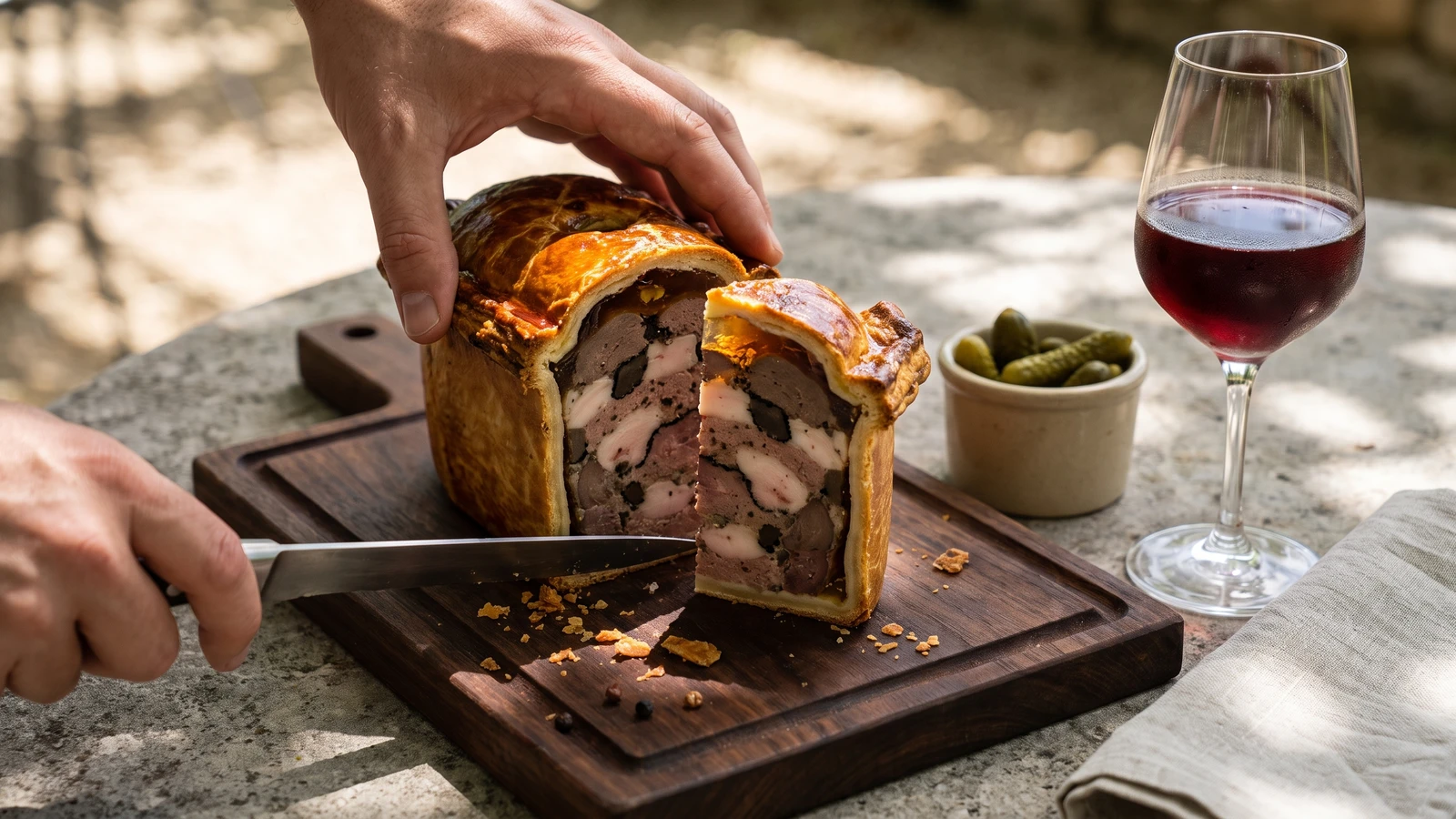
A burnished raised pie of brandied hare, truffle, and bacon, its blood-enriched forcemeat held in firm pastry and its cooling spaces filled with clear, savory hare jelly.
Pâté de Lièvre (raised hare pie) teaches the architecture of charcuterie: cold forcemeat binds, firm pastry contains it, and jelly occupies the space the meat leaves as it cooks. The one true thing to know before you touch a pan is this: keep the hare, pork, bowl, and blade cold. Warm fat smears instead of binding, and the slice crumbles where it should cut into a clean mosaic.
The source assumed a whole game larder, a larding needle, a tammy, a tall raised-pie mould, a saucier, and hare fumet ready from a stockpot that never went cold. At home, a narrow knife and skewer do the larding, a 6-inch springform replaces the mould, and a chilled food processor followed by a sturdy fine-mesh sieve replaces the brigade at the tammy. The book's ratios remain exact: six ounces of veal and pork and one and one-half pounds of fresh fatback for each pound of hare used in the forcemeat, followed by one egg and three tablespoons of brandy per pound of forcemeat. Only the quantity and equipment have changed. The marinade, blood, fat ratio, pastry seal, and almost-cold jelly pour are the dish and must stay.
The work belongs to one cook, one stove, one evening; the cold rest belongs to tomorrow's table. Cut the finished Pâté de Lièvre and you find wine-dark hare, black truffle, pale bacon, amber jelly, and a close rose-brown forcemeat beneath a deeply gilded crust. Keep the forcemeat cold while it binds. That is the step that decides everything.
Pâté de lièvre belongs to the game cookery of Sologne and the hunting tables of central France, while its tall decorated form traveled through Parisian charcuterie and the grand kitchen. In classical French vocabulary, pâté named the pastry case as much as the meat inside, which is why this raised pie is not simply a terrine wrapped for show. Blood deepens the forcemeat and hare fumet sets the jelly, two practices that use the animal completely and keep the cold slice succulent.
Quantity
1½ cups loosely packed (360 ml / 220 g)
all tendons removed; cut into ¾-inch (2 cm) strips
Quantity
¼ cup loosely packed (60 ml / 30 g)
chilled and cut into fine larding strips
Quantity
½ cup (120 ml / 120 g) Cooked Marinade for Venison (No. 168)
chilled
Quantity
2 tablespoons (30 ml / 28 g)
Quantity
⅓ cup loosely packed (80 ml / 45 g)
well drained if preserved; cut into strips
Quantity
⅓ cup loosely packed (80 ml / 45 g)
cut into narrow batons
Quantity
1 cup loosely packed (240 ml / 158 g)
completely free of tendon, diced and chilled
Quantity
¼ cup loosely packed (60 ml / 30 g)
diced and chilled
Quantity
¼ cup loosely packed (60 ml / 30 g)
diced and chilled
Quantity
1⅓ cups loosely packed (320 ml / 236 g)
diced and chilled
Quantity
1
Quantity
3 tablespoons (45 ml / 42 g)
Quantity
3 tablespoons (45 ml / 48 g)
thoroughly chilled
Quantity
2½ teaspoons (12.5 ml / 14 g)
Quantity
1 teaspoon (5 ml / 2 g)
Quantity
¼ teaspoon (1.25 ml / 0.5 g)
Quantity
⅛ teaspoon (0.6 ml / 0.25 g)
Quantity
8 to 10 thin slices (110 g)
reserved for lining and covering the filling
Quantity
2⅞ cups (690 ml / 350 g)
Quantity
½ cup (120 ml / 100 g)
diced
Quantity
⅓ cup (80 ml / 75 g)
diced
Quantity
1¼ teaspoons (6.25 ml / 7 g)
Quantity
1
Quantity
6 tablespoons (90 ml / 90 g)
Quantity
1 tablespoon (15 ml / 14 g)
for the mould
Quantity
¼ teaspoon (1.25 ml / 0.25 g)
finely powdered
Quantity
⅛ teaspoon (0.6 ml / 0.15 g)
Quantity
1
beaten
Quantity
1 cup (240 ml / 240 g)
chilled
Quantity
2¼ teaspoons (11 ml / 7 g)
| Ingredient | Quantity |
|---|---|
| trimmed hare fillets and boned leg meatall tendons removed; cut into ¾-inch (2 cm) strips | 1½ cups loosely packed (360 ml / 220 g) |
| fresh pork fatback for lardingchilled and cut into fine larding strips | ¼ cup loosely packed (60 ml / 30 g) |
| Cooked Marinade for Venisonchilled | ½ cup (120 ml / 120 g) Cooked Marinade for Venison (No. 168) |
| brandy for marinating | 2 tablespoons (30 ml / 28 g) |
| fresh or preserved black trufflewell drained if preserved; cut into strips | ⅓ cup loosely packed (80 ml / 45 g) |
| fresh pork fatback for layeringcut into narrow batons | ⅓ cup loosely packed (80 ml / 45 g) |
| hare trimmingscompletely free of tendon, diced and chilled | 1 cup loosely packed (240 ml / 158 g) |
| veal filletdiced and chilled | ¼ cup loosely packed (60 ml / 30 g) |
| pork filletdiced and chilled | ¼ cup loosely packed (60 ml / 30 g) |
| fresh pork fatback for the forcemeatdiced and chilled | 1⅓ cups loosely packed (320 ml / 236 g) |
| large egg for the forcemeat | 1 |
| brandy for the forcemeat | 3 tablespoons (45 ml / 42 g) |
| food-grade hare bloodthoroughly chilled | 3 tablespoons (45 ml / 48 g) |
| fine salt for the filling | 2½ teaspoons (12.5 ml / 14 g) |
| freshly ground black pepper | 1 teaspoon (5 ml / 2 g) |
| ground allspice | ¼ teaspoon (1.25 ml / 0.5 g) |
| ground mace | ⅛ teaspoon (0.6 ml / 0.25 g) |
| unsmoked streaky baconreserved for lining and covering the filling | 8 to 10 thin slices (110 g) |
| all-purpose flour | 2⅞ cups (690 ml / 350 g) |
| cold larddiced | ½ cup (120 ml / 100 g) |
| cold unsalted butterdiced | ⅓ cup (80 ml / 75 g) |
| fine salt for the pastry | 1¼ teaspoons (6.25 ml / 7 g) |
| large egg for the pastry | 1 |
| ice-cold water | 6 tablespoons (90 ml / 90 g) |
| softened unsalted butterfor the mould | 1 tablespoon (15 ml / 14 g) |
| dried thymefinely powdered | ¼ teaspoon (1.25 ml / 0.25 g) |
| ground bay leaf | ⅛ teaspoon (0.6 ml / 0.15 g) |
| large egg for gildingbeaten | 1 |
| concentrated unsalted hare fumetchilled | 1 cup (240 ml / 240 g) |
| powdered gelatin | 2¼ teaspoons (11 ml / 7 g) |
Mix the salt, pepper, allspice, and mace to make the spiced salt. Reserve two-thirds for the forcemeat. Inspect the hare carefully, removing every tendon and any shot from wild meat. Make narrow lengthwise channels through the thick fillet and leg strips with a chilled metal skewer followed by the tip of a narrow knife, then draw the fine larding strips through the channels. This replaces the larding needle without changing its purpose: lean hare receives small seams of fat from within. Put the larded hare, truffle strips, and 45 g fatback batons in a shallow nonreactive dish. Season with the remaining spiced salt, pour over the chilled Cooked Marinade for Venison (No. 168) and 2 tablespoons brandy, cover, and refrigerate for 1 hour. Drain thoroughly and pat the meat, truffle, and fatback dry; discard the marinade that touched the raw meat.
Combine the flour and pastry salt. Rub in the cold lard and butter until the mixture resembles fine crumbs with a few pea-sized pieces remaining. Beat the pastry egg with 5 tablespoons of the cold water, add it to the flour, and bring the dough together firmly. Add the final tablespoon of water only if dry flour remains. Knead for about 30 seconds, just until smooth, then flatten, wrap, and refrigerate for 45 minutes. If the dough crumbles when pressed, work in a teaspoon of cold water; if it feels greasy, chill it before rolling.
Chill the processor bowl and blade for 15 minutes. Process the hare trimmings, veal, pork, and reserved spiced salt until finely minced and tacky. Add the diced fatback in three batches, pulsing after each, then add the egg and 3 tablespoons brandy. Process only until the forcemeat is smooth and cohesive. Press it through a sturdy fine-mesh sieve with a flexible scraper, the home equivalent of rubbing a brigade quantity through a tammy, then fold in the cold hare blood until the colour is even. If the mixture begins to shine with separate beads of fat, stop immediately, spread it in a shallow metal bowl, and chill it for 20 minutes before pulsing briefly again. Ça se rattrape. Fry a teaspoonful until fully cooked, taste it cold for a moment, and correct the salt or pepper before returning the forcemeat to the refrigerator.
Butter a 6-inch (15 cm) springform or raised-pie mould about 3 inches (8 cm) deep. Reserve one-third of the pastry for the lid and decorations. Roll the remainder about 3/16 inch (5 mm) thick and ease it into the mould, leaving a ¾-inch (2 cm) overhang. Press it firmly into the base and sides without stretching. If it tears, seal the gap from inside with a moistened pastry scrap; a sound patch is stronger than a thinly stretched wall. Line the pastry completely with the bacon slices, overlapping them slightly and leaving enough hanging over the rim to cover the filling.
Spread a ½-inch (1 cm) coating of cold forcemeat over the bacon-lined base and sides. Fill the mould with alternating layers of forcemeat, drained hare strips, truffle, and fatback batons, pressing each layer firmly so no air pockets remain. Keep the hare pieces running lengthwise so the finished slices show distinct pieces rather than small scattered cubes. Finish with forcemeat, level the surface, fold over the bacon, and cover with the remaining bacon slice. Sprinkle the powdered thyme and bay over the bacon. Firm packing is essential because jelly should fill the natural cooking gap, not large holes left by careless assembly.
Roll the reserved pastry to 3/16 inch (5 mm). Moisten the exposed rim, lay on the lid, and press the two layers together. Trim, then pinch the crest firmly inside and out to make an airtight seal. Cut a 1-inch (2.5 cm) chimney in the centre and line it with a small collar of baking parchment. Cut leaves from the pastry scraps and attach them with beaten egg, keeping the chimney open. Gild the lid by brushing it evenly with the remaining beaten egg. Chill the assembled pie for 20 minutes while the oven heats to 350°F (180°C).
Set the mould on a rimmed baking sheet and bake on the lower-middle rack for 1 hour 40 minutes to 2 hours. The crust should be deeply golden and firm, and an instant-read thermometer inserted through the chimney must reach 160°F (71°C) at the centre. If the lid reaches a dark chestnut before the filling is ready, cover the top loosely with parchment and foil while leaving the chimney uncovered. Set the pie, still in its mould, on a rack and let it cool until only faintly warm, about 2 hours.
Sprinkle the gelatin over 3 tablespoons of the cold hare fumet and leave it for 5 minutes. Heat the remaining fumet just below a simmer, remove it from the heat, and stir in the softened gelatin until completely dissolved. Cool the jelly until fluid but no longer warm. When the pie is almost cold, pour the jelly slowly through the chimney, about ¼ cup at a time, pausing after each addition so it runs into the spaces around the filling. Continue until the pie accepts no more. If jelly escapes from a seam, stop, tighten the springform ring, chill the pie for 15 minutes, and resume with jelly that has thickened slightly. If the jelly sets in the jug, warm it gently until fluid again.
Refrigerate the filled pie in its mould for at least 6 hours, preferably overnight. Release the mould, then let the Pâté de Lièvre stand for 20 minutes before cutting so the pastry loses its refrigerator hardness while the jelly remains set. Slice with a sharp serrated knife through the crust, then finish each cut with a chef's knife for a clean face. Serve in generous wedges with cornichons, Dijon mustard, and bread. For a picnic, carry it below 40°F (4°C) and return leftovers to the cold within 2 hours. À table!
1 serving (about 480g)
Culinary guides, cultural storytelling, and the editorial depth that makes cooking meaningful.
Discover Culinary ExplorerChef Juliette
John Dory has the delicacy of sole and the firmness of turbot. A light flouring, a quick butter sauté, and nut-brown beurre noisette show exactly why looks never mattered.

Chef Juliette
Fresh haddock proves its delicacy in the meunière pan: a fine flour crust, moist pearly flakes, and beurre noisette sharpened with lemon and parsley, ready from one skillet in half an hour.

Chef Juliette
Éperlans à l’Anglaise turns small fish into a lesson in disciplined coating: boned smelts under a close, crisp crumb, pan-fried in clarified butter and finished with bright, half-melted maître d’hôtel butter.

Chef Juliette
Tiny smelts, shallot, mushrooms, white wine, gratin sauce, and fine bread raspings meet a fierce oven, where the fish must turn tender in the same breath the buttered crust bronzes.