
Chef Juliette
John Dory (St. Pierre)
John Dory has the delicacy of sole and the firmness of turbot. A light flouring, a quick butter sauté, and nut-brown beurre noisette show exactly why looks never mattered.
A cooking platform built around craft, culture, and the stories behind what we eat.
Created by Chef Juliette
Based on No. 1816, Filets de Levraut à la Dampierre, from Le Guide Culinaire (1907) by Auguste Escoffier
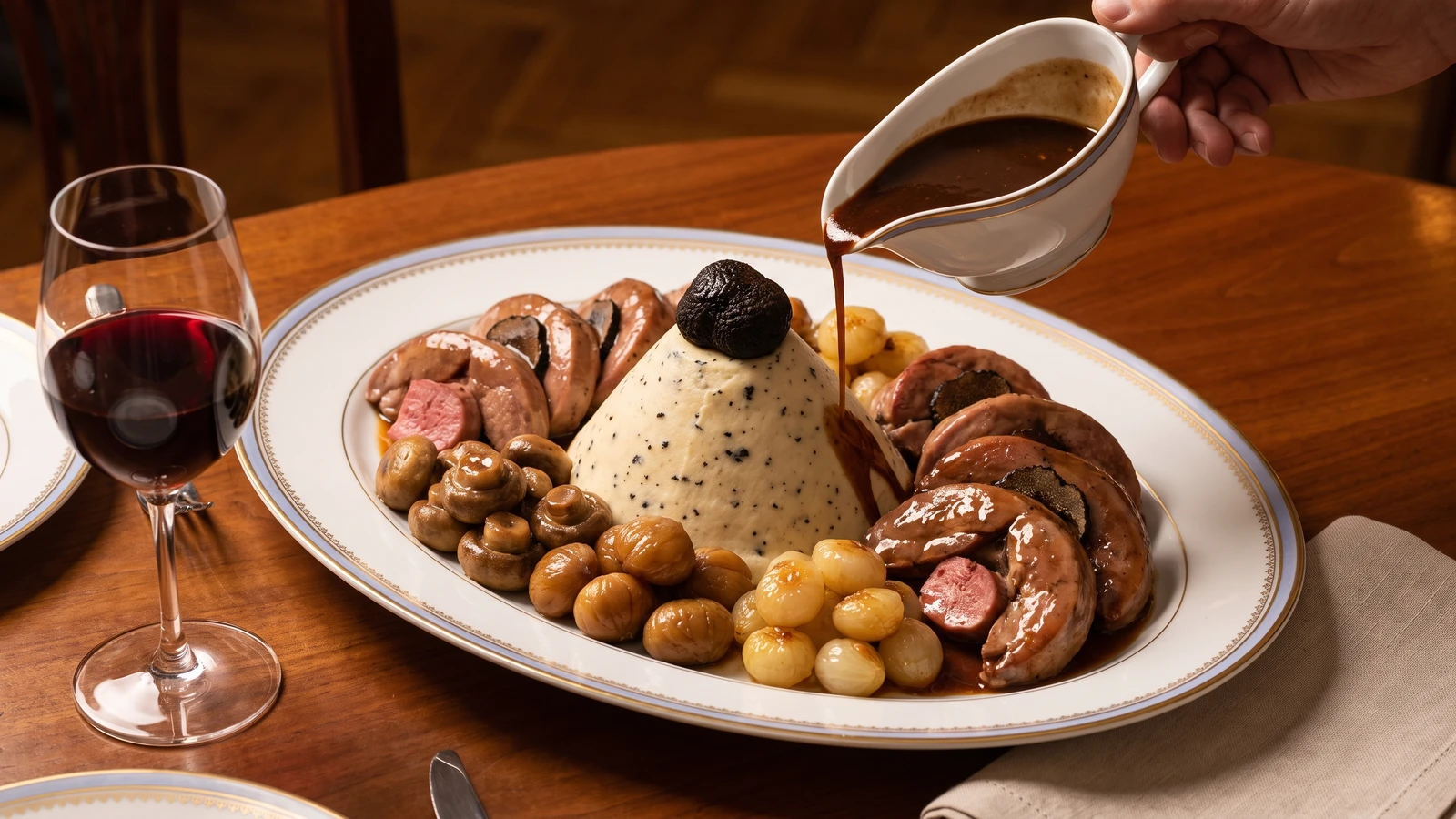
Truffle-contised leveret fillets and tenderloins stand around their own silken mousseline, with chestnuts, mushrooms, onions, and a peppery poivrade made from every drop of cooking liquor.
Filets de Levraut à la Dampierre (Dampierre-style leveret fillets) teaches one discipline above all: cold for the mousseline, gentle heat for everything afterward. The fillets are contised, meaning incised and inlaid with truffle, then poached just until tender. Their trimmings become a mousseline, a cream-lightened forcemeat, which supports the whole arrangement and proves that nothing useful from the animal need be lost.
The original set five leverets before a brigade, with a saucier tending poivrade, stock never off the fire, and the mild front of a great oven ready for several dishes at once. Here, two butchered young hares feed four. A food processor replaces the pounding and sieving hands, a tapered ovenproof bowl replaces the freely shaped cone, and a low oven with a bain-marie supplies the gentle heat. The brigade quantity and separate stations were scaffolding. The truffle contise, cold mousseline, careful poaching, radial arrangement, and cooking liquor folded into poivrade are the dish, so they stay. One cook, one stove, one evening.
Keep the hare and cream very cold while making the mousseline. If that emulsion warms, it turns greasy rather than silken; guard the temperature now, and the rest becomes an exercise in calm assembly.
Filets de Levraut à la Dampierre belongs to the grand Paris table, where game from the hunt was separated into fillets, minions, forcemeat, garnish, and sauce, then recomposed as a generous formal entrée. Dampierre is a classical service title rather than a regional hare preparation, and levraut means young hare, not rabbit; the poivrade, truffle, salted tongue, chestnuts, and radial architecture distinguish it from a farmhouse civet. Generations of home cooks have simplified such presentations, but the underlying practice remains useful: each cut receives the cooking method that suits it, and every flavorful liquor returns to the sauce.
Quantity
2
butchered to yield 4 back fillets (about 1 lb / 450 g), 4 minion fillets or tenderloins (about 4 oz / 120 g), 12 oz / 340 g cold lean trim, and chopped bones and trimmings
Quantity
1 set: 16 black-truffle slices (about 1/4 cup / 60 ml / 25 g) and 8 salted-tongue strips (about 1/3 cup / 80 ml / 50 g)
truffle sliced paper-thin; cooked salted tongue cut into narrow strips
Quantity
2 tbsp (30 ml / 20 g)
finely chopped
Quantity
1 small truffle, about 1/2 oz / 15 g
reserved for the center
Quantity
2 tbsp (30 ml / 30 g)
divided
Quantity
1 cup plus 2 tbsp (270 ml / 270 g)
divided
Quantity
2
Quantity
10 tbsp (150 ml / 142 g)
divided
Quantity
2 tbsp (30 ml / 29 g)
Quantity
2 1/2 tsp (12.5 ml / 15 g)
divided
Quantity
1/2 tsp (2.5 ml / 1 g)
Quantity
2 tsp (10 ml / 5 g)
lightly crushed
Quantity
1/2 cup (120 ml / 60 g)
finely diced
Quantity
1/3 cup (80 ml / 50 g)
finely diced
Quantity
1 1/2 tbsp (22 ml / 12 g)
Quantity
1/4 cup (60 ml / 60 g)
Quantity
1/2 cup (120 ml / 120 g)
Quantity
2 cups (480 ml / 480 g)
Quantity
1
thyme, parsley stems, and 1 bay leaf
Quantity
12
peeled
Quantity
12 mushrooms (about 2 cups / 480 ml / 225 g)
trimmed
Quantity
12 chestnuts (about 1 1/2 cups / 360 ml / 180 g)
Quantity
1 cup (240 ml / 240 g)
| Ingredient | Quantity |
|---|---|
| commercially processed farmed leverets or young haresbutchered to yield 4 back fillets (about 1 lb / 450 g), 4 minion fillets or tenderloins (about 4 oz / 120 g), 12 oz / 340 g cold lean trim, and chopped bones and trimmings | 2 |
| contise set prepared in the manner of Poularde Chevalière (No. 1458)truffle sliced paper-thin; cooked salted tongue cut into narrow strips | 1 set: 16 black-truffle slices (about 1/4 cup / 60 ml / 25 g) and 8 salted-tongue strips (about 1/3 cup / 80 ml / 50 g) |
| black trufflefinely chopped | 2 tbsp (30 ml / 20 g) |
| whole black trufflereserved for the center | 1 small truffle, about 1/2 oz / 15 g |
| natural black-truffle juicedivided | 2 tbsp (30 ml / 30 g) |
| cold heavy creamdivided | 1 cup plus 2 tbsp (270 ml / 270 g) |
| large egg whites | 2 |
| unsalted butterdivided | 10 tbsp (150 ml / 142 g) |
| Cognac or fine French brandy | 2 tbsp (30 ml / 29 g) |
| fine saltdivided | 2 1/2 tsp (12.5 ml / 15 g) |
| finely ground white pepper | 1/2 tsp (2.5 ml / 1 g) |
| black peppercornslightly crushed | 2 tsp (10 ml / 5 g) |
| carrotfinely diced | 1/2 cup (120 ml / 60 g) |
| shallotfinely diced | 1/3 cup (80 ml / 50 g) |
| plain flour | 1 1/2 tbsp (22 ml / 12 g) |
| red wine vinegar | 1/4 cup (60 ml / 60 g) |
| dry red wine | 1/2 cup (120 ml / 120 g) |
| unsalted brown game or beef stock | 2 cups (480 ml / 480 g) |
| bouquet garnithyme, parsley stems, and 1 bay leaf | 1 |
| small pearl onionspeeled | 12 |
| small button mushroomstrimmed | 12 mushrooms (about 2 cups / 480 ml / 225 g) |
| cooked peeled chestnuts | 12 chestnuts (about 1 1/2 cups / 360 ml / 180 g) |
| clear beef or game consommé | 1 cup (240 ml / 240 g) |
Separate the four back fillets, four minion fillets, lean mousseline meat, and sauce bones. Remove every trace of sinew from the fillets and lean trim. Cut the trim into small cubes, spread it on a cold plate, and chill it with the processor bowl and blade for at least 20 minutes. Pat the fillets dry and keep them covered in the cold. The mousseline meat should feel nearly firm before processing, not merely cool.
Melt 1 tbsp of the butter in a heavy saucepan over medium heat. Add the chopped hare bones and trimmings, browning them until the pan floor carries a dark hazelnut-colored fond. Add the carrot, shallot, and crushed peppercorns; cook until the vegetables color at their edges. Stir in the flour and cook for 2 minutes, letting this small roux turn tawny. Add the vinegar and wine, scrape the fond cleanly from the pan, and reduce until about one-third remains. Pour in the brown stock, add the bouquet garni, and hold at a bare simmer for 30 minutes. Strain through a fine sieve, pressing lightly, then return the liquid to a clean saucepan. It should taste peppery and concentrated but remain a little thin, because the fillets' cooking liquor still has to join it.
Use one sauté pan for all three garnishes. Brown the mushrooms in 1 1/2 tbsp butter until their rounded sides are bronze, season lightly, and set them aside. Add 1 tbsp butter, the pearl onions, and 1/4 cup of the consommé; cover and cook gently until the onions are tender, then uncover and roll them through the reducing liquor until glossy. Lift them out. Add the chestnuts, remaining consommé, and 1 tbsp butter, then simmer gently until the chestnuts are hot, intact, and lacquered by the reduced consommé. Keep all three garnishes covered.
Use the contise set prepared in the manner of Poularde Chevalière (No. 1458). With the tip of a sharp paring knife, make four shallow diagonal incisions along each back fillet and slip a truffle slice halfway into every cut, leaving a narrow black edge visible. Bend each fillet gently into a crescent. Make two small radiating incisions in each minion fillet and insert the salted-tongue strips so their rose-colored ends form a simple rosette. A paring knife does the work once assigned to a larding needle, and it gives the same pattern without tearing such small pieces.
Put the chilled hare trim in the chilled processor with about 1 1/4 tsp of the salt and all the white pepper. Process in short pulses until the meat becomes smooth and tacky. Add the egg whites and process just until absorbed. With the machine running, pour in 1 cup of the cold cream gradually, stopping once to scrape the bowl. Fold in the chopped truffle and 1 tbsp of the truffle juice by hand. Poach a teaspoonful in barely trembling water, taste it only once fully cooked, and correct the seasoning. The mousseline should hold a soft ridge from the spoon. If it loosens, shines with separated fat, or feels warm, stop. Set the bowl over ice for 10 minutes. Put the reserved 2 tbsp cold cream in the clean chilled processor, blend in 2 tbsp of the mousseline until smooth, then add the remaining mixture a spoonful at a time. Ça se rattrape.
Heat the oven to 300°F (150°C). Butter a 1-quart (1-liter) tapered ovenproof bowl or charlotte mold with 1 tbsp butter. Pack in the mousseline firmly to remove air pockets, level the top, and cover it with buttered parchment and foil. Set the mold in a roasting pan and pour hot water halfway up its sides to make a bain-marie. Bake gently for 30 to 40 minutes, until the center reaches 160°F (71°C). Rest it in the water for 5 minutes, then lift it out and keep covered. The tapered mold replaces freehand shaping on the serving dish, giving one cook a clean truncated cone without changing its purpose.
Butter a shallow ovenproof dish with 1 tbsp butter. Arrange the crescent-shaped back fillets and tongue-studded minions in one layer, season lightly, and sprinkle them with the Cognac. Melt 1 1/2 tbsp butter and spoon it over the meat. Cover first with parchment, then tightly with foil, and place the dish in the 300°F (150°C) oven. Begin checking the small minions after 7 minutes and the back fillets after 10; remove each piece when its center reaches 160°F (71°C), then keep it covered. The liquor must gather quietly around the meat, never boil. If it begins sputtering, pull the dish from the oven and let the retained heat finish the cooking.
Pour every drop of the fillets' cooking liquor through a fine sieve into the poivrade base and add the remaining 1 tbsp truffle juice. Bring it to a full simmer for 3 minutes, then reduce until the sauce nappes, meaning it coats the back of a spoon in a glossy veil. Take it off the heat and whisk in 2 tbsp cold butter a little at a time. Taste for salt and pepper. If the sauce tightens too far, loosen it with a spoonful of consommé; if the butter begins to separate, whisk in 1 tsp cold water away from the heat until the gloss returns.
Warm an oval serving platter. Run a thin knife only around the upper rim of the mousseline mold, invert the cone onto the center, and lift the mold away. If it clings, wrap the mold briefly in a hot damp cloth rather than digging at the mousseline. Stand the back fillets and minions radially against the cone, alternating the truffle-black crescents with the rose-marked minions. Glaze the whole truffle in a spoonful of poivrade and set it at the center. Arrange mushrooms, chestnuts, and pearl onions in a repeating ring around the base. Spoon a modest pool of poivrade around them and serve the rest in a warm sauceboat. The architecture should look generous, not fussy. À table!
1 serving (about 480g)
Culinary guides, cultural storytelling, and the editorial depth that makes cooking meaningful.
Discover Culinary ExplorerChef Juliette
John Dory has the delicacy of sole and the firmness of turbot. A light flouring, a quick butter sauté, and nut-brown beurre noisette show exactly why looks never mattered.

Chef Juliette
Fresh haddock proves its delicacy in the meunière pan: a fine flour crust, moist pearly flakes, and beurre noisette sharpened with lemon and parsley, ready from one skillet in half an hour.

Chef Juliette
Éperlans à l’Anglaise turns small fish into a lesson in disciplined coating: boned smelts under a close, crisp crumb, pan-fried in clarified butter and finished with bright, half-melted maître d’hôtel butter.

Chef Juliette
Tiny smelts, shallot, mushrooms, white wine, gratin sauce, and fine bread raspings meet a fierce oven, where the fish must turn tender in the same breath the buttered crust bronzes.