Culinary Explorer

A cooking platform built around craft, culture, and the stories behind what we eat.
Discover Culinary Explorer
Poularde Chevalière

Poularde Chevalière

Created by Chef Juliette

Based on No. 1458, Poularde Chevalière, from Le Guide Culinaire (1907) by Auguste Escoffier

The butchery lesson of the canon: breasts threaded with truffle and tongue, legs filled with cream godiveau, every remaining bone turned into stock for a glossy suprême sauce.

Main Dishes
French
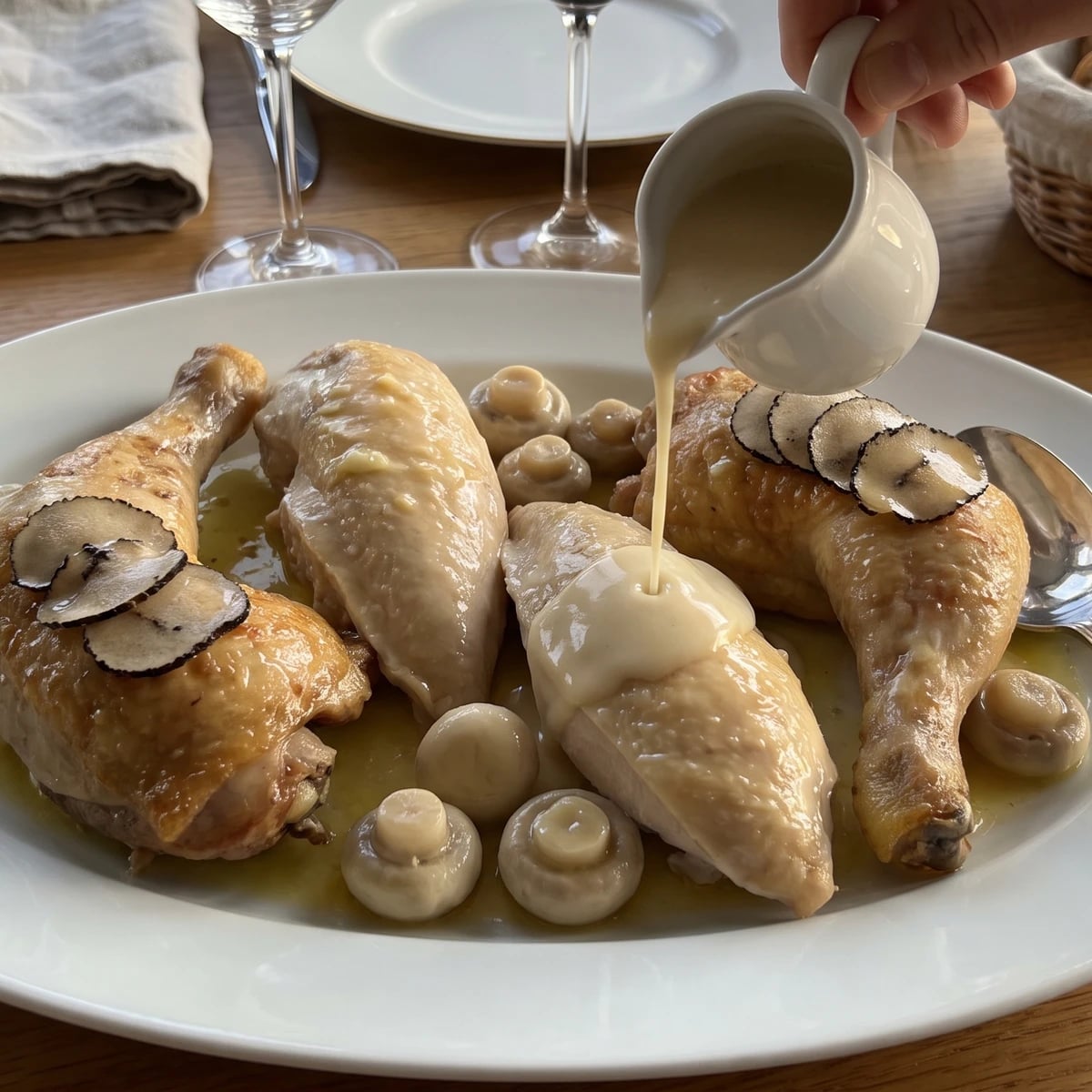
Dinner Party
Special Occasion
1 hr 30 min
Active Time
1 hr 45 min cook3 hr 15 min total
Yield4 servings

Poularde Chevalière (truffled pullet with stuffed legs) is the butchery lesson of the canon. It asks you to take one bird apart by purpose: suprêmes (the breast fillets) for larding, minion fillets for rings, legs for cream godiveau, and the carcass for the stock that poaches and sauces everything. The one true thing before you touch a pan is this: label and chill each piece as it comes off the bird, because precise butchery and cold forcemeat make the whole construction possible.

The original assumed a saucier on staff, stock never off the fire, separate sauté pans, and several hands to build a pyramid croûton, decorated quenelle pedestals, and a hatelet (ornamental skewer). At home, the carcass makes one quick white stock, a covered sauté pan poaches the breast pieces in sequence, and a small saucepan builds the suprême sauce. The croûton pyramid, silver border, rare cock's combs, kidneys, and ornamental pedestals are brigade scaffolding, so they go. The truffle and tongue larding, stuffed legs, ringed minion fillets, mushroom caps, and cream-finished sauce stay, because they are the dish. One cook, one stove, one evening.

When it is right, the poultry remains pale and succulent beneath a butter sheen, the sliced breast reveals dark truffle and rose-colored tongue, and the sauce runs ivory and glossy from its boat. Keep the godiveau truly cold while you work. That emulsion is the step that decides whether the stuffed legs cut like silk or shed their fat into the poaching stock.

Poularde Chevalière belongs not to a regional farmhouse table but to the Parisian grand-kitchen canon, where a named poultry dish displayed butchery, forcemeat, sauce work, and formal mounting together. Chevalière means a signet ring, echoed by the minion fillets slit with truffle and drawn into circles above the stuffed legs. As the repertoire passed from grand kitchens into bourgeois celebration cooking, the pyramid croûton, decorated quenelles, hatelet, cock's combs, kidneys, and chased border often fell away, while the economy underneath endured: the carcass supplies the poaching stock, and nothing useful is wasted.

The technique, the tradition, and the story behind every dish.

Discover Culinary Explorer

Ingredients

plump poularde or large pullet

Quantity

1 bird, 4½ to 5 pounds (2 to 2.3 kg)

giblets removed

cold water

Quantity

7 cups (1.65 L / 1.65 kg)

small onion

Quantity

1, about ¾ cup (180 ml / 115 g)

sliced

small leek, white part only

Quantity

1, about 1 cup (240 ml / 85 g)

sliced and rinsed

celery

Quantity

1 stalk, about ⅓ cup (80 ml / 40 g)

sliced

bouquet garni of parsley stems, thyme, and bay leaf

Quantity

1

small white button mushrooms

Quantity

12, about 3 cups (720 ml / 225 g)

stems removed and reserved

water for cooking the mushrooms

Quantity

½ cup (120 ml / 120 g)

preserved black truffle

Quantity

1 small truffle, about 1 ounce (28 g)

drained

cooked cured beef or ox tongue

Quantity

½ cup loosely packed (120 ml / 55 g)

cut into slender batons

very cold lean veal

Quantity

½ cup diced (120 ml / 90 g)

very cold beef kidney suet

Quantity

½ cup diced (120 ml / 90 g)

large egg yolk

Quantity

1, about 1 tablespoon (15 ml / 18 g)

cold heavy cream for the godiveau

Quantity

3 tablespoons (45 ml / 45 g)

heavy cream for the suprême sauce

Quantity

½ cup (120 ml / 120 g)

unsalted butter

Quantity

6 tablespoons (90 ml / 85 g)

divided

fresh lemon juice

Quantity

1 tablespoon (15 ml / 15 g)

divided

all-purpose flour

Quantity

3 tablespoons (45 ml / 24 g)

fine sea salt

Quantity

2 teaspoons (10 ml / 11 g), plus more to taste

divided

ground white pepper

Quantity

½ teaspoon (2.5 ml / 1 g)

divided

freshly grated nutmeg

Quantity

1 pinch

Equipment Needed

  • Narrow boning knife
  • Larding needle or slender smooth skewer
  • Small food processor
  • Kitchen-dedicated darning needle or wooden picks
  • Strong cotton kitchen string
  • 8-inch (20 cm) narrow saucepan with lid
  • 11-inch (28 cm) sauté pan with lid
  • Fine-mesh strainer
  • Instant-read thermometer
  • Warm oval serving platter and sauceboat

Instructions

  1. 1

    Break down the poularde

    Set the poularde breast-side up. Following the breastbone and ribs with a narrow knife, remove each suprême cleanly, peel away its skin, and lift out the slender minion fillet attached beneath it. Cover and chill the four pieces immediately. Remove each leg at the hip while preserving as much skin as possible. Scrape out the thigh bone, then bone the drumstick to within 1⅓ inches (3.5 cm) of its lower joint. Most market birds arrive without feet, so the source's angled removal of the claws has already been done; retain the short terminal bone as a neat handle. Chill the legs, then chop the carcass, wings, neck, and reserved mushroom stems into pieces for stock.

    Keep the knife against bone rather than cutting outward into the meat. A little flesh left on the carcass strengthens the stock, but a gouged suprême cannot be made whole again.
  2. 2

    Make the carcass stock

    Put the chopped carcass, wings, neck, and mushroom stems in a narrow pot with the cold water. Bring it up slowly, skim away the grey foam, then add the onion, leek, celery, bouquet garni, and ½ teaspoon of the salt. Hold the stock at the barest tremble for 1 hour, never at a rolling boil; hard boiling clouds the stock and gives the suprême sauce a coarse taste. Strain without pressing the solids. You should have 4 to 5 cups (960 ml to 1.2 L). If there is less, add enough hot water to reach 4 cups (960 ml); if there is more than 5 cups, reduce it gently.

  3. 3

    Cook the mushroom caps

    Melt 1 tablespoon of the butter in a small saucepan. Add the mushroom caps, the measured ½ cup water, 2 teaspoons of the lemon juice, and a pinch each of salt and white pepper. Cover with a round of parchment and simmer gently for 5 to 7 minutes, turning once, until the caps are tender but remain very white. Lift them out and cover them. Strain and reserve every drop of their cooking liquor; it supplies the mushroom foundation for poaching the suprêmes.

  4. 4

    Lard and ring

    Cut half the truffle into slender batons matching the tongue, then cut the remainder into very thin slices. With a larding needle, or a narrow paring knife followed by a smooth skewer, form four parallel channels through each suprême without splitting its surface. Thread two channels with truffle and two with tongue, alternating the rows. Make five or six shallow crosswise slits in each minion fillet, stopping before you cut through. Slip a thin truffle slice halfway into every slit, curve each fillet into a ring, and secure its ends with a short wooden pick. Cover and return everything to the cold.

  5. 5

    Make the cream godiveau

    Make the godiveau à la crème (veal-and-suet forcemeat enriched with cream) while every ingredient is refrigerator-cold. Pulse the veal, suet, ¾ teaspoon salt, ¼ teaspoon white pepper, and nutmeg in a small food processor until evenly minced. Add the yolk and pulse until the mixture turns sticky, then add the cold cream a spoonful at a time, pulsing only until smooth and cohesive. Poach a teaspoonful in the stock and cut it open to test the texture and seasoning. If the forcemeat sheds fat or looks grainy, it became warm. Ça se rattrape: spread it in a cold bowl, chill it for 10 minutes, then pulse briefly until the emulsion closes and test again.

  6. 6

    Stuff and truss

    Divide the godiveau between the two boned legs, filling the cavities evenly without packing them hard. Draw the long skin over each opening and close it with a few stitches of strong cotton using a kitchen-dedicated needle, or overlap the skin and secure it with wooden picks. Tie each leg into a compact oval, gathering the flesh around its short exposed bone so it resembles a small duck. If the skin tears, do not discard the leg. Wrap it snugly in buttered parchment, tie the parcel at three points, and poach it in that support.

  7. 7

    Poach the stuffed legs

    Bring enough carcass stock to cover the legs to 170 to 180°F (77 to 82°C) in a narrow saucepan. Lower in the stuffed legs and hold the liquid below a simmer for 30 to 40 minutes, turning once, until the center of the godiveau reaches 165°F (74°C). Boiling can burst the seams and squeeze out the forcemeat; if a closure begins to open, lower the heat immediately, wrap the leg in buttered parchment, retie it, and continue gently. Lift the legs out, cover them loosely, and strain the poaching stock.

  8. 8

    Poach the breast pieces

    Butter a wide sauté pan with 1 tablespoon of the butter and lay in the suprêmes. Add the reserved mushroom liquor, the remaining teaspoon of lemon juice, and enough strained carcass stock to come one-third of the way up the meat. Cover with buttered parchment and a lid, then poach at the faintest tremble for 8 to 12 minutes. Add the minion-fillet rings during the final 4 minutes. Remove the rings when firm and the suprêmes when their centers reach 160°F (71°C); rest them covered for 5 minutes and verify that they reach 165°F (74°C). Strain and reserve the poaching liquid.

  9. 9

    Finish the suprême sauce

    Melt 2 tablespoons of the butter in a saucepan, stir in the flour, and cook this pale roux for 2 minutes without letting it color. Measure 1½ cups (360 ml) of the combined leg stock and breast-poaching liquid, heat it, then whisk it gradually into the roux. Simmer for 10 to 12 minutes, whisking along the bottom, until smooth. Reserve 1 tablespoon of the sauce cream, add the rest, and reduce gently until the sauce is nappant, glossy enough to coat the back of a spoon while still flowing freely. Strain, then whisk in 1 tablespoon cold butter and correct the salt and white pepper. If it becomes too thick, loosen it with stock. If violent heat makes it look oily, take it off the fire and whisk in the reserved cold cream until smooth.

  10. 10

    Mount the platter

    Remove every stitch, pick, and length of string. Warm the mushroom caps in the remaining butter with a spoonful of stock. On a heated oval platter, alternate the two stuffed legs with the two suprêmes, placing a truffle-set minion ring on each leg and the white mushroom caps in the spaces between. The original raised each portion on decorated quenelles around a pyramid croûton crowned by a hatelet; those pieces held the display upright but added little to the eating. The unavailable cock's combs and kidneys go without imitation, because liver or sweetbreads would change the dish rather than translate it. Bring the suprême sauce separately in a warm sauceboat and pour it at the table. À table!

Chef Tips

  • Order the poularde whole and untouched, with its skin intact and carcass included. If your butcher is willing, ask only for the feet and head to be removed. The breasts, minion fillets, long leg skin, and bones all have separate work to do.
  • A good preserved black truffle is the honest classical pantry answer when fresh truffle is unavailable. Truffle oil cannot be threaded through a suprême and brings none of the texture this preparation requires.
  • Buy cooked cured beef or ox tongue from a proper deli or butcher and cut it into firm, narrow batons. Ham is easier to find but softer and saltier, and it erases the deliberate contrast between tongue and truffle.
  • Serve with small buttered potatoes or plain rice to catch the suprême sauce. A full-bodied white Burgundy or a dry Champagne has enough breadth for the cream, truffle, and tongue without obscuring the poultry.

Advance Preparation

  • The poularde can be broken down and its stock made one day ahead. Chill the stock promptly, cover the poultry pieces separately, and remove any set fat before reheating the stock.
  • The mushroom caps and their liquor can be prepared one day ahead. The legs may also be filled and trussed, then kept covered in the cold for no longer than one day before poaching.
  • Lard the suprêmes and shape the minion rings up to 6 hours ahead. Keep them covered and well chilled so the tongue remains firm and the truffle stays seated.
  • The pale roux and stock portion of the suprême sauce can be cooked earlier in the day. Reheat gently, then add the cream, reduce, and mount with cold butter shortly before serving.

Frequently Asked Questions

Nutrition Information

1 serving (about 550g)

Calories
1250 calories
Total Fat
100 g
Saturated Fat
44 g
Trans Fat
3 g
Unsaturated Fat
48 g
Cholesterol
380 mg
Sodium
1500 mg
Total Carbohydrates
10 g
Dietary Fiber
1 g
Sugars
3 g
Protein
77 g

Note: Chef personas and recipes are created with AI assistance. Cook with care: follow safe food-handling practices, check doneness with a thermometer when needed, and adapt for allergies and your kitchen.

Where cooking meets culture.

Culinary guides, cultural storytelling, and the editorial depth that makes cooking meaningful.

Discover Culinary Explorer

More from Poultry (Volaille)

Browse the full collection