
Chef Juliette
John Dory (St. Pierre)
John Dory has the delicacy of sole and the firmness of turbot. A light flouring, a quick butter sauté, and nut-brown beurre noisette show exactly why looks never mattered.
A cooking platform built around craft, culture, and the stories behind what we eat.
Created by Chef Juliette
Based on No. 1813, Râble de Lièvre à l’Allemande, from Le Guide Culinaire (1907) by Auguste Escoffier
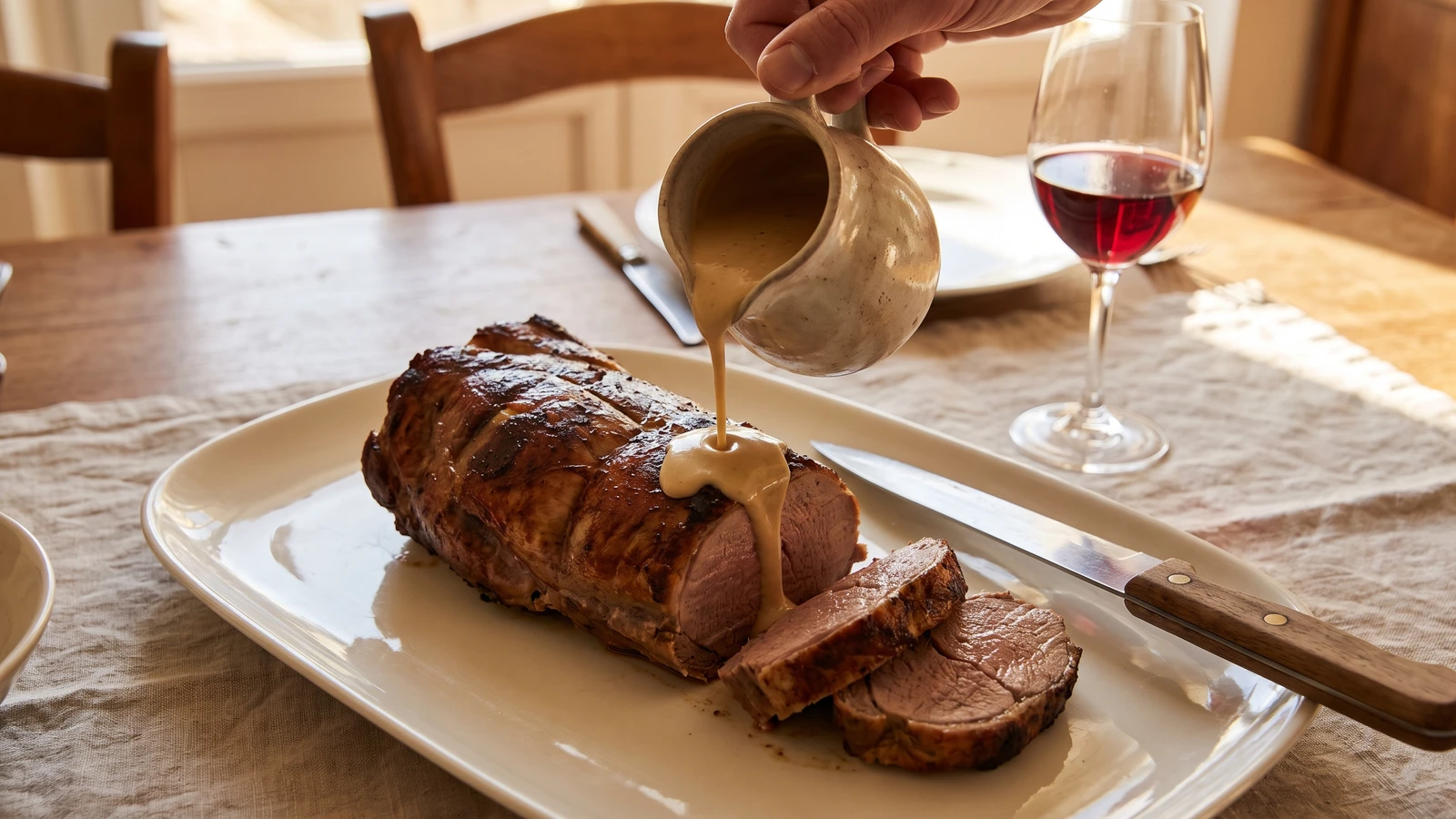
A lean hare saddle roasts over the marinade vegetables, then finishes under cream: disciplined timing, constant basting, and a few drops of lemon turn spare game into a generous platter.
Râble de Lièvre à l’Allemande (hare saddle in the German manner) teaches control at the seam between roasting and sauce-making. The râble is the back of the hare, carrying the tender loins, and the one true thing to know before touching the pan is that this meat has almost no patience. Roast it too far before the cream enters and no sauce can return its moisture. The vegetables perfume and protect it first; the cream joins only when the saddle is nearly cooked.
The original assumed a game larder with five quarts of Cooked Marinade for Venison (No. 168) ready, a roasting cook free to baste without pause, and a fine strainer always at hand. It needed neither a saucier on staff, a stockpot never off the fire, nor a salamander. Its real brigade scaffolding was volume and constant attention. At home, one quart of finished marinade in a narrow container, a shallow roasting dish, a spoon, and a thermometer do the same work. Refrigerating the hare for one night also removes the old need to hold and repeatedly boil a blood-touched marinade for days.
The five-quart quantity is scaffolding and can go. The sequence is the dish and must stay: dry the râble completely, roast it over the drained vegetables, remove them, add a quarter pint of real cream, baste to the end, and brighten the strained sauce with only a few drops of lemon. Watch the first roast closely. Stopping while the loin is still underdone is the decision that makes everything afterward possible.
The real home of Râble de Lièvre à l’Allemande is the French grand and bourgeois game table, where the saddle was prized as the hare's tender roasting cut and served whole before carving. In French classical nomenclature, à l’Allemande identifies the kitchen's German-facing treatment rather than proving a single German regional origin; here the wine-and-vinegar marinade is answered by cream, with lemon restoring the balance. Across generations, grand kitchens formalized a game cook's practical sequence of tempering mature meat with aromatics and acid, protecting it during roasting, and turning its juices into the accompanying sauce.
Quantity
1 large saddle, 2½ to 3 lb (1.1 to 1.4 kg)
trimmed of silverskin
Quantity
4 cups (950 ml / about 980 g) Cooked Marinade for Venison (No. 168)
fully chilled, with its strained cooked vegetables reserved separately
Quantity
generous ½ cup (140 ml / 140 g)
brought to room temperature
Quantity
1 tablespoon (15 ml / 15 g)
kept cold for rescuing the sauce
Quantity
8 to 12 drops (about ½ ml / ½ g)
| Ingredient | Quantity |
|---|---|
| bone-in hare saddletrimmed of silverskin | 1 large saddle, 2½ to 3 lb (1.1 to 1.4 kg) |
| Cooked Marinade for Venisonfully chilled, with its strained cooked vegetables reserved separately | 4 cups (950 ml / about 980 g) Cooked Marinade for Venison (No. 168) |
| heavy cream, at least 35% fatbrought to room temperature | generous ½ cup (140 ml / 140 g) |
| cold heavy cream (optional)kept cold for rescuing the sauce | 1 tablespoon (15 ml / 15 g) |
| fresh lemon juice | 8 to 12 drops (about ½ ml / ½ g) |
Put the hare saddle in a long, narrow nonreactive container and pour over the fully chilled Cooked Marinade for Venison (No. 168). Reserve its strained cooked vegetables separately in the refrigerator, before the liquid touches the raw hare. Cover and refrigerate the râble for 12 to 18 hours, turning it once so the acid and aromatics work evenly. Do not exceed 24 hours; the vinegar will begin to make the loin's surface soft rather than tender.
Heat the oven to 425°F (220°C). Lift the râble from the marinade, discard the raw-meat marinade, and dry every surface thoroughly with kitchen paper. Let the meat lose its refrigerator chill for 30 minutes while the oven heats. Spread the reserved vegetables from the Cooked Marinade for Venison (No. 168) across the bottom of a long, shallow roasting dish and set the râble on them, bone-side down. Drying is the step that decides the roast: wet hare pales and stews, while a dry surface takes the bronze the sauce needs.
Roast the râble over the vegetables until its surface is deeply browned and the thickest part of a loin registers about 130°F (54°C), usually 15 to 20 minutes. Judge by the thermometer rather than the clock because hare saddles vary sharply in size. The vegetables protect the underside and perfume the roasting juices, but they have finished their work once the meat is nearly cooked.
Lower the oven to 375°F (190°C). Lift the râble briefly onto a warm plate, remove every piece of vegetable from the roasting dish, and return the meat. Pour the room-temperature cream around the râble, scraping it through the browned juices, then roast for another 8 to 12 minutes. Baste generously every 2 to 3 minutes until the cream is ivory-tan and glossy and the loin registers 155°F (68°C). Keep the cream at a lively murmur, never a violent boil. If it separates into curds and clear fat, finish the meat without panic, then strain the sauce and whisk in the optional cold cream off the heat. Ça se rattrape.
Transfer the râble to a board and rest it loosely covered for 10 to 15 minutes; confirm that carryover heat brings the centre to 160°F (71°C). If it remains below that temperature, return it to a 350°F (175°C) oven for 3 to 5 minutes, then rest it again. Pour the cream and roasting juices through a fine-mesh strainer into a small saucepan. Warm gently until the sauce lightly coats a spoon, reducing it for only a minute or two if necessary. Take it off the heat and add the lemon juice drop by drop, tasting after six drops. Lemon should lift the cream, not announce itself. If the acid makes the sauce grainy, whisk in the optional cold cream off the heat until it smooths. Ça se rattrape.
Run a sharp knife closely along each side of the backbone and lift away the two loins. Remove the small tenderloins from underneath, then slice the larger loins thickly across the grain. Arrange the hare on a warmed oval platter and spoon the strained cream roasting juices around it, leaving the browned surfaces visible. Serve immediately. À table!
1 serving (about 270g)
Culinary guides, cultural storytelling, and the editorial depth that makes cooking meaningful.
Discover Culinary ExplorerChef Juliette
John Dory has the delicacy of sole and the firmness of turbot. A light flouring, a quick butter sauté, and nut-brown beurre noisette show exactly why looks never mattered.

Chef Juliette
Fresh haddock proves its delicacy in the meunière pan: a fine flour crust, moist pearly flakes, and beurre noisette sharpened with lemon and parsley, ready from one skillet in half an hour.

Chef Juliette
Éperlans à l’Anglaise turns small fish into a lesson in disciplined coating: boned smelts under a close, crisp crumb, pan-fried in clarified butter and finished with bright, half-melted maître d’hôtel butter.

Chef Juliette
Tiny smelts, shallot, mushrooms, white wine, gratin sauce, and fine bread raspings meet a fierce oven, where the fish must turn tender in the same breath the buttered crust bronzes.