
Chef Juliette
John Dory (St. Pierre)
John Dory has the delicacy of sole and the firmness of turbot. A light flouring, a quick butter sauté, and nut-brown beurre noisette show exactly why looks never mattered.
A cooking platform built around craft, culture, and the stories behind what we eat.
Created by Chef Juliette
Based on No. 1812, Râble de Lièvre, from Le Guide Culinaire (1907) by Auguste Escoffier
Lean hare teaches precision: trim every tendon, lard the râble finely, roast it with nerve, then turn its fond into a glossy red-wine jus for four at the home table.
Râble de lièvre (the whole back of hare) teaches one true thing before you touch a pan: lean game must be protected from within. Clear away every tendon, then thread the meat with fine, cold strips of fatback. Thick plugs make greasy tunnels; fine larding melts through the muscle while the outside bronzes, and that precision is the dish.
The grand kitchen surrounding the original entry assumed a game larder, a proper larding needle, marinade made by the quart, a saucier on staff, and stock never off the fire. Your equivalent is a narrow skewer, a flameproof roasting pan, good unsalted stock, and one reduction made while the meat rests. A salamander has no work here; the oven supplies the bronzing. The bulk marinade is brigade scaffolding, so reach for the separate Cooked Marinade for Venison (No. 168) only when a sound piece has been kept. A young, fresh hare goes straight to the roast. One cook, one stove, one evening.
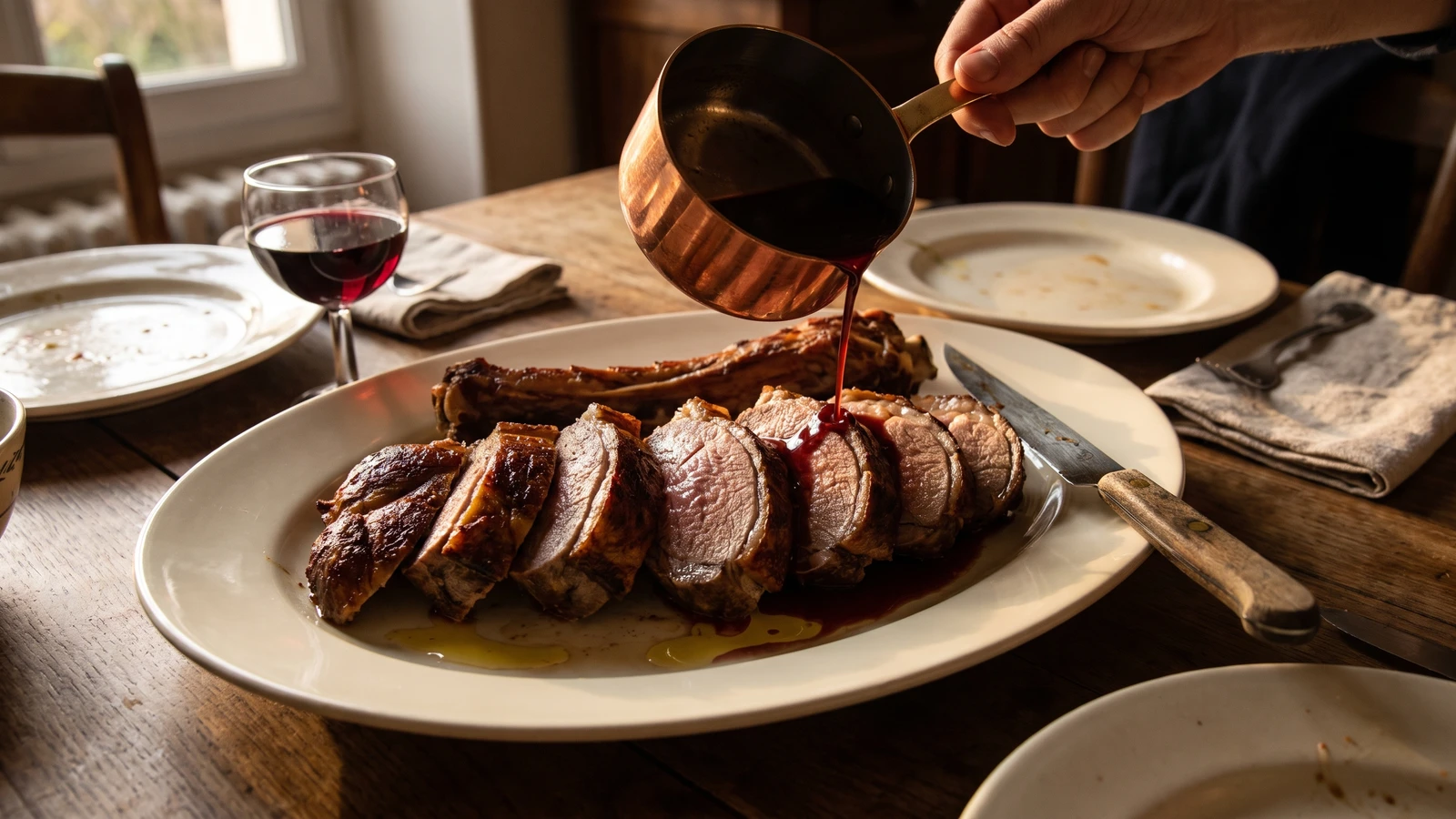
The finished râble should arrive burnished and neatly carved, its fine larding just visible through the moist meat and its jus pooling wine-dark around it. Don't hide the hare beneath a heavy sauce. The step that decides everything comes before heat: remove every silver thread without gouging the loin, then lard it evenly while both meat and fat are cold.
Râble de lièvre belongs to the cuisine de chasse of northern and central France, particularly the hunting tables of Burgundy, the Loire, and Île-de-France. Classical usage is broader than the modern butcher's saddle: râble can mean the back from the root of the neck to the tail with the ribs cut short, though many cooks reserve the word for the section between the croup and floating ribs. Generations of manuals treat marinading as conditional, intended for game that has been held, while a young fresh hare is simply trimmed, finely larded, and cooked.
Quantity
1, weighing 3 to 3½ pounds (1.35 to 1.6 kg)
ribs cut short
Quantity
½ cup loosely packed (120 ml / 85 g)
cut into fine ⅛-inch (3 mm) strips
Quantity
5 cups (1.2 liters / 1.2 kg) Cooked Marinade for Venison (No. 168)
thoroughly chilled
Quantity
1½ teaspoons (7.5 ml / 9 g)
Quantity
¾ teaspoon (3.75 ml / 1.5 g)
Quantity
2 tablespoons (30 ml / 28 g)
Quantity
2, about ¼ cup (60 ml / 55 g)
finely minced
Quantity
¾ cup (180 ml / 180 g)
Quantity
1½ cups (360 ml / 360 g)
Quantity
2 tablespoons (30 ml / 28 g)
cut into four pieces
| Ingredient | Quantity |
|---|---|
| bone-in whole back of young hareribs cut short | 1, weighing 3 to 3½ pounds (1.35 to 1.6 kg) |
| chilled pork fatbackcut into fine ⅛-inch (3 mm) strips | ½ cup loosely packed (120 ml / 85 g) |
| Cooked Marinade for Venison (optional)thoroughly chilled | 5 cups (1.2 liters / 1.2 kg) Cooked Marinade for Venison (No. 168) |
| fine sea salt | 1½ teaspoons (7.5 ml / 9 g) |
| freshly ground black pepper | ¾ teaspoon (3.75 ml / 1.5 g) |
| clarified butter | 2 tablespoons (30 ml / 28 g) |
| small shallotsfinely minced | 2, about ¼ cup (60 ml / 55 g) |
| dry red wine | ¾ cup (180 ml / 180 g) |
| unsalted veal or game stock | 1½ cups (360 ml / 360 g) |
| cold unsalted buttercut into four pieces | 2 tablespoons (30 ml / 28 g) |
Set the râble bone-side down and identify the two long loins running beside the spine. With the point of a flexible knife, lift each strip of silverskin and tendon, then angle the blade slightly upward as you draw it away so the sinew, not the meat, meets the edge. Trim ragged fat and shorten any projecting ribs if the butcher has not done so. Keep the thin belly flaps attached; fold them snugly beneath the loins rather than sacrificing good meat.
Chill the fatback strips until firm but still flexible. Working with the grain of each loin, pass a larding needle through the muscle and draw a strip of fatback behind it, leaving only the smallest ends visible. Make 12 to 16 fine, evenly spaced threads across the two loins rather than a few thick plugs. Without a larding needle, open each passage with a narrow metal skewer and push the fat through with the blunt end of a thin chopstick. If the fat softens or tears, stop and chill it for 10 minutes. Ça se rattrape. If the meat begins to split, stop adding fat and tie the râble neatly at 1½-inch (4 cm) intervals with butcher's twine.
If the hare is young and fresh, omit this step entirely. Marinading is not a ceremony, and it is not the dish. Only for a sound piece that has been kept, place the larded râble in a close-fitting nonreactive dish and cover it with the thoroughly chilled Cooked Marinade for Venison (No. 168). Refrigerate for 8 to 12 hours, turning once, then drain, discard the used marinade, and dry the meat meticulously. A marinade cannot rescue game with a sour smell, tacky surface, or doubtful handling; such meat does not belong in the pan.
Take the râble from the cold 30 minutes before cooking and heat the oven to 450°F (230°C). Pat the meat dry once more, then season it with the salt and pepper; if it was marinated, use only half the listed salt at first. Heat the clarified butter in a large flameproof roasting pan over medium-high heat. Lay in the râble and brown each fleshy side for 2 to 3 minutes without dragging it around the pan. Turn it only when the meat releases cleanly and has taken a deep Maillard bronze.
Set the râble bone-side down and transfer the pan to the oven. Roast for 10 minutes, baste with the butter in the pan, then begin checking the thickest part of the loin with an instant-read thermometer. Continue roasting until it reaches 155°F (68°C), usually another 8 to 15 minutes depending on thickness. The temperature should rise to 160°F (71°C) while resting. If the surface darkens before the centre is ready, cover it loosely with foil and reduce the oven to 375°F (190°C). If it overshoots, don't carve it thin; thicker slices and a generous spoonful of jus will protect what moisture remains.
Move the râble to a warm platter, cover it loosely, and rest it for 10 to 12 minutes. Pour away excess fat from the roasting pan while keeping every browned deposit. Set the pan over medium heat, add the shallots, and stir for 1 minute. Pour in the red wine and scrape the fond from the pan floor, then boil until only about ¼ cup (60 ml) remains. Add the stock and reduce to roughly ¾ cup (180 ml), glossy enough to cling lightly to a spoon but still fluid. This is a jus, not gravy.
Strain the reduction into a small saucepan and taste for salt and pepper. Remove it from the heat and monter au beurre, finish by whisking in the cold butter one piece at a time, until the jus gleams. Never boil it after the butter goes in. If it separates into oily beads, ça se rattrape: take the pan off the heat, whisk in 1 teaspoon of cold water, then add a fresh piece of cold butter gradually. If it becomes too tight, loosen it with a spoonful of stock.
Check that the thickest loin has reached 160°F (71°C) after resting; if it has not, return the râble to the oven for 2 to 4 minutes. Remove the twine. Run a sharp knife closely along each side of the backbone to lift away the loins, free the small underfillets beneath, and cut everything across the grain into generous slices. Arrange the meat on the warm platter, spoon over enough jus to make it gleam, and serve the rest separately. À table!
1 serving (about 215g)
Culinary guides, cultural storytelling, and the editorial depth that makes cooking meaningful.
Discover Culinary ExplorerChef Juliette
John Dory has the delicacy of sole and the firmness of turbot. A light flouring, a quick butter sauté, and nut-brown beurre noisette show exactly why looks never mattered.

Chef Juliette
Fresh haddock proves its delicacy in the meunière pan: a fine flour crust, moist pearly flakes, and beurre noisette sharpened with lemon and parsley, ready from one skillet in half an hour.

Chef Juliette
Éperlans à l’Anglaise turns small fish into a lesson in disciplined coating: boned smelts under a close, crisp crumb, pan-fried in clarified butter and finished with bright, half-melted maître d’hôtel butter.

Chef Juliette
Tiny smelts, shallot, mushrooms, white wine, gratin sauce, and fine bread raspings meet a fierce oven, where the fish must turn tender in the same breath the buttered crust bronzes.