
Chef Juliette
John Dory (St. Pierre)
John Dory has the delicacy of sole and the firmness of turbot. A light flouring, a quick butter sauté, and nut-brown beurre noisette show exactly why looks never mattered.
A cooking platform built around craft, culture, and the stories behind what we eat.
Created by Chef Juliette
Based on No. 1808, Civet de Chevreuil, from Le Guide Culinaire (1907) by Auguste Escoffier
Civet de chevreuil turns hard-working venison cuts into a wine-dark braise, then asks one honest question: will hare's blood give the sauce its defining civet finish, or will you serve the excellent stew it becomes without it?
Civet de Chevreuil (roe deer braised in red wine) teaches the difference between a fine game stew and a civet. Shoulder, neck, and breast supply the gelatin; red wine, fond, and a golden roux build the sauce. Yet the classical stamp comes from the final liaison au sang, thickening with blood. Without food-safe hare's blood, the source itself calls the dish a stew. Here the word carries the technique, and we keep the distinction honestly.
The source classes this as food for the home, yet its cross-reference assumes the habits of a saucier: separate pans, a strainer ready, and a warmed timbale for service. A stock never off the fire and a salamander do not belong here, so I won't invent work for them. A five-quart cocotte, one skillet, and a fine sieve replace the brigade choreography. Moving the meat through several saucepans is scaffolding; the six-hour marinade, golden roux, quiet braise, strained sauce, and blood liaison are the dish. One cook, one stove, one evening.
Before you touch the pan, know this one thing: dry the marinated venison completely. Wet game chills the fat, waters the roux, and leaves the sauce tasting boiled. Dry meat firms cleanly against the heat and gives the wine something deep to gather around. That drying is the step that decides the civet.
Civet de chevreuil belongs to the hunting tables of forested regions such as Burgundy and Sologne, where shoulder, neck, and breast were valued for the long, gentle cooking that tender cuts neither need nor tolerate. The name civet is commonly traced to cive, an old word for members of the onion family, but within the classical kitchen the final blood liaison became its defining mark. Because roe-deer blood was difficult to retain, the home table often served the preparation as a red-wine stew, while hare's blood supplied the full civet finish when it could be obtained.
Quantity
3 lb (1.35 kg)
trimmed and cut into 2-inch pieces
Quantity
1 bottle (750 ml / 750 g)
reserve 2 tablespoons before marinating
Quantity
1 linked four-serving method framework (No. 1821)
used for the sauce and garnish sequence
Quantity
¾ cup (180 ml / 115 g)
cut into large dice
Quantity
6 tablespoons (90 ml / 85 g)
divided
Quantity
2 medium (about 2 cups / 300 g)
quartered
Quantity
2 tablespoons (30 ml / 16 g)
Quantity
1 large bouquet garni
Quantity
16 (about 1½ cups / 250 g)
peeled
Quantity
½ cup (120 ml / 120 g)
Quantity
1 teaspoon (5 ml / 4 g)
Quantity
20 (about 3 cups / 250 g)
trimmed
Quantity
½ cup (120 ml / 125 g)
Quantity
8 thin slices (about 4 oz / 120 g)
cut into rough heart shapes
Quantity
½ teaspoon (2.5 ml / 3 g), plus more as needed
Quantity
½ teaspoon (2.5 ml / 1 g), plus more as needed
| Ingredient | Quantity |
|---|---|
| boneless roe deer or venison shoulder, neck, and breasttrimmed and cut into 2-inch pieces | 3 lb (1.35 kg) |
| Cooked Marinade for Venisonfully cooled | 1 cup (240 ml / 245 g) (No. 168) |
| dry, deeply colored red winereserve 2 tablespoons before marinating | 1 bottle (750 ml / 750 g) |
| Civet de Lièvreused for the sauce and garnish sequence | 1 linked four-serving method framework (No. 1821) |
| lean unsmoked lardons or thick-cut baconcut into large dice | ¾ cup (180 ml / 115 g) |
| unsalted butterdivided | 6 tablespoons (90 ml / 85 g) |
| medium onionsquartered | 2 medium (about 2 cups / 300 g) |
| plain flour | 2 tablespoons (30 ml / 16 g) |
| bouquet garni with parsley stems, thyme, bay leaf, and garlic | 1 large bouquet garni |
| pearl onionspeeled | 16 (about 1½ cups / 250 g) |
| water | ½ cup (120 ml / 120 g) |
| granulated sugar | 1 teaspoon (5 ml / 4 g) |
| small button mushroomstrimmed | 20 (about 3 cups / 250 g) |
| food-safe hare's blood from a licensed supplier (optional) | ½ cup (120 ml / 125 g) |
| baguettecut into rough heart shapes | 8 thin slices (about 4 oz / 120 g) |
| fine salt | ½ teaspoon (2.5 ml / 3 g), plus more as needed |
| freshly ground black pepper | ½ teaspoon (2.5 ml / 1 g), plus more as needed |
Put the venison in a snug glass or ceramic dish. Add the fully cooled Cooked Marinade for Venison (No. 168) and all but the reserved 2 tablespoons of red wine, turning the pieces until every surface is wet. Cover and refrigerate for six hours, turning once halfway through. Longer is not better with these small pieces; too much acid eventually gives the surface a cured, cottony texture.
Set a colander over a bowl and drain the venison, saving every drop of the red-wine marinade. Spread the pieces on towels and dry them with great attention, then season with the measured pepper. From this point, Civet de Lièvre (No. 1821) supplies the method framework: lardons, browned onions, golden roux, gentle braise, glazed onions, mushrooms, strained sauce, and the optional blood liaison. The hare has become venison, and the quantities are scaled for four; the sequence stays intact.
Heat the oven to 300°F (150°C). Melt 2 tablespoons of the butter in a five-quart cocotte over medium heat. Add the lardons and cook until their edges are bronze and their fat has rendered, then lift them out with a slotted spoon. Add the quartered onions to the same butter and brown their cut faces patiently. Lower the heat if the butter darkens faster than the onions.
Sprinkle the flour over the onions and cook gently for 3 to 4 minutes, stirring, until the roux turns pale gold and smells faintly nutty. Add the dried venison and raidir, firm its outer surface, by turning the pieces through the hot roux for 4 to 5 minutes. You are not chasing a hard crust now, because flour is already in the pot and would scorch before the meat browned deeply.
Pour in the reserved red-wine liquid containing the Cooked Marinade for Venison (No. 168) in three additions, stirring around the meat and scraping the fond from the pot floor. If the roux gathers into lumps, lift out the meat, whisk the liquid smooth, and return it; ça se rattrape. Add the bouquet garni and bring the liquid to a full boil for one minute because it touched raw meat. Cover, transfer to the oven, and braise for 1 hour 45 minutes to 2 hours 15 minutes, until a fork enters the shoulder and neck without resistance. Check after the first hour; the liquid should barely tremble. If it boils hard, lower the oven to 275°F (135°C).
While the civet braises, melt 1 tablespoon butter in a wide skillet. Add the pearl onions, water, sugar, and salt, then cover and simmer gently until nearly tender. Uncover and roll them through the reducing liquid until they are glossy and lightly browned; transfer them to the lardons. Melt another tablespoon butter in the skillet and sauté the mushrooms over lively heat until their moisture cooks away and their edges bronze. Add them to the lardons and onions.
Lift the tender venison into a warm bowl with the lardons, pearl onions, and mushrooms. Discard the bouquet garni, then pass the sauce through a fine sieve into the cleaned cocotte without forcing the softened onions through. Skim excess fat and reduce over medium heat. If using blood, stop while the sauce is slightly loose because the liaison will thicken it; without blood, reduce until it nappes, coating the back of a spoon. If it tightens too far or the salt sharpens, loosen it with a spoonful of hot water.
If food-safe hare's blood is unavailable, skip this step and serve the preparation honestly as the source's excellent venison stew. If using it, whisk the blood smooth in a bowl, then temper it with about 1 cup of hot sauce, added gradually while whisking. Take the cocotte off the heat and whisk in the tempered blood in a thin stream. Return it to the lowest heat and stir until the sauce turns velvety and coats a spoon, but never let it simmer. At the first sign of graininess, pull it from the heat, whisk in the reserved cold wine, and strain it; ça se rattrape when caught early. A hard boil fully coagulates the blood and cannot be reversed.
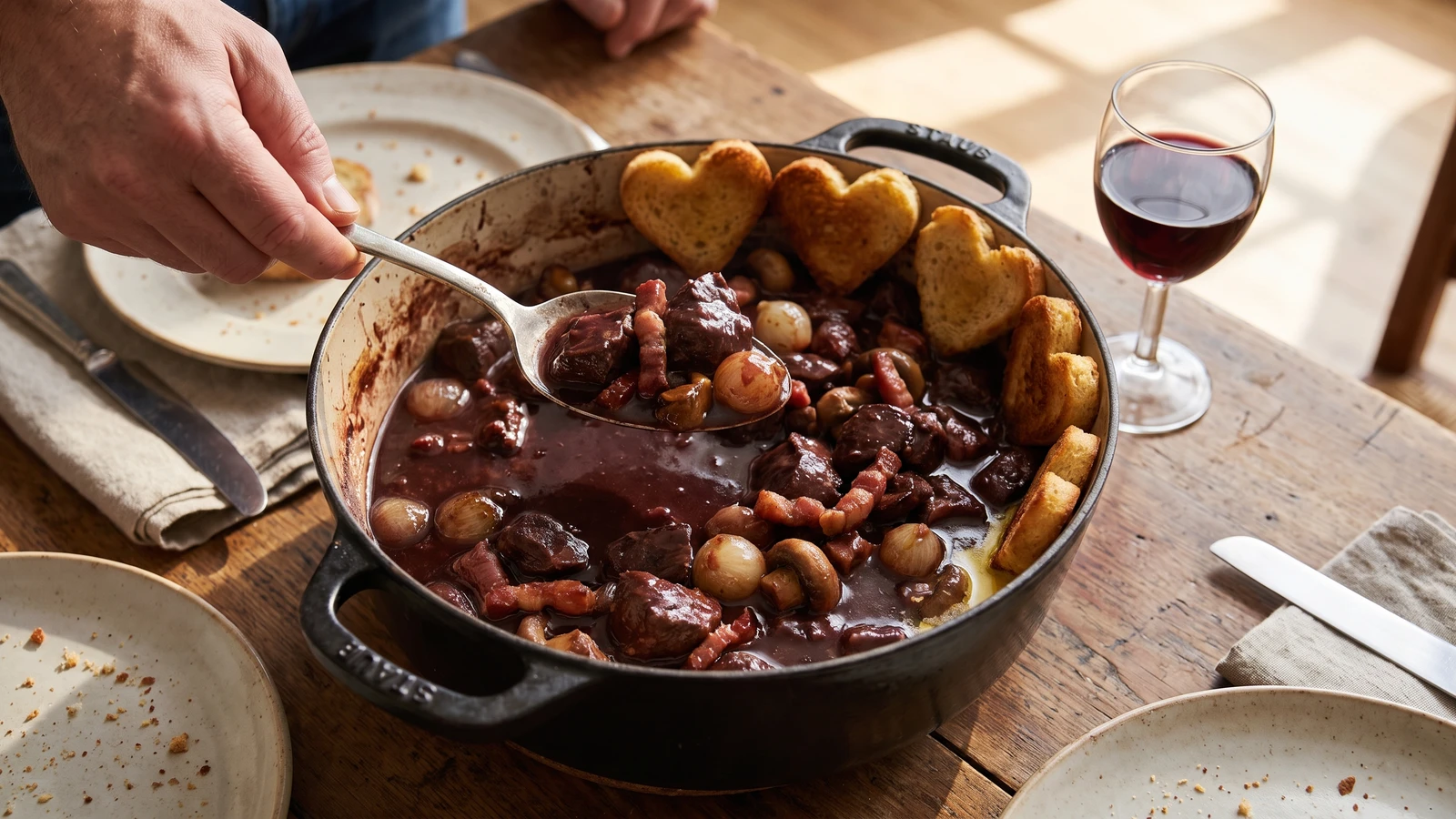
Return the venison, lardons, pearl onions, and mushrooms to the sauce and warm them gently. If the blood liaison was used, keep the pot below a simmer. Melt the remaining 2 tablespoons butter in the skillet and fry the heart-shaped croûtons at the last moment until crisp and chestnut-gold on both sides. Bring the civet to the table in its cocotte, with the croûtons arranged around the edge for catching the sauce. À table!
1 serving (about 620g)
Culinary guides, cultural storytelling, and the editorial depth that makes cooking meaningful.
Discover Culinary ExplorerChef Juliette
John Dory has the delicacy of sole and the firmness of turbot. A light flouring, a quick butter sauté, and nut-brown beurre noisette show exactly why looks never mattered.

Chef Juliette
Fresh haddock proves its delicacy in the meunière pan: a fine flour crust, moist pearly flakes, and beurre noisette sharpened with lemon and parsley, ready from one skillet in half an hour.

Chef Juliette
Éperlans à l’Anglaise turns small fish into a lesson in disciplined coating: boned smelts under a close, crisp crumb, pan-fried in clarified butter and finished with bright, half-melted maître d’hôtel butter.

Chef Juliette
Tiny smelts, shallot, mushrooms, white wine, gratin sauce, and fine bread raspings meet a fierce oven, where the fish must turn tender in the same breath the buttered crust bronzes.