
Chef Juliette
John Dory (St. Pierre)
John Dory has the delicacy of sole and the firmness of turbot. A light flouring, a quick butter sauté, and nut-brown beurre noisette show exactly why looks never mattered.
A cooking platform built around craft, culture, and the stories behind what we eat.
Created by Chef Juliette
Based on No. 1804, Noisettes de Chevreuil Romanoff, from Le Guide Culinaire (1907) by Auguste Escoffier
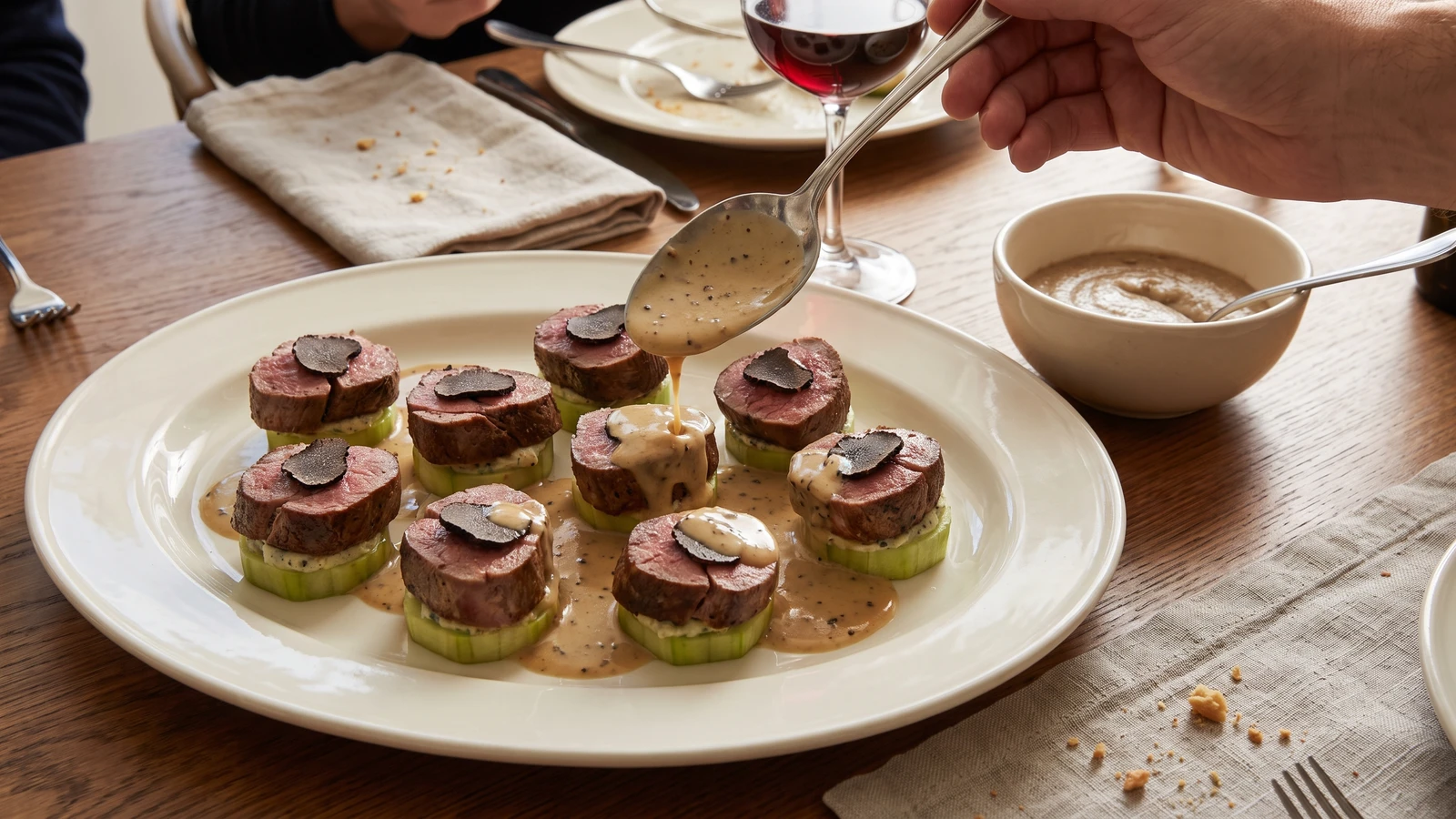
Rose-centred venison noisettes sit on chicken-stuffed cucumber, crowned with black truffle and glossed with poivrade crémée, while mushroom purée waits beside the platter: a composed classic made workable for one careful cook.
Noisettes de Chevreuil Romanoff (Romanoff-style venison loin medallions) teaches the discipline of a composed dish: every garnish waits, then the lean meat sees the pan only at the end. That is the one true thing to know before touching a skillet. Venison cannot wait while you finish the sauce, so the poivrade crémée (peppery wine-and-vinegar sauce enriched with cream), the purée de champignons (mushroom purée), and the cucumber cases must all be ready first.
The grand-kitchen entry assumed a saucier on staff, stock never off the fire, and another cook handing over Concombres Farcis.—A (No. 2124) already hot. A salamander has no useful work here, so none is invented. At home, a compact stock reduction builds the poivrade, a blender replaces the laborious tamis for the mushroom purée, and a low oven holds the cited cucumber garnish. When roe deer cannot be had, inspected farmed venison loin preserves the cut and leanness, though its flavour is a little less delicate. One cook, one stove, one evening.
Separate stations and ranks of holding pans were brigade scaffolding, and they can go. The architecture must stay: stuffed cucumber beneath, rosy venison above, one slice of truffle on each noisette, poivrade over, mushroom purée served separately. The deciding step is the final sear. Have everything else hot before the venison meets the pan.
Noisettes de Chevreuil Romanoff belongs to the cosmopolitan Parisian grand-kitchen canon rather than to one provincial French table; noisette denotes the small, neatly trimmed round of loin at the centre of the composition. Romanoff names suggested Russian courtly splendour on French menus, but this is not a Russian household dish: its poivrade, stuffed cucumber garnish, truffle, and separate mushroom purée follow French classical service. The sauce carries the game more than the truffle does, using pepper, vinegar, wine, stock, and cream to join lean venison to the mild garnishes.
Quantity
8, each about 1 inch (2.5 cm) thick (about 1 pound 5 ounces / 600 g total)
silver skin removed
Quantity
8 from Concombres Farcis.—A (No. 2124)
Quantity
8 thin slices (about 1/2 ounce / 15 g)
Quantity
1 1/2 teaspoons (7.5 ml / 9 g)
divided
Quantity
1/2 teaspoon (2.5 ml / 1 g)
Quantity
2 tablespoons (30 ml / 28 g)
for searing the venison
Quantity
1 tablespoon (15 ml / 14 g)
for building the poivrade
Quantity
1 medium (about 1/4 cup / 60 ml / 40 g)
chopped for the poivrade
Quantity
1 small (about 1/3 cup / 80 ml / 45 g)
finely chopped
Quantity
1/4 cup (60 ml / 60 g)
Quantity
1/2 cup (120 ml / 120 g)
Quantity
2 cups (480 ml / 480 g)
Quantity
2 sprigs
Quantity
1
Quantity
2 teaspoons (10 ml / 5 g)
coarsely crushed
Quantity
1/2 cup (120 ml / 120 g)
for the poivrade
Quantity
1 tablespoon (15 ml / 14 g)
for finishing the poivrade
Quantity
6 cups sliced (1.4 litres / 450 g)
Quantity
3 tablespoons (45 ml / 42 g)
for the mushroom purée
Quantity
1 medium (about 1/4 cup / 60 ml / 40 g)
finely chopped for the mushroom purée
Quantity
1/3 cup (80 ml / 80 g)
for the mushroom purée
| Ingredient | Quantity |
|---|---|
| venison loin medallions, preferably roe deersilver skin removed | 8, each about 1 inch (2.5 cm) thick (about 1 pound 5 ounces / 600 g total) |
| finished stuffed cucumber cases | 8 from Concombres Farcis.—A (No. 2124) |
| fresh black truffle or whole preserved black truffle | 8 thin slices (about 1/2 ounce / 15 g) |
| fine sea saltdivided | 1 1/2 teaspoons (7.5 ml / 9 g) |
| freshly ground black pepper | 1/2 teaspoon (2.5 ml / 1 g) |
| clarified butterfor searing the venison | 2 tablespoons (30 ml / 28 g) |
| unsalted butterfor building the poivrade | 1 tablespoon (15 ml / 14 g) |
| shallotchopped for the poivrade | 1 medium (about 1/4 cup / 60 ml / 40 g) |
| carrotfinely chopped | 1 small (about 1/3 cup / 80 ml / 45 g) |
| red wine vinegar | 1/4 cup (60 ml / 60 g) |
| dry red wine | 1/2 cup (120 ml / 120 g) |
| rich, unsalted veal or beef stock | 2 cups (480 ml / 480 g) |
| fresh thyme | 2 sprigs |
| bay leaf | 1 |
| black peppercornscoarsely crushed | 2 teaspoons (10 ml / 5 g) |
| heavy creamfor the poivrade | 1/2 cup (120 ml / 120 g) |
| cold unsalted butterfor finishing the poivrade | 1 tablespoon (15 ml / 14 g) |
| cremini or button mushrooms | 6 cups sliced (1.4 litres / 450 g) |
| unsalted butterfor the mushroom purée | 3 tablespoons (45 ml / 42 g) |
| shallotfinely chopped for the mushroom purée | 1 medium (about 1/4 cup / 60 ml / 40 g) |
| heavy creamfor the mushroom purée | 1/3 cup (80 ml / 80 g) |
Take the venison from the cold for 20 minutes, then pat every surface dry. Keep the medallions together in thickness so they cook at the same pace, but do not season them yet. Slice the truffle and measure every sauce ingredient. The venison is the last thing you will cook; beginning with it would leave eight beautiful noisettes waiting while their garnishes caught up.
Melt the 3 tablespoons butter in a wide pan over medium heat. Add the shallot and cook without browning for 2 minutes, then add the mushrooms and 1/2 teaspoon of the salt. Raise the heat and cook for 12 to 15 minutes, stirring only as needed, until the mushrooms release their water, the pan goes dry, and their edges take a little bronze. Add the 1/3 cup cream and simmer for 3 minutes. Blend until completely smooth, then press through a fine sieve if the texture remains coarse. If the purée is loose, return it to the pan and stir over gentle heat until it sits in a soft mound; ça se rattrape. Cover and keep warm for serving separately.
Reserve 1/4 cup (60 ml) of the stock for the venison pan. Melt 1 tablespoon butter in a 2-quart saucepan over medium heat, then add the poivrade shallot and carrot. Cook for 8 to 10 minutes, stirring often, until the vegetables and the pan floor are properly browned. Add the vinegar and wine, scrape up the fond, and boil until only about 1/4 cup (60 ml) remains. Add the remaining stock, thyme, and bay leaf, then simmer until reduced to about 1 cup (240 ml), 25 to 35 minutes. Add the crushed peppercorns for the final 5 minutes so their perfume stays alive, then strain into a clean saucepan.
Add the 1/2 cup cream to the strained poivrade and simmer gently until the sauce nappe (coats the back of a spoon), about 6 to 10 minutes. Taste before adding salt because the stock has concentrated. Keep the sauce warm without boiling. If it becomes too thick, loosen it with hot stock or water a tablespoon at a time. If the cream turns oily at the edge, take the pan off the heat and whisk in a spoonful of cold cream. Ça se rattrape.
Heat the oven to 275°F (135°C). Set the finished Concombres Farcis.—A (No. 2124) in a covered baking dish and warm them gently for about 12 minutes, until the cucumber is hot but still holds its round shape. If the cases are coming directly from the refrigerator, heat the chicken forcemeat centres to 165°F (74°C). Hold them covered for no more than 20 minutes; longer cooking softens the cucumber and tightens the forcemeat.
Heat a heavy 12-inch skillet over medium-high heat. Season the dry venison with the remaining salt and the ground black pepper, then add the clarified butter. When the butter gleams, arrange the noisettes in one uncrowded layer. Sear without nudging for about 2 minutes, turn, and cook the second side for 1 1/2 to 2 1/2 minutes, depending on thickness. Pull them at 125 to 130°F (52 to 54°C) for rosy centres after resting, then move them to a warm plate for 5 minutes. If the pan fat blackens, lift the meat out, wipe away the burnt fat, and continue with fresh clarified butter; the meat can be rescued, but burnt fond cannot.
Pour away excess fat from the venison skillet without disturbing its browned film. Add the reserved 1/4 cup stock and scrape firmly over medium heat until the liquid reduces by half. Strain this fresh fond into the poivrade and bring it back to nappe consistency. Remove the saucepan from the heat and whisk in the cold tablespoon of butter. This is monter au beurre (finishing with cold butter): it gives the sauce its final gloss. Do not boil it afterward.
Arrange two hot cucumber cases on each warmed plate, or all eight on a warmed oval platter. Set one noisette squarely on each case, place a truffle slice on every noisette, then coat each stack lightly with the poivrade crémée, following the source sequence exactly. Spoon the warm purée de champignons into a separate serving bowl and send it around at the table. No extra garnish is needed. À table!
1 serving (about 385g)
Culinary guides, cultural storytelling, and the editorial depth that makes cooking meaningful.
Discover Culinary ExplorerChef Juliette
John Dory has the delicacy of sole and the firmness of turbot. A light flouring, a quick butter sauté, and nut-brown beurre noisette show exactly why looks never mattered.

Chef Juliette
Fresh haddock proves its delicacy in the meunière pan: a fine flour crust, moist pearly flakes, and beurre noisette sharpened with lemon and parsley, ready from one skillet in half an hour.

Chef Juliette
Éperlans à l’Anglaise turns small fish into a lesson in disciplined coating: boned smelts under a close, crisp crumb, pan-fried in clarified butter and finished with bright, half-melted maître d’hôtel butter.

Chef Juliette
Tiny smelts, shallot, mushrooms, white wine, gratin sauce, and fine bread raspings meet a fierce oven, where the fish must turn tender in the same breath the buttered crust bronzes.