
Chef Juliette
John Dory (St. Pierre)
John Dory has the delicacy of sole and the firmness of turbot. A light flouring, a quick butter sauté, and nut-brown beurre noisette show exactly why looks never mattered.
A cooking platform built around craft, culture, and the stories behind what we eat.
Created by Chef Juliette
Based on No. 1783, Côtelettes de Pigeonneaux à la Nesles, from Le Guide Culinaire (1907) by Auguste Escoffier
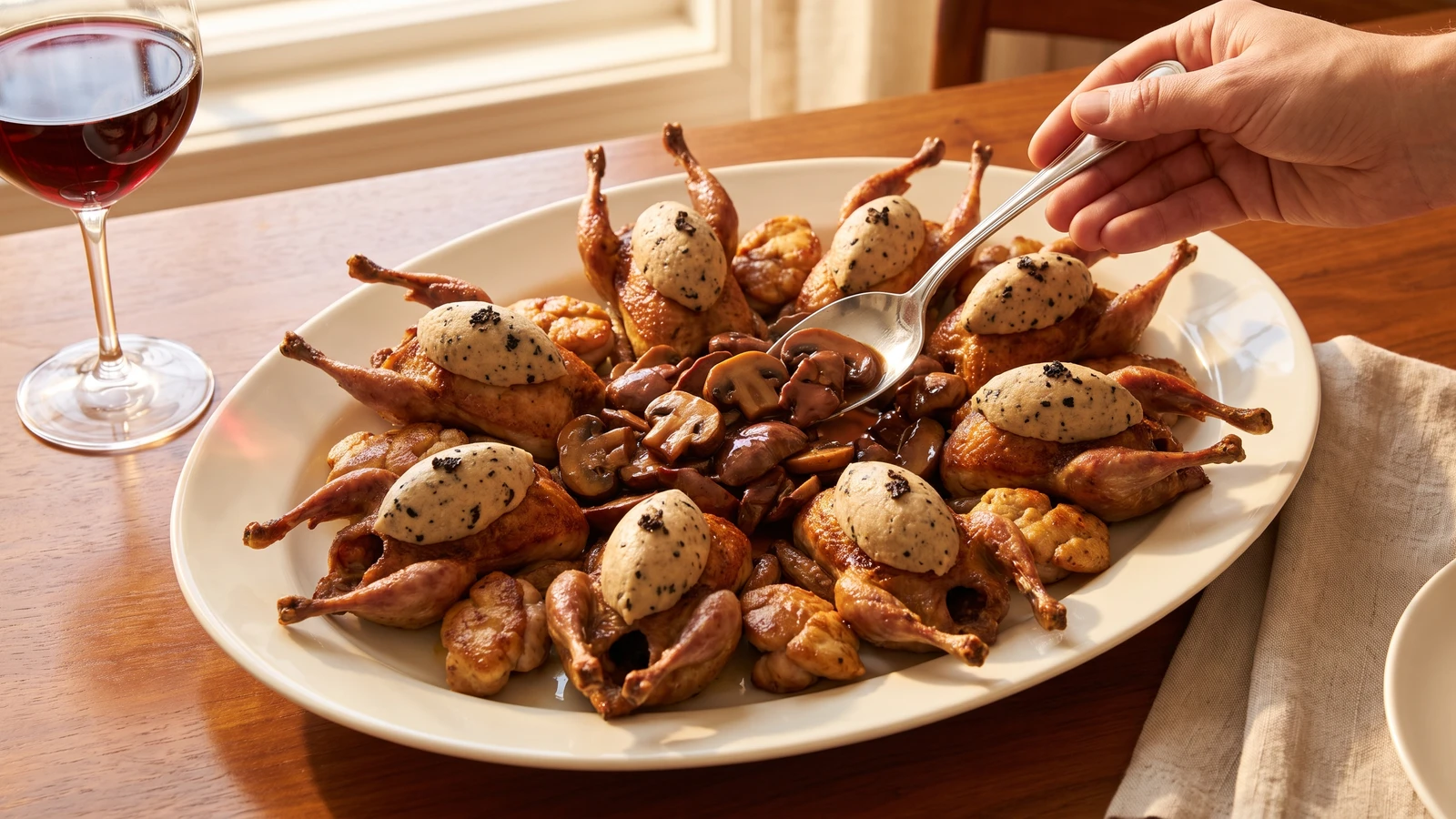
Eight golden squab cutlets, each crowned with truffled godiveau, finished gently in the oven, and ringed with crisp sweetbreads around a glossy Madeira-bound heart of mushrooms and livers.
Côtelettes de Pigeonneaux à la Nesles (squab cutlets domed with truffled forcemeat) teach controlled cooking in layers. The squab receives colour on one side only, cools under light pressure, then finishes beneath a soft crown of godiveau à la crème, a veal-and-cream forcemeat, strengthened with exactly one-third its bulk of farce gratin, a seared liver-and-veal forcemeat. The one true thing is simple: the cutlets must be cold and level before that crown goes on.
The original kitchen could call on a saucier, brown stock never off the fire, a cold room, several pairs of hands, and a salamander for rapid gratins. Here, concentrated gelatin-rich stock replaces the endless stockpot, a food processor replaces the mortar and sieve, two trays make the press, and an ordinary moderate oven completes the light gratin without scorching the forcemeat. Separate brigade stations were scaffolding, so their work is brought into one sequence for one cook, one stove, one evening.
The one-sided frying, the pressing, the three-to-one proportion of godiveau to farce gratin, and the gentle oven poach are the dish itself. They stay. Don't chase a dark crust under the broiler, because the forcemeat must set tenderly while the squab finishes beneath it. Cool and flatten the one-sided sear completely before you spread the truffled dome; that cold, level surface decides the dish.
À la Nesles belongs to the formal Parisian grand-kitchen register rather than to the larder of a particular French region. Its retained claw is not merely ornament: it makes each flattened half-pigeon read as a côtelette, while the truffled forcemeat, breaded sweetbreads, and Madeira-bound garnish show how several specialist preparations once met on a single platter. At the home table, the same composition survives through careful sequencing rather than a full brigade.
Quantity
4, each 14 to 16 ounces (400 to 450 g)
halved lengthwise, retaining one thoroughly cleaned foot and claw on each half when available
Quantity
1 tablespoon (15 ml / 18 g)
divided
Quantity
1 teaspoon (5 ml / 2 g)
divided
Quantity
12 tablespoons (180 ml / 170 g)
divided
Quantity
1 cup (240 ml / 240 g), made from 4¼ ounces (120 g) very cold lean veal, 1½ ounces (45 g) very cold beef suet, 1 large egg white (2 tablespoons / 30 g), and 3 tablespoons (45 ml / 45 g) very cold heavy cream
Quantity
⅓ cup (80 ml / 80 g) finished, made from 1¾ ounces (50 g) calf liver, 1 ounce (25 g) lean veal, and 1 ounce (25 g) fat bacon
Quantity
2 tablespoons (30 ml / 20 g)
finely chopped
Quantity
12 ounces (340 g)
Quantity
2 large eggs (6 tablespoons / 100 g)
beaten
Quantity
1 cup (240 ml / 100 g)
Quantity
3 cups (720 ml / 225 g)
quartered
Quantity
1½ cups (360 ml / 200 g)
trimmed and sliced ⅜ inch (1 cm) thick
Quantity
1 cup (240 ml / 240 g)
Quantity
¼ cup (60 ml / 60 g)
Quantity
1 application of Gratins (No. 268)
| Ingredient | Quantity |
|---|---|
| oven-ready young squabshalved lengthwise, retaining one thoroughly cleaned foot and claw on each half when available | 4, each 14 to 16 ounces (400 to 450 g) |
| fine saltdivided | 1 tablespoon (15 ml / 18 g) |
| ground white pepperdivided | 1 teaspoon (5 ml / 2 g) |
| unsalted butterdivided | 12 tablespoons (180 ml / 170 g) |
| Godiveau à la crème | 1 cup (240 ml / 240 g), made from 4¼ ounces (120 g) very cold lean veal, 1½ ounces (45 g) very cold beef suet, 1 large egg white (2 tablespoons / 30 g), and 3 tablespoons (45 ml / 45 g) very cold heavy cream |
| farce gratin | ⅓ cup (80 ml / 80 g) finished, made from 1¾ ounces (50 g) calf liver, 1 ounce (25 g) lean veal, and 1 ounce (25 g) fat bacon |
| black trufflefinely chopped | 2 tablespoons (30 ml / 20 g) |
| veal sweetbreads | 12 ounces (340 g) |
| large eggsbeaten | 2 large eggs (6 tablespoons / 100 g) |
| fine fresh breadcrumbs | 1 cup (240 ml / 100 g) |
| small button mushroomsquartered | 3 cups (720 ml / 225 g) |
| chicken or squab liverstrimmed and sliced ⅜ inch (1 cm) thick | 1½ cups (360 ml / 200 g) |
| rich unsalted veal or chicken stock | 1 cup (240 ml / 240 g) |
| Madeira | ¼ cup (60 ml / 60 g) |
| Gratins, the moderate-oven finishing operation | 1 application of Gratins (No. 268) |
Soak the sweetbreads in abundant cold water for 2 hours, changing the water once. Put them in a saucepan, cover with fresh cold water, bring slowly to a bare simmer, and blanch for 5 minutes. Transfer them to cold water, peel away the membrane and any coarse tubes, then place them between two trays under about 2 pounds (1 kg) of weight for 30 minutes. Pressing gives the sweetbreads an even shape that can be cut into neat collops.
Simmer the stock in a small saucepan until reduced by half and glossy with its own gelatin. Add the Madeira and continue at a lively simmer until about 6 tablespoons (90 ml) remain and the sauce naps the back of a spoon. If it reduces to a sticky glaze, loosen it with a spoonful of water or stock. Ça se rattrape. Cover and hold it off the heat.
Melt 1 teaspoon of the butter in a small skillet. Add the fat bacon and let it begin to render, then add the veal and calf liver. Cook briskly until the surfaces brown and the centres are just cooked. Cool completely, then process to a smooth, close paste. Weigh out ⅓ cup (80 ml / 80 g). This is the farce gratin, and its finished bulk must remain one-third that of the godiveau.
Chill the food-processor bowl and blade. Process the cold veal with ¼ teaspoon of the measured salt until the meat becomes tacky, then add the cold suet and egg white. With the machine running in short pulses, add 2 tablespoons of the cream gradually; reserve the final tablespoon. The godiveau should be smooth, cohesive, and very cold. If it turns greasy or grainy, stop immediately, chill everything for 10 minutes, then pulse in the reserved cold cream a teaspoon at a time. Ça se rattrape. Fold the 1 cup (240 ml / 240 g) godiveau together with the ⅓ cup (80 ml / 80 g) farce gratin and chopped truffle. Poach a teaspoonful in barely simmering water until firm, taste it, and correct the salt and pepper before chilling the finished topping.
Pat the squab halves thoroughly dry. If the cleaned claws were supplied, leave them attached to serve as the cutlets' bones; wrap their tips loosely in foil during cooking. If your poulterer removed them, retain the lower leg bone as the handle and do not graft on a decorative foot. Lay each half between sheets of parchment and press gently with the heel of your hand until evenly flattened without crushing the bones. Season both sides with salt and white pepper.
Heat 4 tablespoons of butter in a broad skillet over medium-high heat, working in two batches if necessary. When the foam subsides, lay the squab halves skin-side down and fry until that side alone is deep golden, about 3 minutes. Do not turn them. The source method is precise here: only the fried side receives the forcemeat, while the other side completes its cooking in the oven.
Transfer the squab to a clean parchment-lined tray, fried sides up. Cover with another sheet of parchment and a second tray, then add a light weight of about 2 pounds (1 kg). Refrigerate for 25 to 30 minutes, until the halves are cold, flat, and firm. Use slight pressure, not force; you are setting their shape, not squeezing out their juices.
Heat the oven to 325°F (165°C) and butter a rimmed tray with 1 teaspoon of butter. Set the pressed squab on it with their unseared sides down. Divide the truffled forcemeat among them, about 3 generous tablespoons per half, spreading it over each fried side in a smooth dome. If a dome slides, the squab or topping is too warm: wipe away surface butter, chill both for 10 minutes, and shape again. Apply Gratins (No. 268) by baking in the moderate oven for 20 to 25 minutes, until the forcemeat is set at 160°F (71°C) and the deepest part of each squab reaches 165°F (74°C). Do not use the broiler; the dome is meant to poach tenderly, not take a hard crust.
While the squab bakes, cut the pressed sweetbreads into 8 oval collops about ⅜ inch (1 cm) thick. Season lightly, dip each in beaten egg, then coat with the fresh breadcrumbs, pressing gently so they adhere. Melt 3 tablespoons of butter over medium heat and sauté the collops until crisp and golden on both sides, about 2 to 3 minutes per side. Hold them on a warm plate.
Melt 2 tablespoons of butter in the skillet over medium-high heat. Toss the mushrooms until browned and their liquid has cooked away, then remove them. Add another 2 tablespoons of butter and sauté the sliced poultry livers in a single layer until browned and cooked to 165°F (74°C). Return the mushrooms and add the Madeira sauce a tablespoon at a time, using only enough to cohere the garnish into a glossy whole. It must hold together without swimming.
Remove the foil from the claws. Arrange the 8 domed squab cutlets in a circle on a warm oval platter, claws pointing outward, and place a breaded sweetbread collop between each pair. Spoon the Madeira-bound mushrooms and sliced livers into the centre. Keep the pale truffled domes uncovered and bring the platter directly to the table. À table!
1 serving (about 540g)
Culinary guides, cultural storytelling, and the editorial depth that makes cooking meaningful.
Discover Culinary ExplorerChef Juliette
John Dory has the delicacy of sole and the firmness of turbot. A light flouring, a quick butter sauté, and nut-brown beurre noisette show exactly why looks never mattered.

Chef Juliette
Fresh haddock proves its delicacy in the meunière pan: a fine flour crust, moist pearly flakes, and beurre noisette sharpened with lemon and parsley, ready from one skillet in half an hour.

Chef Juliette
Éperlans à l’Anglaise turns small fish into a lesson in disciplined coating: boned smelts under a close, crisp crumb, pan-fried in clarified butter and finished with bright, half-melted maître d’hôtel butter.

Chef Juliette
Tiny smelts, shallot, mushrooms, white wine, gratin sauce, and fine bread raspings meet a fierce oven, where the fish must turn tender in the same breath the buttered crust bronzes.