
Chef Juliette
Caneton Nantais à la Choucroûte
A whole Nantes duckling, browned and gently braised with Rhine wine, carved over choucroute glazed nearly dry with salt pork, then finished beneath a restrained veil of glossy veal sauce.
A cooking platform built around craft, culture, and the stories behind what we eat.
Created by Chef Juliette
Based on No. 1780, Pigeonneaux en Compote, from Le Guide Culinaire (1907) by Auguste Escoffier
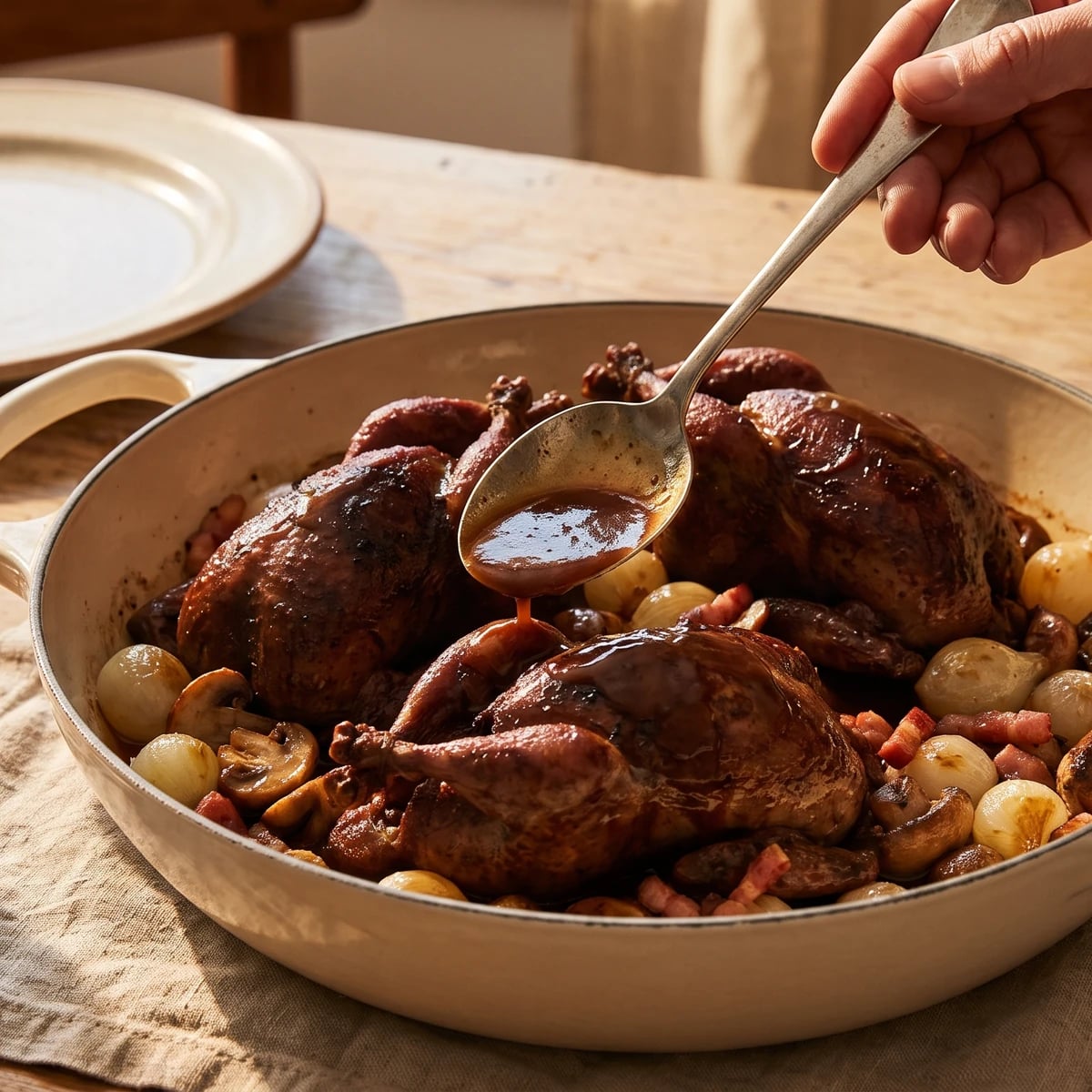
Young pigeons browned in butter, then braised with white wine, brown stock, tomatéd half-glaze, bacon, mushrooms, and glazed onions until every bird wears a deep, clinging sauce.
Pigeonneaux en Compote (young pigeons braised with bacon, mushrooms, and glazed onions) teaches reduction as judgment, not a clock. Before you touch a pan, know this: the birds may be cooked before the sauce has fallen by half, and you must remove them rather than sacrifice tender meat to the saucepan. The sauce can finish alone, then return to the birds and cling.
The original recipe assumed a saucier, brown stock never off the fire, ready half-glaze, and enough pans to transfer everything without thought. At home, four squabs fit a snug braiser, good prepared brown stock supplies the foundation, and pourable demi-glace tomatéd with purée supplies the half-glaze. The separate finishing saucepan is brigade scaffolding, so a wiped braiser and fine sieve replace it. What stays is the dish itself: browning in butter, reducing the wine, equal measures of stock and half-glaze, six glazed onions for every bird, and a sauce reduced by half.
The finished Pigeonneaux en Compote should arrive glossy and abundant, the browned birds surrounded by little onions, mushrooms, and salt pork, with no watery moat beneath them. Choose a pot that holds the birds closely and watch the sauce level as carefully as the cooking meat. That reduction decides the dish.
Pigeonneaux en Compote belongs to the Parisian classical entrée table, where tender young pigeon was paired with the bourgeois garnish of salt pork, mushrooms, and many little onions. It moved between well-supplied household kitchens and the grand kitchen, which kept the brown stock and half-glaze needed to give a short braise remarkable depth. Compote here does not mean fruit; it describes the bird and its garnishes simmered together until they form one mellow, composed whole.
Quantity
4, about 14 to 16 ounces (400 to 450 g) each
giblets removed
Quantity
6 tablespoons (90 ml / 85 g)
divided
Quantity
⅓ cup (80 ml / 57 g), prepared by Blanchings (No. 273)
drained well and cut into ½-inch (1 cm) lardons
Quantity
¾ cup (180 ml / 57 g)
peeled and quartered
Quantity
½ cup (120 ml / 120 g)
Quantity
3 cups (710 ml / 710 g)
warmed
Quantity
3 cups (710 ml / about 750 g), made from 2⅞ cups (680 ml / 720 g) pourable demi-glace and 2 tablespoons (30 ml / 32 g) tomato purée
Quantity
1
tied
Quantity
24, about 10 ounces (285 g)
peeled
Quantity
¾ cup (180 ml / 180 g)
for glazing the onions
Quantity
as needed
| Ingredient | Quantity |
|---|---|
| dressed squabs (young pigeons)giblets removed | 4, about 14 to 16 ounces (400 to 450 g) each |
| unsalted butterdivided | 6 tablespoons (90 ml / 85 g) |
| salted pork breastdrained well and cut into ½-inch (1 cm) lardons | ⅓ cup (80 ml / 57 g), prepared by Blanchings (No. 273) |
| small raw button mushroomspeeled and quartered | ¾ cup (180 ml / 57 g) |
| dry white wine | ½ cup (120 ml / 120 g) |
| prepared unsalted brown stockwarmed | 3 cups (710 ml / 710 g) |
| prepared half-glaze sauce (tomatéd) | 3 cups (710 ml / about 750 g), made from 2⅞ cups (680 ml / 720 g) pourable demi-glace and 2 tablespoons (30 ml / 32 g) tomato purée |
| bouquet garni of parsley stems, thyme, and bay leaftied | 1 |
| small pearl onionspeeled | 24, about 10 ounces (285 g) |
| waterfor glazing the onions | ¾ cup (180 ml / 180 g) |
| fine salt | as needed |
Pat the squabs thoroughly dry. Tuck each pair of wing tips beneath the back, draw the legs close to the body, and secure them with kitchen twine so the birds brown evenly and keep their shape. Season them lightly with salt, remembering that the pork and half-glaze bring salt of their own. Combine the pourable demi-glace and tomato purée to make 3 cups of half-glaze sauce (tomatéd); the tomato should be distinctly visible in both colour and flavour without turning the sauce into tomato sauce. Warm this and the brown stock separately.
Put the 24 pearl onions in a 10-inch skillet with 2 tablespoons of the butter, the water, and a small pinch of salt. Cover and simmer gently until nearly tender, 10 to 12 minutes, then uncover and roll the onions through the butter as the water evaporates. They are ready when tender and evenly lacquered with pale brown butter. If the liquid disappears while the centres are still firm, add another spoonful of water and continue. Ça se rattrape. Transfer the onions to a plate.
Melt the remaining 4 tablespoons of butter in a snug, heavy braiser over medium heat. Add the salted pork breast prepared by Blanchings (No. 273) and fry until its edges begin to colour and its fat turns translucent. Add the quartered mushrooms and cook until they lose their raw whiteness and take a little bronze at the edges. Lift both out with a slotted spoon and drain them, leaving the butter and browned film in the braiser.
Raise the heat to medium-high and brown the squabs in the same butter, working two at a time if necessary so the pot never crowds. Turn them patiently until the breasts, backs, and legs are a deep butter-gold. Pale birds give nothing to the sauce. If the butter darkens too quickly, lower the heat and keep turning; browned milk solids are welcome, black ones are bitter. Lift the squabs out and let the excess butter drain away.
Pour off excess fat while leaving the brown fond attached to the pot. Add the white wine and scrape the base clean with a wooden spoon, then boil until the wine has reduced to a glossy few spoonfuls. Pour in the warm brown stock and an equal volume of half-glaze sauce (tomatéd), add the bouquet garni, and settle in the squabs. The liquid should just cover them in a snug pot. Note its starting level, then hold the braise uncovered at a quiet simmer until the liquid has fallen by half and each bird reaches at least 165°F (74°C) in the thickest part of the thigh, usually 30 to 45 minutes. Check from 25 minutes onward. If the birds finish first, lift them out and reduce the sauce alone; if the sauce reaches half first, lower the heat and finish the birds gently in it. Ça se rattrape, and tender pigeon matters more than obedience to the clock.
Transfer the squabs to a warm platter and discard the bouquet garni. Pass the sauce through a fine sieve into the wiped braiser, skimming away any obvious surface fat. Return the squabs, then add the fried salt pork, mushrooms, and all 24 glazed onions. Simmer gently for exactly 10 minutes so the garnish takes up the sauce. The finished sauce must nap the back of a spoon and cling to the birds. If it remains thin, lift out the birds and garnish and reduce it harder for a few minutes. If it tightens too far, loosen it one tablespoon at a time with warm brown stock. Never apologize for a sauce that needed correction; correct it.
Remove the twine and arrange one squab per person in the hot serving dish. Spoon six glazed onions around each bird, divide the mushrooms and salt pork fairly, and coat everything generously with the reduced sauce. Bring the dish to the table at once, with the remaining sauce pooled beneath the birds. À table!
1 serving (about 560g)
Culinary guides, cultural storytelling, and the editorial depth that makes cooking meaningful.
Discover Culinary Explorer
Chef Juliette
A whole Nantes duckling, browned and gently braised with Rhine wine, carved over choucroute glazed nearly dry with salt pork, then finished beneath a restrained veil of glossy veal sauce.

Chef Juliette
A butter-poêled Aylesbury duckling, bronzed only after its covered roast, with mint inside and clear veal gravy brightened by lemon. The lesson is simple: poêlé means butter, a lid, and no added liquid.

Chef Juliette
Caneton Molière rebuilds a boned duckling around foie gras, pork, and two truffle rows, then poaches it in carcass stock before a glossy Madeira finish. The lesson is cold filling, even shaping, and gentle heat.

Chef Juliette
Caneton Braisé aux Navets turns one cocotte into a lesson in glazing: burnished duck, pearl onions, and turnips carried to light brown before they finish in a glossy classical sauce.