
Chef Juliette
John Dory (St. Pierre)
John Dory has the delicacy of sole and the firmness of turbot. A light flouring, a quick butter sauté, and nut-brown beurre noisette show exactly why looks never mattered.
A cooking platform built around craft, culture, and the stories behind what we eat.
Created by Chef Juliette
Based on No. 1777, Pigeonneaux en Casserole à la Paysanne, from Le Guide Culinaire (1907) by Auguste Escoffier
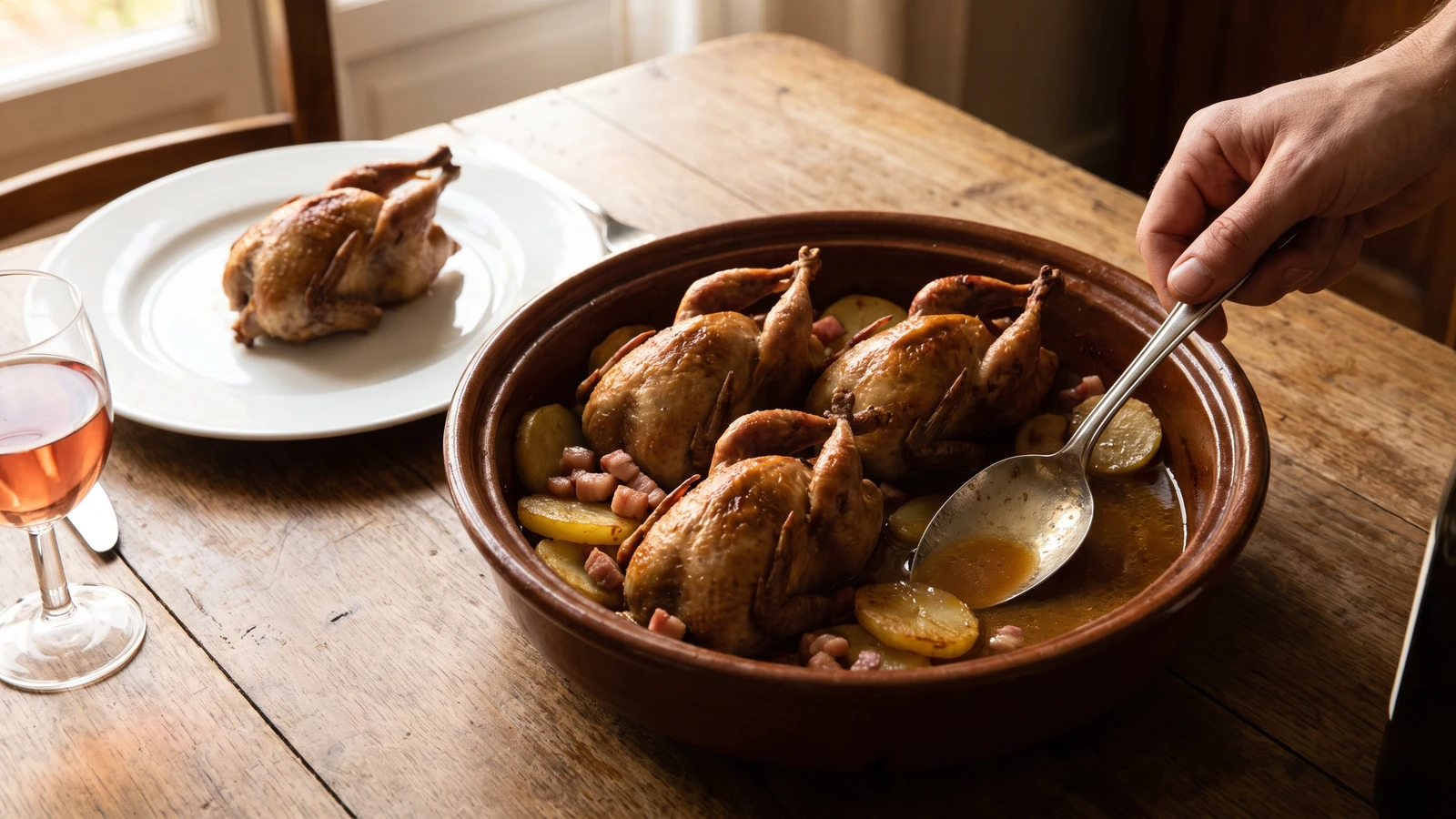
Four squabs roast without liquid in a buttered casserole, then meet their paysanne garnish of salt pork and golden potatoes before a little good gravy gathers every browned juice.
Pigeonneaux en Casserole à la Paysanne (country-style squabs in a casserole) teaches the discipline of dry casserole roasting. The one true thing to know before touching the pan is this: no liquid enters while the birds cook. Butter, a close-fitting lid, and the squabs' own juices keep the flesh succulent while the casserole builds a concentrated fond underneath.
The original formula assumed an earthenware saucepan, several birds moving through service, and a saucier with good gravy always ready. For four at home, a heavy lidded casserole replaces the old earthenware vessel, and a small measure of rich poultry gravy replaces the stockpot that never left the fire. The source proportions remain exact: one and one-half ounces of salted pork and two ounces of potatoes for every pigeon. Maintaining a sauce station was brigade scaffolding and can go; Blanchings (No. 273), sautéing the potatoes, and adding both only when the birds are two-thirds cooked are the dish itself and must stay. One cook, one stove, one evening.
When it is right, the squabs arrive burnished and compact, surrounded by butter-gold potato slices and little dice of pork, with just enough gravy to gather the casserole juices. Watch the timing of the garnish. Add it too soon and the potatoes dry before the birds are ready; add it too late and it never takes on the flavor of the pot.
Pigeonneaux en Casserole à la Paysanne sits in the French cuisine bourgeoise repertoire rather than belonging to one province: households with access to dovecotes roasted young pigeons in covered earthenware and used salt pork and potatoes to carry their juices. In the Parisian classical kitchen, that household method became a named casserole formula, but à la paysanne still described the garnish, not an imagined rustic region. Its restraint is deliberate: the bird cooks without moistening, and gravy enters only when the dish is ready to serve.
Quantity
4, about 1 pound (450 g) each
Quantity
1¼ cups (300 ml / 170 g), prepared according to Blanchings (No. 273)
cut into small dice
Quantity
2 cups (475 ml / 225 g)
peeled and sliced ¼ inch (6 mm) thick
Quantity
4 tablespoons (60 ml / 57 g)
softened and divided
Quantity
½ teaspoon (2.5 ml / 3 g)
Quantity
½ teaspoon (2.5 ml / 1 g)
Quantity
⅓ cup (80 ml / 80 g)
heated
| Ingredient | Quantity |
|---|---|
| oven-ready domestic squabs | 4, about 1 pound (450 g) each |
| salted breast of pork or unsmoked salt porkcut into small dice | 1¼ cups (300 ml / 170 g), prepared according to Blanchings (No. 273) |
| waxy potatoespeeled and sliced ¼ inch (6 mm) thick | 2 cups (475 ml / 225 g) |
| unsalted buttersoftened and divided | 4 tablespoons (60 ml / 57 g) |
| fine sea salt | ½ teaspoon (2.5 ml / 3 g) |
| freshly ground black pepper | ½ teaspoon (2.5 ml / 1 g) |
| rich poultry gravyheated | ⅓ cup (80 ml / 80 g) |
Heat the oven to 400°F (200°C) with a rack in the center. Pat the squabs thoroughly dry, including their cavities, then tuck the wing tips underneath and tie the legs together loosely. Season inside and out with the salt and pepper. Rub 1 tablespoon (15 ml / 14 g) of the butter over the birds and use another 1 tablespoon (15 ml / 14 g) to coat the bottom and sides of a heavy lidded casserole. Arrange the squabs breast-side up in one snug layer and cover.
Roast the covered squabs for 18 to 22 minutes without adding water, wine, stock, or gravy. This closed, dry oven cooking is the principle of the dish. At the two-thirds point, the skins will be pale gold, the casserole will hold a little clear butter and concentrated bird juice, and an instant-read thermometer inserted into the breast should read roughly 125 to 135°F (52 to 57°C). Do not keep opening the lid; every inspection throws away the gentle heat protecting the breasts.
While the squabs roast, prepare the diced salted breast of pork according to Blanchings (No. 273), then drain and dry it thoroughly. Melt the remaining 2 tablespoons (30 ml / 28 g) butter in a wide skillet over medium-high heat. Sauté the potato slices in one layer, working in batches if necessary, until lightly golden on both sides and nearly tender, 6 to 8 minutes. Turn them carefully so they keep their shape, then lift them from the skillet. Do not salt them; the pork and gravy will bring enough.
Remove the casserole lid and reduce the oven to 375°F (190°C). Surround the squabs with the blanched pork dice and sautéed potatoes, turning the garnish once through the butter and juices without covering the birds. Return the casserole to the oven uncovered and cook gently for 12 to 18 minutes, rotating the vessel once, until the potatoes are tender and both the thickest breast and inner thigh of each squab register 165°F (74°C). If the potatoes brown before the birds are ready, lift them to a warm plate and return them for the final 2 minutes. Ça se rattrape. Do not add liquid to slow the browning; lower the oven to 350°F (175°C) and cover loosely instead.
Lift the squabs, pork, and potatoes temporarily to a warm dish and let the birds rest while the gravy is finished. Spoon off any large pool of clear fat from the casserole, leaving the brown cooking juices behind. Pour in the hot poultry gravy and scrape the casserole floor with a wooden spoon until every trace of fond has joined it. If the vessel is flameproof, warm it over medium heat for 1 to 2 minutes; otherwise, the retained oven heat is sufficient. The gravy should gleam and pool lightly, not drown the garnish. Taste before adding any salt.
Return the squabs to the casserole and arrange the potatoes and pork around them. Spoon the gravy beneath and around the birds so their browned skins remain visible. Serve one squab per person directly from the casserole. À table!
1 serving (about 285g)
Culinary guides, cultural storytelling, and the editorial depth that makes cooking meaningful.
Discover Culinary ExplorerChef Juliette
John Dory has the delicacy of sole and the firmness of turbot. A light flouring, a quick butter sauté, and nut-brown beurre noisette show exactly why looks never mattered.

Chef Juliette
Fresh haddock proves its delicacy in the meunière pan: a fine flour crust, moist pearly flakes, and beurre noisette sharpened with lemon and parsley, ready from one skillet in half an hour.

Chef Juliette
Éperlans à l’Anglaise turns small fish into a lesson in disciplined coating: boned smelts under a close, crisp crumb, pan-fried in clarified butter and finished with bright, half-melted maître d’hôtel butter.

Chef Juliette
Tiny smelts, shallot, mushrooms, white wine, gratin sauce, and fine bread raspings meet a fierce oven, where the fish must turn tender in the same breath the buttered crust bronzes.