
Chef Juliette
John Dory (St. Pierre)
John Dory has the delicacy of sole and the firmness of turbot. A light flouring, a quick butter sauté, and nut-brown beurre noisette show exactly why looks never mattered.
A cooking platform built around craft, culture, and the stories behind what we eat.
Created by Chef Juliette
Based on No. 1773, Timbale de Caneton à la Voisin, from Le Guide Culinaire (1907) by Auguste Escoffier
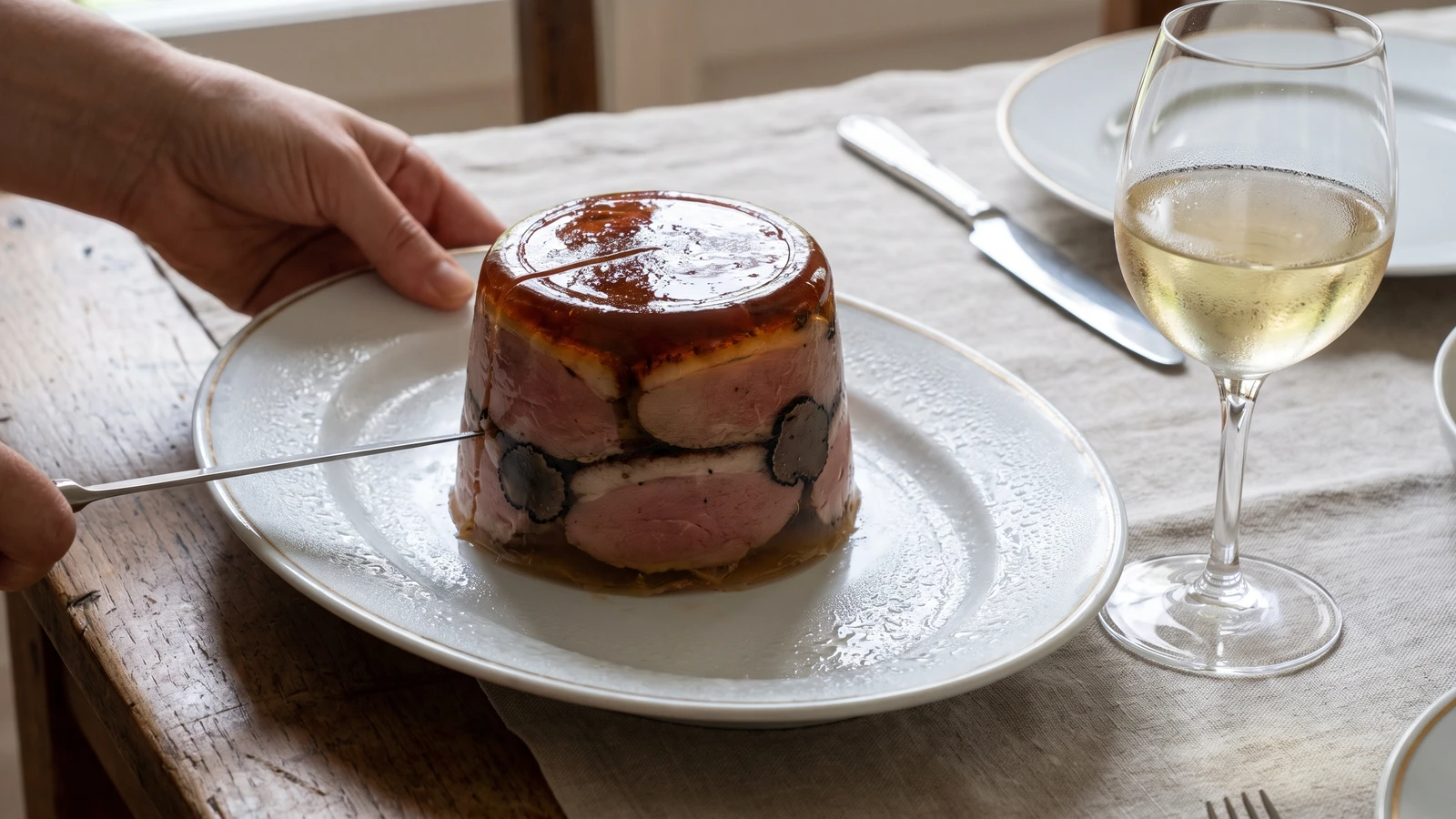
A cold salmis built layer by layer: rosy duck breast, truffle, glossy sauce, and clear aspic held until each setting is firm, then unmolded for a generous make-ahead table.
Timbale de Caneton à la Voisin (roast duck breast layered cold with carcass sauce, truffle, and aspic) teaches the discipline of setting. Before you touch a pan, know this: every layer must be fully firm and the next pour cool enough not to melt it. The architecture is simple, but impatience shows at the first slice.
The original kitchen assumed a saucier on staff, a stock never off the fire, a supply of finished aspic, and a cold room within steps of the salamander. At home, one duck, a good clear stock strengthened with powdered gelatin, a refrigerator, and a 1.2 litre metal mold do the same work. I have cut the brigade quantity to four servings and replaced the standing aspic pot with measured gelatin because those are service scaffolding; the carcass reduction, the coating of every breast slice, the truffle, and the firm set between layers are the dish and they stay.
Done properly, the timbale turns out in one glossy piece, amber aspic revealing rosy duck and black truffle, with the wine-dark salmis holding each slice close. This is one cook, one stove, one evening of work, then a night in the cold and a table already half prepared for tomorrow. Guard the temperature of each pour; if a mixture sets too quickly or threatens the layer beneath, ça se rattrape, and the method tells you where.
Timbale de Caneton à la Voisin belongs to the Parisian grand-kitchen repertory, while its Rouen duckling comes from Normandy and the lower Seine, where ducks prized for fine flesh supplied city tables. The method carries salmis, the carcass-built sauce traditionally used to finish roasted game, from hot service into the cold entrée by adding aspic and layering it with truffle. Despite the word timbale, this is neither a pastry case nor a forcemeat, but simply a cold salmis molded for clean service.
Quantity
1, about 4 lb (1.8 kg)
giblets removed
Quantity
2 teaspoons (10 ml / 12 g)
divided
Quantity
1 teaspoon (5 ml / 2 g)
divided
Quantity
2 tablespoons (30 ml / 28 g)
Quantity
⅔ cup (160 ml / 100 g)
thinly sliced
Quantity
½ cup (120 ml / 70 g)
finely diced
Quantity
1½ cups (375 ml / 375 g)
Quantity
4 cups (950 ml / 950 g)
divided
Quantity
1
1 parsley stem, 1 thyme sprig, and 1 small bay leaf
Quantity
½ cup (120 ml / 120 g)
Quantity
2 tablespoons plus 2 teaspoons (40 ml / 24 g)
Quantity
1 small, about 1½ oz (40 g)
cut into paper-thin slices
| Ingredient | Quantity |
|---|---|
| Rouen duckling or Pekin duckgiblets removed | 1, about 4 lb (1.8 kg) |
| fine sea saltdivided | 2 teaspoons (10 ml / 12 g) |
| freshly ground black pepperdivided | 1 teaspoon (5 ml / 2 g) |
| unsalted butter | 2 tablespoons (30 ml / 28 g) |
| shallotsthinly sliced | ⅔ cup (160 ml / 100 g) |
| carrotfinely diced | ½ cup (120 ml / 70 g) |
| dry red wine | 1½ cups (375 ml / 375 g) |
| clear low-sodium duck or chicken stockdivided | 4 cups (950 ml / 950 g) |
| bouquet garni1 parsley stem, 1 thyme sprig, and 1 small bay leaf | 1 |
| cold water | ½ cup (120 ml / 120 g) |
| unflavored powdered gelatin | 2 tablespoons plus 2 teaspoons (40 ml / 24 g) |
| whole black truffle, fresh or preservedcut into paper-thin slices | 1 small, about 1½ oz (40 g) |
Heat the oven to 450°F (230°C). Pat the duck completely dry, then season it inside and out with half the salt and pepper. Set it breast-side up on a rack in a roasting pan and roast for 15 minutes. Lower the heat to 375°F (190°C) and continue for 25 to 35 minutes, beginning to check early, until the thickest part of the breast reaches 145°F (63°C). Rest it for 8 minutes before carving; the breast should remain rosy because it will be served cold, while the legs and carcass will cook fully in the sauce. For anyone at increased risk from undercooked poultry, roast the breast to 165°F (74°C).
Lift each breast from the warm carcass in one whole fillet, following the breastbone closely with a narrow knife. Remove the skin so no cold, soft layer of fat remains beneath the sauce. Put the breasts on a rack for 15 minutes, then refrigerate them uncovered until thoroughly cold, about 45 minutes; keep their total time at room temperature under 2 hours. Cut the legs and wings away and break the carcass into several pieces with sturdy kitchen shears.
Melt the butter in a heavy saucepan over medium-high heat. Add the carcass pieces, legs, and wings, then brown them deeply for 8 to 10 minutes. Add the shallots and carrot and cook until gilded at the edges. Pour off excess duck fat but leave the browned fond in the pan. Add the wine, scrape that fond loose, and boil until the wine has reduced to about ½ cup (120 ml). Add 2 cups (475 ml / 475 g) of the stock and the bouquet garni, then simmer gently for 45 minutes. Strain into a clean saucepan, discard the solids, skim away every trace of surface fat, and reduce the liquid to 1 cup (240 ml). Season with some of the remaining salt and pepper. The reduction should taste concentrated but balanced, since the aspic will soften it.
Sprinkle the gelatin evenly over the cold water and leave it for 10 minutes to bloom. Warm the remaining 2 cups (475 ml / 475 g) stock until just below a simmer, season it slightly more firmly than you would a hot broth, then remove it from the heat and stir in the bloomed gelatin until completely dissolved. Do not boil it. Stir ½ cup (120 ml) of this aspic into the salmis reduction, creating a chaud-froid, a sauce prepared warm and served set cold. Reserve ½ cup (120 ml) of the salmis sauce for the mold base. Set the rest over an ice bath and stir until it reaches nappe, the point where it coats a spoon thickly without setting into ridges. If it becomes lumpy or firm, warm the bowl briefly over hot water and stir it smooth. If it runs straight off the spoon, return it to the ice bath. Ça se rattrape.
Cut the cold breast fillets across the grain on a slight bias into slices about ¼ inch (6 mm) thick. Dip each slice into the salmis sauce, coating both sides, then lift it with a fork and let the excess drain before placing it on a chilled parchment-lined tray. Do not stack the pieces. Refrigerate for 10 to 15 minutes, until the coating is firm to a light touch. If the sauce puddles beneath the duck, scrape it back into the bowl, cool it for another minute over ice, and coat the bare surfaces again.
Rinse a 1¼-quart (1.2 litre) metal timbale or charlotte mold with very cold water, drain it without wiping, and refrigerate it for 10 minutes. Pour the reserved ½ cup (120 ml) salmis sauce into the bottom, tilting the mold only enough to level it. Refrigerate for about 15 minutes, until completely firm. This base becomes the glossy crown when the timbale is unmolded, so set the mold on a level shelf.
Cool the clear aspic until it is barely fluid and feels cool, not warm. If it has set, stand its container briefly in warm water and stir gently until liquid. Arrange a close layer of coated duck slices over the firm sauce base, overlapping them slightly and alternating them with truffle slices. Spoon over only enough aspic to fill the spaces and cover the surface by about ⅛ inch (3 mm), then refrigerate for 12 to 15 minutes, until firm. Repeat with the remaining duck and truffle, setting every thin aspic layer before the next row goes on. Finish with a thicker layer of aspic, about ⅜ inch (1 cm). If a duck slice floats, the aspic is too warm or the layer beneath is too soft; hold the slice down with a chilled spoon, refrigerate for 5 minutes, then add the remaining aspic. Do not pour ahead. The separate, fully set layers are the dish.
Cover the mold once its surface has set and refrigerate for at least 6 hours, preferably overnight. To unmold, dip only the outside of the mold into hot water for 5 to 8 seconds, wipe it dry, place a chilled platter over it, and invert in one confident movement. If it clings, wrap the mold in a hot damp towel for another 5 seconds; do not run a knife around the aspic. If the timbale feels soft, return it to the refrigerator in its mold for another hour. Cut it with a thin knife dipped in hot water and wiped dry between slices. Serve cold with dressed bitter leaves and bread alongside. À table!
1 serving (about 440g)
Culinary guides, cultural storytelling, and the editorial depth that makes cooking meaningful.
Discover Culinary ExplorerChef Juliette
John Dory has the delicacy of sole and the firmness of turbot. A light flouring, a quick butter sauté, and nut-brown beurre noisette show exactly why looks never mattered.

Chef Juliette
Fresh haddock proves its delicacy in the meunière pan: a fine flour crust, moist pearly flakes, and beurre noisette sharpened with lemon and parsley, ready from one skillet in half an hour.

Chef Juliette
Éperlans à l’Anglaise turns small fish into a lesson in disciplined coating: boned smelts under a close, crisp crumb, pan-fried in clarified butter and finished with bright, half-melted maître d’hôtel butter.

Chef Juliette
Tiny smelts, shallot, mushrooms, white wine, gratin sauce, and fine bread raspings meet a fierce oven, where the fish must turn tender in the same breath the buttered crust bronzes.