
Chef Juliette
John Dory (St. Pierre)
John Dory has the delicacy of sole and the firmness of turbot. A light flouring, a quick butter sauté, and nut-brown beurre noisette show exactly why looks never mattered.
A cooking platform built around craft, culture, and the stories behind what we eat.
Created by Chef Juliette
Based on No. 1770, Mousse de Caneton Rouennais, from Le Guide Culinaire (1907) by Auguste Escoffier
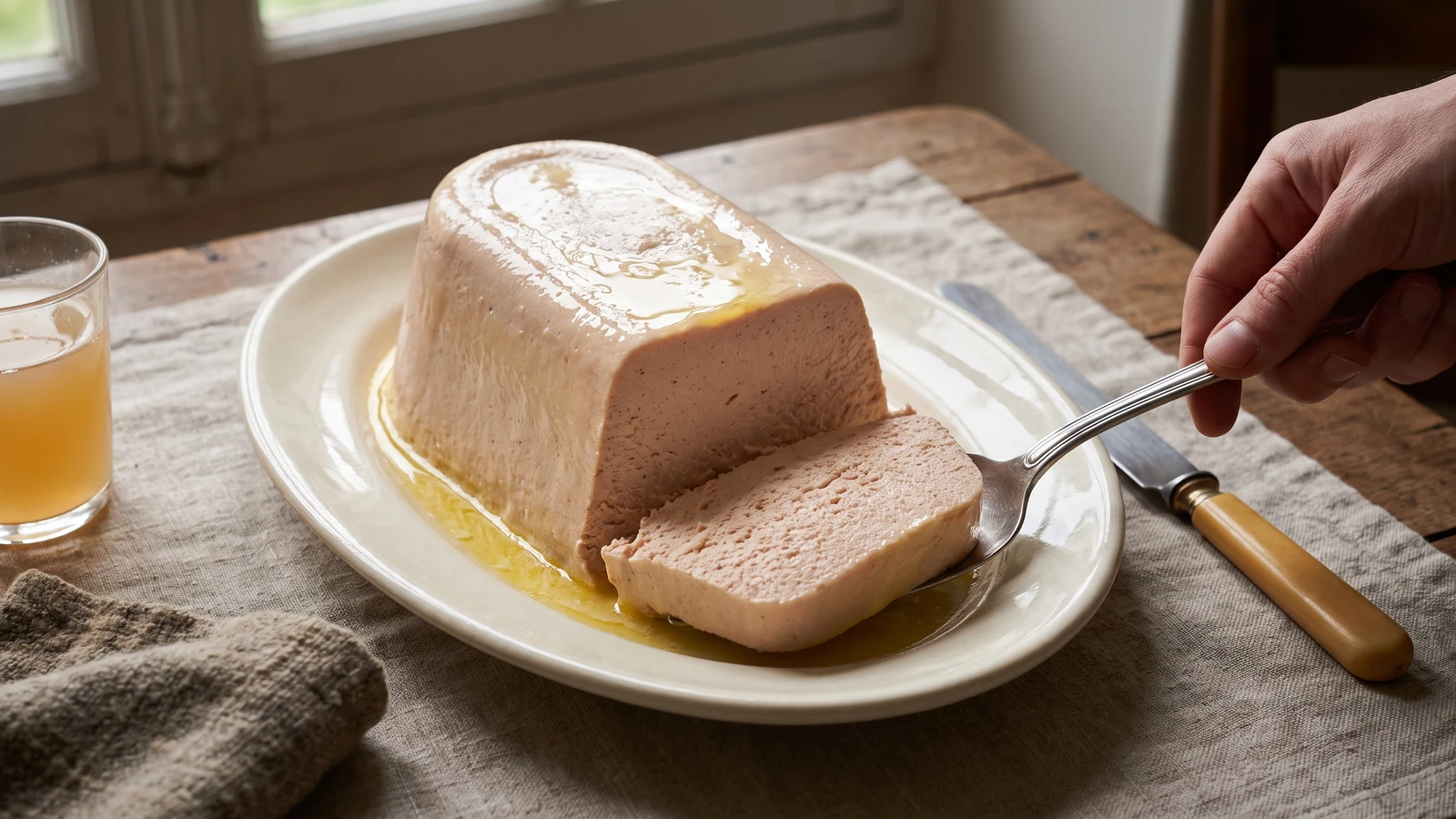
Mousse de Caneton Rouennais turns cold duck mousseline into one generous, sliceable form, gently set in a bain-marie. Keep the emulsion cold and the cooking quiet, and four guests receive it together.
Mousse de Caneton Rouennais (moulded Rouen duckling mousseline) teaches one uncompromising principle: the forcemeat must remain cold enough to hold its emulsion. The forcemeat and the mould are the dish. Keep the first cold, fill the second without trapping air, and the finished mousse will be fine-grained, tender, and rich with duck rather than heavy with separated fat.
The classical kitchen surrounding this entry might have had a saucier, a stockpot never off the fire, and a salamander within reach, but this formula calls on none of them. Its actual brigade scaffolding was a ready batch of poultry mousseline and enough hands to prepare several moulds. At home, the honest equivalent is one cold 800-gram batch, one 1-litre mould, and the steady heat of an oven bain-marie. We change the quantity and the heat source, not the method. One cook, one stove, one evening.
The reward comes to the table whole, pale rose-beige and lightly glossy with butter, then opens under the knife into four generous slices. Before the pan of water is filled, remember the deciding step: keep the mousseline cold until the mould is packed.
Rouen duckling belongs to Rouen and the lower Seine in Normandy, where its deeply flavoured flesh has long been valued at both prosperous home tables and in the grand kitchen repertory. In classical vocabulary, Mousses are moulded large for several people, while mousselines are individual, quenelle-like portions. The Rouen character of this formula comes from the bird itself, not from additions of apples, Calvados, or Norman cream; it is the established poultry mousse method given intact to duckling.
Quantity
1 batch, about 3⅓ cups (800 ml / 800 g), from Mousses et Mousselines de Volaille (No. 1670)
prepared with Rouen duckling as the principal meat and kept cold
Quantity
1 tablespoon (15 ml / 14 g)
softened, for the mould
| Ingredient | Quantity |
|---|---|
| duck mousseline forcemeatprepared with Rouen duckling as the principal meat and kept cold | 1 batch, about 3⅓ cups (800 ml / 800 g), from Mousses et Mousselines de Volaille (No. 1670) |
| unsalted buttersoftened, for the mould | 1 tablespoon (15 ml / 14 g) |
Set the cold duck mousseline forcemeat made through Mousses et Mousselines de Volaille (No. 1670) over a bowl of ice while you prepare the mould. Poach a teaspoonful in barely simmering water until completely cooked, about 2 minutes. It should hold together with a tender, fine texture. If it feathers at the edges or feels slack, the mixture has warmed; chill it for 15 minutes and test again. Ça se rattrape. If visible beads of fat still escape, the emulsion must be corrected within the referenced preparation before you continue.
Heat the oven to 325°F (165°C). Butter a 1-litre metal charlotte mould or straight-sided soufflé dish thoroughly, reaching into the lower edge and coating the rim. Cut a parchment circle to fit the top and butter one side lightly. Chill the prepared mould for 5 minutes so its butter firms.
Spoon the cold mousseline into the mould in several additions, pressing each one firmly against the bottom and sides with a cold spatula. This removes hidden air pockets without beating warmth into the mixture. Tap the mould twice against a folded towel, level the top, and cover it with the parchment, buttered side down, followed by a snug lid or foil. One large mould is essential here: it makes a mousse for the table rather than separate mousselines for each plate.
Place a folded kitchen towel in a deep roasting pan and stand the mould on it. Pour very hot water around the mould until it reaches halfway up the sides, then transfer the pan carefully to the oven. The bain-marie must remain calm, with only an occasional tremble at the edge. If the water begins bubbling hard, lower the oven and add a small glass of cold water to the pan. Ça se rattrape, provided you quiet the heat promptly.
Cook for 45 to 55 minutes, until the mousse pulls very slightly from the edge, springs gently beneath a fingertip, and reaches 165°F (74°C) at its centre. Test through the covering with an instant-read thermometer and don't rely on colour, since duck mousseline remains softly rosy beige when safely cooked. If the centre is not ready after 55 minutes, cover it again and continue in 5-minute intervals without raising the heat.
Lift the mould from the water and let it rest, still covered, for 10 minutes. Remove the covering, run a thin knife only around the upper edge, and invert the mousse onto a warm oval platter. If it clings, don't shake it apart. Dip the base of the mould into the hot bain-marie for 5 seconds, dry it, and invert again; the butter will release its hold.
Carry the mousse to the table whole and cut it into four thick portions with a warm, clean knife. The source entry specifies no sauce, garnish, or additional flavouring, so none is invented here; any accompanying classical sauce remains a separate preparation. Serve promptly while the texture is tender and the butter still gives the surface its sheen. À table!
1 serving (about 190g)
Culinary guides, cultural storytelling, and the editorial depth that makes cooking meaningful.
Discover Culinary ExplorerChef Juliette
John Dory has the delicacy of sole and the firmness of turbot. A light flouring, a quick butter sauté, and nut-brown beurre noisette show exactly why looks never mattered.

Chef Juliette
Fresh haddock proves its delicacy in the meunière pan: a fine flour crust, moist pearly flakes, and beurre noisette sharpened with lemon and parsley, ready from one skillet in half an hour.

Chef Juliette
Éperlans à l’Anglaise turns small fish into a lesson in disciplined coating: boned smelts under a close, crisp crumb, pan-fried in clarified butter and finished with bright, half-melted maître d’hôtel butter.

Chef Juliette
Tiny smelts, shallot, mushrooms, white wine, gratin sauce, and fine bread raspings meet a fierce oven, where the fish must turn tender in the same breath the buttered crust bronzes.