
Chef Juliette
John Dory (St. Pierre)
John Dory has the delicacy of sole and the firmness of turbot. A light flouring, a quick butter sauté, and nut-brown beurre noisette show exactly why looks never mattered.
A cooking platform built around craft, culture, and the stories behind what we eat.
Created by Chef Juliette
Based on No. 1760, Caneton Rouennais au Porto, from Le Guide Culinaire (1907) by Auguste Escoffier
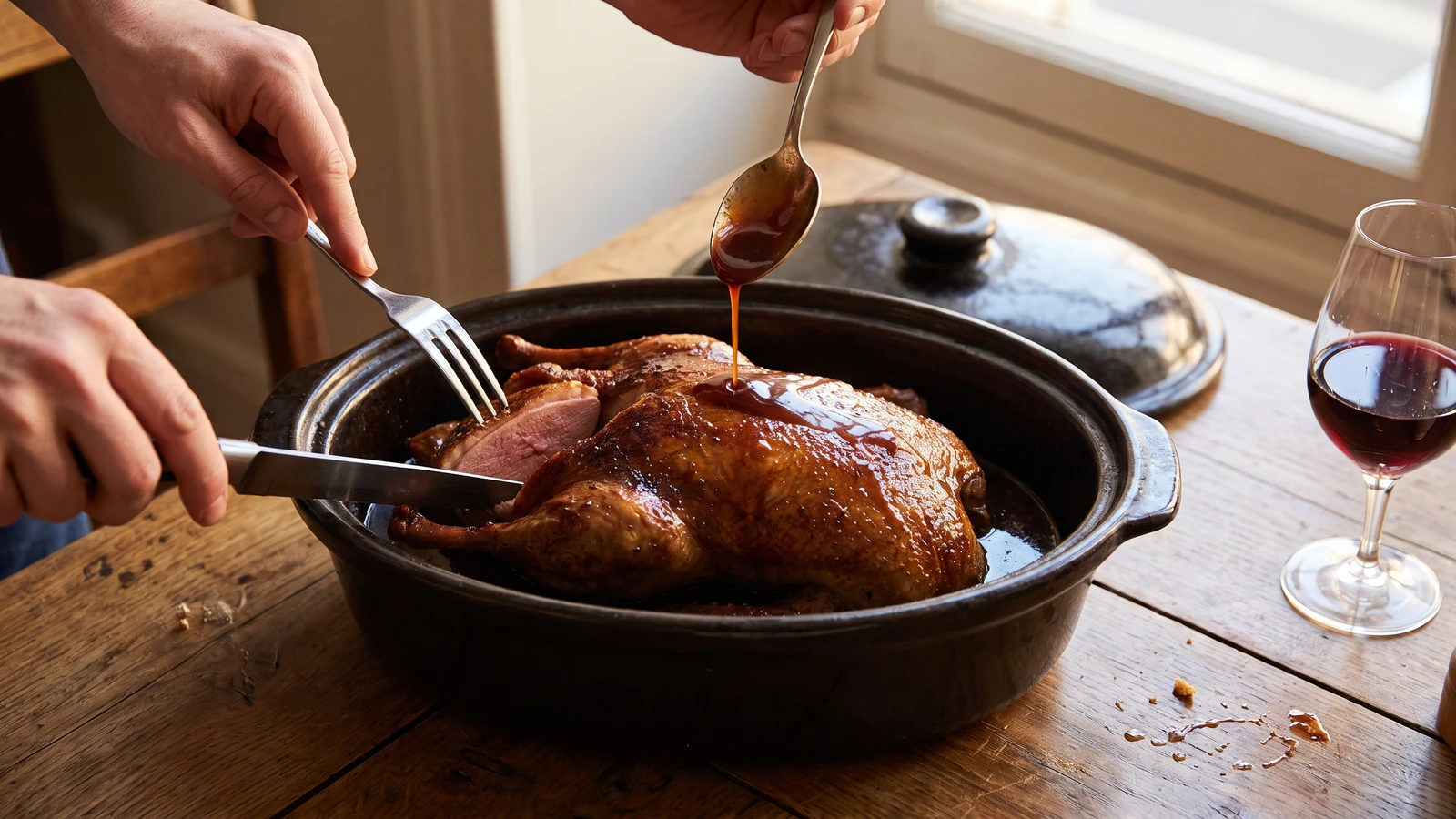
A young Rouen duckling cooks en casserole in butter alone, then a measured Port reduction joins clear duck gravy, with arrowroot preserving its gloss and the bird served at the instant it is just done.
Caneton Rouennais au Porto (Rouen duckling with Port) teaches one exact distinction: en casserole, butter roasting in a covered pot, is not a braise. Before you touch the pan, know the rule. No moistening reaches the duck while it cooks; the gravy comes afterward. Add stock early and the word has lost its technique.
The original kitchen assumed a seasoned earthenware casserole, a saucier beside it, and duck gravy ready from a stockpot never off the fire. At home, a snug Dutch oven replaces the earthenware, prepared clear duck gravy replaces the perpetual stockpot, and the saucier's work fits in a small saucepan. The elaborate Matignon, pork-fat wrapping, and buttered paper of the broader Poëlings (No. 250) are scaffolding here; its en casserole form calls for butter alone. A salamander has no job in this dish. The liquid measures become ½ cup Port and 1¼ cups gravy, keeping the book's two-to-five ratio for four.
The finished duck arrives deep bronze, with a clear garnet-brown gravy that gleams rather than blankets. One cook, one stove, one evening. The step that decides everything is taking the bird from the oven the moment it is safely, only just done; extra time dries the breast, and no sauce can give that tenderness back.
Caneton rouennais belongs to Normandy, where Rouen duckling became prized at city tables for flesh darker and fuller than that of many young domestic ducks. Rouennais names the bird as much as a single preparation, so this dish should not be confused with canard à la presse (pressed duck), the blood-bound preparation often associated with Rouen. The au Porto treatment carries the Norman bird into the national classical sauce system, pairing butter cooking en casserole with concentrated duck gravy and imported fortified wine.
Quantity
1 bird, 4½ to 5 lb (2 to 2.3 kg), for Poëlings (No. 250)
giblets removed and skin patted dry
Quantity
½ cup (120 ml / 120 g)
Quantity
1¼ cups (300 ml / 300 g)
unthickened
Quantity
2 teaspoons (10 ml / 6 g)
Quantity
1 tablespoon (15 ml / 15 g)
| Ingredient | Quantity |
|---|---|
| whole young Rouen ducklinggiblets removed and skin patted dry | 1 bird, 4½ to 5 lb (2 to 2.3 kg), for Poëlings (No. 250) |
| Port wine | ½ cup (120 ml / 120 g) |
| well-seasoned clear duckling gravyunthickened | 1¼ cups (300 ml / 300 g) |
| arrowroot | 2 teaspoons (10 ml / 6 g) |
| cold water | 1 tablespoon (15 ml / 15 g) |
Prepare the duckling by Poëlings (No. 250), selecting its en casserole form and following that formula intact. Use a snug lidded Dutch oven as the honest equivalent of the seasoned earthenware casserole, and keep the defining rule: butter, gentle oven heat, and no stock, water, or wine while the bird cooks. Take it out when the skin is deeply bronzed and the thickest breast and innermost thigh register at least 165°F (74°C). If the breast colours before the bird is safe, cover that part loosely with foil and continue; do not add liquid.
Transfer the duckling to a warm platter and cover it loosely for 15 minutes. Spoon off the freely pooled fat from the casserole, leaving a thin film of butter, the dark roasting juices, and every browned trace fixed to the bottom. Keep the fat for potatoes. We don't apologize for butter, and we certainly don't throw good duck fat away.
Take the casserole off the heat before adding the Port, especially over a gas flame. Return it to medium heat and scrape firmly to release the fond, then boil steadily until the Port has reduced by exactly half, leaving ¼ cup (60 ml) of concentrated swilling liquor. It should smell round and wine-dark, not burnt. If it slips below the mark but has not caught, add enough fresh Port to return it to ¼ cup and warm it briefly.
Stir the arrowroot with the cold water until perfectly smooth. Bring the duckling gravy to a bare simmer in a small saucepan, whisk in the slurry, and cook gently for 20 to 30 seconds, just until the gravy turns glossy and lightly coats a spoon. Do not let it roll at a hard boil, which weakens arrowroot and can make the sauce thin again. If it clumps, strain it; if it becomes too tight, loosen it with a spoonful of water. Ça se rattrape.
Whisk the reduced Port and every loosened roasting juice into the arrowroot-thickened duckling gravy. Warm the sauce gently without boiling and skim away any beads of fat that rise. The finished gravy should remain clear, fluid, and glossy, with enough body to cling briefly before running from the spoon.
Return the rested duckling to the casserole and spoon a little Port gravy around it, keeping the bronzed skin uncovered. Hold it only long enough to bring to the table, without letting the sauce boil beneath the bird. Serve the remaining gravy in a warm sauceboat and carve at once. À table!
1 serving (about 300g)
Culinary guides, cultural storytelling, and the editorial depth that makes cooking meaningful.
Discover Culinary ExplorerChef Juliette
John Dory has the delicacy of sole and the firmness of turbot. A light flouring, a quick butter sauté, and nut-brown beurre noisette show exactly why looks never mattered.

Chef Juliette
Fresh haddock proves its delicacy in the meunière pan: a fine flour crust, moist pearly flakes, and beurre noisette sharpened with lemon and parsley, ready from one skillet in half an hour.

Chef Juliette
Éperlans à l’Anglaise turns small fish into a lesson in disciplined coating: boned smelts under a close, crisp crumb, pan-fried in clarified butter and finished with bright, half-melted maître d’hôtel butter.

Chef Juliette
Tiny smelts, shallot, mushrooms, white wine, gratin sauce, and fine bread raspings meet a fierce oven, where the fish must turn tender in the same breath the buttered crust bronzes.