
Chef Juliette
John Dory (St. Pierre)
John Dory has the delicacy of sole and the firmness of turbot. A light flouring, a quick butter sauté, and nut-brown beurre noisette show exactly why looks never mattered.
A cooking platform built around craft, culture, and the stories behind what we eat.
Created by Chef Juliette
Based on No. 1757, Aiguillettes de Rouennais aux Truffes, from Le Guide Culinaire (1907) by Auguste Escoffier
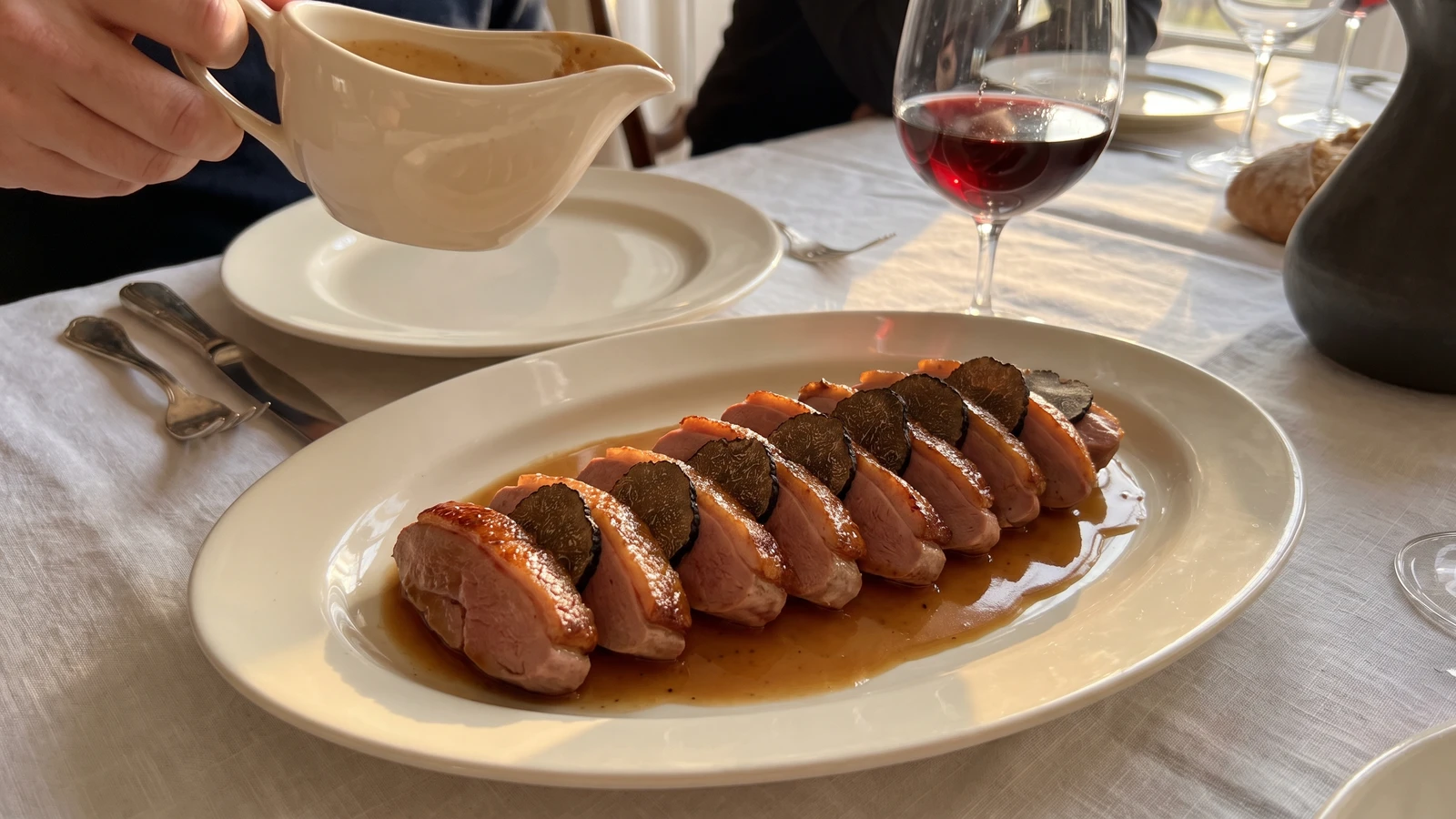
Chambertin-poached black truffles alternate with rosy aiguillettes of butter-poëled duckling, all under the thinnest glossy coat of sauce Rouennaise: a grand dish disciplined by restraint.
Aiguillettes de Rouennais aux Truffes (thin slices of Rouen-style duckling breast with truffles) teaches restraint. The Chambertin must perfume the truffle without bullying it, the duckling must remain rosy, and the sauce must lie over both as a thin gleaming veil. The one true thing to know before touching a pan is this: too much sauce buries the dish.
The original kitchen assumed a saucier with light sauce Rouennaise waiting, a stockpot never cold, a deep poëling pan, and spare hands to carve while the cooking liquor was reduced and strained. A home kitchen has a heavy cocotte, a fine sieve, an instant-read thermometer, and one pair of hands. That is enough. The salamander can stay out of it; the cocotte's uncovered finish gives the duckling its colour. Separate hot holding and serviette-straining were brigade scaffolding, so they become a lukewarm platter and a fine sieve. What stays is the dish itself: Poëlings (No. 250), whole truffles cooked in Chambertin, the reduction folded into sauce Rouennaise, and the lengthwise carving established by Aiguillettes de Rouennais à la Bigarrade (No. 1755).
One cook, one stove, one evening. Hold back a little plain sauce before finishing, because if the reduction tightens or turns greasy, ça se rattrape. Most of all, stop reducing while the sauce still runs freely from the spoon. A thick coat is not generosity here; it is poor judgment in evening clothes.
Aiguillettes de Rouennais belong to Rouen and Normandy's celebrated duck tradition, where the breast is kept rosy, carved lengthwise, and served with a sauce built from the bird's own character. Grand kitchens carried the Rouennaise family into composed aiguillette dishes, and this variation brings in Chambertin and black truffle deliberately, without pretending that Burgundy belongs to Normandy. Its surprising discipline is the thin coating: duck and truffle remain distinct, while the remaining sauce is offered separately.
Quantity
1, 4 to 4½ pounds (1.8 to 2 kg), for the lengthwise carving used in Aiguillettes de Rouennais à la Bigarrade (No. 1755)
Quantity
1 application (No. 250), sufficient for 1 duckling
including its real butter and raw matignon
Quantity
1½ teaspoons (7.5 ml / 9 g)
Quantity
½ teaspoon (2.5 ml / 1 g)
Quantity
5 medium, about 4½ ounces (125 g)
peeled
Quantity
scant ½ cup (95 ml / 95 g)
Quantity
1½ cups (360 ml / 360 g)
prepared as its own canonical component
| Ingredient | Quantity |
|---|---|
| whole young duckling | 1, 4 to 4½ pounds (1.8 to 2 kg), for the lengthwise carving used in Aiguillettes de Rouennais à la Bigarrade (No. 1755) |
| home-scaled Poëlings preparationincluding its real butter and raw matignon | 1 application (No. 250), sufficient for 1 duckling |
| fine sea salt | 1½ teaspoons (7.5 ml / 9 g) |
| freshly ground black pepper | ½ teaspoon (2.5 ml / 1 g) |
| fresh black trufflespeeled | 5 medium, about 4½ ounces (125 g) |
| Chambertin wine | scant ½ cup (95 ml / 95 g) |
| somewhat light sauce Rouennaiseprepared as its own canonical component | 1½ cups (360 ml / 360 g) |
Heat the oven to 375°F (190°C). Season the duckling inside and out with the salt and pepper. Warm the sauce Rouennaise very gently, then hold back ¼ cup (60 ml / 60 g) in a separate bowl for correcting the finished sauce. Warm an oval serving platter until it feels pleasantly lukewarm, never hot; a fierce platter keeps cooking the rosy aiguillettes while you arrange them.
Carry out the home-scaled Poëlings (No. 250) through its covered cook and brief uncovered colouring, without adding liquid during the cook. Begin checking the thickest part of the breast after 25 minutes. Remove the duckling when the breast reaches 155°F (68°C) and remains there for at least 1 minute, then rest it loosely covered for 10 minutes. The breast should be juicy and faintly rosy. If the legs need more cooking, return them with the carcass to the oven after removing the breasts; tonight's aiguillettes must not be sacrificed to the legs.
Transfer the rested duckling to a board and leave the poëling liquor, butter, vegetables, and browned deposits in the cocotte. Pour in the Chambertin and add the five whole peeled truffles. Cover and hold the liquid at the gentlest simmer for 8 to 10 minutes, turning the truffles once, until the wine carries their deep woodland fragrance. Lift out the truffles and keep them covered on the lukewarm platter.
Let the Chambertin and poëling liquor boil steadily until reduced to about ⅓ cup (80 ml / 80 g), glossy and concentrated but not syrupy. Only now skim away the excess grease; its time in contact with the wine and vegetables has carried flavour into the reduction. Pass the liquid through a fine sieve, pressing lightly, then discard the exhausted vegetables.
Whisk the strained reduction gradually into the warm sauce Rouennaise and bring it just below a simmer. Reduce only until the sauce nappes, meaning it coats the back of a spoon in a thin, translucent film and runs cleanly from its edge. If it becomes thick, loosen it teaspoon by teaspoon with warm water. If it looks grainy or beads with fat, take it off the heat, pass it through the clean sieve, and whisk in the reserved plain sauce. Ça se rattrape. Taste before adding any salt; the reduction has already concentrated everything.
Remove each breast cleanly from the carcass. Following the lengthwise aiguillette cut used in Aiguillettes de Rouennais à la Bigarrade (No. 1755), slice each breast with the grain into about 10 slim, even aiguillettes. Slice the warm truffles into thin rounds. Use a long, sharp knife and one confident stroke for each cut so the duck remains clean-edged rather than ragged.
Arrange the aiguillettes on the lukewarm platter, alternating each piece of duckling with a slice of truffle so both remain plainly visible. Spoon over only enough sauce to give the arrangement a thin, glossy coat. Transfer the rest to a warmed sauceboat and serve it alongside, not over the platter. This is the moment for restraint. À table!
1 serving (about 335g)
Culinary guides, cultural storytelling, and the editorial depth that makes cooking meaningful.
Discover Culinary ExplorerChef Juliette
John Dory has the delicacy of sole and the firmness of turbot. A light flouring, a quick butter sauté, and nut-brown beurre noisette show exactly why looks never mattered.

Chef Juliette
Fresh haddock proves its delicacy in the meunière pan: a fine flour crust, moist pearly flakes, and beurre noisette sharpened with lemon and parsley, ready from one skillet in half an hour.

Chef Juliette
Éperlans à l’Anglaise turns small fish into a lesson in disciplined coating: boned smelts under a close, crisp crumb, pan-fried in clarified butter and finished with bright, half-melted maître d’hôtel butter.

Chef Juliette
Tiny smelts, shallot, mushrooms, white wine, gratin sauce, and fine bread raspings meet a fierce oven, where the fish must turn tender in the same breath the buttered crust bronzes.