
Chef Juliette
John Dory (St. Pierre)
John Dory has the delicacy of sole and the firmness of turbot. A light flouring, a quick butter sauté, and nut-brown beurre noisette show exactly why looks never mattered.
A cooking platform built around craft, culture, and the stories behind what we eat.
Created by Chef Juliette
Based on No. 1752, Pâté Chaud de Caneton, from Le Guide Culinaire (1907) by Auguste Escoffier
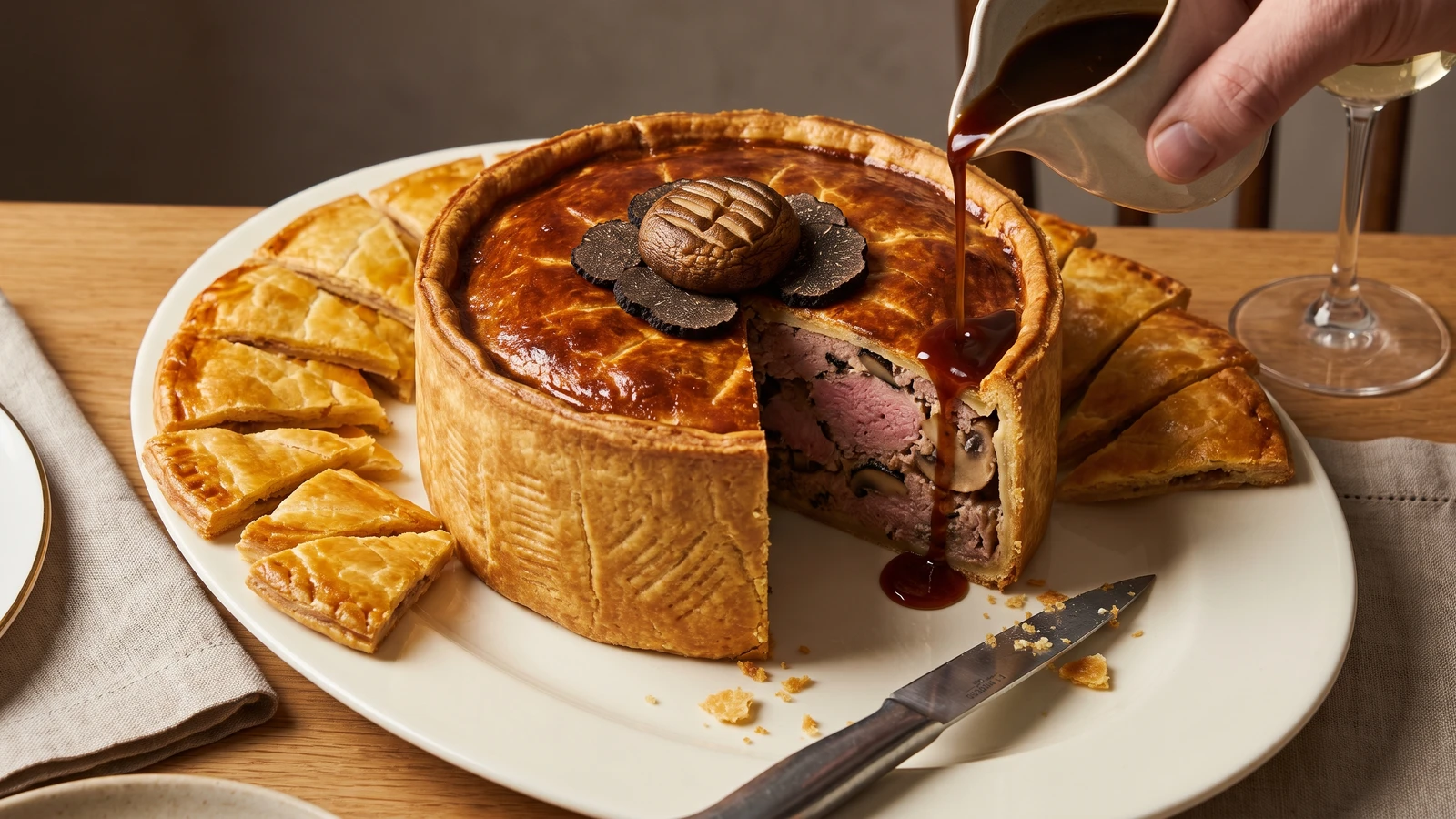
Underdone duck breast, gratin forcemeat, mushrooms, and truffle rise inside a burnished Charlotte-mould crust, then meet Madeira sauce at the table: the grand hot pie made workable for four.
Pâté Chaud de Caneton (hot raised duckling pie) teaches one true thing before you touch a pan: roast the duck breast short, because the hour inside the pastry is its second roasting. Take the first roast too far and no sauce can return its tenderness. Pull it rosy, slice it into long collops, and let the oven finish what you began.
The original kitchen assumed a saucier on staff, a stockpot never off the fire, a large Charlotte mould, and a salamander within reach, though this pie earns its colour in an ordinary oven. At home, the honest equivalents are prepared reduced demi-glace and Madeira sauce, a 1½-quart straight-sided mould, and finished forcemeat waiting cold. The book's brigade quantity of 1⅔ pounds of forcemeat becomes 450 grams for four, while its four tablespoons of half-glaze become 35 millilitres. The ratio has not moved. One cook, one stove, one evening.
Separate hands building sauces while another cook roasted the bird were brigade scaffolding, and that can go. What stays is the dish: short paste fitted without holes, alternating layers of forcemeat, duck, cooked mushrooms, and truffle, then the inversion, the pastry triangles, and the generous spooning of Madeira sauce. Keep the filling cool enough not to soften the pastry, but continue directly to the final bake. The step that decides everything remains the first one: roast the breast underdone.
Pâté chaud de caneton belongs to the Parisian classical service and the formal bourgeois dinner table, where pâtés chauds were unmoulded and sauced for immediate serving rather than preserved. Its Charlotte-mould form turns pastry into architecture: after inversion, the former base is removed, cut into triangles, and arranged around the exposed forcemeat. The word pâté here names the pastry-enclosed construction, not a cold spread, a distinction often lost as the dish travels beyond the French table.
Quantity
2¾ cups (660 ml / 330 g)
Quantity
¾ teaspoon (4 ml / 5 g)
Quantity
¾ cup (180 ml / 170 g)
diced
Quantity
1
Quantity
3 to 4 tablespoons (45 to 60 ml / 45 to 60 g)
Quantity
1 tablespoon (15 ml / 14 g)
for the mould
Quantity
1, about 4 pounds (1.8 kg)
Quantity
1½ teaspoons (7.5 ml / 9 g)
Quantity
½ teaspoon (2.5 ml / 1 g)
Quantity
about 2 cups (475 ml / 450 g) Gratin Forcemeat for Ordinary Hot, Raised Pies (No. 202)
chilled
Quantity
2 tablespoons plus 1 teaspoon (35 ml / 38 g)
chilled
Quantity
1¾ cups (415 ml / 200 g)
thinly sliced
Quantity
1
stem trimmed and cap grooved
Quantity
2 tablespoons (30 ml / 28 g)
Quantity
1 small truffle (28 g)
thinly sliced
Quantity
1 pinch (0.3 ml / 0.1 g)
Quantity
1 pinch (0.3 ml / 0.05 g)
Quantity
1
beaten
Quantity
1 teaspoon (5 ml / 5 g)
Quantity
1 cup (240 ml / 245 g)
heated for serving
| Ingredient | Quantity |
|---|---|
| all-purpose flour | 2¾ cups (660 ml / 330 g) |
| fine salt for the pastry | ¾ teaspoon (4 ml / 5 g) |
| cold unsalted butterdiced | ¾ cup (180 ml / 170 g) |
| large egg for the pastry | 1 |
| ice water | 3 to 4 tablespoons (45 to 60 ml / 45 to 60 g) |
| softened unsalted butterfor the mould | 1 tablespoon (15 ml / 14 g) |
| young duckling | 1, about 4 pounds (1.8 kg) |
| fine salt for the duck | 1½ teaspoons (7.5 ml / 9 g) |
| freshly ground black pepper | ½ teaspoon (2.5 ml / 1 g) |
| Gratin Forcemeat for Ordinary Hot, Raised Pieschilled | about 2 cups (475 ml / 450 g) Gratin Forcemeat for Ordinary Hot, Raised Pies (No. 202) |
| very reduced demi-glace (half-glaze sauce)chilled | 2 tablespoons plus 1 teaspoon (35 ml / 38 g) |
| button mushroomsthinly sliced | 1¾ cups (415 ml / 200 g) |
| large button mushroomstem trimmed and cap grooved | 1 |
| unsalted butter for the mushrooms | 2 tablespoons (30 ml / 28 g) |
| black trufflethinly sliced | 1 small truffle (28 g) |
| finely ground dried thyme | 1 pinch (0.3 ml / 0.1 g) |
| ground dried bay leaf | 1 pinch (0.3 ml / 0.05 g) |
| large egg for gildingbeaten | 1 |
| water for gilding | 1 teaspoon (5 ml / 5 g) |
| prepared Madeira sauceheated for serving | 1 cup (240 ml / 245 g) |
Pâte brisée (short paste) must be sturdy enough to stand when the mould comes away, but tender enough to cut without a struggle. Mix the flour and salt, then rub in the cold butter until most pieces resemble coarse crumbs with a few flat flakes remaining. Add the egg and 3 tablespoons of ice water, mixing only until the dough gathers; add the final tablespoon drop by drop if dry flour remains. Flatten into a disc, wrap, and chill for 45 minutes. If the dough cracks when pressed, it needs a few drops more water, not more kneading. Ça se rattrape.
Heat the oven to 450°F (230°C). Dry the duckling thoroughly and season it inside and out with the salt and pepper. Set it breast up on a rack over a roasting pan and roast for 22 to 28 minutes, until the skin has coloured and a thermometer inserted sideways into the thickest part of the breast reads about 122°F (50°C). Rest for 10 minutes, remove the breast skin, and lift both breasts cleanly from the bone. Cut all the breast meat on a long bias into collops about ⅛ inch (3 to 4 mm) thick. Let them cool only until they will not melt the pastry, then continue directly with assembly. The breast is deliberately underdone now; the pie must later reach 165°F (74°C) at its centre.
Melt the 2 tablespoons of butter in a wide sauté pan. Cook the sliced mushrooms briskly until they surrender their water and take light colour, then remove them to a plate. Cook the grooved mushroom cap in the same butter until tender and golden at the edges; reserve it for the crown. Cool both completely. Fold the chilled, very reduced demi-glace into the Gratin Forcemeat for Ordinary Hot, Raised Pies (No. 202), preserving the book's ratio of 35 millilitres for 450 grams. If warmth loosens the forcemeat, stop and chill it until it holds a ridge from the spoon. Do not repair it with flour.
Lower the oven to 350°F (180°C). Butter a 1½-quart (1.4-litre) Charlotte mould thoroughly, reaching into the lower edge. Roll two-thirds of the pastry to a scant ⅛ inch (3 mm), cut a circle for the bottom and a strip for the wall, then fit them into the mould with a firmly pinched seam and ½ inch (1.25 cm) overhang. Press a thin coat of forcemeat over the entire pastry-lined interior, including the sides. If the pastry tears, press on a thin patch with cold fingers. A patched shell is sound; an open hole is not. Chill the lined mould for 15 minutes.
Arrange a close layer of duck collops over the forcemeat, followed by cooked mushroom slices and a few truffle slices. Repeat with forcemeat, duck, mushrooms, and truffle, pressing each layer gently enough to remove air pockets without crushing the slices. Reserve about one-third of the truffle for the crown. Finish with a complete coat of forcemeat, leaving about ½ inch (1.25 cm) for the lid, then sprinkle the powdered thyme and bay evenly over it. Even layering is the dish: every cut portion should carry duck, mushroom, truffle, and forcemeat together.
Roll the remaining pastry into a thin circle slightly wider than the mould. Moisten the pastry overhang sparingly with water, lay on the lid, and pinch the edges together firmly. Trim the excess and turn the seam inward so it cannot catch when the pie is inverted. Mix the beaten egg with the teaspoon of water and gild the lid, brushing it with a thin, even coat of egg. Cut a 1-inch (2.5-cm) slit in the centre so pressure can escape.
Set the mould on a rimmed baking sheet and bake for about 1 hour. The pastry should be deeply butter-gold, firm at the rim, and beginning to draw slightly from the mould; the centre must register 165°F (74°C) when tested through the slit. If the exposed lid colours before the filling is ready, cover it loosely with foil and continue baking. Pale pastry means the shell is still soft, but darkening too fast is only a question of shielding it. Ça se rattrape. Rest the pie in its mould for 10 minutes.
Place a warmed serving platter over the mould and invert both together in one confident movement. Lift the mould straight upward. If it clings, wrap the outside briefly with a warm towel, loosen the upper edge with a thin knife, and try again without shaking. The pastry that lined the bottom is now the top: cut around its edge, lift it away intact, divide it into 8 triangles, and arrange those triangles around the foot of the pie.
Spoon 3 to 4 tablespoons of the heated Madeira sauce over the forcemeat exposed at the top. Set the grooved mushroom cap in the centre and arrange the reserved truffle slices around it as a crown. Bring the remaining Madeira sauce separately, giving each portion another spoonful after cutting. Serve at once, while the pastry remains crisp and the sauce gleams. À table!
1 serving (about 495g)
Culinary guides, cultural storytelling, and the editorial depth that makes cooking meaningful.
Discover Culinary ExplorerChef Juliette
John Dory has the delicacy of sole and the firmness of turbot. A light flouring, a quick butter sauté, and nut-brown beurre noisette show exactly why looks never mattered.

Chef Juliette
Fresh haddock proves its delicacy in the meunière pan: a fine flour crust, moist pearly flakes, and beurre noisette sharpened with lemon and parsley, ready from one skillet in half an hour.

Chef Juliette
Éperlans à l’Anglaise turns small fish into a lesson in disciplined coating: boned smelts under a close, crisp crumb, pan-fried in clarified butter and finished with bright, half-melted maître d’hôtel butter.

Chef Juliette
Tiny smelts, shallot, mushrooms, white wine, gratin sauce, and fine bread raspings meet a fierce oven, where the fish must turn tender in the same breath the buttered crust bronzes.