
Chef Juliette
John Dory (St. Pierre)
John Dory has the delicacy of sole and the firmness of turbot. A light flouring, a quick butter sauté, and nut-brown beurre noisette show exactly why looks never mattered.
A cooking platform built around craft, culture, and the stories behind what we eat.
Created by Chef Juliette
Based on No. 1751, Caneton aux Petits Pois, from Le Guide Culinaire (1907) by Auguste Escoffier
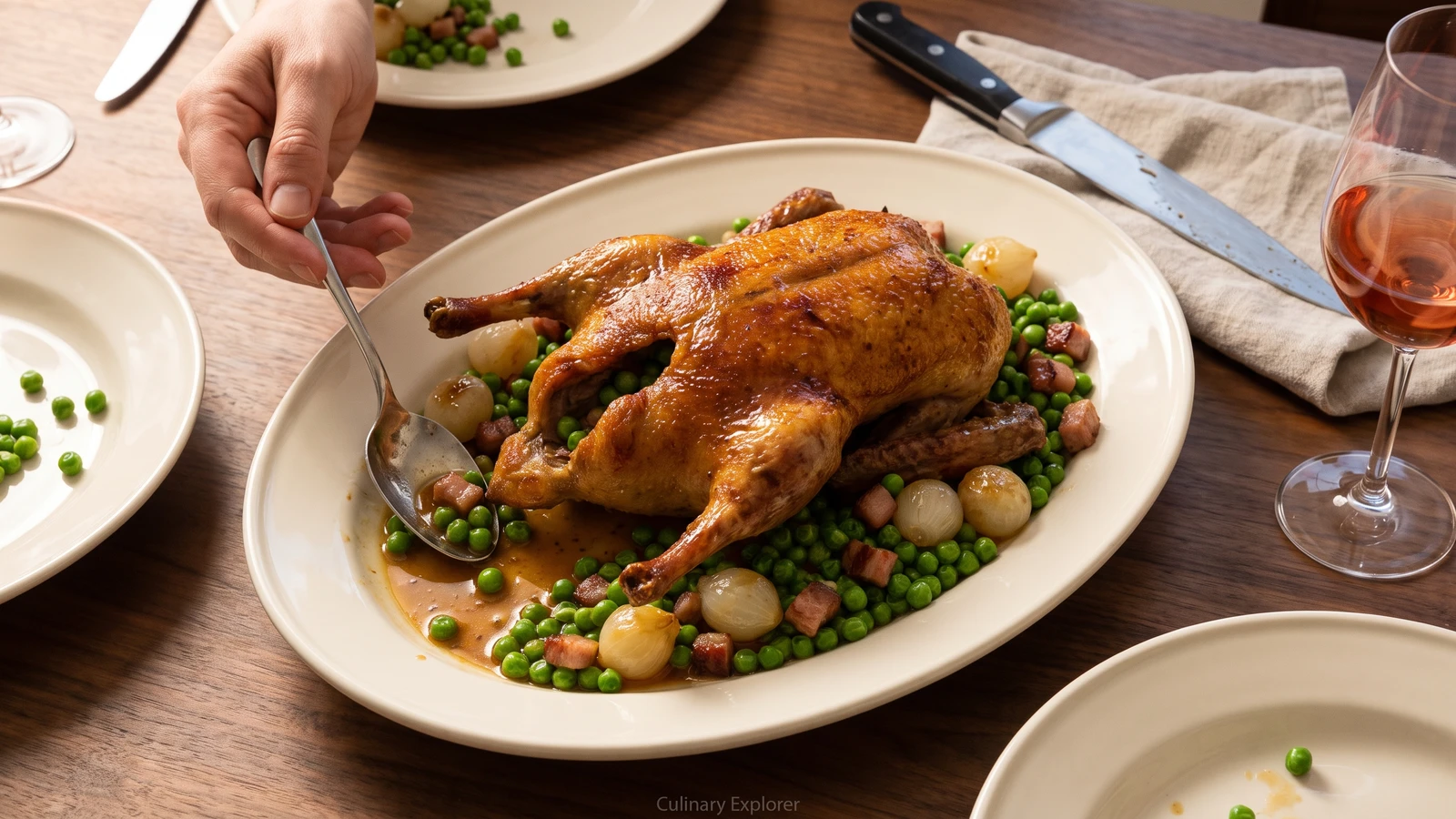
Caneton aux Petits Pois brings burnished duckling, salt pork, pearl onions, and spring peas together under a glossy half-glaze, teaching the essential measure of a garnish sauce: enough to coat, never enough to drown.
Caneton aux Petits Pois (duckling with green peas) teaches proportion. The bird may be beautifully browned and the peas perfectly tender, but the dish succeeds only when its reduced sauce just coats the garnish. A flood turns peas dull and hides the small onions; a gloss binds pork, peas, and duck into one generous pot.
The original formula assumed a saucier on staff, brown stock never off the fire, and thin half-glaze ready at arm's reach. At home, a reliable prepared demi-glace thinned with unsalted brown chicken or duck stock gives the same structure in one cocotte. A salamander has no work in this covered braise, so none is invented. One young duckling serves four. One cook, one stove, one evening.
The separate sauce station was brigade scaffolding, and it goes. Browning the pork, onions, and duck in the same butter, loosening the fond with stock, cooking everything gently, and reducing the sauce at the end are the dish itself, so every one of those steps stays. Before you touch the pan, remember the measure: the finished sauce must only just cover the garnish.
Caneton aux petits pois belongs to the spring table of Parisian cuisine bourgeoise and the wider French classical repertoire, where young duck and freshly shelled peas met in a covered casserole rather than as a roast with a separate vegetable. Grand kitchens formalized that household method with brown stock and half-glaze, but the essential practice remained unchanged: bird, pork, onions, peas, and sauce cook as one composed garnish. Despite its polished name, this is a pot dish, and the careful final reduction marks its passage from casserole to dining room.
Quantity
1, weighing 3 1/2 to 4 lb (1.6 to 1.8 kg)
giblets removed
Quantity
6 oz (170 g), prepared by Blanchings (No. 273)
cut into 3/4-inch dice
Quantity
15 (about 7 oz / 200 g)
peeled
Quantity
3 tablespoons (45 ml / 42 g)
Quantity
1/2 cup (120 ml / 120 g)
divided
Quantity
1 cup (240 ml / 240 g)
combine 1/2 cup (120 ml / 120 g) prepared demi-glace with 1/2 cup (120 ml / 120 g) unsalted brown chicken or duck stock
Quantity
3 cups (720 ml / 435 g)
Quantity
1
tie together 4 parsley stems, 2 thyme sprigs, and 1 bay leaf
Quantity
1/2 teaspoon (2.5 ml / 3 g), plus more only if needed
divided
Quantity
1/2 teaspoon (2.5 ml / 1 g)
divided
| Ingredient | Quantity |
|---|---|
| whole young ducklinggiblets removed | 1, weighing 3 1/2 to 4 lb (1.6 to 1.8 kg) |
| unsmoked salt pork bellycut into 3/4-inch dice | 6 oz (170 g), prepared by Blanchings (No. 273) |
| small pearl onionspeeled | 15 (about 7 oz / 200 g) |
| unsalted butter | 3 tablespoons (45 ml / 42 g) |
| unsalted brown chicken or duck stockdivided | 1/2 cup (120 ml / 120 g) |
| thin demi-glace (half-glaze sauce)combine 1/2 cup (120 ml / 120 g) prepared demi-glace with 1/2 cup (120 ml / 120 g) unsalted brown chicken or duck stock | 1 cup (240 ml / 240 g) |
| freshly shelled green peas | 3 cups (720 ml / 435 g) |
| bouquet garnitie together 4 parsley stems, 2 thyme sprigs, and 1 bay leaf | 1 |
| fine sea saltdivided | 1/2 teaspoon (2.5 ml / 3 g), plus more only if needed |
| freshly ground black pepperdivided | 1/2 teaspoon (2.5 ml / 1 g) |
Pat the duckling thoroughly dry inside and out. Trim away loose flaps of cavity fat, tie the legs loosely with kitchen twine, and season the bird with half the salt and pepper. Stir together the prepared demi-glace and stock for the thin half-glaze sauce. Have every component beside the stove before browning begins, because the same butter and fond must carry cleanly from garnish to bird.
Drain the salt pork prepared by Blanchings (No. 273) and dry it well. Melt the butter in a heavy oval cocotte over medium heat. Add the pork and pearl onions, then cook for 7 to 10 minutes, turning them often, until the pork is golden at the edges and the onions wear an even light-brown glaze. Lift both out with a slotted spoon and reserve them. If the butter smells scorched rather than nutty, stop and replace it before adding the duck. Ça se rattrape, but burnt milk solids cannot be persuaded into a good sauce.
Set the duckling into the same cocotte and brown it patiently on the breast, back, and both sides, about 12 to 15 minutes in all. Let each surface take a deep butter-gold colour before rolling the bird onward. Wet skin steams and pale skin contributes nothing to the sauce, which is why the careful drying mattered. Lift the browned duckling onto a tray, then pour off the rendered fat while leaving the brown film, the fond, firmly in the pot.
Return the cocotte to medium heat and pour in the brown stock, holding back about 2 tablespoons for the final adjustment. Scrape the pot floor until every brown morsel dissolves into the liquid. Return the duckling, pour in the thin demi-glace, and add the peas, bouquet garni, browned salt pork, and onions around it. Bring the liquid just to a simmer, then cover the cocotte.
Lower the heat and maintain the barest tremble for 45 to 55 minutes, basting the exposed duck every 15 minutes without crushing the peas. A hard boil tightens the bird, splits the peas, and drives the sauce greasy; gentle movement is enough. The duckling is ready when the thigh joint yields easily and the thickest part of the thigh reaches at least 165°F (74°C). If it needs more time, cover it again and continue in 5-minute intervals.
Transfer the duckling to a warm serving platter and let it rest loosely covered. Discard the bouquet garni. Lift the peas, pork, and onions into a warm bowl with a slotted spoon, then skim excess fat from the sauce and boil the liquid briskly until it turns glossy and lightly coats a spoon, 3 to 8 minutes. Return the garnish and fold it through without mashing the peas. If the sauce is still loose, lift the garnish and reduce again; if it has tightened too far, whisk in the reserved stock a spoonful at a time. Ça se rattrape. Taste only now for the remaining salt and pepper, because the pork and demi-glace have already spoken.
Spoon the peas, pearl onions, and salt pork around the resting duckling, then pour over only enough sauce to glaze the bird and just cover the garnish. There should be no deep pool beneath it. Carve at the table, giving each plate duck, peas, onions, pork, and a spoonful of sauce. À table!
1 serving (about 415g)
Culinary guides, cultural storytelling, and the editorial depth that makes cooking meaningful.
Discover Culinary ExplorerChef Juliette
John Dory has the delicacy of sole and the firmness of turbot. A light flouring, a quick butter sauté, and nut-brown beurre noisette show exactly why looks never mattered.

Chef Juliette
Fresh haddock proves its delicacy in the meunière pan: a fine flour crust, moist pearly flakes, and beurre noisette sharpened with lemon and parsley, ready from one skillet in half an hour.

Chef Juliette
Éperlans à l’Anglaise turns small fish into a lesson in disciplined coating: boned smelts under a close, crisp crumb, pan-fried in clarified butter and finished with bright, half-melted maître d’hôtel butter.

Chef Juliette
Tiny smelts, shallot, mushrooms, white wine, gratin sauce, and fine bread raspings meet a fierce oven, where the fish must turn tender in the same breath the buttered crust bronzes.