
Chef Juliette
John Dory (St. Pierre)
John Dory has the delicacy of sole and the firmness of turbot. A light flouring, a quick butter sauté, and nut-brown beurre noisette show exactly why looks never mattered.
A cooking platform built around craft, culture, and the stories behind what we eat.
Created by Chef Juliette
Based on No. 1750, Caneton Braisé à l’Orange, from Le Guide Culinaire (1907) by Auguste Escoffier
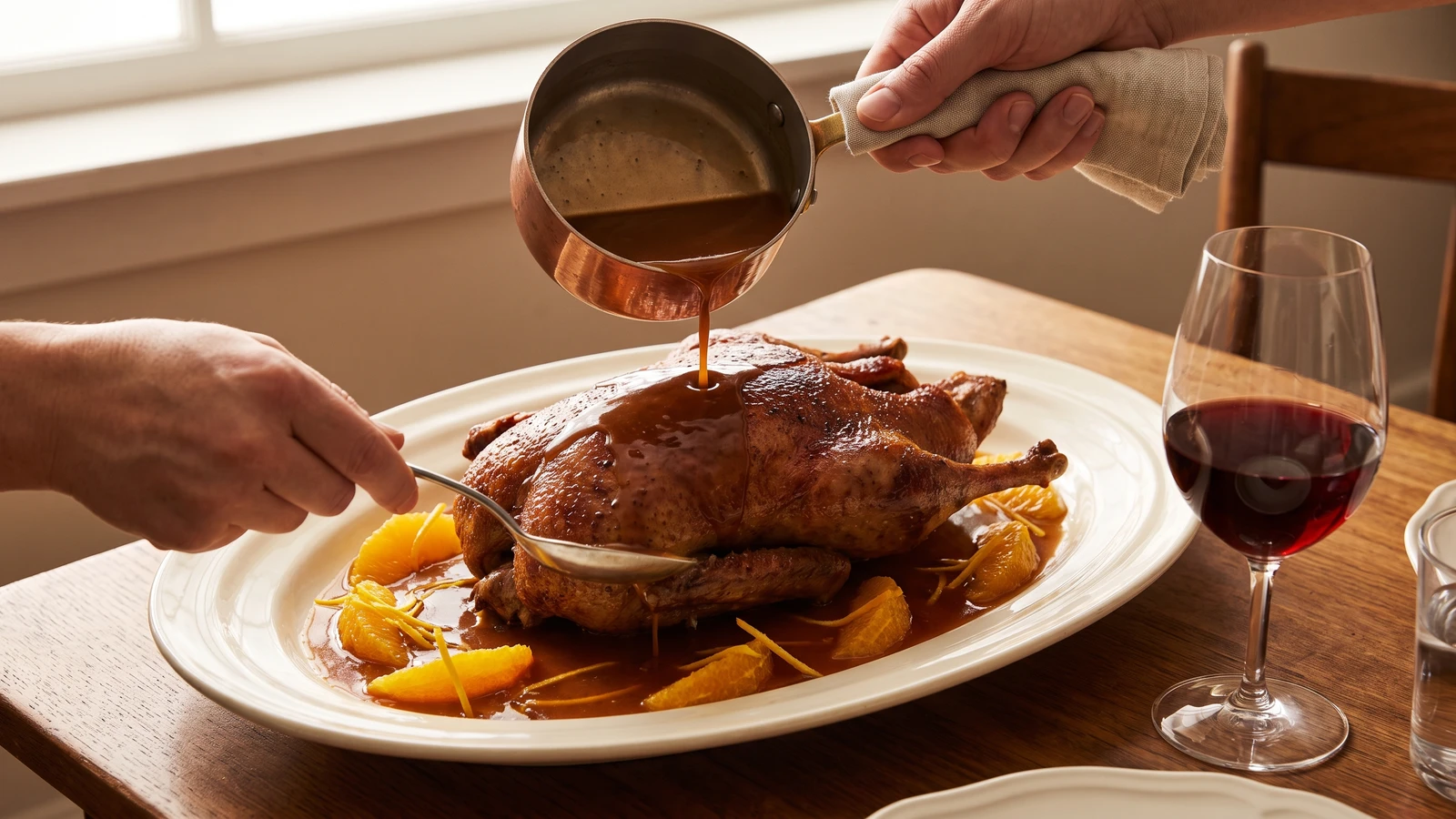
Whole duckling braised until a spoon parts it, lacquered with its reduced brown sauce, then sharpened at the last moment with orange, lemon, and fine citrus julienne that never returns to the boil.
Caneton Braisé à l’Orange (duckling braised with orange) teaches control after concentration. Braise until a spoon parts the meat, reduce the Espagnole until stiff, then restore the sauce with fresh citrus off the heat. The one true thing to know before touching the pan is this: orange is the finishing acid, not the braising liquid, and once it enters, the sauce must never boil again.
The original kitchen assumed a saucier on staff, brown stock never off the fire, a tammy for straining, and a salamander waiting to glaze the bird. For four people, one cook needs one duckling, 1½ cups of Espagnole, half as much brown stock, a fine-mesh sieve in place of the tammy, and a watchful home broiler. The saucier’s separate station is brigade scaffolding and can go. The 2:1 proportion of Espagnole to stock, spoon tenderness, thorough degreasing, stiff reduction, and last-minute citrus are the dish, so every one stays.
Reduce before you reach for the juice. If the sauce is merely thick rather than stiff, the oranges will leave it watery; if you carry it too far, loosen it with a spoonful of brown stock before any citrus enters. Ça se rattrape. This is the step that decides the whole plate.
Caneton braisé à l’orange belongs to the Parisian grande cuisine table, where the brown-sauce system turned a whole young duck into a formal braise rather than a roast. The distinction matters: its backbone is Espagnole and brown stock, while orange and lemon enter only after reduction to restore freshness and consistency. Seville oranges may supply the juice, but their bitter sections traditionally stay off the platter, which is surrounded instead with sweet orange cut raw from its membranes.
Quantity
1, 4½ to 5 pounds (2 to 2.3 kg)
giblets and excess cavity fat removed
Quantity
1½ teaspoons (7.5 ml / 9 g)
Quantity
½ teaspoon (2.5 ml / 1 g)
Quantity
1½ cups (360 ml / about 375 g)
Quantity
¾ cup (180 ml / 180 g), plus up to ¼ cup (60 ml / 60 g) for adjustment
Quantity
2, yielding about ⅔ cup (160 ml / 160 g) juice
juiced, with the yellow zest of ½ orange reserved and cut julienne-fashion
Quantity
2, about 1 pound (450 g)
peeled and cut raw into skinless sections
Quantity
1, about 4 ounces (115 g)
yellow zest of ½ lemon cut julienne-fashion and ½ lemon juiced, yielding about 1½ tablespoons (22 ml / 22 g)
| Ingredient | Quantity |
|---|---|
| whole young ducklinggiblets and excess cavity fat removed | 1, 4½ to 5 pounds (2 to 2.3 kg) |
| fine sea salt | 1½ teaspoons (7.5 ml / 9 g) |
| freshly ground black pepper | ½ teaspoon (2.5 ml / 1 g) |
| prepared Sauce Espagnole | 1½ cups (360 ml / about 375 g) |
| brown stock | ¾ cup (180 ml / 180 g), plus up to ¼ cup (60 ml / 60 g) for adjustment |
| citrus-julienne preparationfor the orange and lemon zest | 1 batch of Blanchings (No. 273) |
| medium sweet oranges for juice and zestjuiced, with the yellow zest of ½ orange reserved and cut julienne-fashion | 2, yielding about ⅔ cup (160 ml / 160 g) juice |
| medium sweet oranges for servingpeeled and cut raw into skinless sections | 2, about 1 pound (450 g) |
| medium lemonyellow zest of ½ lemon cut julienne-fashion and ½ lemon juiced, yielding about 1½ tablespoons (22 ml / 22 g) | 1, about 4 ounces (115 g) |
Heat the oven to 325°F (165°C). Pat the duckling completely dry, then season it lightly inside and out with the salt and pepper. Set the trimmed cavity fat in a heavy cocotte over medium heat until it renders, remove the spent pieces, and lay in the duckling breast-side down. Brown it patiently on the breast, back, and both sides until the skin is deep bronze, about 12 to 15 minutes in all. Lift it out and pour the rendered fat into a heatproof bowl, leaving the brown fond fixed to the pot.
Stir the Sauce Espagnole and ¾ cup (180 ml) brown stock together in the cocotte, scraping the fond from the floor, and bring them to a bare simmer. Return the duckling breast-side up, cover tightly, and transfer it to the oven. Braise for about 2 hours, turning it onto one side after 45 minutes, onto the other side 45 minutes later, then breast-side up for the finish. It is ready only when the leg moves loosely, a spoon presses through the thigh joint without resistance, and the thickest part of the thigh has reached at least 175°F (79°C). If the liquid falls below the lower third of the bird before the meat is tender, lower the oven slightly and add reserved brown stock a spoonful at a time.
While the duckling braises, remove only the colored yellow rind from half an orange and half a lemon, leaving every trace of bitter white pith behind. Cut the rind julienne-fashion into fine match-shaped rods, prepare it using Blanchings (No. 273), then cool and drain it thoroughly. Cut two sweet oranges into suprêmes, skinless sections removed raw from between their membranes, and keep them covered. Juice the other two oranges and half the lemon separately, reserving 1 teaspoon of orange juice for the final correction.
Lift the tender duckling carefully onto a rack set over a rimmed tray. Pour the braising sauce into a saucepan, let the fat rise for several minutes, then skim it away completely; gloss is welcome, grease is not. Boil the sauce over lively heat until it becomes stiff, dark, and concentrated enough that a spoon drawn across the pan leaves a clean path for a moment. Pass it through a fine-mesh sieve, the honest home equivalent of a tammy. If it becomes pasty, loosen it with a spoonful of brown stock now. Ça se rattrape, but make the correction before the citrus enters.
Reserve 3 tablespoons (45 ml) of the stiff reduction and brush about two-thirds of it in a thin coat over the duckling. Heat the broiler with the rack about 8 inches (20 cm) from the element, then glaze the bird for 1 to 3 minutes, watching without wandering away, until the coating catches the light like dark lacquer. This brief broiling replaces the old salamander. Pull the duckling the moment the glaze is bronze and glossy; blackened sauce is bitter sauce.
Take the remaining strained reduction completely off the heat. Stir in the orange juice in three additions, then the half-lemon juice, watching the stiff sauce return to a smooth consistency that coats the back of a spoon. Fold in the drained orange and lemon julienne. If the sauce turns too thin, stir in the final spoonful of reserved stiff reduction off the heat; if it remains too tight, add the reserved teaspoon of orange juice. Once the citrus enters, the saucepan never returns to the burner. If one bubble appears, pull it away immediately and stir in the reserved fresh juice. Ça se rattrape. Repeated boiling, however, dulls the orange and draws bitterness from the rind.
Set the glazed duckling on a warmed oval platter and coat it lightly with the finished sauce, leaving the bronze skin visible. Arrange the raw orange suprêmes around it and carry the remaining sauce to the table in a warmed sauceboat. The meat should yield to the serving spoon, the sauce should cling rather than flood, and the citrus should smell freshly cut. À table!
1 serving (about 470g)
Culinary guides, cultural storytelling, and the editorial depth that makes cooking meaningful.
Discover Culinary ExplorerChef Juliette
John Dory has the delicacy of sole and the firmness of turbot. A light flouring, a quick butter sauté, and nut-brown beurre noisette show exactly why looks never mattered.

Chef Juliette
Fresh haddock proves its delicacy in the meunière pan: a fine flour crust, moist pearly flakes, and beurre noisette sharpened with lemon and parsley, ready from one skillet in half an hour.

Chef Juliette
Éperlans à l’Anglaise turns small fish into a lesson in disciplined coating: boned smelts under a close, crisp crumb, pan-fried in clarified butter and finished with bright, half-melted maître d’hôtel butter.

Chef Juliette
Tiny smelts, shallot, mushrooms, white wine, gratin sauce, and fine bread raspings meet a fierce oven, where the fish must turn tender in the same breath the buttered crust bronzes.