
Chef Juliette
John Dory (St. Pierre)
John Dory has the delicacy of sole and the firmness of turbot. A light flouring, a quick butter sauté, and nut-brown beurre noisette show exactly why looks never mattered.
A cooking platform built around craft, culture, and the stories behind what we eat.
Created by Chef Juliette
Based on No. 1746, Caneton d’Aylesbury Poëlé à la Menthe, from Le Guide Culinaire (1907) by Auguste Escoffier
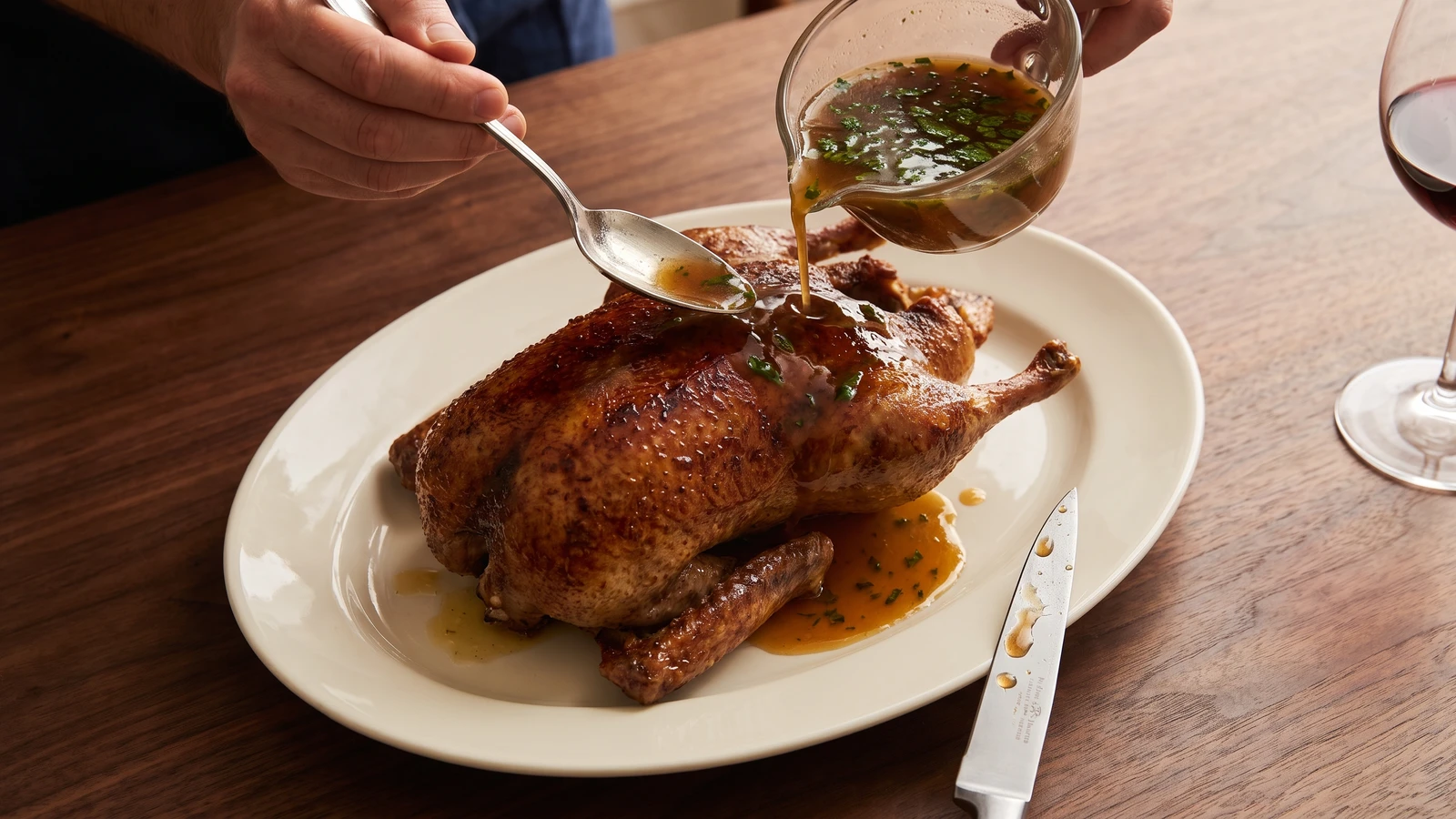
A butter-poêled Aylesbury duckling, bronzed only after its covered roast, with mint inside and clear veal gravy brightened by lemon. The lesson is simple: poêlé means butter, a lid, and no added liquid.
Caneton d’Aylesbury Poëlé à la Menthe (Aylesbury duckling butter-roasted with mint) teaches the classical meaning of poêlé. It isn't pan-fried. The bird cooks in butter under a lid, with no added liquid, then browns uncovered. That dry, covered roast is the one true thing to know before touching the pan: pour in stock too early and the duck braises, losing the concentrated flavor that defines the dish.
The grand kitchen assumed a deep poêling pan, a stockpot never off the fire, a saucier to swill, strain, and degrease the gravy, and a salamander if the color needed help. One cook, one stove, one evening uses a snug Dutch oven, strong unsalted veal stock reduced to the original one-sixth pint, a fine sieve, and the uncovered oven for the final bronze. The elaborate wrapping in aromatic vegetables, pork fat, and buttered paper was scaffolding for large birds and brigade service, so it goes. The butter, lid, basting, dry cooking, ten-minute contact between gravy and fat, and final mint stay, because they are the dish.
The finished duck comes out deeply bronzed, gently scented with mint from within, and glossed with a light amber gravy sharpened by lemon. Keep the pot dry until the bird comes out. The stock belongs to the sauce, never the roast.
Caneton d’Aylesbury begins in Buckinghamshire, England, where the Aylesbury duck was prized for tender, delicately flavored flesh, then passes into the Parisian classical repertoire, whose kitchens regularly identified favored poultry breeds by name. Here poêlé does not mean a quick sauté: in grand-kitchen vocabulary it is a covered butter roast on aromatics, browned only at the end, itself a simplification of a more elaborate wrapping in vegetables, pork fat, and buttered paper. Mint keeps an English accent beside the bird, while clear veal gravy, lemon, and the poëling method place the preparation firmly in the French canon.
Quantity
1 duckling, 4 to 5 lb (1.8 to 2.3 kg), Poëlings (No. 250)
giblets removed and skin thoroughly dried
Quantity
2 tablespoons (30 ml / 28 g)
softened
Quantity
1 teaspoon (5 ml / 1 g)
finely chopped
Quantity
4 tablespoons (60 ml / 56 g)
melted
Quantity
⅔ cup (160 ml / 100 g)
cut into ½-inch dice
Quantity
½ cup (120 ml / 65 g)
cut into ½-inch dice
Quantity
⅓ cup (80 ml / 50 g)
cut into ½-inch dice
Quantity
2 teaspoons (10 ml / 12 g)
Quantity
¾ teaspoon (4 ml / 2 g)
Quantity
⅓ cup plus 1 tablespoon (95 ml / 95 g), or begin with ¾ cup (190 ml / 190 g) stock
Quantity
2 teaspoons (10 ml / 10 g)
Quantity
1 teaspoon (5 ml / 1 g)
finely chopped
| Ingredient | Quantity |
|---|---|
| Aylesbury duckling for Poëlingsgiblets removed and skin thoroughly dried | 1 duckling, 4 to 5 lb (1.8 to 2.3 kg), Poëlings (No. 250) |
| unsalted butter for the cavitysoftened | 2 tablespoons (30 ml / 28 g) |
| fresh spearmint for the cavityfinely chopped | 1 teaspoon (5 ml / 1 g) |
| unsalted butter for poëling and bastingmelted | 4 tablespoons (60 ml / 56 g) |
| yellow onioncut into ½-inch dice | ⅔ cup (160 ml / 100 g) |
| carrotcut into ½-inch dice | ½ cup (120 ml / 65 g) |
| celerycut into ½-inch dice | ⅓ cup (80 ml / 50 g) |
| fine sea salt | 2 teaspoons (10 ml / 12 g) |
| freshly ground black pepper | ¾ teaspoon (4 ml / 2 g) |
| clear veal gravy, or unsalted veal stock reduced by half | ⅓ cup plus 1 tablespoon (95 ml / 95 g), or begin with ¾ cup (190 ml / 190 g) stock |
| fresh lemon juice | 2 teaspoons (10 ml / 10 g) |
| fresh spearmint for finishingfinely chopped | 1 teaspoon (5 ml / 1 g) |
Heat the oven to 350°F (180°C), or 325°F (165°C) with convection. Take the duckling from the cold about thirty minutes before cooking. Remove any loose fat from the cavity, then dry the bird thoroughly inside and out. Wet skin turns flabby under a lid, while a dry surface can take the butter and eventually bronze. Season the cavity and exterior evenly with the salt and pepper.
Combine the softened cavity butter with the first teaspoon of chopped mint. Put all of it inside the duckling, spreading it against the cavity walls rather than leaving one cold lump in the center. Tie the legs together and tuck the wing tips beneath the bird. The butter carries the mint through the duck from within, exactly as the source intends; mint smeared over the skin would scorch and turn bitter.
Scatter the onion, carrot, and celery over the bottom of a heavy lidded pot just large enough to hold the duckling. This is the matignon, the aromatic vegetable bed. Set the bird breast-side up on the vegetables, pour three tablespoons of the melted butter over it, and reserve the remaining tablespoon for basting. Cover tightly. This is the home-scale setup for Poëlings (No. 250): butter and a lid, but no stock, wine, or water.
Roast the covered duckling for 55 to 60 minutes. Every twenty minutes, lift the lid briefly and baste the breast and legs with the butter and rendered fat from the pot. The vegetables should soften and turn golden without blackening. If their edges darken too quickly or the butter smells scorched, lower the oven to 325°F (165°C), tuck the vegetables farther beneath the bird, and add the reserved butter. Do not reach for stock. Ça se rattrape, but only while the pot remains a roast and not a braise.
Remove the lid, raise the oven to 400°F (200°C), and baste once more. Roast uncovered for 30 to 45 minutes, turning the pot halfway through, until the skin is a deep, even bronze. Test at the thickest part without touching bone: the breast must reach at least 165°F (74°C), and the inner thigh should reach 170°F (77°C). If the duck is cooked but remains pale, place it beneath a hot broiler for one to three minutes, watching without interruption. That is the home salamander, and a minute is often enough. If the breast darkens too fast, shield only that area with a loose piece of foil.
Transfer the duckling to a warmed oval platter and cover it loosely with foil. Rest for twenty minutes while the sauce is made. Leave every vegetable, browned deposit, and drop of fat in the cooking pot. Resting settles the juices inside the bird; a tight covering would soften the newly bronzed skin, so keep the foil loose.
Set the cooking pot over medium heat. Pour in the clear veal gravy and lemon juice without first removing the fat, then scrape and swill the pot until every savory brown deposit loosens. Bring it to a gentle boil and cook for ten minutes, stirring occasionally. This ten-minute contact between the gravy, vegetables, butter, and duck fat is part of Poëlings (No. 250): the fat has captured the aromas, and the liquid needs time to take them back before the grease is removed.
Strain the pan liquid through a fine-mesh sieve into a heatproof jug, pressing the vegetables gently but never mashing them. Let it stand for two minutes, then skim away every visible layer of fat or use a fat separator. If the sauce looks cloudy and greasy, do not whisk it. Leave it undisturbed for another five minutes and skim again; ça se rattrape. Reduce the degreased sauce briefly if it seems watery, or loosen it with a spoonful of hot water if it has become salty or too concentrated. It should be clear and lightly glossy, not thick. Stir in the final teaspoon of mint off the heat and correct the salt or lemon.
Remove the foil and spoon the mint-flecked veal gravy over the breast and legs at the last possible moment, allowing a little to pool beneath the duckling. Present it whole, then carve into two breasts and two leg portions at the table. Pass any remaining gravy beside it. À table!
1 serving (about 300g)
Culinary guides, cultural storytelling, and the editorial depth that makes cooking meaningful.
Discover Culinary ExplorerChef Juliette
John Dory has the delicacy of sole and the firmness of turbot. A light flouring, a quick butter sauté, and nut-brown beurre noisette show exactly why looks never mattered.

Chef Juliette
Fresh haddock proves its delicacy in the meunière pan: a fine flour crust, moist pearly flakes, and beurre noisette sharpened with lemon and parsley, ready from one skillet in half an hour.

Chef Juliette
Éperlans à l’Anglaise turns small fish into a lesson in disciplined coating: boned smelts under a close, crisp crumb, pan-fried in clarified butter and finished with bright, half-melted maître d’hôtel butter.

Chef Juliette
Tiny smelts, shallot, mushrooms, white wine, gratin sauce, and fine bread raspings meet a fierce oven, where the fish must turn tender in the same breath the buttered crust bronzes.