
Chef Juliette
John Dory (St. Pierre)
John Dory has the delicacy of sole and the firmness of turbot. A light flouring, a quick butter sauté, and nut-brown beurre noisette show exactly why looks never mattered.
A cooking platform built around craft, culture, and the stories behind what we eat.
Created by Chef Juliette
Based on No. 1745, Caneton Nantais à la Choucroûte, from Le Guide Culinaire (1907) by Auguste Escoffier
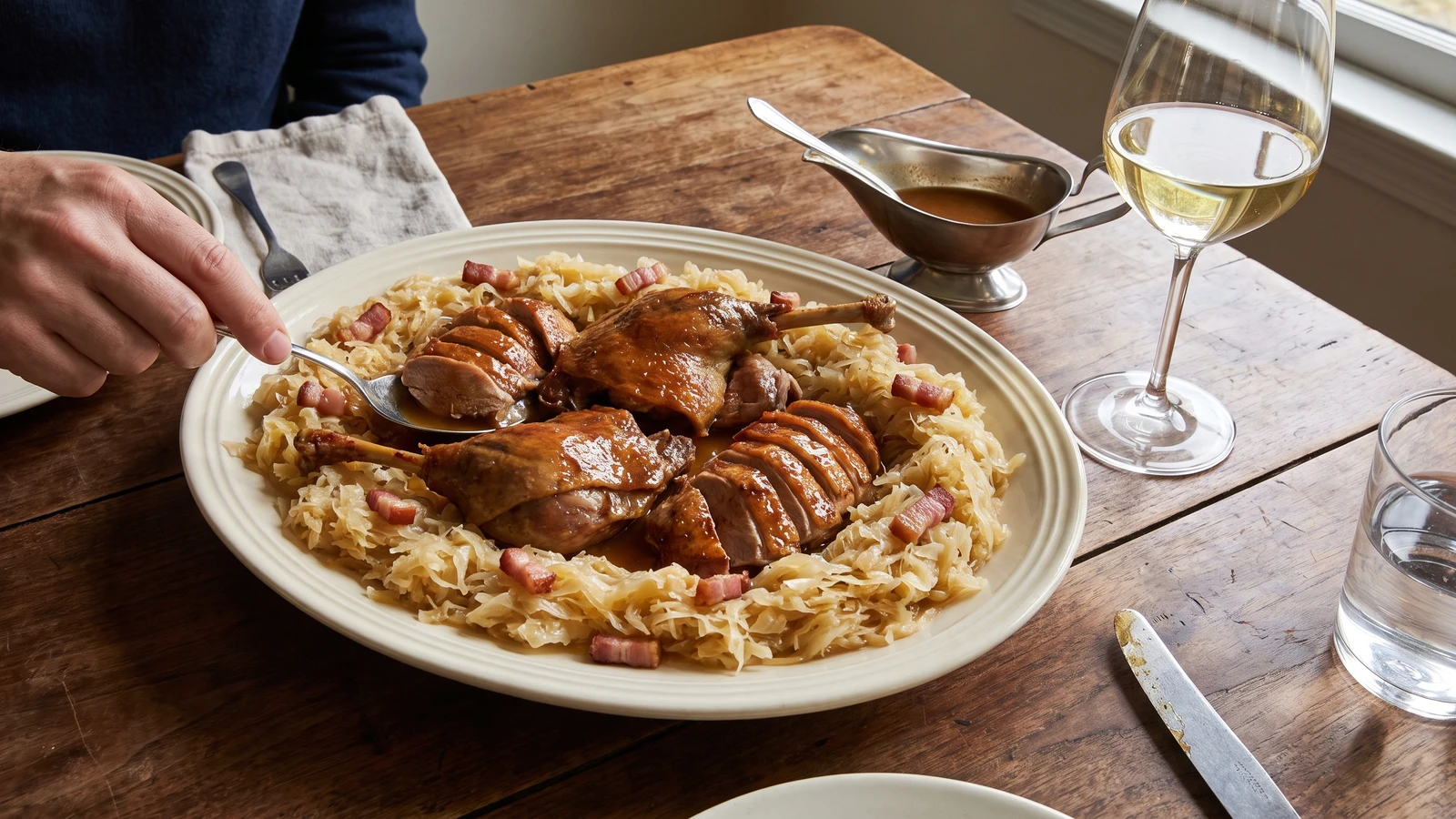
A whole Nantes duckling, browned and gently braised with Rhine wine, carved over choucroute glazed nearly dry with salt pork, then finished beneath a restrained veil of glossy veal sauce.
Caneton Nantais à la Choucroûte (Nantes duckling with braised sauerkraut) teaches one thing before you touch a pan: moisture must be invited in for tenderness, then driven out for concentration. The duck needs its gentle bath of white veal stock and Rhine wine. The choucroute must lose every last puddle of its finishing gravy and wine, or it goes slack beneath the bird.
The book's kitchen assumed a saucier within calling distance, white veal stock and veal gravy never off the fire, a shallow braising pan, and enough hands to tend duck, cabbage, and sauce separately. The old quantity already centers on one duck and two pounds of choucroute, an honest four-person table, so the scale stays and the pan system changes. One tight cocotte replaces separate browning and braising vessels, while good unsalted veal stock and a prepared veal demi-glace (half-glaze sauce) replace the sauce station. Those extra vessels were brigade scaffolding. The browning, the two-to-one stock-and-wine ratio, the salt pork, and the final dry reduction are the dish, so they stay. One cook, one stove, one evening.
When it lands, the duck is bronzed and tender, its slices just veiled in glossy sauce, while the pale choucroute holds a neat border and tastes of pork, wine, and patient reduction. Watch the cabbage, not the clock: before you carve, drag a spoon across the pan and make certain no liquid runs into the path. That is the step that decides the whole platter.
Caneton Nantais names the young duck associated with Nantes and the lower Loire, while choucroute belongs to Alsace and its Rhine-facing larder. This compound dish is a classical table marriage, not evidence that sauerkraut began in Nantes: Rhine wine and salt pork preserve its Alsatian register while the duckling supplies the composed centerpiece. Arranging the cabbage as a border and serving extra demi-glace separately show how grand kitchens carried a regional preserved food into formal service without erasing its character.
Quantity
1 bird, 4 to 4½ pounds (1.8 to 2 kg)
giblets removed and bird patted dry
Quantity
2 tablespoons (30 ml / 8 g)
finely chopped
Quantity
2 tablespoons (30 ml / 20 g)
finely chopped
Quantity
1½ teaspoons (7.5 ml / 9 g)
divided
Quantity
½ teaspoon (2.5 ml / 1 g)
Quantity
1 medium (about 150 g)
thickly sliced
Quantity
1 medium (about 100 g)
thickly sliced
Quantity
4 cups (960 ml / 960 g)
Quantity
2 cups (480 ml / 480 g)
for braising the duck
Quantity
8 packed cups (1.9 L / 907 g)
drained
Quantity
1 piece, 8 ounces (225 g)
left whole
Quantity
2 cups (480 ml / 480 g)
Quantity
¾ cup (180 ml / 180 g)
or white veal stock reduced by half
Quantity
6 tablespoons (90 ml / 90 g)
for finishing the choucroute
Quantity
1 cup (240 ml / 240 g)
| Ingredient | Quantity |
|---|---|
| whole Nantes ducklinggiblets removed and bird patted dry | 1 bird, 4 to 4½ pounds (1.8 to 2 kg) |
| Manied Butterfreshly prepared | ¼ cup (60 ml / 55 g) Manied Butter (No. 151) |
| flat-leaf parsleyfinely chopped | 2 tablespoons (30 ml / 8 g) |
| shallotfinely chopped | 2 tablespoons (30 ml / 20 g) |
| fine sea saltdivided | 1½ teaspoons (7.5 ml / 9 g) |
| freshly ground black pepper | ½ teaspoon (2.5 ml / 1 g) |
| yellow onionthickly sliced | 1 medium (about 150 g) |
| carrotthickly sliced | 1 medium (about 100 g) |
| unsalted white veal stock | 4 cups (960 ml / 960 g) |
| dry Rhine wine, preferably dry Rieslingfor braising the duck | 2 cups (480 ml / 480 g) |
| refrigerated sauerkrautdrained | 8 packed cups (1.9 L / 907 g) |
| salt pork bellyleft whole | 1 piece, 8 ounces (225 g) |
| water | 2 cups (480 ml / 480 g) |
| unsalted veal gravyor white veal stock reduced by half | ¾ cup (180 ml / 180 g) |
| dry Rhine wine, preferably dry Rieslingfor finishing the choucroute | 6 tablespoons (90 ml / 90 g) |
| prepared veal demi-glace | 1 cup (240 ml / 240 g) |
Heat the oven to 450°F (230°C). Place the freshly prepared Manied Butter (No. 151) inside the duckling with the chopped parsley and shallot. Truss the legs and wings close to the body so the bird forms a compact oval and cooks evenly. Season the cavity and skin with 1 teaspoon of the salt and all the pepper, reserving the remaining salt for the finished sauce.
Set the duck breast-side up in a dry 5½ to 6-quart cocotte and roast uncovered for 20 to 25 minutes, until the skin is a deep, even bronze and the pot holds a layer of rendered fat. Give it another 5 minutes if it remains pale. Lift out the duck, pour off all but 2 tablespoons of fat, and save the rest for another use. Spread the onion and carrot across the bottom to form the braising bed, then return the duck to the cocotte.
Reduce the oven to 325°F (165°C). Pour the white veal stock and 2 cups of Rhine wine around the duck, preserving the book's exact two-to-one ratio. Bring the liquid to the barest tremble on the stove, cover, and braise in the oven for 70 to 85 minutes, turning the bird carefully halfway through because a deep home cocotte will not cover it as completely as a shallow braising pan. It is ready when the thigh joint yields easily and the thickest part of the thigh reaches at least 170°F (77°C). Keep the liquid gentle. If it reaches a hard boil, lower the heat immediately; the duck will survive, but boiling can tighten the meat and give the Manied Butter liaison a floury edge. Later, strain the liquor finely and let the demi-glace provide the final body.
As soon as the duck begins braising, taste the sauerkraut. Rinse it briefly under cold water only if it is aggressively sour or salty, then squeeze it well. Put it in a wide lidded sauté pan with the whole piece of salt pork and the water. Cover and hold at a gentle simmer for about 45 minutes, until the strands are three-quarters tender but retain a little spring. Drain thoroughly, return the cabbage and pork to the pan, and add the veal gravy and 6 tablespoons of Rhine wine. Cook uncovered over medium-low heat for 15 to 25 minutes, turning the cabbage occasionally, until the added liquid has reduced completely. The pan should give a soft hiss, and no puddle should appear when you tilt it. If the cabbage begins catching before it is tender, lower the heat and add 2 tablespoons of duck braising liquor. Once the choucroute is ready, lift out the pork and cut it into small rectangles.
Lift the duck onto a board, tip any juices from its cavity back into the cocotte, and let the bird rest loosely covered. Strain the braising liquor into the widest saucepan you own, discard the vegetables, and skim away the surface fat. Reserve ½ cup of the liquor, then reduce the remainder at an active tremble until about 1 cup remains. Stir in the veal demi-glace and hold it just below a boil until the sauce coats a spoon in a thin, glossy film. If it tightens too far, add the reserved liquor one tablespoon at a time; if it remains thin, continue the gentle reduction. Ça se rattrape. Taste only now, then add some or all of the reserved salt if the sauce needs it.
Remove the trussing string. Separate the legs at their joints, take the breasts from the carcass, and slice each breast on a slight angle. Arrange the choucroute as a generous border on a warmed oval platter, leaving space in the center, and set the salt-pork rectangles around it. Place the carved duck in the center and spoon over just enough sauce to give the meat a glossy veil, never enough to drown the cabbage. Send the remaining sauce separately in a warm sauceboat. À table!
1 serving (about 650g)
Culinary guides, cultural storytelling, and the editorial depth that makes cooking meaningful.
Discover Culinary ExplorerChef Juliette
John Dory has the delicacy of sole and the firmness of turbot. A light flouring, a quick butter sauté, and nut-brown beurre noisette show exactly why looks never mattered.

Chef Juliette
Fresh haddock proves its delicacy in the meunière pan: a fine flour crust, moist pearly flakes, and beurre noisette sharpened with lemon and parsley, ready from one skillet in half an hour.

Chef Juliette
Éperlans à l’Anglaise turns small fish into a lesson in disciplined coating: boned smelts under a close, crisp crumb, pan-fried in clarified butter and finished with bright, half-melted maître d’hôtel butter.

Chef Juliette
Tiny smelts, shallot, mushrooms, white wine, gratin sauce, and fine bread raspings meet a fierce oven, where the fish must turn tender in the same breath the buttered crust bronzes.