
Chef Juliette
Oison à l’Allemande
A small gosling, its breast boned and filled with buttered apples, braised under a faithful baste, then ringed with ruby-filled apples and served with a glossy roast gravy.
A cooking platform built around craft, culture, and the stories behind what we eat.
Created by Chef Juliette
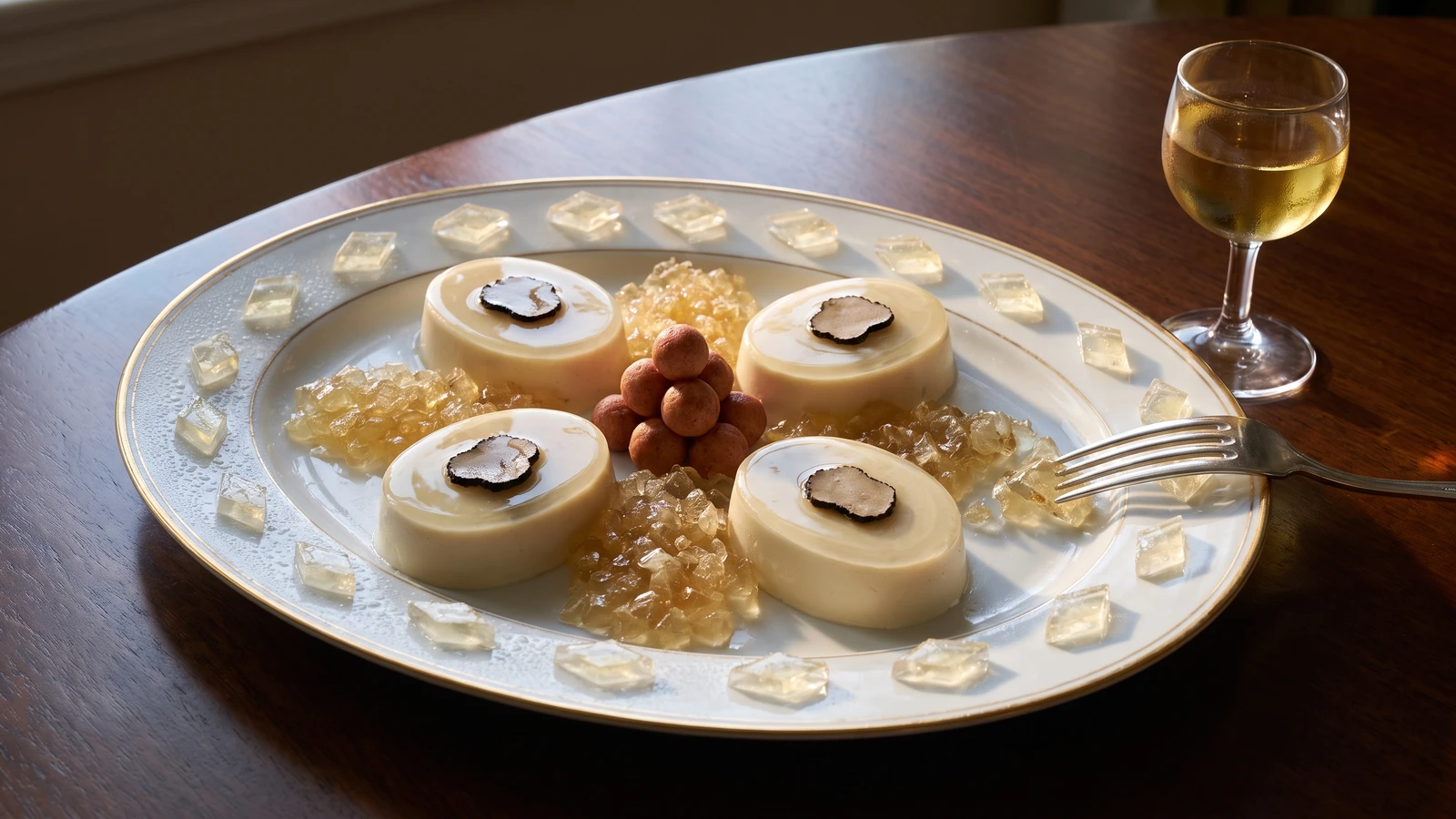
Based on No. 1738, Escalopes de Foie Gras Maréchale, from Le Guide Culinaire (1907) by Auguste Escoffier
Cold luxury with discipline: oval foie gras collops, domed with Pain de Foie Gras, masked in ivory chaud-froid, glazed clear, and ringed around truffle-hearted purée cherries.
Escalopes de Foie Gras Maréchale (cold oval slices of foie gras under a set cream coating) teaches the discipline of cold masking. Chaud-froid is a sauce applied while fluid and served cold and set; the word carries that reversal. The one true thing to know before touching a pan is this: every foie gras surface must be firm and every coating cool enough to cling, or the whole architecture slips.
The brigade version assumed a saucier on staff, stock never off the fire, a garde-manger crew for the cold work, and a salamander standing ready for hot finishes. This dish asks nothing of the salamander. At home, a small saucepan, clear stock, measured gelatin, a rack, and the refrigerator do the useful work for four. The Pain de Foie Gras (No. 1741) is prepared ahead as its own finished component, exactly as the cross-reference intends. One cook, one stove, one evening.
Four collops replace the ranks of a buffet platter, and a low cushion of chopped aspic replaces the brigade's sculpted support. Those are scaffolding. The domed pain, ivory chaud-froid, truffle, reddish-brown purée cherries, and clear aspic glaze must stay because they are the dish. Chill each dome until firm before masking it. If the sauce runs, scrape it back, cool it over ice, and coat again. Ça se rattrape.
Escalopes de Foie Gras Maréchale belong to the Parisian grand-kitchen repertoire of cold entrées and buffet dishes, where the garde-manger transformed terrines into composed presentations with chaud-froid and aspic. Maréchale is not a regional claim; in classical menu language it signals a rich, truffle-marked treatment and a polished presentation. The aspic was practical as well as decorative, sealing the cream mask and protecting the foie gras through cold service.
Quantity
1 terrine, 12 oz (340 g)
thoroughly chilled
Quantity
¾ cup (180 ml / 170 g) Pain de Foie Gras (No. 1741)
prepared and thoroughly chilled
Quantity
1 small truffle, about 1 oz (28 g)
fresh or preserved and well drained
Quantity
2½ cups (600 ml / 600 g)
chilled and defatted
Quantity
4 teaspoons (20 ml / 12 g)
Quantity
⅓ cup (80 ml / 80 g)
Quantity
3 tablespoons (45 ml / 45 g)
divided
Quantity
1½ tablespoons (22 ml / 21 g)
Quantity
2 tablespoons (30 ml / 18 g)
Quantity
½ cup (120 ml / 120 g)
Quantity
1 teaspoon (5 ml / 6 g)
Quantity
½ teaspoon (2.5 ml / 3 g)
divided
Quantity
⅛ teaspoon (0.6 ml / 0.3 g)
| Ingredient | Quantity |
|---|---|
| very firm foie gras terrinethoroughly chilled | 1 terrine, 12 oz (340 g) |
| Pain de Foie Grasprepared and thoroughly chilled | ¾ cup (180 ml / 170 g) Pain de Foie Gras (No. 1741) |
| whole black trufflefresh or preserved and well drained | 1 small truffle, about 1 oz (28 g) |
| clear, rich unsalted chicken stockchilled and defatted | 2½ cups (600 ml / 600 g) |
| unflavored powdered gelatin | 4 teaspoons (20 ml / 12 g) |
| cold water | ⅓ cup (80 ml / 80 g) |
| Madeiradivided | 3 tablespoons (45 ml / 45 g) |
| unsalted butter | 1½ tablespoons (22 ml / 21 g) |
| plain flour | 2 tablespoons (30 ml / 18 g) |
| heavy cream | ½ cup (120 ml / 120 g) |
| tomato paste | 1 teaspoon (5 ml / 6 g) |
| fine saltdivided | ½ teaspoon (2.5 ml / 3 g) |
| finely ground white pepper | ⅛ teaspoon (0.6 ml / 0.3 g) |
Sprinkle the gelatin evenly over the cold water and leave it for 5 minutes to swell. Bring 1¼ cups (300 ml) of the stock, 2 tablespoons (30 ml) of the Madeira, and half the salt just below a simmer. Remove from the heat, add the swollen gelatin, and stir until completely dissolved without whisking in bubbles. Strain through a fine sieve. Pour a scant 1 cup (230 ml) into a shallow 8-inch (20 cm) square pan so it forms a sheet about ¼ inch (6 mm) deep. Pour the remaining ¾ cup (180 ml) into a small covered container. Chill both for at least 2 hours, until firmly set.
Unmold the cold terrine. Dip a thin knife into hot water, wipe it completely dry, and cut four slices about ½ inch (1.25 cm) thick. Trim each into a neat oval roughly 3½ by 2 inches (9 by 5 cm), reserving about 4 oz (115 g) of the trimmings for the purée balls. Place the collops on a parchment-lined cold tray. If their edges soften or smear, stop and chill them for 15 minutes. Firm foie gras cuts; warm foie gras argues.
Divide the chilled Pain de Foie Gras (No. 1741) into four equal portions. Let each portion soften for no more than a minute between two sheets of parchment, then press it gently over a collop and shape it into a smooth, shallow dome. Do not knead or whip it; overworking warms the butter and destroys the close texture. Smooth the joins with a cold palette knife, then refrigerate the domed collops for 30 minutes, until the surface feels firm under a gentle touch.
Melt the butter in a small heavy saucepan over medium-low heat. Stir in the flour and cook this roux for 2 minutes without letting it color. Whisk in the remaining 1¼ cups (300 ml) stock a little at a time, scraping into the corners, then simmer gently for 8 to 10 minutes until the sauce nappes, or coats, the back of a spoon. Add the cream and simmer until the mixture measures about 1¼ cups (300 ml), with no taste of raw flour. Melt the reserved aspic gently over warm water. Whisk 7 tablespoons (110 ml) into the sauce, reserving the remaining ¼ cup plus 1 tablespoon (70 ml) for glazing. Season the chaud-froid with the remaining salt and the white pepper. Measure ½ cup (120 ml) into a second bowl for the purée balls and keep it fluid over barely warm water.
Set a wire rack over a cold rimmed tray and place the domed collops on it. Cool the ivory chaud-froid over an ice bath, stirring slowly, until it is about 72 to 75°F (22 to 24°C) and falls from the spoon in a thick, opaque ribbon. Test a spoonful on a cold saucer: it should cover without showing the plate beneath. Spoon it over each dome from the crown downward in one confident coat. If the mask runs translucent, scrape the runoff back into the bowl, cool it for another 2 minutes, and try again. If it sets in ridges, warm the bowl over lukewarm water for a few seconds and stir smooth. Ça se rattrape. Chill the coated collops for 20 minutes.
Press the reserved foie gras trimmings once through a fine sieve to make a smooth purée, working as little as possible. Divide it into eight equal portions of about ½ oz (14 g). Cut eight tiny round pellets from the truffle, reserving enough truffle for four thin decorative slices. Flatten each foie gras portion in a cold palm, set a truffle pellet at its center in imitation of a cherry stone, and close the purée around it. Roll quickly into balls the size of large cherries and chill for 15 minutes.
Simmer the remaining 1 tablespoon (15 ml) Madeira with the tomato paste for 1 minute, until smooth and darkened. Whisk this into the reserved chaud-froid to make the reddish-brown coating described in the original dish. Cool it over ice until it clings thickly, then roll each foie gras ball through it with two forks. Transfer the coated balls to the rack and chill for 20 minutes. If the coating slides, the sauce or the foie gras is too warm; return both to the cold, stir the sauce smooth, and coat again.
Lay one paper-thin truffle slice on the crown of each ivory collop. Melt the final ¼ cup plus 1 tablespoon (70 ml) aspic over warm water, then cool it until barely fluid. Brush a thin, clear coat over the collops and reddish-brown balls. Chill for 10 minutes and apply a second light coat wherever the gloss is uneven. Never use hot aspic here; it melts the chaud-froid beneath. If that happens, chill the piece firm, smooth on a little reserved sauce, and glaze again.
Turn the sheet of aspic onto a cold board and cut twelve small diamonds for the jelly croûtons. These are shaped pieces of jelly, not bread. Chop the remaining aspic finely and pack it inside a 3½-inch (9 cm) ring at the center of a very cold platter, forming a low circular cushion; this replaces the brigade's sculpted buffet support without changing the composition. Arrange the four collops around it, set the reddish-brown bigaroons in a small pyramid on top, and border the platter with the jelly croûtons. Chill until service, then let the platter stand for 8 to 10 minutes so the foie gras loses its waxy refrigerator chill without softening. À table!
1 serving (about 335g)
Culinary guides, cultural storytelling, and the editorial depth that makes cooking meaningful.
Discover Culinary ExplorerChef Juliette
A small gosling, its breast boned and filled with buttered apples, braised under a faithful baste, then ringed with ruby-filled apples and served with a glossy roast gravy.

Chef Juliette
A sausage-stuffed gosling, browned in butter and poêlé without one drop of cooking liquid, then set over goose-fat choucroute with lean bacon: Alsace’s generous lesson in dry covered roasting.

Chef Juliette
A burnished young goose filled with sage, dry-baked onion, and pressed bread, its rich pan gravy served around the bird and its lightly sweetened apples passed separately.

Chef Juliette
Oison en civet teaches the civet's final discipline: gosling braised in red wine, its sauce strained and bound with blood off the boil until wine-dark, satin-bodied, and ready for a generous table.