Culinary Explorer
A cooking platform built around craft, culture, and the stories behind what we eat.
Pain de Foie Gras
Created by Chef Juliette
Pain de Foie Gras turns Madeira-braised liver into a silken, truffled aspic: a lesson in warm emulsion, gentle folding, and the quiet confidence of a cold dish made entirely ahead.
Pain de Foie Gras (a moulded foie gras loaf) teaches one true thing before you touch a pan: temperature is an ingredient. The Madeira liquor is mounted with yolks and real butter by the Hollandaise method, then joined with sieved foie gras only when both are lukewarm. Too hot and the fat separates. Too cold and the gelatin catches before the mixture turns silken.
The original assumed a Madeira-braised foie already waiting cold, clear aspic from a stockpot never off the fire, and a saucier free to tend the emulsion. Your honest equivalents are a snug saucepan, prepared clear poultry aspic, a bowl over barely simmering water, a fine sieve, and a small mould sized for four. The yolks and butter are reduced in proportion with the foie gras, and the elaborate buffet decoration becomes a few true truffle slices and diamond croûtons of jelly. That decoration is scaffolding. The reduction, warm emulsion, sieve, and restrained folding are the dish itself.
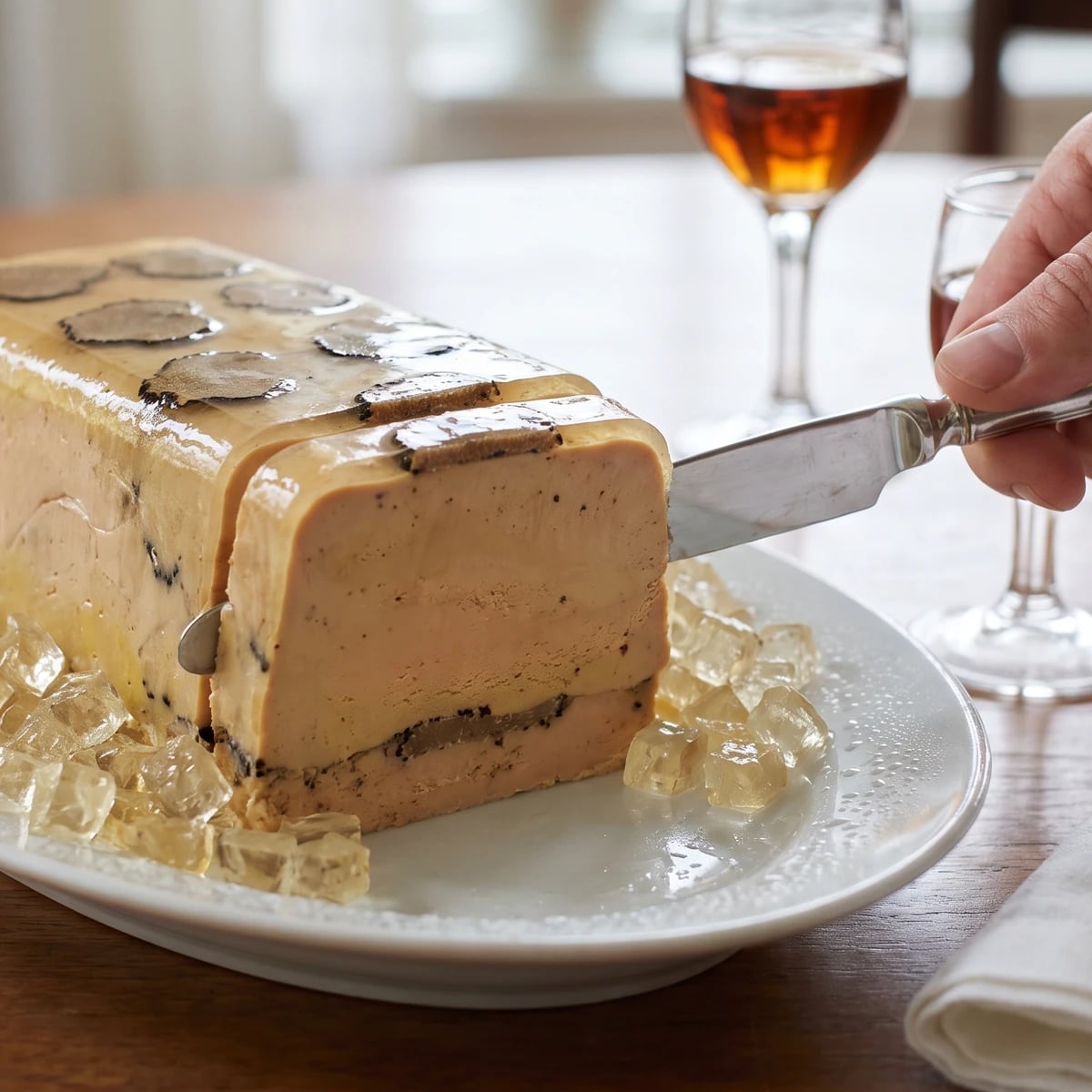
Once unmoulded, the pain should stand pale gold beneath a lucid coat of aspic, with dark truffle and neat collops crossing each slice. It is generous, cold, and entirely make-ahead. The step that matters most is the fold: wait until the emulsion is lukewarm, work gently, and stop the moment it is smooth.
Ingredients
fresh duck or goose foie gras lobe
Quantity
1 lobe (about 1 lb / 450 g)
deveined and kept whole
fine sea salt
Quantity
¾ teaspoon (3.75 ml / 4.5 g)
ground white pepper
Quantity
⅛ teaspoon (0.6 ml / 0.3 g)
| Ingredient | Quantity |
|---|---|
| fresh duck or goose foie gras lobedeveined and kept whole | 1 lobe (about 1 lb / 450 g) |
| fine sea salt | ¾ teaspoon (3.75 ml / 4.5 g) |
| ground white pepper | ⅛ teaspoon (0.6 ml / 0.3 g) |
Where cooking meets culture.
Culinary guides, cultural storytelling, and the editorial depth that makes cooking meaningful.
Discover Culinary Explorer