Culinary Explorer

A cooking platform built around craft, culture, and the stories behind what we eat.
Discover Culinary Explorer
Oison au Raifort

Oison au Raifort

Created by Chef Juliette

Based on No. 1725, Oison au Raifort, from Le Guide Culinaire (1907) by Auguste Escoffier

Oison au Raifort turns one braise into a lesson in reduction: tender gosling, buttered noodles or Riz au Gras (No. 2252), and cold Horse-radish Sauce (No. 138) served apart.

Main Dishes
French
Holiday
Dinner Party
Special Occasion
35 min
Active Time
3 hr cook3 hr 35 min total
Yield4 servings

Oison au Raifort (braised gosling with cold horseradish cream) teaches reduction with unusual clarity. The one true thing to know before touching the pan is this: the reduced braising liquor is all the final seasoning the buttered noodles or rice receive. Brown the bird deeply, braise it gently, then boil that liquor down until a spoonful tastes complete.

The original assumes a whole young bird in a deep braising pan, stock never off the fire, a saucier free to reduce the liquor, and separate hands finishing the garnish. At home, one 6-to-7-pound gosling fits a 7-quart cocotte, a wide saucepan does the saucier's work, and each cross-referenced component appears only in the quantity four people need. The separate staff and oversized batches are scaffolding and can go. The braise, hard reduction, buttered starch, and cold Horse-radish Sauce (No. 138) served apart are the dish and stay. A salamander is irrelevant here, since there is no gratin to brown. One cook, one stove, one evening.

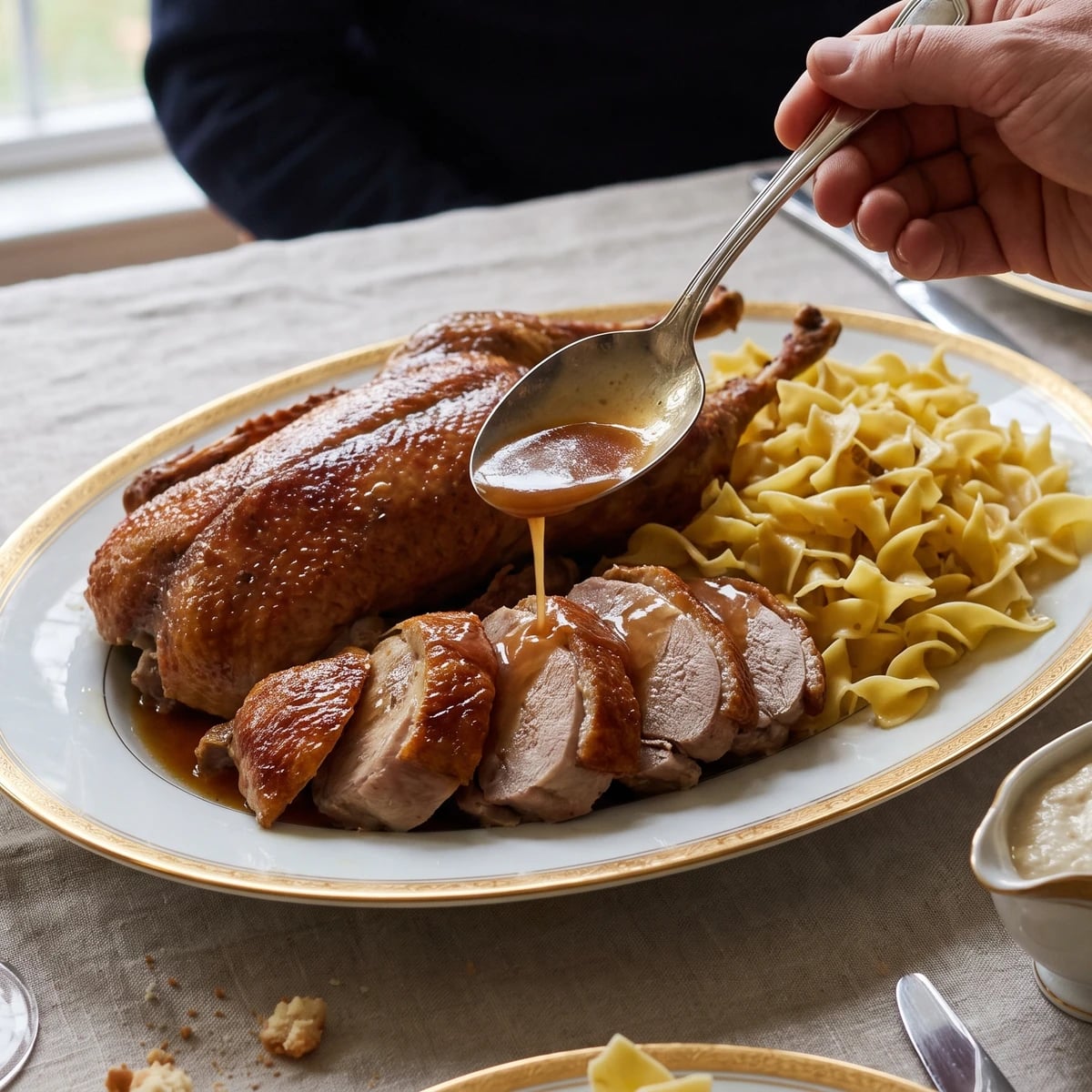
The finished platter should be generous: soft, burnished gosling surrounded by butter-glossed noodles or Riz au Gras (No. 2252), the dark braising liquor caught in their folds, and the pale cold sauce waiting beside it. Watch the reduction, not the clock. Stop when it coats the spoon and tastes deep without becoming salty.

Oison au Raifort belongs to the French classical bourgeois table rather than to one claimed province, though horseradish has its deepest French footing in Alsace and the northern and eastern border larders. The cold, bread-thickened Horse-radish Sauce (No. 138) is served apart, a deliberate contrast to rich young goose rather than a cream sauce poured over it. The same repertoire sends gosling toward chestnuts, à la Chipolata with small sausages, en daube, or en salmis, proof that this raifort service is one branch of a living grammar.

The technique, the tradition, and the story behind every dish.

Discover Culinary Explorer

Ingredients

oven-ready young gosling

Quantity

1 bird, 6 to 7 lb (2.7 to 3.2 kg)

neck and giblets removed

fine sea salt

Quantity

2 teaspoons (10 ml / 12 g)

freshly ground black pepper

Quantity

1 teaspoon (5 ml / 2 g)

yellow onion

Quantity

1 1/2 cups (360 ml / 225 g)

coarsely chopped

carrots

Quantity

1 cup (240 ml / 130 g)

coarsely chopped

celery

Quantity

1/2 cup (120 ml / 60 g)

coarsely chopped

garlic

Quantity

2 cloves

lightly crushed

bouquet garni of parsley stems, thyme, and bay

Quantity

1

unsalted white chicken stock

Quantity

4 cups (960 ml / 960 g)

heated

wide egg noodles (optional)

Quantity

6 cups dry (1.4 L / 340 g)

unsalted butter (optional)

Quantity

1/4 cup (60 ml / 57 g)

for the noodles

finished Riz au Gras (optional)

Quantity

4 cups (960 ml / about 760 g) Riz au Gras (No. 2252)

cold Horse-radish Sauce

Quantity

1 1/2 cups (360 ml / about 360 g) Horse-radish Sauce (No. 138)

Equipment Needed

  • 7-to-8-quart oval cocotte or Dutch oven with a tight lid
  • Wide 3-quart saucepan for reducing the braising liquor
  • Fine-mesh sieve and fat separator
  • Instant-read meat thermometer
  • Large warm oval serving platter

Instructions

  1. 1

    Prepare the gosling

    Heat the oven to 325°F (165°C). Pull any loose fat from the gosling's cavity and reserve it for another use, then prick only the skin over the thighs and lower breast with a fine skewer. Do not pierce the meat. Dry the bird thoroughly, season it inside and out with the salt and pepper, and tie the legs loosely together. Dry skin browns; wet skin clings and goes grey.

    A poultry butcher can remove the neck and giblets and truss the bird for you. Keep the neck for stock, but do not put the liver into this braise, where its mineral flavour would dominate the reduction.
  2. 2

    Brown and build fond

    Set a 7-to-8-quart heavy cocotte over medium heat. Lay in the gosling breast-side down without added fat; within a minute or two its own fat will begin to render. Brown the breast, back, and both sides patiently, turning with two sturdy wooden spoons or tongs, until the skin is deep golden, 15 to 20 minutes. If it grips the pot, wait another minute before forcing it. Lift out the bird, pour off the rendered fat except for 2 tablespoons, then cook the onion, carrots, and celery for 8 to 10 minutes until browned at their edges. Add the garlic for the final minute. That brown glaze on the pot floor is the fond, and the liquor needs every bit of it.

    Strain and chill the poured-off goose fat. It keeps well in the cold and makes splendid roast potatoes. Never apologize for good fat used well.
  3. 3

    Braise at a tremble

    Return the gosling to the cocotte breast-side up and tuck in the bouquet garni. Pour in enough hot stock to rise about one-third of the way up the bird, scraping the pot floor as the liquid comes to a bare simmer. Reserve any unused stock. Cover tightly and braise in the oven for 1 hour 45 minutes to 2 hours 15 minutes, basting every 30 minutes, until the thigh joint yields when moved and a thermometer reaches at least 165°F (74°C) in the breast and 175°F (79°C) in the inner thigh. The liquid should barely tremble. If it boils hard, lower the oven and add a splash of reserved hot stock. The bird isn't lost. Ça se rattrape.

    Do not judge tenderness by temperature alone. Gosling is ready when the thigh joint loosens and a skewer enters the thick meat with little resistance.
  4. 4

    Rest and strain

    Lift the gosling onto a warm platter, cover it loosely, and rest it for 20 to 25 minutes. Strain the braising liquid through a fine sieve into a wide saucepan without pressing the vegetables, since pressing clouds the liquor. Let the fat rise, then skim it thoroughly or use a fat separator. Keep the bird warm, but do not seal it under tight foil or its browned skin will become sodden.

  5. 5

    Reduce the liquor hard

    Boil the defatted braising liquid briskly in the wide saucepan until it falls to about 1 1/2 cups and becomes glossy enough to coat the back of a spoon, 15 to 25 minutes. This hard reduction is the dish's foundation, not decorative sauce work. Taste repeatedly near the end. If it becomes too salty before it coats the spoon, stop reducing and loosen it with unsalted stock; if it has gone sticky, whisk in hot stock one tablespoon at a time. Ça se rattrape. The finished liquor should be concentrated and fluid, never syrupy.

    Use a wide saucepan, not a narrow one. More surface area reduces the liquor quickly, preserving its clean roasted flavour instead of cooking it into heaviness.
  6. 6

    Finish the garnish

    While the liquor reduces, cook the egg noodles in unsalted water until tender but not slack. Drain them very thoroughly and toss them with the butter, adding no further salt because the reduced liquor supplies the final seasoning. If you prefer rice, bring 4 cups of finished Riz au Gras (No. 2252) hot to the table instead; it remains a separate preparation and is not remade inside this recipe.

  7. 7

    Set the cold sauce

    Take the cold Horse-radish Sauce (No. 138) from the refrigerator only when the platter is nearly ready. Whisk it gently if it has settled, transfer it to a chilled sauceboat, and keep it apart from the hot braise. Do not warm or pour it over the gosling. Its cold, sharp creaminess is the deliberate counterpoint to the rich meat and reduced liquor.

  8. 8

    Carve and serve

    Carve the rested gosling into breasts and leg portions. Mound the buttered noodles or hot Riz au Gras (No. 2252) around the meat, then spoon the reduced braising liquor generously over the garnish so it catches in every fold or grain. Serve the cold Horse-radish Sauce (No. 138) separately, letting each guest take as much as desired. À table!

Chef Tips

  • Ask specifically for a young gosling weighing 6 to 7 pounds. A mature goose is fattier, tougher, and too large for this timing; if that is all the market has, change the plan rather than pretending the birds cook alike.
  • The stock must be genuinely unsalted. Commercial salted broth can become briny long before a hard reduction reaches the glossy body this dish requires.
  • If using noodles, drain them until no water remains and butter them immediately. Do not rinse them. Their dry, lightly starchy surface catches the reduced liquor instead of sending it to the bottom of the platter.
  • A dry Alsace Riesling has the acidity for the goose and the nerve for raifort. Serve it cool, not icy, so the wine keeps its aroma beside the cold sauce.

Advance Preparation

  • Prepare the Horse-radish Sauce (No. 138) through its own entry up to a day ahead and keep it very cold. Whisk gently before transferring it to the sauceboat.
  • The gosling may be braised a day ahead. Carve it for faster chilling, refrigerate the meat and strained liquor separately within two hours, then reheat the meat covered with 1 cup of liquor at 300°F (150°C) until it reaches 165°F (74°C). Defat and reduce the remaining liquor while it reheats.
  • If serving Riz au Gras (No. 2252), prepare that finished component close to service. Buttered noodles should be cooked at the last moment, since they become heavy and clumped when held.

Frequently Asked Questions

Nutrition Information

1 serving (about 750g)

Calories
1680 calories
Total Fat
103 g
Saturated Fat
42 g
Trans Fat
1 g
Unsaturated Fat
57 g
Cholesterol
400 mg
Sodium
1690 mg
Total Carbohydrates
74 g
Dietary Fiber
4 g
Sugars
6 g
Protein
103 g

Note: Chef personas and recipes are created with AI assistance. Cook with care: follow safe food-handling practices, check doneness with a thermometer when needed, and adapt for allergies and your kitchen.

Where cooking meets culture.

Culinary guides, cultural storytelling, and the editorial depth that makes cooking meaningful.

Discover Culinary Explorer

More from Poultry (Volaille) - Goose (Oie)

Browse the full collection