
Chef Juliette
John Dory (St. Pierre)
John Dory has the delicacy of sole and the firmness of turbot. A light flouring, a quick butter sauté, and nut-brown beurre noisette show exactly why looks never mattered.
A cooking platform built around craft, culture, and the stories behind what we eat.
Created by Chef Juliette
Based on No. 1722c, Oison à l’Alsacienne, from Le Guide Culinaire (1907) by Auguste Escoffier
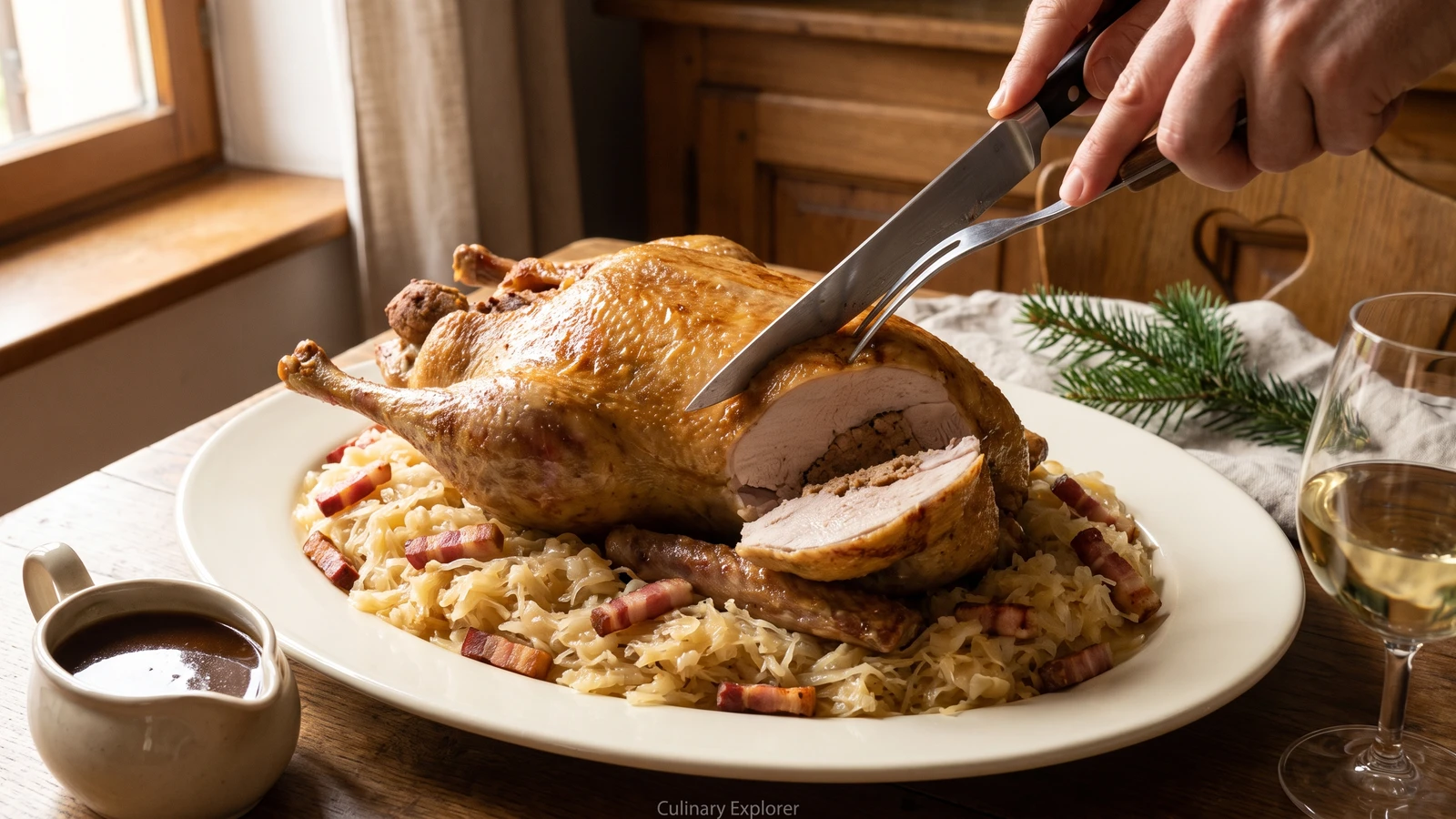
A sausage-stuffed gosling, browned in butter and poêlé without one drop of cooking liquid, then set over goose-fat choucroute with lean bacon: Alsace’s generous lesson in dry covered roasting.
Oison à l’Alsacienne (Alsatian-style gosling) teaches poêlage, dry covered roasting carried by butter, and its one truth is absolute: never moisten the bird while it cooks. Pour in stock and you may make a fine braise, but not this dish. The butter must carry the aromas while the gosling keeps the concentrated savour of a roast.
The old kitchen sent the bird through Poëlings (No. 250) and assumed a saucier on staff, brown veal stock never off the fire for the liquor made afterward, and a deep pan fitted precisely to the bird. Unlike a gratin, this dish asks nothing of a salamander; uncovering the cocotte supplies the final colour. A heavy oval cocotte replaces the special pan, and a fine-mesh strainer replaces the serviette. Those are brigade scaffolding. The butter-only cooking, the absence of liquid, and the stock added only after the bird leaves the pot are the dish and must stay. A 7 to 8 pound gosling, 2 cups of sausage-meat, and 8 cups of choucroute bring the professional platter down to four without changing its character. One cook, one stove, one evening.
When it is right, the skin is butter-bronze, the stuffing is juicy rather than compressed, and the choucroute underneath tastes tart, rich, and faintly smoky from the bacon. Watch the cocotte during the poêlage: if the bottom threatens to scorch, lower the heat and add melted butter, never stock or water. Ça se rattrape. Guard that dry poêlage; it decides the dish.
Oison à l’Alsacienne belongs to Alsace, where preserved cabbage, pork, and goose meet at the same generous cold-weather table; choucroute is not decoration here, but the tart bed that balances the fatty bird. The pairing passed from the region’s household larder into the classical canon, where the gosling was stuffed, poêlé in butter, and presented whole with bacon cut into neat rectangles. A common confusion is to call the covered cooking a braise, but poêlage takes no moistening during cooking, and that distinction preserves the flavour of a roast.
Quantity
1 bird, 7 to 8 pounds (3.2 to 3.6 kg)
neck and giblets removed, thoroughly dried
Quantity
2½ teaspoons (12 ml / 15 g)
divided
Quantity
1 teaspoon (5 ml / 2 g)
Quantity
2 cups (475 ml / 450 g)
kept cold
Quantity
5 tablespoons (75 ml / 70 g)
divided
Quantity
1 home-scale preparation of Poëlings (No. 250), sized for the gosling
Quantity
8 loosely packed cups (1.9 L / 900 g)
drained
Quantity
¼ cup (60 ml / 55 g)
Quantity
8 ounces (225 g)
cut into 12 neat rectangles
Quantity
1 cup (240 ml / 240 g), plus more if needed
| Ingredient | Quantity |
|---|---|
| oven-ready young goslingneck and giblets removed, thoroughly dried | 1 bird, 7 to 8 pounds (3.2 to 3.6 kg) |
| fine sea saltdivided | 2½ teaspoons (12 ml / 15 g) |
| freshly ground black pepper | 1 teaspoon (5 ml / 2 g) |
| very good plain pork sausage-meatkept cold | 2 cups (475 ml / 450 g) |
| unsalted butterdivided | 5 tablespoons (75 ml / 70 g) |
| Poëlings | 1 home-scale preparation of Poëlings (No. 250), sized for the gosling |
| plain sauerkrautdrained | 8 loosely packed cups (1.9 L / 900 g) |
| goose fat | ¼ cup (60 ml / 55 g) |
| lean slab baconcut into 12 neat rectangles | 8 ounces (225 g) |
| water | 1 cup (240 ml / 240 g), plus more if needed |
Taste the sauerkraut before rinsing it. A well-balanced choucroute needs only draining; if the brine is fiercely salty or sour, rinse it briefly under cold water and squeeze it dry. Melt the goose fat in a heavy covered pot over medium-low heat. Add the bacon rectangles and turn them for 3 minutes, just until glossy and beginning to release their fat, without crisping them. Fold in the sauerkraut, coating every strand with fat, then add the water and bring it to the barest simmer. Cover and cook gently for 1½ to 2 hours, turning the cabbage every 30 minutes. If the bottom dries before the cabbage is tender, add hot water 2 tablespoons at a time. Choucroute is a braise and may be moistened; the gosling must not be.
Take the sausage-meat from the cold only when the gosling is ready. Season the cavity with ½ teaspoon of the salt and a little pepper, then spoon in the sausage-meat loosely. Do not ram or compress it; a packed stuffing heats slowly and cooks to a heavy block. Truss the legs and secure the cavity with kitchen twine, then season the whole exterior with the remaining salt and pepper, reserving a small pinch of salt for the choucroute. Stuff the bird immediately before cooking, never hours ahead.
Melt 4 tablespoons of the butter in the heavy oval cocotte over medium heat. When the foam subsides, lower in the gosling and brown it patiently on the breast, back, and both sides, turning with long tongs and a sturdy wooden spoon. Allow 10 to 15 minutes and look for an even, deep butter-gold colour, not scattered black patches. If the butter burns before the skin colours, remove the pot from the heat and lift out the bird. Ça se rattrape: discard the blackened butter, wipe away the bitter specks with paper held in tongs, add the reserved tablespoon of fresh butter, and continue over gentler heat.
Proceed immediately with Poëlings (No. 250), carrying out that preparation in the heavy cocotte and using a 325°F (165°C) home oven for this 7 to 8 pound stuffed bird. Do not pour water, wine, or stock into the vessel while the gosling cooks. Begin checking after 1 hour 45 minutes; most birds of this size require about 2 to 2½ hours after browning. The centre of the sausage stuffing must reach 165°F (74°C), and the deepest part of the thigh should reach at least 170°F (77°C) without the thermometer touching bone. If the pot smells too dark before the bird is done, lower the oven by 25°F (15°C) and add a spoonful of melted butter, not liquid. If the skin is already dark but the stuffing remains under temperature, keep the vessel covered and continue gently. Rest the finished gosling loosely covered for 25 minutes.
When the choucroute is tender but still holds distinct strands, uncover it. If liquid remains, cook gently until it has evaporated and the cabbage glistens with goose fat rather than swimming in broth. If it has tightened too far, fold in a spoonful of hot water. Taste before adding the reserved salt because both the sauerkraut and bacon may already have supplied enough. Keep the bacon rectangles whole and hold everything covered over the lowest heat.
While the gosling rests, complete and strain the cooking liquor exactly as directed in Poëlings (No. 250), then hold it in a warm sauceboat. This is where stock belongs, after the bird has left the cocotte, so it can capture the butter, vegetables, and roasting juices without turning the poêlage into a braise. If the finished liquor still looks greasy, let it stand briefly and skim it again; fat should lend aroma and gloss, not float in a heavy layer.
Remove the twine from the rested gosling. Spread the choucroute across a warmed oval platter, leaving a shallow hollow in the centre, and arrange the bacon rectangles around its edge. Set the whole gosling on the cabbage for the table, then carve it into breast slices and leg portions, giving each person some sausage stuffing, choucroute, and bacon. Keep the poëling liquor in its sauceboat so the burnished skin stays itself. À table!
1 serving (about 820g)
Culinary guides, cultural storytelling, and the editorial depth that makes cooking meaningful.
Discover Culinary ExplorerChef Juliette
John Dory has the delicacy of sole and the firmness of turbot. A light flouring, a quick butter sauté, and nut-brown beurre noisette show exactly why looks never mattered.

Chef Juliette
Fresh haddock proves its delicacy in the meunière pan: a fine flour crust, moist pearly flakes, and beurre noisette sharpened with lemon and parsley, ready from one skillet in half an hour.

Chef Juliette
Éperlans à l’Anglaise turns small fish into a lesson in disciplined coating: boned smelts under a close, crisp crumb, pan-fried in clarified butter and finished with bright, half-melted maître d’hôtel butter.

Chef Juliette
Tiny smelts, shallot, mushrooms, white wine, gratin sauce, and fine bread raspings meet a fierce oven, where the fish must turn tender in the same breath the buttered crust bronzes.