
Chef Juliette
John Dory (St. Pierre)
John Dory has the delicacy of sole and the firmness of turbot. A light flouring, a quick butter sauté, and nut-brown beurre noisette show exactly why looks never mattered.
A cooking platform built around craft, culture, and the stories behind what we eat.
Created by Chef Juliette
Based on No. 1722a, Dindonneau Froid, from Le Guide Culinaire (1907) by Auguste Escoffier
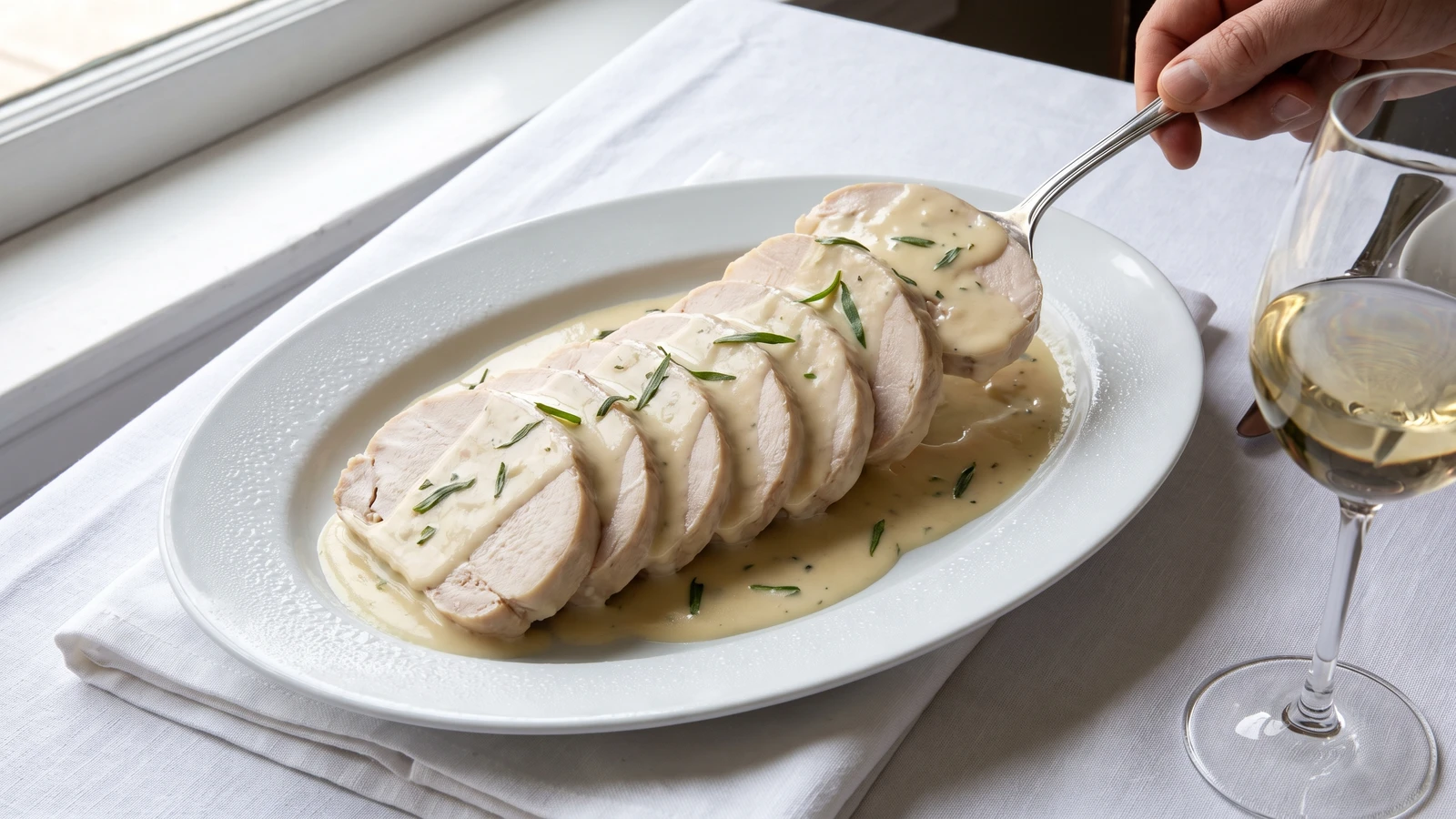
Dindonneau froid proves that cold poultry lives or dies by moisture: turkey breast poached at a bare tremble, chilled quickly, then veiled in a satin chaud-froid sauce that sets tenderly, never rubbery.
Dindonneau froid (cold young turkey) teaches one true thing: cold magnifies dryness. The bird must be cooked more gently than one meant for carving hot, then cooled quickly and kept covered, because no sauce can return moisture squeezed out by boiling. Season with conviction too. Cold softens salt, pepper, and acidity.
The old entry is deliberately spare, declaring that every cold pullet preparation carries across to young turkey. It assumed a whole bird, a saucier at elbow, stock never off the fire, many hands for masking and decorating, and a cold room built for rapid cooling. For four, a bone-in breast half is the honest equivalent. One saucepan builds the chaud-froid, an ice bath replaces the cold room's speed, and a thermometer accounts for the turkey's greater size. One cook, one stove, one evening.
The whole-bird display and brigade decoration are scaffolding, so they can go. Gentle pochage (poaching), complete chilling, and the tender set of the chaud-froid (a chilled velouté coating) are the dish and must stay. Before you heat the pot, clear a refrigerator shelf for a shallow tray. Cooling the turkey promptly is the step that decides both its texture and its safety.
Dindonneau froid belongs to the French classical cold buffet, particularly the Parisian banquet table and the bourgeois holiday meal, where young turkey could appear under chaud-froid, set in aspic, or worked into mousse or terrine. The classical entry is a transfer rule rather than a single fixed garnish: every cold pullet preparation carries over to turkey, provided the larger bird receives longer cooking and more careful cooling. It is the canon behaving as a family system, not a regional recipe pretending to have only one form.
Quantity
1, about 3 to 3½ pounds (1.35 to 1.6 kg)
Quantity
1 tablespoon (15 ml / 18 g)
divided
Quantity
1 teaspoon (5 ml / 2 g)
divided
Quantity
6 cups (1.4 L / 1.4 kg)
Quantity
1 cup (240 ml / 240 g)
Quantity
1 medium (100 g)
sliced
Quantity
1 small (150 g)
white and pale green parts sliced and washed
Quantity
1 small (150 g)
quartered
Quantity
1 stalk (50 g)
sliced
Quantity
1
1 bay leaf, 4 parsley stems, and 2 thyme sprigs
Quantity
Up to 1 cup (240 ml / 240 g)
only if needed to cover the turkey
Quantity
¼ cup (60 ml / 60 g)
for blooming the gelatin
Quantity
2¼ teaspoons (11 ml / 7 g)
Quantity
3 tablespoons (45 ml / 42 g)
Quantity
¼ cup (60 ml / 30 g)
Quantity
¾ cup (180 ml / 180 g)
Quantity
1 tablespoon (15 ml / 15 g)
Quantity
2 tablespoons (30 ml / 4 g)
half finely chopped and half left small
| Ingredient | Quantity |
|---|---|
| bone-in, skin-on young turkey breast half | 1, about 3 to 3½ pounds (1.35 to 1.6 kg) |
| fine sea saltdivided | 1 tablespoon (15 ml / 18 g) |
| ground white pepperdivided | 1 teaspoon (5 ml / 2 g) |
| unsalted chicken stock | 6 cups (1.4 L / 1.4 kg) |
| dry white wine | 1 cup (240 ml / 240 g) |
| carrotsliced | 1 medium (100 g) |
| leekwhite and pale green parts sliced and washed | 1 small (150 g) |
| yellow onionquartered | 1 small (150 g) |
| celerysliced | 1 stalk (50 g) |
| bouquet garni1 bay leaf, 4 parsley stems, and 2 thyme sprigs | 1 |
| water (optional)only if needed to cover the turkey | Up to 1 cup (240 ml / 240 g) |
| cold waterfor blooming the gelatin | ¼ cup (60 ml / 60 g) |
| unflavored powdered gelatin | 2¼ teaspoons (11 ml / 7 g) |
| unsalted butter | 3 tablespoons (45 ml / 42 g) |
| all-purpose flour | ¼ cup (60 ml / 30 g) |
| heavy cream | ¾ cup (180 ml / 180 g) |
| fresh lemon juice | 1 tablespoon (15 ml / 15 g) |
| fresh tarragon leaveshalf finely chopped and half left small | 2 tablespoons (30 ml / 4 g) |
Mix 2 teaspoons of the salt with ¾ teaspoon of the white pepper. Pat the turkey dry, season it evenly on every side, and refrigerate it uncovered for at least 1 hour or as long as 12 hours. This short salage, or dry seasoning, gives the salt time to reach the meat rather than sitting on its surface. Blot away moisture before cooking, but don't rinse it.
Combine the chicken stock, wine, carrot, leek, onion, celery, and bouquet garni in a heavy pot that holds the turkey snugly. Bring to a gentle simmer and cook for 20 minutes so the vegetables give the liquor their sweetness. Lower the turkey into the pot, skin side up. The liquid should cover it or reach nearly to the top; add only enough water to make up the difference.
Hold the liquid between 175°F and 185°F (80°C and 85°C), with an occasional bubble but never a boil. Poach the turkey for 50 to 70 minutes, turning it once, until the thickest part reaches 165°F (74°C) without the thermometer touching bone. If the pot boils, lift the turkey out, pull the pot from the heat, and let the liquid settle before returning it. Ça se rattrape, provided you stop the hard heat before the meat tightens. Transfer the cooked turkey to a shallow tray. Boil the cooking liquor briskly for 3 minutes, skim it, strain it, and reserve 2¼ cups (540 ml / 540 g).
Let the turkey stand for 10 minutes, then remove the skin and bone while it is still manageable, keeping the breast meat in one or two large pieces. Place the meat in a single layer in a shallow metal pan and spoon ¼ cup (60 ml / 60 g) of the strained liquor around it. Refrigerate uncovered for 30 minutes, then press parchment against the surface, cover the pan, and chill until the center is thoroughly cold, about 2 hours. Don't leave the bird cooling inside its deep pot of liquor. A professional cold room could manage that mass; a home refrigerator cannot.
Sprinkle the gelatin over the ¼ cup cold water and leave it for 5 minutes. Melt the butter in a saucepan, stir in the flour, and cook this roux blond, a pale butter-and-flour thickener, for 2 minutes without letting it color. Whisk in 2 cups (480 ml / 480 g) of the hot reserved liquor a little at a time. Simmer gently for 8 minutes, whisking at the corners, then add the cream and cook until the sauce coats the back of a spoon, about 5 minutes. Strain it into a clean bowl, then stir in the bloomed gelatin, lemon juice, chopped tarragon, and the remaining salt and pepper. Taste while warm. It should seem a shade too salty and bright because chilling will soften both.
Set the bowl of chaud-froid over an ice bath and stir until the sauce thickens to the consistency of heavy cream but still flows in a smooth ribbon. Slice the cold turkey across the grain into 8 thick pieces and arrange them on a wire rack over a rimmed tray. Spoon over a thin, even coat, chill for 10 minutes, then apply a second coat to cover any bare places. If the sauce sets in the bowl, warm it gently over barely warm water; if it runs straight off the turkey, stir it over ice for another minute. Ça se rattrape. Chill the coated pieces for at least 2 hours, until the sauce is tenderly set.
Arrange the turkey pieces in an overlapping row on a chilled oval platter and scatter the small tarragon leaves lightly over the top. Take the platter from the refrigerator 15 minutes before serving so the chaud-froid loses its refrigerator stiffness and returns to a soft satin texture. Serve cold, not numb. À table!
1 serving (about 400g)
Culinary guides, cultural storytelling, and the editorial depth that makes cooking meaningful.
Discover Culinary ExplorerChef Juliette
John Dory has the delicacy of sole and the firmness of turbot. A light flouring, a quick butter sauté, and nut-brown beurre noisette show exactly why looks never mattered.

Chef Juliette
Fresh haddock proves its delicacy in the meunière pan: a fine flour crust, moist pearly flakes, and beurre noisette sharpened with lemon and parsley, ready from one skillet in half an hour.

Chef Juliette
Éperlans à l’Anglaise turns small fish into a lesson in disciplined coating: boned smelts under a close, crisp crumb, pan-fried in clarified butter and finished with bright, half-melted maître d’hôtel butter.

Chef Juliette
Tiny smelts, shallot, mushrooms, white wine, gratin sauce, and fine bread raspings meet a fierce oven, where the fish must turn tender in the same breath the buttered crust bronzes.