
Chef Juliette
Poularde à la Carmélite
Poularde à la Carmélite turns poached chicken, crayfish mousse, truffle, and melting aspic into a cold Parisian centerpiece. The mastery lies in coating while the sauce still flows smoothly.
A cooking platform built around craft, culture, and the stories behind what we eat.
Created by Chef Juliette
Based on No. 1721, Blanc de Dindonneau à la Toulousaine, from Le Guide Culinaire (1907) by Auguste Escoffier
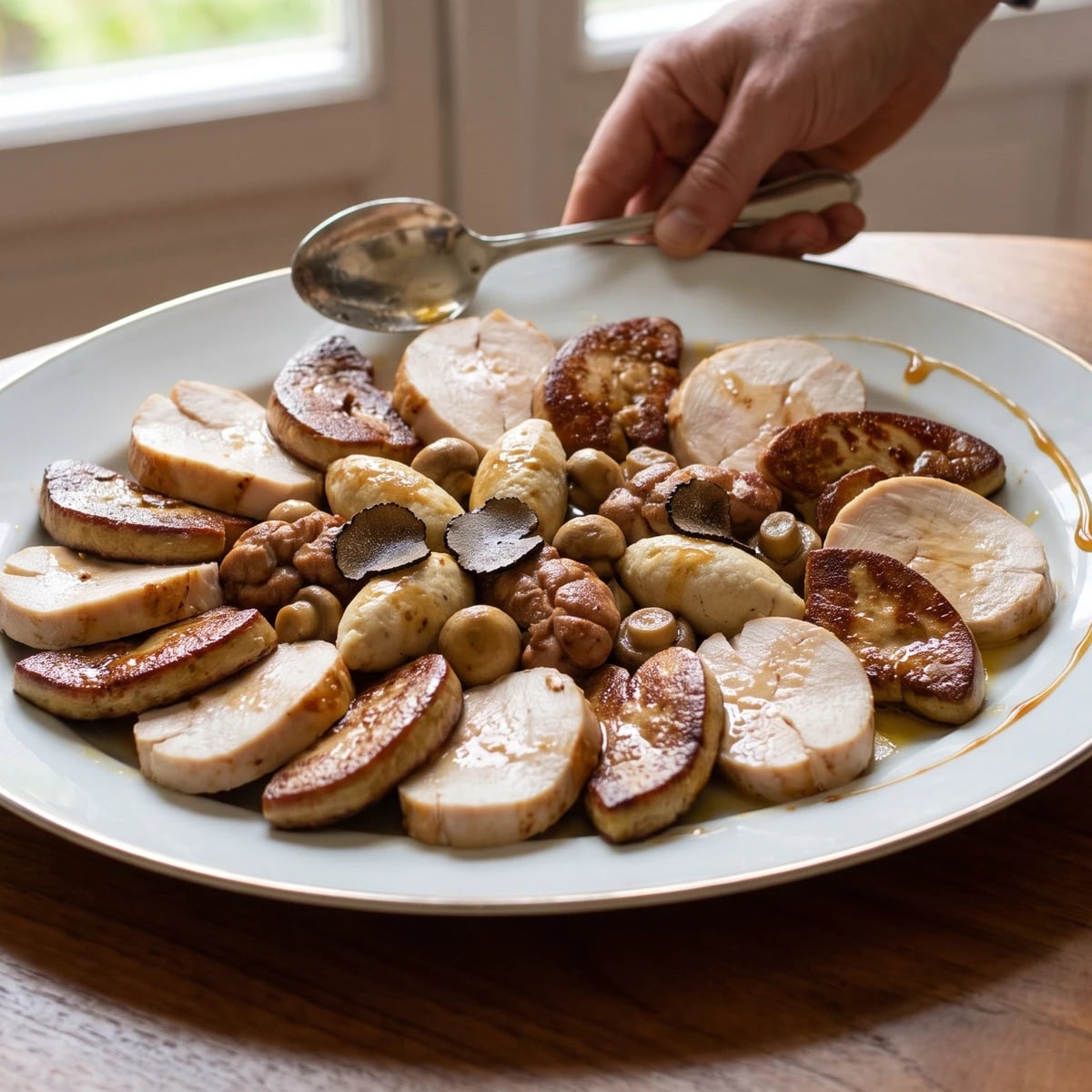
Thick collops of poëled turkey alternate with butter-sautéed foie gras around a pale Toulousaine garnish, while a thread of light glaze proves that classical abundance can still land gracefully on a home table.
Blanc de Dindonneau à la Toulousaine (young turkey breast butter-roasted with foie gras and the Toulouse garnish) teaches the architecture of a composed dish: each component receives its proper heat, then everything meets without cooking the turkey twice. The suprême, the breast fillet, must be sliced last. Finish the garnish first, because once that breast becomes collops, thick oval slices, elegance can turn to dryness very quickly.
The original sat inside a brigade: a whole young turkey moving through Poëlings (No. 250), a saucier with glaze ready, stock never off the fire, extra hands trimming poultry offal, and a salamander standing by even though this platter does not need it. At home, one breast feeds four, and its poëling liquor becomes both sauce foundation and glaze. Cockscombs and cock kidneys are omitted because they demand specialty sourcing and separate preparation; sweetbreads, mushrooms, truffle, and small poultry quenelles preserve the Toulousaine pattern of pale, delicate textures. Separate warming pans are brigade scaffolding and can go. The poëling, thick collops, butter-sautéed foie gras, central garnish, and light glaze are the dish, so they stay.
On the platter, ivory turkey and bronzed foie gras alternate around a creamy, truffled center, with the glaze drawn as a narrow shining thread. It is generous without becoming ponderous. One cook, one stove, one evening. Complete the Toulousaine garnish and the glaze before you cut the suprême, then move directly to the table.
À la Toulousaine belongs to the classical vocabulary of Toulouse and the south-western French table, where foie gras, truffles, poultry offal, and fine forcemeats formed a particularly generous garnish. In grand kitchens the name settled around poultry quenelles, cockscombs and cock kidneys, mushrooms, truffles, and often sweetbreads, held together by a pale rich sauce. Blanc de Dindonneau à la Toulousaine is therefore not a rustic Toulouse turkey roast, but the canon's composed treatment of a mild poëled bird with the prized textures of the south-west.
Quantity
1 breast, about 2 lb (900 g) raw weight, prepared according to Poëlings (No. 250)
rested and kept warm
Quantity
1½ cups (360 ml / 360 g), reserved from Poëlings (No. 250)
Quantity
4 oz (115 g)
chilled and cut into small cubes
Quantity
1
Quantity
¾ cup (180 ml / 180 g)
divided
Quantity
8 oz (225 g)
soaked, blanched, pressed, peeled, and cut into bite-size pieces
Quantity
8 oz (225 g)
trimmed and halved if necessary
Quantity
1 oz (28 g)
drained if preserved and thinly sliced
Quantity
2 tablespoons (30 ml / 30 g)
Quantity
6 tablespoons (90 ml / 85 g)
divided
Quantity
2 tablespoons (30 ml / 16 g)
Quantity
1
Quantity
2 teaspoons (10 ml / 10 g)
Quantity
1 teaspoon (5 ml / 6 g), divided, plus more as needed
Quantity
¼ teaspoon (1.25 ml / 0.6 g)
divided
Quantity
6 oz (170 g)
chilled and cut into 8 small collops
| Ingredient | Quantity |
|---|---|
| completed poëled young turkey breastrested and kept warm | 1 breast, about 2 lb (900 g) raw weight, prepared according to Poëlings (No. 250) |
| strained, degreased poëling cooking liquor | 1½ cups (360 ml / 360 g), reserved from Poëlings (No. 250) |
| skinless chicken breastchilled and cut into small cubes | 4 oz (115 g) |
| large egg white | 1 |
| cold heavy creamdivided | ¾ cup (180 ml / 180 g) |
| lamb sweetbreadssoaked, blanched, pressed, peeled, and cut into bite-size pieces | 8 oz (225 g) |
| small button mushroomstrimmed and halved if necessary | 8 oz (225 g) |
| fresh black truffle or whole preserved truffledrained if preserved and thinly sliced | 1 oz (28 g) |
| preserved truffle liquor (optional) | 2 tablespoons (30 ml / 30 g) |
| unsalted butterdivided | 6 tablespoons (90 ml / 85 g) |
| all-purpose flour | 2 tablespoons (30 ml / 16 g) |
| large egg yolk | 1 |
| fresh lemon juice | 2 teaspoons (10 ml / 10 g) |
| fine sea salt | 1 teaspoon (5 ml / 6 g), divided, plus more as needed |
| ground white pepperdivided | ¼ teaspoon (1.25 ml / 0.6 g) |
| fresh raw duck foie graschilled and cut into 8 small collops | 6 oz (170 g) |
Schedule the completed Poëlings (No. 250) preparation so the turkey breast finishes near the end of the garnish work, not an hour before service. Keep the cooked breast whole and skin-on, loosely covered while it rests, and measure 1½ cups of its strained, degreased cooking liquor. Do not slice the suprême yet. It holds its juices far better as one piece.
Chill the bowl and metal blade of a food processor for 15 minutes. Process the cubed chicken with ½ teaspoon of the salt and a pinch of white pepper until it becomes smooth and tacky. Add the egg white and process just until absorbed, then add ¼ cup of the cold cream in three additions, pulsing only until the mousseline is smooth. Keep everything cold: if the paste turns loose or oily, stop immediately, chill the bowl for 10 minutes, then pulse in a teaspoon of cold cream. Ça se rattrape.
Bring a wide saucepan of lightly salted water to 175°F (79°C), with movement beneath the surface but no boil. Shape one test quenelle, a small poultry dumpling, between two wet teaspoons and lower it into the water. Poach until firm and cooked through, about 6 minutes, then taste for seasoning. Adjust the mousseline, shape 12 small quenelles, and poach them for 6 to 8 minutes. If they fray at the edges, the water is too hot; lower the heat and chill the remaining paste briefly before continuing. Drain the quenelles on a clean towel.
Melt 1 tablespoon of the butter in a heavy skillet over medium-high heat. Add the mushrooms in one layer and cook until their moisture evaporates and their edges turn golden, then season lightly and lift them out. Add another tablespoon of butter and brown the prepared sweetbread pieces on every side until crisp at the edges and hot through, about 5 minutes. Keep both components warm, but do not crowd them into one covered bowl or their browned surfaces will soften.
Melt 2 tablespoons of butter in a 2-quart saucepan. Stir in the flour and cook the pale roux for 2 minutes without letting it color. Gradually whisk in 1 cup of the cooking liquor from Poëlings (No. 250), followed by the remaining ½ cup cream and the truffle liquor, if using. Simmer gently for 8 minutes, whisking often, until the sauce coats the back of a spoon and no raw flour taste remains. Whisk the egg yolk with the lemon juice, temper it with two spoonfuls of hot sauce, then return it to the pan off the heat. Warm gently until thickened, but never boil. If the liaison turns grainy, take the pan off the heat, whisk in a tablespoon of cold cream, and strain it at once. Fold in the quenelles, mushrooms, sweetbreads, and sliced truffle, reserving a few handsome slices for the top. Hold the Toulousaine garnish over the lowest heat.
Pour the remaining ½ cup cooking liquor from Poëlings (No. 250) into a small saucepan and boil steadily until reduced to about ¼ cup. It should look glossy and flow from a spoon in a narrow thread, not sit like syrup. Remove it from the heat and swirl in 1 tablespoon of butter. If it tightens too far or tastes too concentrated, whisk in a tablespoon of hot water at a time until the glaze flows again.
Lift the skin from the warm turkey breast prepared by Poëlings (No. 250). Cut the suprême across the grain on a slight bias into 8 thick collops, each about ½ inch (1.25 cm) thick. Lay them on a warm plate and cover loosely. If the center has cooled, spoon over a little warm sauce and hold the slices for no more than 5 minutes in a very low oven. High heat now would cook them twice, and dry turkey has no rescue worth trusting.
Wipe the skillet clean and melt the final tablespoon of butter over medium-high heat until its foam subsides. Season the chilled foie gras lightly with salt and white pepper. Sauté, cook swiftly in hot fat, the collops for 30 to 45 seconds per side, just until bronzed outside and softly set within. Work in two batches if the pan is crowded. If a collop begins melting before it browns, lift it to a cold plate and chill the remaining pieces for 5 minutes before continuing.
Arrange the 8 turkey collops in a close circle on a warmed oval platter, placing one sautéed foie gras collop in each interval. Spoon the Toulousaine garnish into the center and show the reserved truffle slices on top. Draw the light glaze in a narrow thread around the outside of the circle, leaving the bronze foie gras visible. Serve immediately. À table!
1 serving (about 490g)
Culinary guides, cultural storytelling, and the editorial depth that makes cooking meaningful.
Discover Culinary Explorer
Chef Juliette
Poularde à la Carmélite turns poached chicken, crayfish mousse, truffle, and melting aspic into a cold Parisian centerpiece. The mastery lies in coating while the sauce still flows smoothly.

Chef Juliette
Poularde au Champagne turns poëling, aspic, and cold service into one lesson in control: truffled foie gras inside a tender pullet, clear Champagne jelly outside, and not one bead of fat to cloud it.

Chef Juliette
Poach the bird gently, cool it in its own liquor, then veil each piece in ivory chaud-froid, black truffle, and clear aspic: a formal cold dish made practical for one home cook.

Chef Juliette
Cold poultry as architecture: tender suprême collops carry a tongue-and-truffle salpicon beneath ivory chaud-froid, then take a bright mosaic of tongue, gherkin, truffle, and egg white before the jelly sets.