
Chef Juliette
John Dory (St. Pierre)
John Dory has the delicacy of sole and the firmness of turbot. A light flouring, a quick butter sauté, and nut-brown beurre noisette show exactly why looks never mattered.
A cooking platform built around craft, culture, and the stories behind what we eat.
Created by Chef Juliette
Based on No. 1697, Poularde à la Neva, from Le Guide Culinaire (1907) by Auguste Escoffier
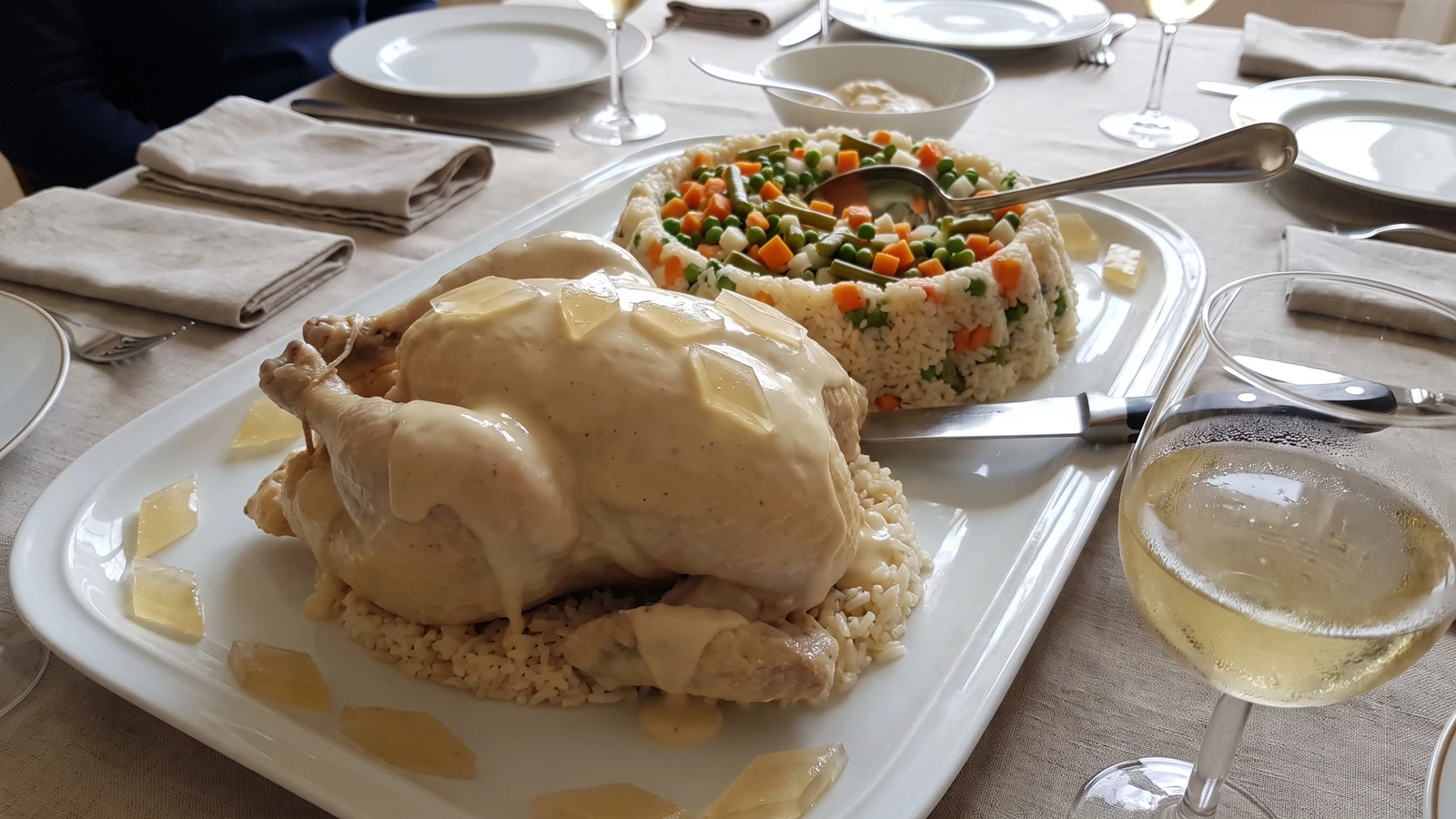
Cold poached poularde, rich with foie gras and truffle, wears an ivory chaud-froid glaze and rests on molded rice, with fine vegetable salad and pale aspic completing the grand composition.
Poularde à la Neva (cold poached pullet with foie gras, truffle, rice, and fine vegetable salad) teaches the architecture of a cold composed dish: season every part while it is warm, because cold quiets salt, aroma, and fat. Its white chaud-froid, a warm-made velouté glaze served set and cold, cannot hide a weak stock or timid seasoning. Know that before touching a pan.
The original assumed Chicken Forcemeat for Galantines, Pies and Terrines (No. 200) waiting in the larder, stock never off the fire, a saucier judging chaud-froid by touch, and cold-room hands to carve a rice shell and cut jelly ornaments. The brigade's salamander has no job here, because this finish is set by cold. Your equivalents are a narrow stockpot, a thermometer, a refrigerator, a shallow tray, and two ordinary bowls for molding the rice. The silver shell and obsessive jelly geometry were service scaffolding, so they become an edible rice shell and clean aspic diamonds; the stuffed poached bird, white coating, rice, vegetable salad, and pale jelly croûtons all stay, because they are the dish.
The decisive moment comes when you coat the poularde. The bird must be thoroughly cold and dry, while the chaud-froid must be cool enough to cling but still able to flow. If it slides away, chill both for ten minutes and apply another thin coat. Ça se rattrape. One cook, one stove, one evening of work, then the refrigerator completes the setting.
Poularde à la Neva belongs to the Parisian grand-kitchen repertoire of cold decorated poultry, made for formal buffet and supper tables rather than the domestic cooking of one French region. Neva names the river running through Saint Petersburg, part of the canon's Russian naming register, but the technique is French: poached poultry masked with chaud-froid, ornamented in aspic, and presented on an edible socle. The geographic title does not make it a Russian household dish; foie gras, truffle, carved rice, and pale jelly describe French ceremonial service.
Quantity
1 (3½ to 4 pounds / 1.6 to 1.8 kg)
Quantity
1¾ cups (415 ml / 450 g) Chicken Forcemeat for Galantines, Pies and Terrines (No. 200)
prepared and thoroughly chilled
Quantity
⅓ cup (80 ml / 90 g)
thoroughly chilled and cut into ½-inch dice
Quantity
⅓ cup (80 ml / 55 g)
fresh or preserved whole, drained and cut into small dice
Quantity
14 cups (3.3 L / 3.3 kg), or enough to cover
divided
Quantity
2½ teaspoons (12.5 ml / 15 g)
divided
Quantity
½ teaspoon (2.5 ml / 1 g)
divided
Quantity
4 tablespoons (60 ml / 57 g)
Quantity
⅓ cup (80 ml / 42 g)
Quantity
1 cup (240 ml / 240 g)
Quantity
1 tablespoon (15 ml / 9 g)
Quantity
2 tablespoons (30 ml / 18 g)
Quantity
¾ cup (180 ml / 180 g)
divided
Quantity
1½ cups (355 ml / 300 g)
Quantity
2¼ cups (530 ml / 530 g)
Quantity
2 tablespoons (30 ml / 28 g)
Quantity
½ cup (120 ml / 70 g)
cut into fine dice
Quantity
½ cup (120 ml / 75 g)
cut into fine dice
Quantity
¾ cup (180 ml / 90 g)
cut into short pieces
Quantity
¾ cup (180 ml / 100 g)
Quantity
⅔ cup (160 ml / 150 g)
Quantity
1 tablespoon (15 ml / 15 g)
| Ingredient | Quantity |
|---|---|
| oven-ready poularde or young fattened hen | 1 (3½ to 4 pounds / 1.6 to 1.8 kg) |
| Chicken Forcemeat for Galantines, Pies and Terrinesprepared and thoroughly chilled | 1¾ cups (415 ml / 450 g) Chicken Forcemeat for Galantines, Pies and Terrines (No. 200) |
| raw foie grasthoroughly chilled and cut into ½-inch dice | ⅓ cup (80 ml / 90 g) |
| black trufflefresh or preserved whole, drained and cut into small dice | ⅓ cup (80 ml / 55 g) |
| clear unsalted chicken stockdivided | 14 cups (3.3 L / 3.3 kg), or enough to cover |
| fine saltdivided | 2½ teaspoons (12.5 ml / 15 g) |
| ground white pepperdivided | ½ teaspoon (2.5 ml / 1 g) |
| unsalted butter for the chaud-froid | 4 tablespoons (60 ml / 57 g) |
| all-purpose flour | ⅓ cup (80 ml / 42 g) |
| heavy cream | 1 cup (240 ml / 240 g) |
| unflavored powdered gelatin for the chaud-froid | 1 tablespoon (15 ml / 9 g) |
| unflavored powdered gelatin for the aspic | 2 tablespoons (30 ml / 18 g) |
| cold water for blooming the gelatindivided | ¾ cup (180 ml / 180 g) |
| uncooked medium-grain white rice | 1½ cups (355 ml / 300 g) |
| water for cooking the rice | 2¼ cups (530 ml / 530 g) |
| unsalted butter for the rice and molds | 2 tablespoons (30 ml / 28 g) |
| carrotcut into fine dice | ½ cup (120 ml / 70 g) |
| turnipcut into fine dice | ½ cup (120 ml / 75 g) |
| green beanscut into short pieces | ¾ cup (180 ml / 90 g) |
| fresh or frozen peas | ¾ cup (180 ml / 100 g) |
| full-fat mayonnaise | ⅔ cup (160 ml / 150 g) |
| fresh lemon juice | 1 tablespoon (15 ml / 15 g) |
Keep the prepared Chicken Forcemeat for Galantines, Pies and Terrines (No. 200), foie gras, truffle, bowl, and spoon thoroughly cold. Fry a teaspoon of the forcemeat, taste it, and correct the seasoning before folding in the foie gras and truffle dice with a cold spatula. Mix only until the dice are evenly distributed. If the fat begins to smear or the forcemeat turns loose and glossy, stop and chill it for twenty minutes; cold restores its structure.
Pat the poularde dry and season its cavity with a measured pinch of the salt and white pepper. Spoon in the cold forcemeat without packing it hard, leaving a little room for expansion. Close the cavity with two small metal skewers and lace them with kitchen twine, then truss the legs and wings close to the body. Refrigerate the bird while the stock heats.
Reserve 2½ cups of the clearest chicken stock for the aspic. Heat the remaining stock in a narrow stockpot to about 180°F (82°C), then lower in the poularde breast-side up; the stock should cover it, so add more hot chicken stock if your pot demands it. Hold the liquid between 175°F and 185°F (79°C and 85°C), with only an occasional tremble at the surface, for 75 to 100 minutes. The poularde is ready when the center of the stuffing reaches 165°F (74°C) and the inner thigh reaches at least 170°F (77°C). A hard boil tightens the breast and can force the stuffing from the cavity, so lower the heat immediately if the stock grows lively.
Lift out 2 cups of poaching stock for the chaud-froid, strain it into a shallow container, and chill it separately. Set the covered stockpot holding the poularde into a sink or basin of ice water, stirring the stock gently around the bird until it falls below 70°F (21°C) within two hours. Refrigerate the poularde submerged in its stock until its center reaches 40°F (4°C) or colder, at least four hours and preferably overnight. Cooling in stock keeps the breast moist while the ice bath brings the temperature down promptly.
Sprinkle the 2 tablespoons of gelatin over ½ cup of the cold water and leave it for five minutes. Warm the reserved 2½ cups of clear stock, taste it cold from a spoon, and season it slightly more firmly than you would a hot broth. Remove it from the heat, stir in the bloomed gelatin until completely dissolved, and strain it into a shallow rimmed tray to a depth of about ¼ inch. Chill until firm, at least three hours, then cut some into small diamonds for decorating the poularde and the rest into tidy triangles or lozenges. These border pieces are the recipe's croûtons, shaped pieces of aspic rather than bread.
Cook the rice with the 2¼ cups of water and 1 teaspoon of the salt at a gentle simmer until tender and the water is absorbed, about eighteen minutes. Rest it covered for ten minutes, then fold in 1 tablespoon of butter. While the rice is warm, press about two-thirds into a low oval cushion on the front half of the long serving platter. Butter a small bowl, pack in the remaining rice, and press a smaller buttered ramekin into its center to form a hollow shell. Chill both forms promptly. This simple molded shell replaces the brigade's carved rice or silver vessel, but keeps the original composition edible and intact.
Blanch the carrot, turnip, green beans, and peas separately in salted water until each is tender but still distinct, about four minutes for the roots, three for the beans, and one for the peas. Cool them in ice water, drain, and dry them thoroughly on a clean towel. Mix the mayonnaise with the lemon juice and a pinch each of salt and white pepper, then fold in the vegetables. If the salad loosens and weeps, do not bury it under more mayonnaise; spread the vegetables on a towel, dry them again, and rebind them with the dressing already in the bowl.
Sprinkle the remaining 1 tablespoon of gelatin over the remaining ¼ cup cold water and leave it to bloom. Melt the 4 tablespoons of butter in a saucepan, stir in the flour, and cook for two minutes without allowing it to color. This is a roux blanc, a white roux, and its restraint keeps the finished coating ivory. Gradually whisk in the 2 cups of strained poaching stock, simmer for ten minutes, then add the cream and simmer gently until the sauce is smooth, glossy, and nappant, thick enough to coat the back of a spoon. Remove it from the heat, stir in the bloomed gelatin, season with salt and white pepper, and strain. Cool it over ice, stirring constantly, until it reaches roughly 82°F to 86°F (28°C to 30°C) and falls from the spoon in a thick ribbon. If it gels in the bowl, set the bowl over barely warm water and stir until it flows again. Ça se rattrape.
Lift the thoroughly chilled poularde from its stock, remove the trussing twine and skewers, and dry every fold of skin carefully. Set it breast-side up on a rack over a tray. Spoon a thin coat of cool chaud-froid over the bird, allowing the excess to drain, then chill for fifteen minutes and apply a second thin coat wherever the skin shows through. If the sauce slides off, either the bird is damp or the sauce is too warm; dry the bare area, chill the sauce for ten minutes, and coat again. While the final coat is still tacky, arrange the small aspic diamonds sparingly across the breast and chill until set.
Set the coated poularde on the chilled rice cushion. Unmold the rice shell behind the bird, easing out the center ramekin first, and fill the hollow generously with the fine vegetable salad so it banks up behind the poularde. Border the platter with the pale aspic croûtons, alternating their points neatly without turning supper into geometry class. Refrigerate the completed platter until the coating and rice are firm, at least one hour.
Bring the platter out only when the table is ready. Present the poularde whole, then use a sharp knife to cut cleanly through the set coating, remove the legs at their joints, and slice the breast. Spoon out the foie gras and truffle forcemeat, giving each plate poultry, stuffing, rice, vegetable salad, and a little aspic. Keep any portion not being served below 40°F (4°C). À table!
1 serving (about 980g)
Culinary guides, cultural storytelling, and the editorial depth that makes cooking meaningful.
Discover Culinary ExplorerChef Juliette
John Dory has the delicacy of sole and the firmness of turbot. A light flouring, a quick butter sauté, and nut-brown beurre noisette show exactly why looks never mattered.

Chef Juliette
Fresh haddock proves its delicacy in the meunière pan: a fine flour crust, moist pearly flakes, and beurre noisette sharpened with lemon and parsley, ready from one skillet in half an hour.

Chef Juliette
Éperlans à l’Anglaise turns small fish into a lesson in disciplined coating: boned smelts under a close, crisp crumb, pan-fried in clarified butter and finished with bright, half-melted maître d’hôtel butter.

Chef Juliette
Tiny smelts, shallot, mushrooms, white wine, gratin sauce, and fine bread raspings meet a fierce oven, where the fish must turn tender in the same breath the buttered crust bronzes.