
Chef Juliette
John Dory (St. Pierre)
John Dory has the delicacy of sole and the firmness of turbot. A light flouring, a quick butter sauté, and nut-brown beurre noisette show exactly why looks never mattered.
A cooking platform built around craft, culture, and the stories behind what we eat.
Created by Chef Juliette
Based on No. 1694, Poularde à la Dampierre, from Le Guide Culinaire (1907) by Auguste Escoffier
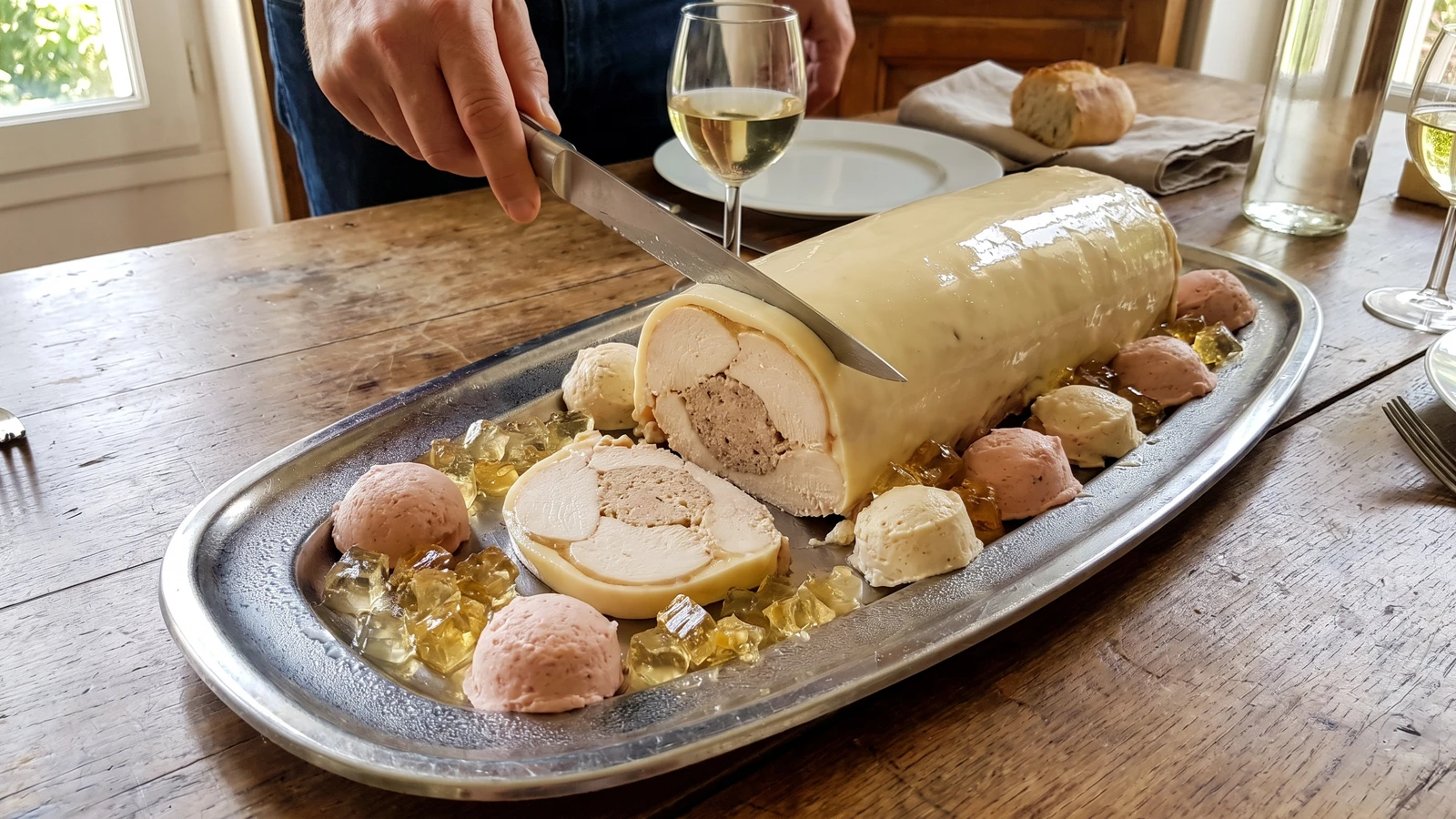
A grand cold entrée made practical: stuffed poularde under an ivory almond chaud-froid, glazed to a quiet sheen and circled with alternating ham and chicken mousses, all built ahead by one attentive cook.
Poularde à la Dampierre (cold stuffed chicken breast with almond chaud-froid) teaches the architecture of a composed cold entrée. The one true thing to know before you touch a pan is that temperature is the structure: the chicken must poach gently, every piece must turn fully cold, and each coating must be just fluid enough to flow without sliding away.
The classical entry assumed a saucier on staff, chicken stock never off the fire, a cold room, rows of dariole-moulds, and hands to sew, truss, glaze, and cut a dozen neat jelly croûtons. At home, one clear stock serves the poach, sauce, and aspic; muslin and twine replace sewing; and six small silicone moulds replace a cupboard of specialized forms. The original twelve mousses become three ham and three chicken mousses because four diners need a border, not a battalion. A salamander has no work here; this cold construction is finished by refrigeration, not top heat. One cook, one stove, one evening of work, with the refrigerator taking the night watch.
The sewn seam and raised banquet cushion were scaffolding, so a snug cloth parcel and a low bed of chopped aspic do their jobs honestly. The stuffed breast, almond-softened chaud-froid, clear aspic glaze, alternating mousses, and sharply cut jelly croûtons are the dish, and they stay. When you coat the poultry, keep it truly cold and the sauce at the texture of thick cream; that is the step that decides whether Dampierre arrives smooth, ivory, and quietly gleaming.
Poularde à la Dampierre belongs to the Parisian grand-kitchen register of cold entrées, where a boned bird was poached, masked with chaud-froid, glazed with aspic, and carried whole to the formal supper table. Its title follows the canon's habit of naming composed dishes for estates and notable tables; it is not a rustic specialty of one Dampierre, and its practical lineage is the galantine and the cold buffet. The croûtons are the sly detail: here they are not bread, but precisely cut pieces of aspic framing the platter.
Quantity
1, about 1¾ lb (800 g)
both lobes kept joined
Quantity
1 cup (240 ml / 240 g) Chicken Forcemeat for Galantines, Pies and Terrines (No. 200)
thoroughly chilled
Quantity
10½ cups (2.5 liters / 2.5 kg)
divided
Quantity
2 teaspoons (10 ml / 12 g)
divided
Quantity
½ teaspoon (2.5 ml / 1 g)
divided
Quantity
2 tablespoons (30 ml / 28 g)
Quantity
¼ cup (60 ml / 30 g)
Quantity
¾ cup plus 2 tablespoons (210 ml / 210 g)
divided, with 90 ml kept well chilled
Quantity
¼ cup (60 ml / 60 g)
Quantity
3 standard envelopes (6¾ teaspoons / 34 ml / 21 g)
Quantity
6 tablespoons (90 ml / 90 g)
Quantity
1 standard envelope (2¼ teaspoons / 11 ml / 7 g)
Quantity
3 tablespoons (45 ml / 45 g)
Quantity
⅔ cup (160 ml / 90 g)
finely diced
Quantity
⅔ cup (160 ml / 90 g)
finely diced
| Ingredient | Quantity |
|---|---|
| whole skin-on boneless breast from a poularde or large roasting chickenboth lobes kept joined | 1, about 1¾ lb (800 g) |
| Chicken Forcemeat for Galantines, Pies and Terrinesthoroughly chilled | 1 cup (240 ml / 240 g) Chicken Forcemeat for Galantines, Pies and Terrines (No. 200) |
| clear unsalted chicken stockdivided | 10½ cups (2.5 liters / 2.5 kg) |
| fine saltdivided | 2 teaspoons (10 ml / 12 g) |
| ground white pepperdivided | ½ teaspoon (2.5 ml / 1 g) |
| unsalted butter | 2 tablespoons (30 ml / 28 g) |
| all-purpose flour | ¼ cup (60 ml / 30 g) |
| heavy creamdivided, with 90 ml kept well chilled | ¾ cup plus 2 tablespoons (210 ml / 210 g) |
| unsweetened, unflavored almond milk | ¼ cup (60 ml / 60 g) |
| unflavored powdered gelatin for the aspic | 3 standard envelopes (6¾ teaspoons / 34 ml / 21 g) |
| cold water for the aspic gelatin | 6 tablespoons (90 ml / 90 g) |
| unflavored powdered gelatin for the chaud-froid | 1 standard envelope (2¼ teaspoons / 11 ml / 7 g) |
| cold water for the chaud-froid gelatin | 3 tablespoons (45 ml / 45 g) |
| cooked hamfinely diced | ⅔ cup (160 ml / 90 g) |
| cooked chicken breastfinely diced | ⅔ cup (160 ml / 90 g) |
Lay the boneless breast skin-side down and open the lobes. Butterfly only the thickest parts until the meat is an even ⅝ inch (1.5 cm) thick, taking care not to pierce the skin. Season the inside with half the salt and a quarter of the white pepper. Shape the chilled Chicken Forcemeat for Galantines, Pies and Terrines (No. 200) into a compact log along the center, then bring the breast meat around it and draw the skin snugly over the seam. If the breast will not close without straining, remove a spoonful of forcemeat; an overfilled parcel bursts before it becomes generous. Wrap the breast firmly in damp muslin or doubled cheesecloth, roll it into an even cylinder, and tie it with kitchen twine every 2 inches (5 cm).
Reserve 3 cups (700 ml) of the clearest stock for the aspic. Heat the remaining stock in a narrow saucepan to 180 to 185°F (82 to 85°C), then lower in the wrapped poularde; the stock should cover it. Hold the liquid at a bare tremble for 45 to 55 minutes, turning the parcel once, until a thermometer pushed through the cloth into the forcemeat center reads 165°F (74°C). A boil tightens the breast and may force out the filling. If the stock begins to boil, lift the pot off the heat immediately and let it settle before continuing gently. Enclose the cooked parcel in a clean food-safe bag, press out the air, and chill it in ice water for 20 minutes. Refrigerate it, still wrapped, for at least 2 hours, until cold through.
While the poularde chills, sprinkle the 21 g gelatin over its 90 ml cold water and leave it for 5 minutes. Heat half the reserved clear stock until hot but not boiling, whisk in the bloomed gelatin until completely dissolved, then stir in the remaining reserved stock. Taste and season lightly with some of the measured salt and white pepper; cold aspic mutes seasoning. Measure 3 tablespoons (45 ml) into each of two cups for the mousses. Pour 2 cups (500 ml) into a shallow 9 by 13 inch (23 by 33 cm) tray, making a layer about ¼ inch (5 mm) deep, and pour the remaining ¾ cup plus 1 tablespoon (200 ml) into a small bowl for glazing. Refrigerate the tray and glazing portion until firmly set. If the gelatin forms threads or lumps, warm it gently and whisk until clear. Never boil it.
Blend the ham with one 3-tablespoon (45 ml) portion of fluid aspic until very smooth, then rub it through a fine sieve. Repeat separately with the cooked chicken and the second portion of aspic. Whip the chilled 6 tablespoons (90 ml) cream to soft folds and divide it evenly between the two cold meat purées. Fold without beating, taste, and season the chicken mixture lightly if it needs it; the ham may need nothing. Fill three 2-fluid-ounce (60 ml) dariole-moulds with ham mousse and three with chicken mousse, tapping each mould against the counter to remove hidden gaps. Refrigerate for at least 3 hours. If either meat base sets before the cream goes in, stand its cup in barely warm water for a few seconds and stir until supple, then continue.
Strain and degrease 1¼ cups (300 ml) of the poaching stock. Melt the butter over gentle heat, stir in the flour, and cook this roux blanc (white roux) for 2 minutes without allowing it to color. Whisk in the warm stock gradually, scraping into every corner, then simmer gently for 10 minutes. Add the remaining ½ cup (120 ml) cream and the almond milk, then simmer for another 5 minutes, until the sauce is nappant (thick enough to coat the back of a spoon). Bloom the remaining 7 g gelatin in its 45 ml cold water for 5 minutes and whisk it into the sauce off the heat. Pass the chaud-froid through a fine sieve, then stir it over an ice bath until it is cool and flows like thick cream. If it sets too far, warm the bowl over tepid water; if it remains thin, keep stirring over ice.
Unwrap the thoroughly chilled poularde, pat it dry, and trim the ends and any ragged edges into a neat elongated form. Set it on a rack over a rimmed tray. Pour a thin layer of chaud-froid from the center outward, refrigerate for 10 minutes to set it, then repeat twice until the breast is smoothly and completely ivory. Keep a few spoonfuls of sauce for repairs. If the coating slides away, either the poultry or the sauce is too warm. Scrape the sauce back into the bowl, chill the breast, bring the sauce again to thick-cream consistency, and begin once more. Ça se rattrape.
Warm the reserved bowl of aspic over tepid water only until it liquefies, then let it cool until faintly syrupy. Brush one thin, even layer over the set chaud-froid, avoiding bubbles and drips, and refrigerate the poularde for 30 minutes. If the aspic softens or pulls at the sauce, stop at once, return the breast to the refrigerator, and patch the mark with the reserved chaud-froid before trying again with cooler aspic. Leave the top undecorated; the unbroken glaze is its finish.
Dip each dariole-mould in lukewarm water for 2 seconds, dry it, and turn out the mousses. Cut the sheet of aspic into neat diamonds or triangles about 1 inch (2.5 cm) wide; these are the jelly croûtons, not bread. Chop the aspic offcuts and arrange them as a low oval cushion on a long chilled platter. Set the glazed poularde on top, alternate the three ham and three chicken mousses around it, and border the rim with the aspic croûtons. Keep the platter cold until 10 minutes before serving. Slice the poularde with a knife dipped in hot water and wiped dry, giving each diner a clean slice and at least one mousse. À table!
1 serving (about 750g)
Culinary guides, cultural storytelling, and the editorial depth that makes cooking meaningful.
Discover Culinary ExplorerChef Juliette
John Dory has the delicacy of sole and the firmness of turbot. A light flouring, a quick butter sauté, and nut-brown beurre noisette show exactly why looks never mattered.

Chef Juliette
Fresh haddock proves its delicacy in the meunière pan: a fine flour crust, moist pearly flakes, and beurre noisette sharpened with lemon and parsley, ready from one skillet in half an hour.

Chef Juliette
Éperlans à l’Anglaise turns small fish into a lesson in disciplined coating: boned smelts under a close, crisp crumb, pan-fried in clarified butter and finished with bright, half-melted maître d’hôtel butter.

Chef Juliette
Tiny smelts, shallot, mushrooms, white wine, gratin sauce, and fine bread raspings meet a fierce oven, where the fish must turn tender in the same breath the buttered crust bronzes.