
Chef Juliette
John Dory (St. Pierre)
John Dory has the delicacy of sole and the firmness of turbot. A light flouring, a quick butter sauté, and nut-brown beurre noisette show exactly why looks never mattered.
A cooking platform built around craft, culture, and the stories behind what we eat.
Created by Chef Juliette
Based on No. 1687, Poularde à la Carmélite, from Le Guide Culinaire (1907) by Auguste Escoffier
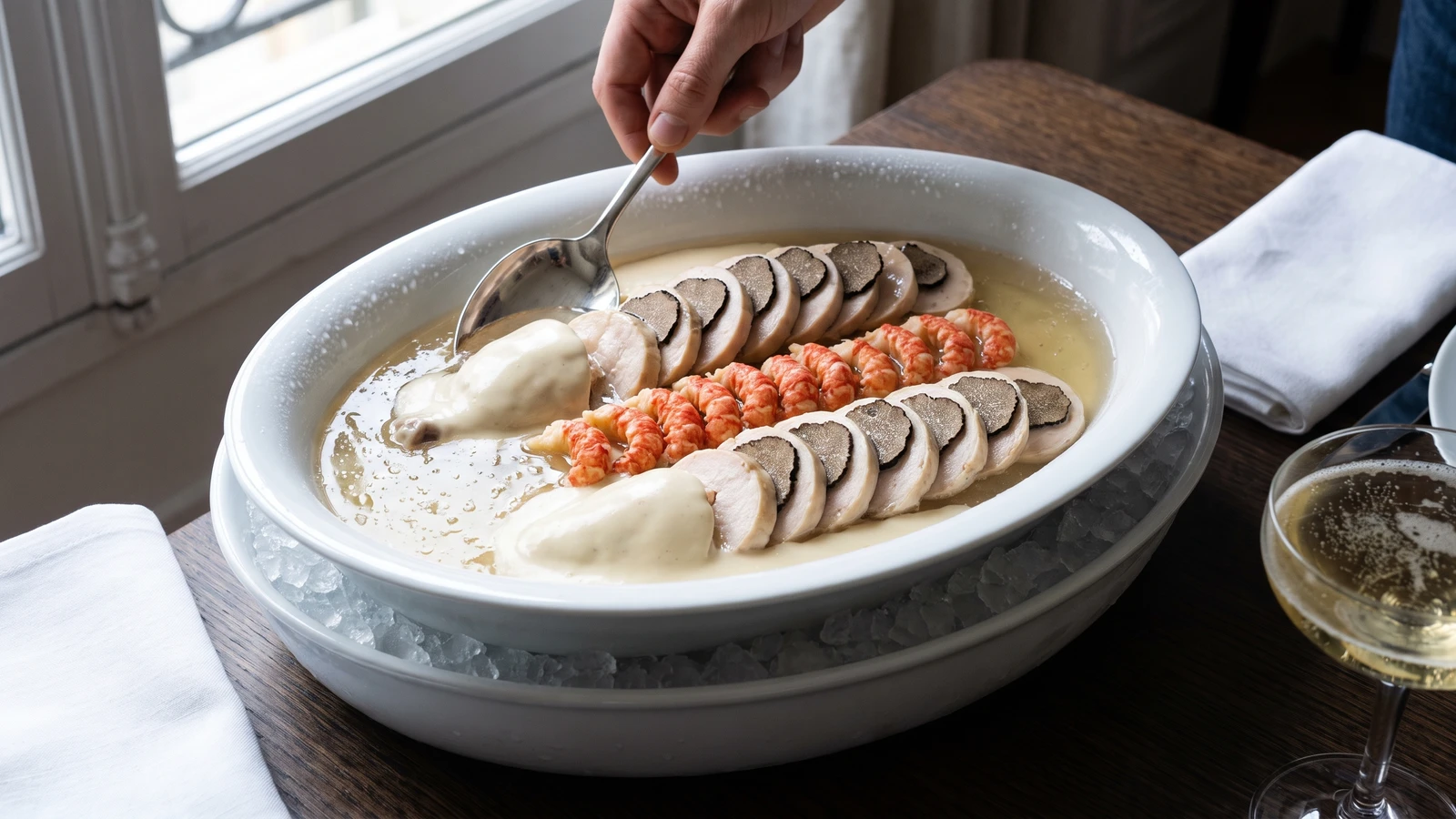
Poularde à la Carmélite turns poached chicken, crayfish mousse, truffle, and melting aspic into a cold Parisian centerpiece. The mastery lies in coating while the sauce still flows smoothly.
Poularde à la Carmélite (cold poached young hen with crayfish mousse) teaches one precise discipline: a chaud-froid, the white coating sauce served cold, must meet the poultry while it is fluid enough to level itself and cool enough to cling opaquely. Too warm and it slides away; too cold and every stroke hardens into a ridge. Catch that brief middle and the whole dish looks composed rather than labored.
The original assumed a saucier on staff, poultry stock never off the fire, finished aspic in the cold kitchen, ample crayfish, and a serving dish carved into a block of ice. At home, the poularde's own reduced poaching liquor builds the sauce, a food processor and sieve make the fine mousse, the refrigerator performs the setting, and a tray of crushed ice replaces the carved block. That block and the brigade quantities were scaffolding and can go. The crayfish mousse, two rows of suprême collops, restrained truffle, reconstructed carcass, and delicate half-immersion in aspic are the dish and must stay. One cook, one stove, one evening.
Begin with Chicken Aspic (No. 159) already prepared, because its separate formula remains whole, just as the canon intends. Then guard the coating temperature. That is the one step that decides the Poularde à la Carmélite before you ever lift the serving spoon.
Poularde à la Carmélite belongs to the composed cold repertoire of Paris, where the garde-manger, the cold kitchen, turned poached poultry, mousses, chaud-froid sauces, and clear aspic into grand buffet dishes. Its name marks a defined classical presentation rather than a regional farmhouse method: crayfish mousse rebuilds the trimmed bird, while truffled breast collops and crayfish tails form the ordered decoration. The aspic was never merely ornamental; it protected sliced poultry during cold service and carried the flavor of the bird back across every portion.
Quantity
1 (about 3½ lb / 1.6 kg)
Quantity
About 12 cups (2.8 L / 2.8 kg)
enough to cover the poultry
Quantity
1 medium
halved
Quantity
2 medium
coarsely chopped
Quantity
1
white and pale green parts split and rinsed
Quantity
2
coarsely chopped
Quantity
1
Quantity
1 tablespoon (15 ml / 18 g)
Quantity
1 teaspoon (5 ml / 2 g)
Quantity
3 tablespoons (45 ml / 42 g)
Quantity
5 tablespoons (75 ml / 40 g)
Quantity
1¾ cups (420 ml / 420 g)
divided
Quantity
6 cups (1.4 L / 1.4 kg) Chicken Aspic (No. 159)
Quantity
2½ cups (12 oz / 340 g)
well drained and chilled
Quantity
12 (about 4 oz / 115 g)
shelled and neatly trimmed
Quantity
1 small (about ¾ oz / 20 g)
thinly sliced
Quantity
Up to 1 teaspoon (5 ml / 6 g)
Quantity
½ teaspoon (2.5 ml / 1 g)
Quantity
About 12 cups (2.8 L / 1.8 kg)
for serving
| Ingredient | Quantity |
|---|---|
| small poularde or plump young chicken | 1 (about 3½ lb / 1.6 kg) |
| cold waterenough to cover the poultry | About 12 cups (2.8 L / 2.8 kg) |
| yellow onionhalved | 1 medium |
| carrotscoarsely chopped | 2 medium |
| leekwhite and pale green parts split and rinsed | 1 |
| celery stalkscoarsely chopped | 2 |
| bouquet garni of parsley stems, thyme, and bay | 1 |
| fine sea salt for poaching | 1 tablespoon (15 ml / 18 g) |
| white peppercorns | 1 teaspoon (5 ml / 2 g) |
| unsalted butter | 3 tablespoons (45 ml / 42 g) |
| all-purpose flour | 5 tablespoons (75 ml / 40 g) |
| heavy creamdivided | 1¾ cups (420 ml / 420 g) |
| prepared and chilled Chicken Aspic | 6 cups (1.4 L / 1.4 kg) Chicken Aspic (No. 159) |
| cooked crayfish tail meatwell drained and chilled | 2½ cups (12 oz / 340 g) |
| large cooked crayfish tailsshelled and neatly trimmed | 12 (about 4 oz / 115 g) |
| black trufflethinly sliced | 1 small (about ¾ oz / 20 g) |
| fine sea salt for sauce and mousse | Up to 1 teaspoon (5 ml / 6 g) |
| ground white pepper | ½ teaspoon (2.5 ml / 1 g) |
| crushed icefor serving | About 12 cups (2.8 L / 1.8 kg) |
Begin with the Chicken Aspic (No. 159) completely finished and chilled. Its texture matters: it should hold a clean cut when cold yet melt readily on the tongue, never bounce like rubber. Keep it refrigerated while the poularde poaches; later, melt only the amount needed for each stage over the gentlest heat.
Set the poularde breast-side up in a close-fitting stockpot with the onion, carrots, leek, celery, bouquet garni, poaching salt, and peppercorns. Add enough cold water to cover, then bring it slowly to 180 to 185°F (82 to 85°C). Hold the liquid at a bare tremble for 45 to 55 minutes, turning the bird once, until the thickest part of the thigh reaches 165°F (74°C). A boil tightens the breast and clouds the liquor; if the surface begins rolling, add a small ladle of cold water and lower the heat at once. Ça se rattrape.
Let the poularde rest in its liquor for 15 minutes, then lift it carefully onto a tray. Strain the liquor and reserve 3 cups (720 ml / 720 g). Raise the suprêmes, the breast fillets, in two whole pieces and remove their skin. Slice each breast on a shallow diagonal into collops about ¼ inch (6 mm) thick, keeping the slices in order. Trim loose skin, fat, and dark meat from the carcass while preserving its breastbone, legs, and general outline; reserve the dark meat for another meal. Chill the collops and carcass promptly and separately.
Melt the butter in a saucepan without coloring it, stir in the flour, and cook this white roux gently for 2 minutes. Whisk in the reserved hot poaching liquor a little at a time, then simmer for 12 to 15 minutes, skimming as needed, until the velouté coats a spoon without tasting floury. Add 1 cup (240 ml / 240 g) of the cream and reduce gently until about 2½ cups (600 ml / 600 g) remain. Remove from the heat and stir in 1 cup (240 ml / 240 g) melted Chicken Aspic (No. 159). Season with salt and white pepper, strain, and cool to 86 to 90°F (30 to 32°C). Test a spoonful on a cold plate: it should cover in an opaque, level coat. If it runs translucent, cool it briefly over ice; if it sets in ridges, warm the bowl over barely warm water. Do not force it. Ça se rattrape.
Dry the chilled breast collops thoroughly and arrange them on a rack over a tray. Spoon the chaud-froid over each in one smooth pass, adding a second coat only where the poultry shows through. Place one restrained piece of truffle on each collop before the surface sets. Dry the trimmed carcass, set it breast-side up, and coat its outside evenly with the same sauce. Chill both for 20 to 30 minutes, until the coating is firm. Return any clean runoff to the bowl before it sets and rewarm it gently if needed.
Process the chilled crayfish meat until very fine, then work it through a fine sieve. Stir in 1 cup (240 ml / 240 g) of the remaining fluid chaud-froid. Whip the remaining ¾ cup (180 ml / 180 g) cream to soft peaks and fold it into the crayfish mixture without knocking out its lightness. Taste it cold and correct the salt and white pepper. Pack the mousse into the body cavity, then mound it over the missing breasts to restore the poularde's plump outline. If the mousse slumps, chill it for 10 minutes and reshape it with a warm spoon. Nothing is lost.
Refrigerate the reconstructed poularde for 60 to 90 minutes, until the mousse holds firmly under a light fingertip. Lay the coated collops neatly over the set mousse in two even rows, keeping the truffle decoration visible. Place all 12 trimmed crayfish tails in a single precise row between them. Press only lightly; the arrangement must adhere without sinking into the mousse.
Gently melt 1½ cups (360 ml / 360 g) Chicken Aspic (No. 159), then cool it until it has the body of light syrup while remaining fluid. Spoon or brush a thin coat over the entire reconstructed poularde, including the collops, truffle, and crayfish tails. If the aspic races off and pools, it is too warm; wait a few minutes. If the brush leaves ropes, warm it by a degree or two. Chill for 30 minutes, then add a second thin glaze where the first looks incomplete.
Transfer the set poularde to a close-fitting deep oval serving dish. Melt enough of the remaining Chicken Aspic (No. 159) to come halfway up the reconstructed bird, then cool it until barely fluid. Pour a thin anchoring layer around the base and chill it for 15 minutes so the bird cannot float. Add the remaining aspic slowly down the side of the dish until the poularde is half-immersed. Refrigerate for at least 3 hours, preferably overnight, until clear and firmly set.
Nest the serving dish in a larger tray filled with crushed ice, the honest home equivalent of the carved ice block. Bring it to the table while the aspic is cold enough to hold a clean edge. Serve each guest several suprême collops, crayfish mousse, three crayfish tails, and a spoonful of aspic; the trimmed carcass is the armature, so do not carve through its bones. Keep the dish over ice during service and return leftovers to the refrigerator within 2 hours. À table!
1 serving (about 800g)
Culinary guides, cultural storytelling, and the editorial depth that makes cooking meaningful.
Discover Culinary ExplorerChef Juliette
John Dory has the delicacy of sole and the firmness of turbot. A light flouring, a quick butter sauté, and nut-brown beurre noisette show exactly why looks never mattered.

Chef Juliette
Fresh haddock proves its delicacy in the meunière pan: a fine flour crust, moist pearly flakes, and beurre noisette sharpened with lemon and parsley, ready from one skillet in half an hour.

Chef Juliette
Éperlans à l’Anglaise turns small fish into a lesson in disciplined coating: boned smelts under a close, crisp crumb, pan-fried in clarified butter and finished with bright, half-melted maître d’hôtel butter.

Chef Juliette
Tiny smelts, shallot, mushrooms, white wine, gratin sauce, and fine bread raspings meet a fierce oven, where the fish must turn tender in the same breath the buttered crust bronzes.