
Chef Juliette
John Dory (St. Pierre)
John Dory has the delicacy of sole and the firmness of turbot. A light flouring, a quick butter sauté, and nut-brown beurre noisette show exactly why looks never mattered.
A cooking platform built around craft, culture, and the stories behind what we eat.
Created by Chef Juliette
Based on No. 1645, Poulet de Grains Tartare, from Le Guide Culinaire (1907) by Auguste Escoffier
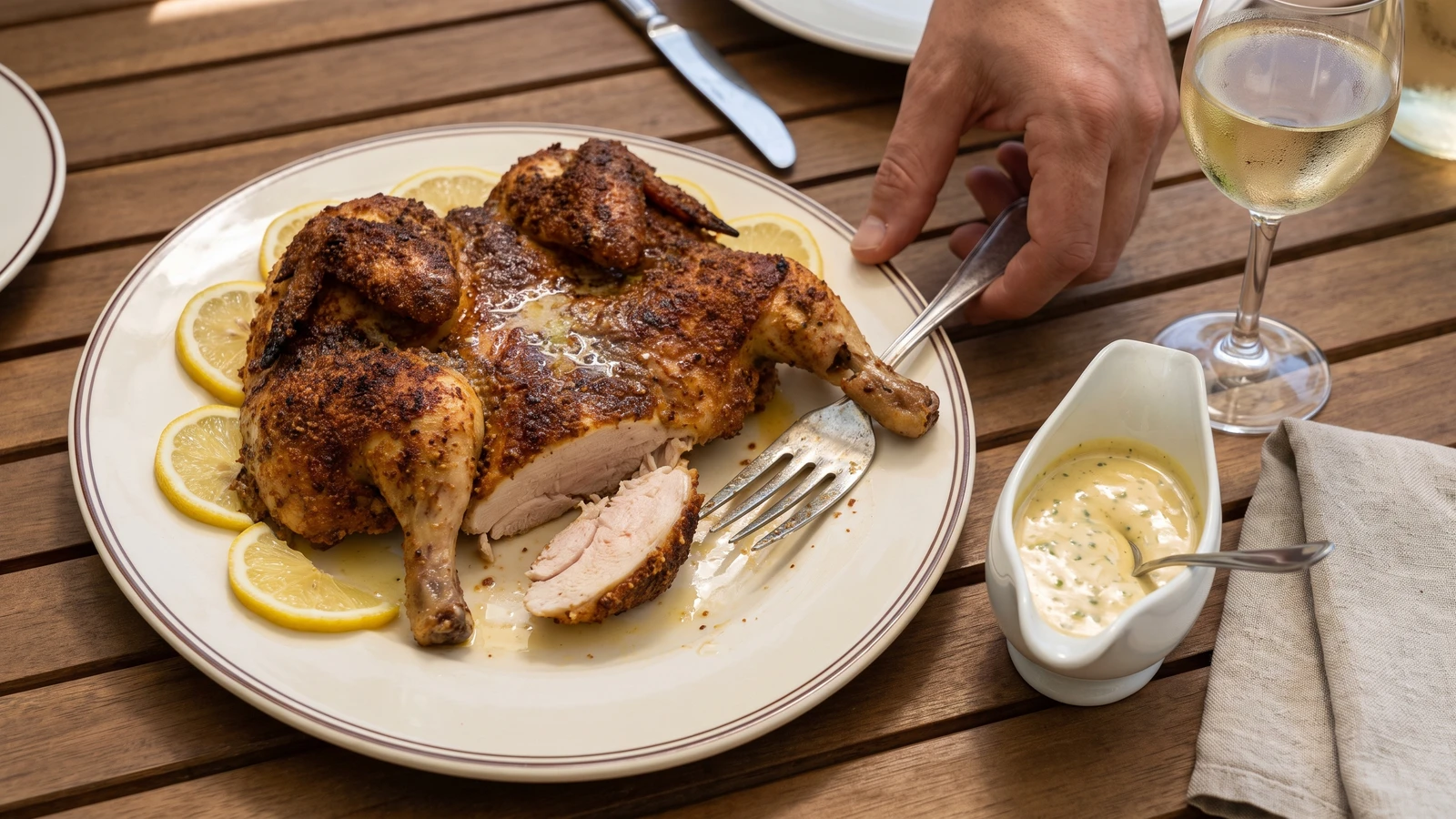
A mustard-bound crumb turns crisp over a tender split bird, then cold Sauce Tartare brings hard-cooked yolk, vinegar, and chives to the table. The pleasure lies in the deliberate meeting of hot and cold.
Poulet de Grains Tartare (grain-fed chicken with cold tartare sauce) teaches contrast: the mustard-bound crumb must arrive hot and crisp, while the cooked-yolk Sauce Tartare stays cool, sharp, and softly spoonable. The sauce is not a blanket. Serve it beside the bird so each bite keeps both temperatures and both textures.
The book's entry assumed an entrée-trussed young bird, a butcher's beater, separate oven and grill, and a cold-sauce station holding enough Tartare for service. At home, Poulet de Grains Grillé Diable (No. 1636) remains the finished bird preparation, while a meat mallet, an oven and broiler, and one hand-whisked bowl do the same work for four. The holding station and brigade quantity are scaffolding and go; the split bird, partial boning, oven-to-grill sequence, mustard-bound crumbs, and butter are the dish and stay. No stockpot or saucier is needed. One cook, one stove, one evening.
Mount the Sauce Tartare patiently from hard-cooked yolks, mustard, vinegar, and oil, then fold in the chives. If the emulsion turns greasy, stop pouring. Ça se rattrape, and the method below shows you how. The first few spoonfuls of oil decide the sauce, so give the emulsion time to take before you add more.
Poulet de grain in the classical Parisian dining room meant a small, tender young bird suited to quick roasting and grilling, not a chicken served with grains. The tartare service moved easily from the professional grill room to the bourgeois home table because it kept the same split, mustard-coated, crumbed bird as the diable preparation, changing only the sauce at the side. The name tartare points to the piquant cold emulsion, not raw poultry; in the classical sauce family it is built from hard-cooked yolks, mustard, oil, vinegar, and chives.
Quantity
1 Poulet de Grains Grillé Diable (No. 1636), serving 4
completed according to its own entry, with the separate devilled sauce omitted
Quantity
2
Quantity
1 tablespoon (15 ml / 15 g)
Quantity
2 tablespoons (30 ml / 30 g)
divided
Quantity
2/3 cup (160 ml / 147 g)
Quantity
2 tablespoons (30 ml / 6 g)
very finely sliced
Quantity
1/4 teaspoon (1.25 ml / 1.5 g)
Quantity
1/8 teaspoon (0.6 ml / 0.3 g)
Quantity
1 tablespoon (15 ml / 15 g)
as needed
| Ingredient | Quantity |
|---|---|
| Poulet de Grains Grillé Diablecompleted according to its own entry, with the separate devilled sauce omitted | 1 Poulet de Grains Grillé Diable (No. 1636), serving 4 |
| large eggs | 2 |
| Dijon mustard | 1 tablespoon (15 ml / 15 g) |
| white wine vinegardivided | 2 tablespoons (30 ml / 30 g) |
| neutral oil, such as grapeseed or sunflower | 2/3 cup (160 ml / 147 g) |
| fresh chivesvery finely sliced | 2 tablespoons (30 ml / 6 g) |
| fine sea salt | 1/4 teaspoon (1.25 ml / 1.5 g) |
| ground white pepper | 1/8 teaspoon (0.6 ml / 0.3 g) |
| cold water (optional)as needed | 1 tablespoon (15 ml / 15 g) |
Lower the eggs into a small saucepan of gently simmering water and cook them for 10 minutes. Transfer them immediately to cold water, then peel and halve them once cool. Remove the firm yolks and reserve the whites for another meal; Sauce Tartare needs the yolks only.
Press the hard-cooked yolks through a fine sieve into a medium bowl, or crush them thoroughly with a fork until no lumps remain. Work in the Dijon mustard, salt, white pepper, and 1 tablespoon (15 ml / 15 g) of the vinegar until you have a perfectly smooth paste. Smoothness now matters, because any yolk lumps left behind will stay grainy in the finished sauce.
Whisk the oil into the yolk paste drop by drop for the first 2 tablespoons (30 ml / 28 g). Once the mixture looks cohesive and glossy, continue in a slender thread, whisking steadily and adding the remaining vinegar in two small additions whenever the sauce becomes very thick. If oil beads on the surface or the emulsion separates, stop. Ça se rattrape: whisk 1 teaspoon (5 ml / 5 g) of cold water in a clean bowl, beat in one spoonful of the failed sauce until smooth, then incorporate the remainder one spoonful at a time.
Fold the finely sliced chives through the Sauce Tartare. It should hold a soft mound on the spoon but fall from it without clinging; if it is too stiff, whisk in cold water 1 teaspoon (5 ml / 5 g) at a time. Taste for salt and vinegar, cover, and chill for at least 20 minutes while the chicken cooks.
While the Sauce Tartare chills, prepare the Poulet de Grains Grillé Diable (No. 1636) for 4 servings exactly through the point of service. Its method remains complete in that entry. Leave its separate devilled sauce aside, since this variation changes only the sauce, and time the bird to finish after the Tartare is cold and ready. The crumb waits badly and should go straight to the table.
Set the finished bird on its round platter with the thin lemon border called for in the referenced preparation. Give the cold Sauce Tartare one final stir and serve it separately in a sauceboat. Do not spoon it over the chicken in advance, or the crisp crumb softens; let each person add sauce at the plate. À table!
1 serving (about 260g)
Culinary guides, cultural storytelling, and the editorial depth that makes cooking meaningful.
Discover Culinary ExplorerChef Juliette
John Dory has the delicacy of sole and the firmness of turbot. A light flouring, a quick butter sauté, and nut-brown beurre noisette show exactly why looks never mattered.

Chef Juliette
Fresh haddock proves its delicacy in the meunière pan: a fine flour crust, moist pearly flakes, and beurre noisette sharpened with lemon and parsley, ready from one skillet in half an hour.

Chef Juliette
Éperlans à l’Anglaise turns small fish into a lesson in disciplined coating: boned smelts under a close, crisp crumb, pan-fried in clarified butter and finished with bright, half-melted maître d’hôtel butter.

Chef Juliette
Tiny smelts, shallot, mushrooms, white wine, gratin sauce, and fine bread raspings meet a fierce oven, where the fish must turn tender in the same breath the buttered crust bronzes.