
Chef Juliette
John Dory (St. Pierre)
John Dory has the delicacy of sole and the firmness of turbot. A light flouring, a quick butter sauté, and nut-brown beurre noisette show exactly why looks never mattered.
A cooking platform built around craft, culture, and the stories behind what we eat.
Created by Chef Juliette
Based on No. 1640, Poulet de Grains à la Katoff, from Le Guide Culinaire (1907) by Auguste Escoffier
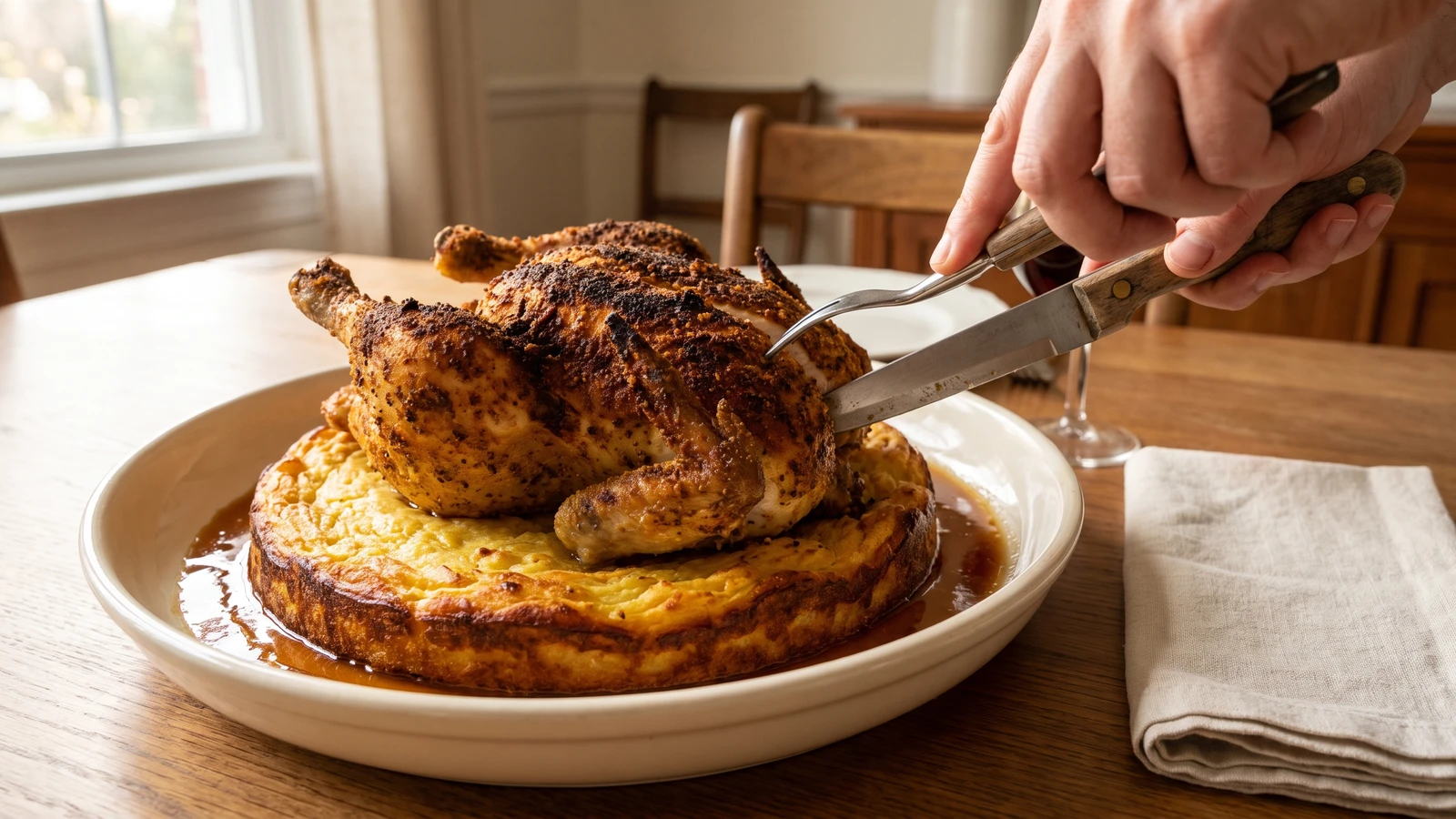
A devilled young chicken, bronzed on the grill and settled over a one-inch galette of pommes duchesse, with strong veal gravy tracing the rim: crisp crumb above, butter-rich potato below.
Poulet de Grains à la Katoff (young devilled chicken on a gilded duchesse-potato galette) teaches structure. The potato is not a side dish tucked beneath the bird; it is the platter, and it must be moulded a full inch thick so it carries the chicken without slumping under its juices.
The original kitchen assumed a saucier at hand, veal stock never off the fire, a separate grill, a salamander to colour on command, and several cooks working at once. At home, concentrated veal gravy, an oven broiler, and one round metal dish do the same work. The brigade portion becomes one small young chicken for four. Separate station choreography is scaffolding and can go; the devilled grill finish, the thick galette, its egg gilding, and the thread of gravy are the dish, and they stay. One cook, one stove, one evening.
When it reaches the table, the chicken should wear a dark golden crumb, the pommes duchesse should be firm beneath and richly bronzed above, and the gravy should gleam around the base rather than soak it. Mould the galette thickly and chill it if it feels soft before baking. That is the step that decides everything.
Poulet de Grains à la Katoff belongs to the codified grand-kitchen repertoire associated with Parisian dining rooms and palace hotels, rather than to a province claiming it as household fare. Its à la title identifies a composed garnish and service: devilled grilled young chicken, a galette of pommes duchesse, and a narrow border of strong veal gravy. The surprising point is that the potato is structural, turning linked preparations into a single entrée meant to be presented whole and carved at the table.
Quantity
1 Poulet de Grains Grillé Diable (No. 1636), using a young chicken about 3 lb (1.4 kg)
prepared according to its entry and ready for final grilling
Quantity
5 cups (1.25 L / 1.1 kg) Pommes de Terre à la Duchesse (No. 2212)
prepared but left unshaped and ungilded
Quantity
1 tablespoon (15 ml / 14 g)
softened
Quantity
1
beaten
Quantity
3/4 cup (180 ml / 190 g)
| Ingredient | Quantity |
|---|---|
| Poulet de Grains Grillé Diableprepared according to its entry and ready for final grilling | 1 Poulet de Grains Grillé Diable (No. 1636), using a young chicken about 3 lb (1.4 kg) |
| Pommes de Terre à la Duchesseprepared but left unshaped and ungilded | 5 cups (1.25 L / 1.1 kg) Pommes de Terre à la Duchesse (No. 2212) |
| unsalted buttersoftened | 1 tablespoon (15 ml / 14 g) |
| large eggbeaten | 1 |
| strong veal gravy | 3/4 cup (180 ml / 190 g) |
Heat the oven to 425°F (220°C), with a rack in the upper third, and butter a 12-inch (30 cm) round ovenproof dish. Have the Pommes de Terre à la Duchesse (No. 2212) ready for moulding and the Poulet de Grains Grillé Diable (No. 1636) prepared according to its own entry up to the final grilling. Move directly from half-cooking to the remaining work; partially cooked poultry must never be cooled and held for later.
Pack the Pommes de Terre à la Duchesse (No. 2212) firmly into a round galette about 10 inches (25 cm) across and a full 1 inch (2.5 cm) thick. Level the top and neaten the edge with a buttered spatula, then gild it, brushing the exposed potato evenly with beaten egg. If the edge slumps as you shape it, stop and chill the galette for 10 minutes before correcting the round. Ça se rattrape. Do not make it thinner merely because that is easier; its thickness is what carries the bird.
Bake the galette for 18 to 22 minutes, until the egg gilding is a deep butter-gold and the surface feels set beneath a light touch. If the top colours before the sides have firmed, move the dish down one rack and shield the centre loosely with foil. Set the baked galette in a warm place while the chicken receives its final grilling.
Switch the oven to its broiler setting and place the rack about 8 inches (20 cm) below the heat. Complete the gentle grilling of the Poulet de Grains Grillé Diable (No. 1636) as its entry directs, turning or rotating the pan as needed, until the coating is crisp and deeply bronzed and the thickest part of the thigh reaches 165°F (74°C). If the crumb darkens before the joint is cooked, lower the rack and cover only the darkest patches with foil; finish at 350°F (180°C) if necessary. Ça se rattrape, but fiercer heat will only burn the mustard crumb.
Warm the strong veal gravy in a small saucepan until it barely simmers and coats the back of a spoon in a thin, glossy layer. If it runs like broth, reduce it for a few minutes; if it has tightened into paste, whisk in water a tablespoon at a time. Keep it fluid enough to pour as a narrow thread, not a heavy moat.
Let the chicken rest for 5 minutes while the oven settles back to 350°F (180°C). Return the galette to the lower rack for 3 to 5 minutes if it has cooled. It should be hot and firm when the bird lands upon it, or the potato will absorb the first juices before reaching the table.
Set the whole grilled chicken squarely on the galette. Pour the strong veal gravy in a narrow, unbroken thread around the potato, never over the crisp coating or across the gilded surface. Carry the dish whole to the table and carve there, giving each serving chicken, a firm wedge of pommes duchesse, and a spoonful of gravy. À table!
1 serving (about 480g)
Culinary guides, cultural storytelling, and the editorial depth that makes cooking meaningful.
Discover Culinary ExplorerChef Juliette
John Dory has the delicacy of sole and the firmness of turbot. A light flouring, a quick butter sauté, and nut-brown beurre noisette show exactly why looks never mattered.

Chef Juliette
Fresh haddock proves its delicacy in the meunière pan: a fine flour crust, moist pearly flakes, and beurre noisette sharpened with lemon and parsley, ready from one skillet in half an hour.

Chef Juliette
Éperlans à l’Anglaise turns small fish into a lesson in disciplined coating: boned smelts under a close, crisp crumb, pan-fried in clarified butter and finished with bright, half-melted maître d’hôtel butter.

Chef Juliette
Tiny smelts, shallot, mushrooms, white wine, gratin sauce, and fine bread raspings meet a fierce oven, where the fish must turn tender in the same breath the buttered crust bronzes.