
Chef Juliette
John Dory (St. Pierre)
John Dory has the delicacy of sole and the firmness of turbot. A light flouring, a quick butter sauté, and nut-brown beurre noisette show exactly why looks never mattered.
A cooking platform built around craft, culture, and the stories behind what we eat.
Created by Chef Juliette
Based on No. 1635, Poulet de Grains Clamart, from Le Guide Culinaire (1907) by Auguste Escoffier
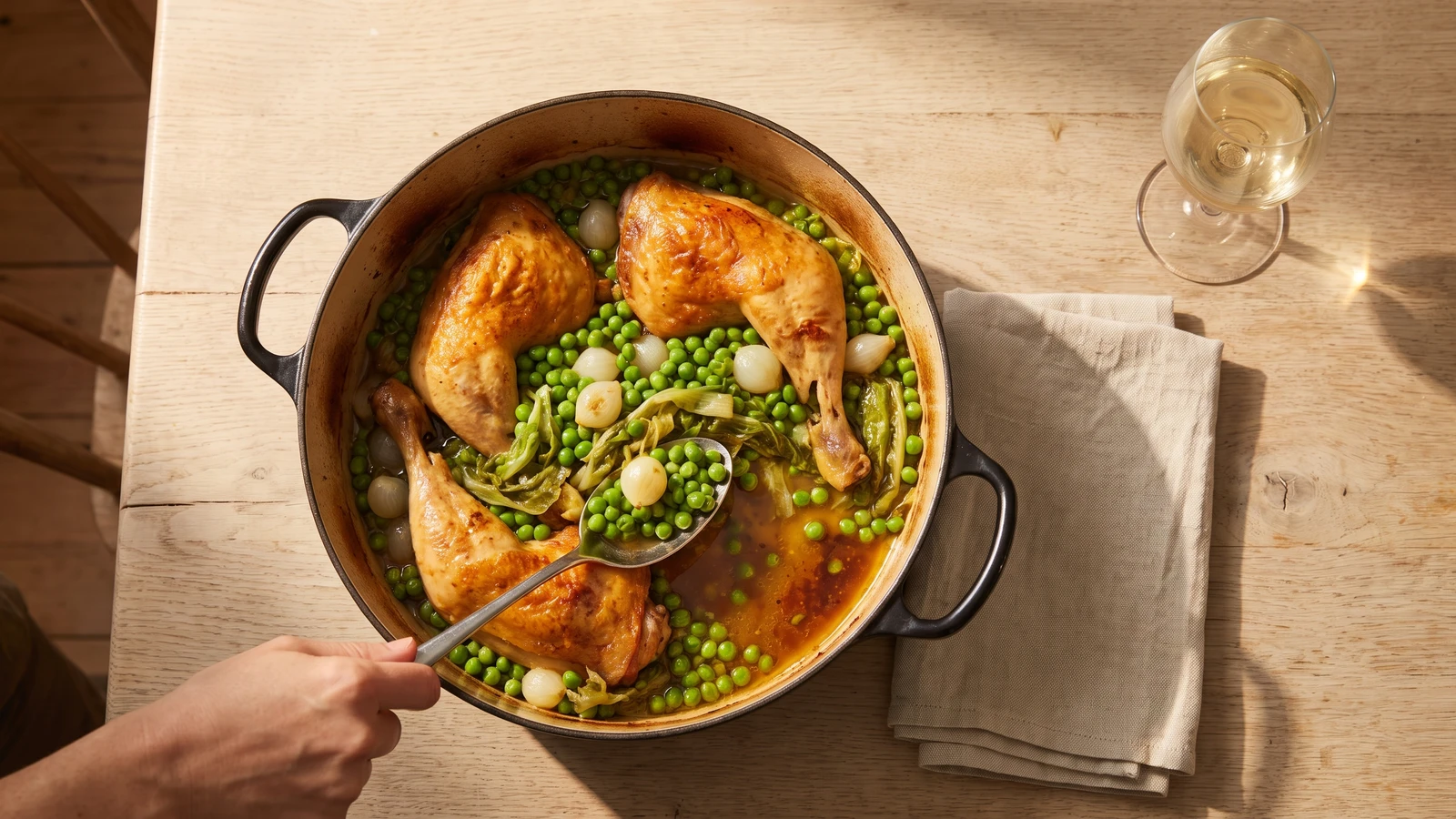
Butter-browned young chicken and petits pois à la française finish in one cocotte, the pea liquor reduced short and shining. The lesson is restraint: do not bind what should remain loose, green, and generous.
Poulet de Grains Clamart (young grain-fed chicken with French-style peas) teaches the discipline of bringing two half-cooked things to perfection together. The one true thing to know before touching the pan is this: the Petits Pois à la Française (peas gently braised with lettuce and small onions) must enter only half-cooked, carrying barely enough liquor to glaze the cocotte. Too much liquid stews the browned chicken and muddles the peas. Kept short, it mingles with the butter and fond into a light, savory sheen.
The original entry assumes a saucier can hold the peas at precisely the right point while another hand browns the chicken, then sends both to a fresh cocotte. Your small saucepan stages the peas first, and one heavy cocotte browns, finishes, and serves the chicken. The clean-pan transfer was brigade scaffolding and goes; the stockpot that never left the fire and the salamander have no work here. Butter browning, half-cooking both elements, and leaving the peas uncohered are the dish itself, so those stay.
Use two small young birds rather than one large roaster. Their pieces finish quickly enough that the peas remain plump and distinct, which is what the source intended when it called for a tender poulet de grains. Watch the moment they come together: short liquor, gentle heat, no vigorous stirring. That is the step that decides the dish. One cook, one stove, one evening.
Clamart lies southwest of Paris, and its market gardens supplied the capital with green peas for generations. In the classical garnish vocabulary, à la Clamart means peas, a place-name carried from the market garden into the grand kitchen rather than the name of a sauce. This formula finishes half-cooked Petits Pois à la Française beside the bird, but omits their usual final butter coherence so the peas stay distinct and their short liquor seasons the chicken.
Quantity
2, about 3 lb (1.36 kg) total
each quartered
Quantity
1½ teaspoons (7.5 ml / 9 g)
Quantity
½ teaspoon (2.5 ml / 1 g)
Quantity
4 tablespoons (60 ml / 57 g)
divided
Quantity
1¼ cups (300 ml / 260 g) Petits Pois à la Française (No. 2193)
half-cooked, with lettuce and onions and cooking liquor reduced very short
| Ingredient | Quantity |
|---|---|
| small young chickenseach quartered | 2, about 3 lb (1.36 kg) total |
| fine sea salt | 1½ teaspoons (7.5 ml / 9 g) |
| freshly ground black pepper | ½ teaspoon (2.5 ml / 1 g) |
| unsalted butterdivided | 4 tablespoons (60 ml / 57 g) |
| Petits Pois à la Françaisehalf-cooked, with lettuce and onions and cooking liquor reduced very short | 1¼ cups (300 ml / 260 g) Petits Pois à la Française (No. 2193) |
Prepare the Petits Pois à la Française (No. 2193) from its own entry, stopping when the peas are only half-cooked: yielding at the surface but still firm at the center. Measure the required amount with its lettuce and small onions. Tilt the saucepan; the liquor should gather into no more than about 2 tablespoons (30 ml / 30 g), a shallow gloss rather than a puddle. If there is more, lift out the peas and onions, reduce the liquor briefly, then return them. Ça se rattrape. Withhold the preparation's final off-heat butter coherence, because this Clamart formula expressly leaves the peas uncohered.
Pat every chicken piece thoroughly dry, especially inside the joints and along the skin. Season evenly with the salt and pepper, then let the pieces stand for 15 minutes while the cocotte heats. A wet surface cannot take a proper butter-browned crust, and that color is the only foundation this spare preparation receives.
Set a heavy 5-quart (4.7-liter) cocotte over medium heat and melt 2 tablespoons (30 ml / 28 g) of the butter. When the foam subsides and the milk solids turn pale hazelnut, lay in half the chicken skin-side down. Brown without crowding for 4 to 5 minutes, then color the other side for 2 minutes. Remove the first batch, add 1 tablespoon (15 ml / 14 g) butter, and repeat. Keep the final tablespoon in reserve. If the butter develops black specks or smells acrid, lift out the chicken, wipe away the burnt solids, lower the heat, and begin again with the reserved butter. Never build a dish on burnt fat.
Return every piece to the cocotte, skin-side up, adding the reserved butter if it was not needed for rescue. Cover, lower the heat, and cook gently for 6 to 8 minutes, turning the leg pieces once while leaving the breast pieces skin-side up. The chicken should be hot but distinctly underdone at its center, roughly 125 to 130°F (52 to 54°C) in the thickest breast. This is not a holding point. Continue directly to the peas.
Spoon the half-cooked peas, lettuce, onions, and their short liquor around and beneath the chicken, keeping the browned skin exposed. Cover and hold the cocotte at the barest tremble for 8 minutes, then uncover and test. Shake the cocotte once or twice instead of stirring, so the peas remain whole. The breast meat must reach 165°F (74°C), the leg joints should move easily, and the peas should be tender but distinct. If the peas finish first, lift them into a warm bowl and cover them while the chicken continues. If the chicken finishes while liquor still pools in the cocotte, remove the bird, reduce the liquor for a minute, and return everything to the pan. Ça se rattrape, but do not add butter to bind the peas.
Take the cocotte off the heat and let the chicken rest uncovered for 5 minutes. Taste the short liquor before adding any more salt, since the pea preparation already carries its own seasoning. Settle the lettuce, onions, and peas generously around the pieces and bring the cocotte directly to the table, exactly as the preparation stands. No extra sauce and no ornamental garnish. À table!
1 serving (about 250g)
Culinary guides, cultural storytelling, and the editorial depth that makes cooking meaningful.
Discover Culinary ExplorerChef Juliette
John Dory has the delicacy of sole and the firmness of turbot. A light flouring, a quick butter sauté, and nut-brown beurre noisette show exactly why looks never mattered.

Chef Juliette
Fresh haddock proves its delicacy in the meunière pan: a fine flour crust, moist pearly flakes, and beurre noisette sharpened with lemon and parsley, ready from one skillet in half an hour.

Chef Juliette
Éperlans à l’Anglaise turns small fish into a lesson in disciplined coating: boned smelts under a close, crisp crumb, pan-fried in clarified butter and finished with bright, half-melted maître d’hôtel butter.

Chef Juliette
Tiny smelts, shallot, mushrooms, white wine, gratin sauce, and fine bread raspings meet a fierce oven, where the fish must turn tender in the same breath the buttered crust bronzes.