
Chef Juliette
John Dory (St. Pierre)
John Dory has the delicacy of sole and the firmness of turbot. A light flouring, a quick butter sauté, and nut-brown beurre noisette show exactly why looks never mattered.
A cooking platform built around craft, culture, and the stories behind what we eat.
Created by Chef Juliette
Based on No. 1630, Poulet de Grains à la Belle-Meunière, from Le Guide Culinaire (1907) by Auguste Escoffier
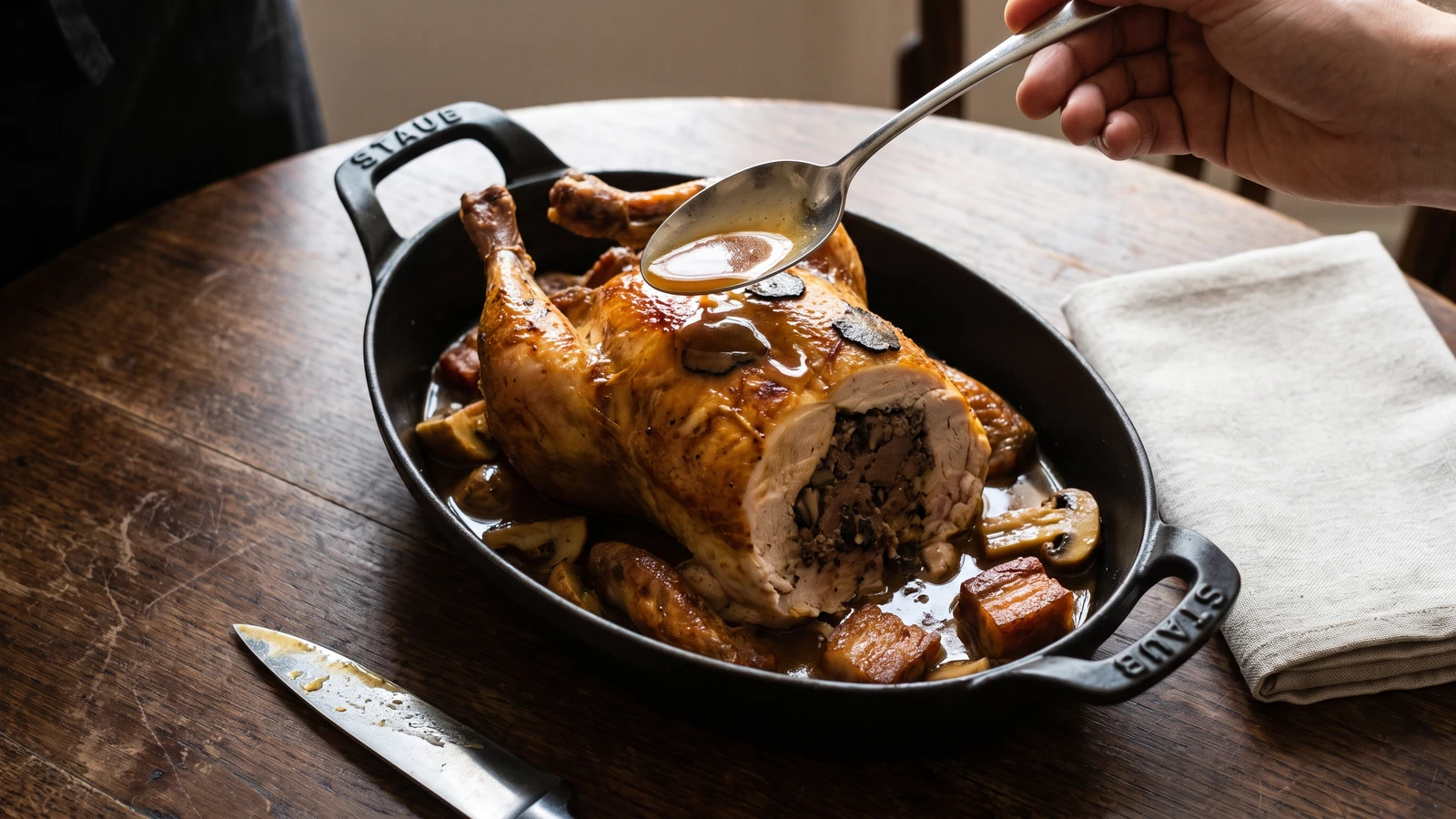
Truffle beneath burnished skin, chicken livers and mushrooms within, butter and pork in the cocotte: Poulet de Grains à la Belle-Meunière teaches that hard browning makes the fond, and the fond makes the sauce.
Poulet de Grains à la Belle-Meunière (grain-fed chicken with truffle, liver, mushrooms, and pork in a covered cocotte) teaches one true thing before you touch a pan: brown the bird deeply, because that bronze fond must carry the entire sauce. The truffle perfumes the breast from beneath its skin, the liver and mushrooms enrich the bird from within, but without that first hard browning the finished jus has no backbone.
The original formula assumed a formal entrée truss, a saucier with veal gravy drawn from a stockpot never off the fire, and enough hands to prepare every garnish separately. It was already written for one bird, so the honest home scaling is not to shrink its four livers or six ounces of mushrooms, but to choose a chicken that feeds four. A simple truss replaces the brigade knot, and two spoonfuls of good prepared veal gravy replace the separate sauce station. There is no salamander work in this entry; the bird cooks under cover, where butter, pork, mushrooms, and chicken juices meet in the cocotte.
The elaborate truss and separate saucier are scaffolding and may go. The truffle under the skin, liver and mushroom filling, butter browning, covered roast, and final veal gravy are the dish, and they stay. Dry the chicken thoroughly and give every side real colour before the lid goes on. That is the step that decides the Belle-Meunière.
Poulet de Grains à la Belle-Meunière belongs to the Parisian classical grand-kitchen repertoire, where an à la title told the cook which garnish and treatment accompanied the bird. Despite meunière in the name, this entry neither flours the chicken nor finishes it with lemon and parsley; its identity is truffle, liver, mushrooms, blanched pork, butter, and a final spoonful of veal gravy. It carried the abundance of a formal entrée into the compact covered cocotte, a vessel equally suited to the bourgeois table.
Quantity
1 chicken (3½ to 4 lb / 1.6 to 1.8 kg)
Quantity
4 livers (about ¾ cup / 170 g)
trimmed and sliced
Quantity
2½ cups (600 ml / 170 g)
wiped clean, quartered, and divided equally
Quantity
5 to 6 thin slices (about 1 tablespoon / 12 g)
fresh or preserved and drained
Quantity
9 tablespoons (½ cup plus 1 tablespoon / 135 ml / 128 g)
divided
Quantity
4 rectangles (about 3 oz / 85 g), prepared using Blanchings (No. 273)
Quantity
2 tablespoons (30 ml / 30 g)
Quantity
2 teaspoons (10 ml / 12 g)
divided
Quantity
½ teaspoon (2.5 ml / 1 g)
divided
| Ingredient | Quantity |
|---|---|
| grain-fed whole chicken, giblets removed | 1 chicken (3½ to 4 lb / 1.6 to 1.8 kg) |
| chicken liverstrimmed and sliced | 4 livers (about ¾ cup / 170 g) |
| small button mushroomswiped clean, quartered, and divided equally | 2½ cups (600 ml / 170 g) |
| black trufflefresh or preserved and drained | 5 to 6 thin slices (about 1 tablespoon / 12 g) |
| unsalted butterdivided | 9 tablespoons (½ cup plus 1 tablespoon / 135 ml / 128 g) |
| unsmoked pork belly or slab bacon, cut into rectangles | 4 rectangles (about 3 oz / 85 g), prepared using Blanchings (No. 273) |
| veal gravy | 2 tablespoons (30 ml / 30 g) |
| fine sea saltdivided | 2 teaspoons (10 ml / 12 g) |
| freshly ground black pepperdivided | ½ teaspoon (2.5 ml / 1 g) |
Heat the oven to 375°F (190°C). Dry the chicken thoroughly, including inside the cavity. Starting at the neck, ease your fingers between the breast meat and skin without tearing it, then distribute the truffle slices in a single layer over both breasts. Smooth the skin back into place. Season the cavity and exterior with 1½ teaspoons of the salt and ¼ teaspoon of the pepper.
Melt 1 tablespoon of the butter in the cocotte over medium-high heat. Add half the quartered mushrooms and the sliced chicken livers, then toss them for 60 to 90 seconds, just until everything is butter-glazed and the liver surfaces lose their raw shine. Season with the remaining ½ teaspoon salt and ¼ teaspoon pepper. Spread the mixture on a plate to cool for about 10 minutes; it should remain undercooked because its cooking finishes inside the bird.
Add another tablespoon of butter to the cocotte and raise the heat. Toss the remaining mushrooms for about 2 minutes, until their edges take a little gold but their centres remain firm. Transfer them to a separate plate. If they shed liquid, spread them into one layer and let that moisture cook away before removing them; crowded, grey mushrooms will only dilute the cocotte juices.
Spoon the cooled liver and mushroom mixture loosely into the cavity. Do not pack it down, because a tight filling heats slowly and presses out its juices. Tie the ankles together with kitchen twine and tuck the wing tips beneath the bird. The original entrée truss was useful brigade scaffolding; this simple tie keeps the chicken compact without turning dinner into needlework.
Melt 2 tablespoons of butter in the cocotte over medium heat. Lay in the chicken and brown it patiently on the breast, back, and both sides, turning with tongs and a wooden spoon, until the skin is deep bronze all over, about 12 to 15 minutes. Let the skin release by itself before turning; pulling early tears it and leaves the colour stuck to the pot. If the butter turns black or smells acrid, lift out the bird, pour off the burned fat, wipe away loose black specks without scrubbing off the bronze fond, and continue over lower heat with the reserved tablespoon of butter. Ça se rattrape.
Set the chicken breast-side up. Add the 4 pork rectangles prepared using Blanchings (No. 273), the sautéed exterior mushrooms, and 4 tablespoons of butter, placing the butter in pieces over and around the bird. Cover the cocotte tightly and roast for 50 minutes, then check every 10 minutes until the thickest part of the thigh and the centre of the liver filling both reach 165°F (74°C), usually 60 to 75 minutes in total. Keep the lid on; this is covered cocotte cooking, not a salamander finish.
Lift the chicken, pork, and exterior mushrooms onto a warm platter, then rest the bird loosely covered for 15 minutes. Spoon away only any large pool of clear fat from the cocotte, leaving the butter-rich cooking juices and every brown trace of fond. Set the cocotte over medium heat, add the veal gravy, and scrape the floor while it simmers for 1 to 2 minutes, until the jus is glossy and lightly coats a spoon. If it looks greasy, remove it from the heat and whisk in a teaspoon of hot water; if it is too loose, simmer it for another 30 seconds.
Remove the twine and spoon the liver and mushroom filling from the cavity onto the platter. Carve the chicken, arrange the pork rectangles and exterior mushrooms around it, and pour over the cocotte jus, including any juices released while the bird rested. The sauce should be scant, concentrated, and glossy rather than abundant. Bring the platter straight to the table. À table!
1 serving (about 315g)
Culinary guides, cultural storytelling, and the editorial depth that makes cooking meaningful.
Discover Culinary ExplorerChef Juliette
John Dory has the delicacy of sole and the firmness of turbot. A light flouring, a quick butter sauté, and nut-brown beurre noisette show exactly why looks never mattered.

Chef Juliette
Fresh haddock proves its delicacy in the meunière pan: a fine flour crust, moist pearly flakes, and beurre noisette sharpened with lemon and parsley, ready from one skillet in half an hour.

Chef Juliette
Éperlans à l’Anglaise turns small fish into a lesson in disciplined coating: boned smelts under a close, crisp crumb, pan-fried in clarified butter and finished with bright, half-melted maître d’hôtel butter.

Chef Juliette
Tiny smelts, shallot, mushrooms, white wine, gratin sauce, and fine bread raspings meet a fierce oven, where the fish must turn tender in the same breath the buttered crust bronzes.