
Chef Juliette
John Dory (St. Pierre)
John Dory has the delicacy of sole and the firmness of turbot. A light flouring, a quick butter sauté, and nut-brown beurre noisette show exactly why looks never mattered.
A cooking platform built around craft, culture, and the stories behind what we eat.
Created by Chef Juliette
Based on No. 1624, Turban de Filets de Poulet, from Le Guide Culinaire (1907) by Auguste Escoffier
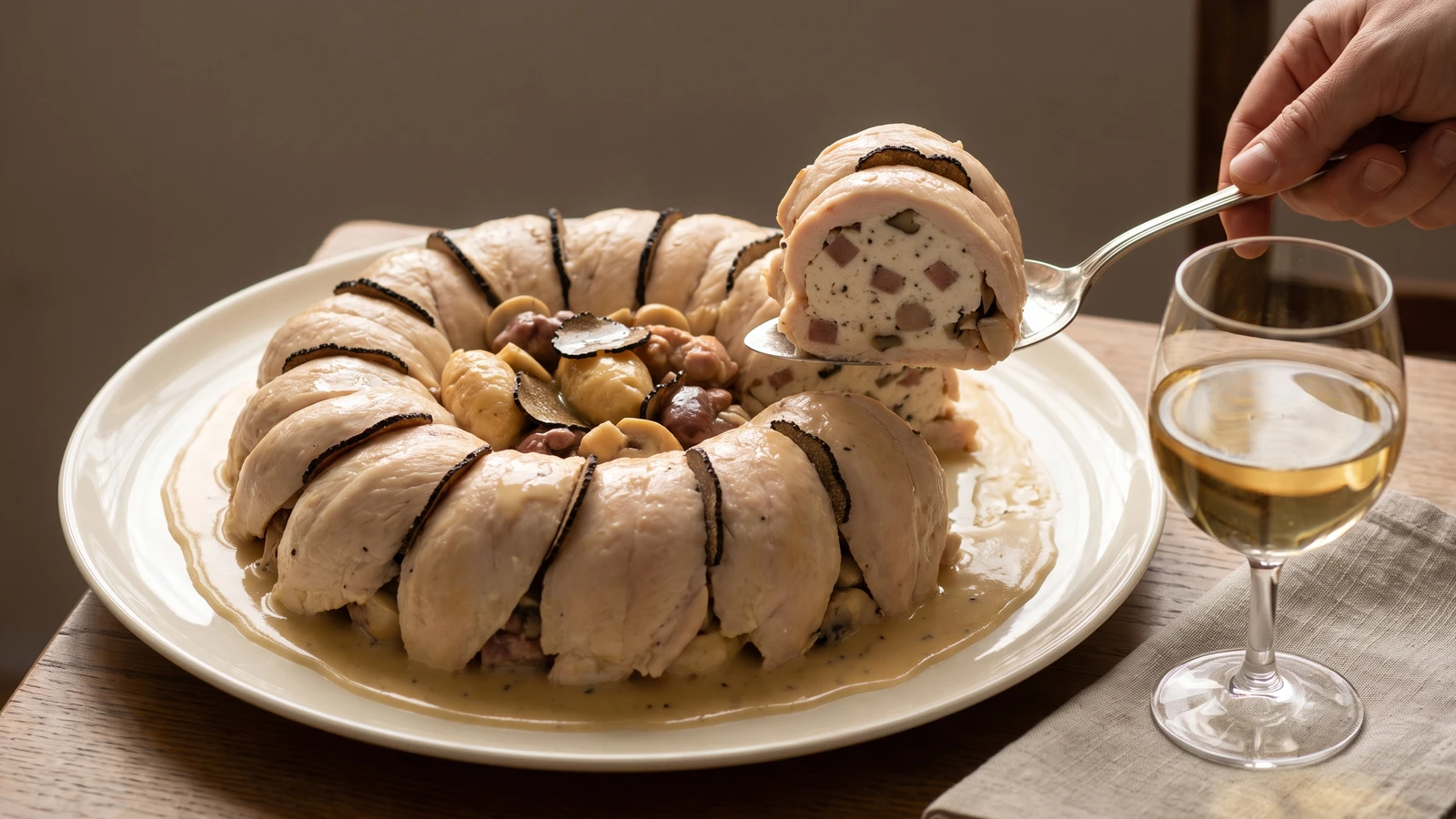
A crown of tender chicken, black truffle, silken mousseline, and rich salpicon, poached gently until it turns out whole, then filled with Toulousaine garnish and ringed with glossy Allemande sauce.
Turban de Filets de Poulet (a crown of chicken fillets) teaches the architecture of a moulded celebration dish: every layer must support the next, but the one true thing is colder and simpler. Everything entering the savarin-mould, an even crown-shaped mould, must be cold. The mousseline, a light chicken forcemeat enriched with cream, loses its emulsion when warm, while a warm salpicon, a large-diced filling bound with sauce, softens it from within.
The original formula assumed a saucier tending Allemande sauce, a stock never off the fire, prepared trays of Toulousaine garnish, and a savarin mould in every size. A salamander waited for dishes needing colour, though this pale, gently poached turban needs none. At home, the finished sauce and referenced garnish are prepared ahead, a food processor replaces the mortar, a fine sieve replaces the drum sieve, and a roasting pan becomes the bain-marie, the hot-water bath. The brigade portions shrink to four. Those separate cooks and oversized batches were scaffolding; the truffled fillet lining, two-thirds-inch mousseline, sauce-bound salpicon, gentle poach, and five-minute settling are the dish and remain. One cook, one stove, one evening.
Turned out correctly, the turban stands as an ivory crown marked by black truffle, its centre generous with quenelles, sweetbreads, mushrooms, and glossy Allemande sauce. There is no browning to disguise poor work, only clean layers and a tender slice. Keep the mousseline cold from processor to mould. That is the step that decides the turban.
Turban de Filets de Poulet belongs to the Parisian grand kitchen and the formal bourgeois table, where moulded poultry displayed exact knife work while allowing a composed garnish to be served from one platter. The turban shape traveled from banquet service into ambitious home cooking through savarin moulds, while mousseline and salpicon carried the brigade system of forcemeats, sauces, and garnishes with it. The Toulousaine name belongs to the garnish vocabulary of the canon, with quenelles, sweetbreads, poultry offal, mushrooms, truffle, and Allemande sauce; it does not make the whole turban a household specialty of Toulouse.
Quantity
4 small (about 1½ lb / 680 g total)
Very cold; butterfly and pound 3 breasts to ⅛ inch (3 mm), cube 1 for the mousseline, and reserve all trimmings
Quantity
1½ teaspoons (7.5 ml / 9 g)
divided
Quantity
½ teaspoon (2.5 ml / 1 g)
divided
Quantity
1 small pinch
Quantity
1 (about 2 tablespoons / 30 ml / 30 g)
Quantity
½ cup plus 2 tablespoons held in reserve (150 ml / 150 g total)
Quantity
1½ tablespoons (22 ml / 21 g)
for the mould
Quantity
¼ cup (60 ml / 30 g)
half thinly sliced and half cut into ⅜-inch (1 cm) dice
Quantity
¾ cup (180 ml / 125 g)
cut into ⅜-inch (1 cm) dice
Quantity
¾ cup (180 ml / 110 g)
cut into ⅜-inch (1 cm) dice
Quantity
1½ cups (360 ml / 360 g)
divided
Quantity
1¼ cups (300 ml / about 285 g) from Poularde Toulousaine (No. 1524)
kept hot
| Ingredient | Quantity |
|---|---|
| boneless, skinless chicken breastsVery cold; butterfly and pound 3 breasts to ⅛ inch (3 mm), cube 1 for the mousseline, and reserve all trimmings | 4 small (about 1½ lb / 680 g total) |
| fine sea saltdivided | 1½ teaspoons (7.5 ml / 9 g) |
| ground white pepperdivided | ½ teaspoon (2.5 ml / 1 g) |
| freshly grated nutmeg | 1 small pinch |
| large egg white | 1 (about 2 tablespoons / 30 ml / 30 g) |
| cold heavy cream | ½ cup plus 2 tablespoons held in reserve (150 ml / 150 g total) |
| softened unsalted butterfor the mould | 1½ tablespoons (22 ml / 21 g) |
| black trufflehalf thinly sliced and half cut into ⅜-inch (1 cm) dice | ¼ cup (60 ml / 30 g) |
| cooked tonguecut into ⅜-inch (1 cm) dice | ¾ cup (180 ml / 125 g) |
| cooked very white button mushroomscut into ⅜-inch (1 cm) dice | ¾ cup (180 ml / 110 g) |
| prepared Allemande saucedivided | 1½ cups (360 ml / 360 g) |
| prepared Toulousaine garnishkept hot | 1¼ cups (300 ml / about 285 g) from Poularde Toulousaine (No. 1524) |
Put ¾ cup (180 ml) of the Allemande sauce in a small saucepan and reduce it gently to ½ cup (120 ml), stirring often so the liaison does not catch. Cool it promptly over ice, then fold in the diced tongue, mushrooms, and diced half of the truffle. The sauce should cohere the salpicon without pooling beneath it. If it remains loose, reduce it a little further before cooling; if it tightens into paste, loosen it with a spoonful of the reserved Allemande sauce. Chill until assembly.
Lay the three butterflied breasts between sheets of baking paper and pound them evenly to ⅛ inch (3 mm), working from the centre outward so the flesh stretches without tearing. Trim them into neat panels long enough to cross the channel of the savarin-mould and hang over both rims; reserve every sound trimming for the mousseline. Season the panels lightly with half the salt and half the white pepper, then return them to the cold.
Put the cubed chicken and reserved trimmings in a chilled food processor with the remaining salt, white pepper, and nutmeg. Process until smooth and sticky, add the egg white, then pour in ½ cup (120 ml) of the cold cream in a thin stream, stopping as soon as the mousseline is pale and glossy. Press it through a fine-mesh sieve into a bowl set over ice. If it turns greasy or grainy, stop and chill it for ten minutes, then process it briefly with 1 tablespoon of the reserved cold cream. Ça se rattrape before it cooks.
Butter an 8-inch (20 cm), 5-cup (1.2 litre) savarin-mould generously. Lay the chicken panels crosswise around its channel, overlapping their sides slightly and leaving their ends hanging over the inner and outer rims. Set a narrow row of thin truffle slices between each panel so the black seams will show when the turban is turned out. Press the lining gently against the buttered metal, repairing any tear with a chicken trimming.
Spread cold mousseline over the lined mould in an even layer about ⅔ inch (1.7 cm) thick, coating the base and both sides of the channel. A spoon dipped in cold water smooths it without dragging. Fill roughly three-quarters of the remaining depth with the chilled salpicon, packing it evenly but without crushing the dice. Keep enough room above it for the sealing layer of mousseline.
Cover the salpicon completely with the remaining mousseline, filling the mould level without mounding it. Fold the overhanging ends of the chicken panels across the mousseline, alternating inner and outer ends so the base closes neatly. Press lightly to remove air pockets. If the mousseline softens or begins sliding, put the whole mould in the cold for ten minutes; patience, not starch.
Heat the oven to 325°F (165°C). Cover the mould with buttered baking paper and foil, set it in a deep roasting pan, and pour in very hot water to reach two-thirds of the way up its sides. Poach in the bain-marie for about 40 minutes, keeping the water below a boil, until the mousseline feels resilient and the thickest part reaches 165°F (74°C). If the centre remains cooler, return it for five-minute intervals; hard boiling will make the fillets tough and the mousseline porous.
Lift the mould from the bain-marie, uncover it, and let it stand for five minutes so its contents settle and grip one another. Run a thin knife only around the two rims, place a warmed round platter over the mould, and invert decisively. If the turban clings, wrap the mould for thirty seconds in a towel wrung from hot water, then lift again. Do not pry at the chicken panels.
Rewarm the remaining Allemande sauce over gentle heat, stirring until it runs in a glossy ribbon; never boil a liaison sauce. Spoon the hot Toulousaine garnish from Poularde Toulousaine (No. 1524) generously into the centre of the turban. Draw a narrow thread of Allemande sauce around its base and serve the rest separately. Carry the platter to the table whole, then cut between the truffle-marked panels. À table!
1 serving (about 420g)
Culinary guides, cultural storytelling, and the editorial depth that makes cooking meaningful.
Discover Culinary ExplorerChef Juliette
John Dory has the delicacy of sole and the firmness of turbot. A light flouring, a quick butter sauté, and nut-brown beurre noisette show exactly why looks never mattered.

Chef Juliette
Fresh haddock proves its delicacy in the meunière pan: a fine flour crust, moist pearly flakes, and beurre noisette sharpened with lemon and parsley, ready from one skillet in half an hour.

Chef Juliette
Éperlans à l’Anglaise turns small fish into a lesson in disciplined coating: boned smelts under a close, crisp crumb, pan-fried in clarified butter and finished with bright, half-melted maître d’hôtel butter.

Chef Juliette
Tiny smelts, shallot, mushrooms, white wine, gratin sauce, and fine bread raspings meet a fierce oven, where the fish must turn tender in the same breath the buttered crust bronzes.